The Poisson distribution
Introduced| English | Meaning |
|---|---|
| Poisson distribution/ˈpɔɪsn ˌdɪstrɪˈbjuːʃn/ | A probability model for event counts in a fixed interval when events occur independently at a constant average rate. |
| interval/ˈɪntəvl/ | A continuous set of real numbers between specified bounds, which may include or exclude its endpoints. |
| mean/miːn/ | The sum of a set of values divided by the number of values. |
| variance/ˈveərɪəns/ | A measure of spread based on the squared deviations of values from their mean. |
| overdispersion/ˌəʊvədɪˈspɜːʃn/ | overdispersion |
| parameter/pəˈræmɪtə/ | A value that specifies a particular member of a family of functions, models or systems. |
The queue that never ends
- Customers arrive at a shop at an average rate of 3 per minute. What's the probability that exactly 5 arrive in the next minute?
- The Poisson distribution 泊松分布 models rare events happening at a steady rate — from phone calls to radioactive decay.
The Poisson distribution
- $X \sim \text{Po}(\lambda)$ models the number of random events in a fixed interval 区间 at a steady rate $\lambda$:
Worked example. Calls arrive at a rate of $\lambda = 4$ per hour. P(exactly 2 calls) $= e^{-4} \dfrac{4^2}{2!} = 0.0183 \times \dfrac{16}{2} = 0.1465$.

People arriving at random in a queue follow a Poisson distribution
The Poisson distribution
X ~ Po(λ)
The Poisson counts random events in an interval. Its mean and variance are both λ.
For X ~ Po(3), find P(X = 2) = e⁻³ × 3²/2!. Give your answer to 3 decimal places.
Difficulty 2/5 · 140 coins + a small bonus on first completion today
P(X=2) = e⁻³ × 9/2 = 0.0498 × 4.5 ≈ 0.224.
For X ~ Po(2), P(X = 0) = e⁻². Find it (3 dp).
Difficulty 2/5 · 140 coins + a small bonus on first completion today
P(X=0) = e⁻² × 2⁰/0! = e⁻² = 0.1353 ≈ 0.135.
Match each Poisson idea to its result.
Difficulty 2/5 · 140 coins + a small bonus on first completion today
For a Poisson distribution the mean and the variance are both lambda.
Properties of the Poisson
- For a Poisson variable, the mean 平均数 and variance 方差 both equal $\lambda$: $E(X) = \text{Var}(X) = \lambda$.
- This is unique — no other common distribution has this property.
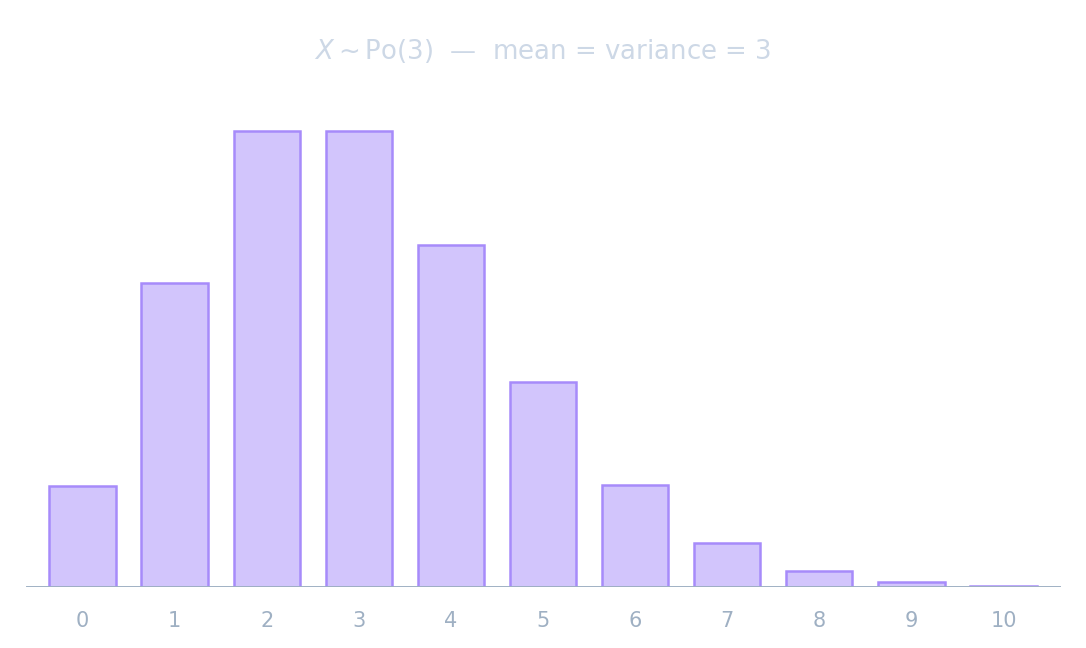
For Po(3) the mean and variance are both 3; the bars give P(X = k).
Mean = variance is the test. If your data has mean ≈ variance, the Poisson model may be appropriate. If variance is much larger than the mean, the events are not independent (overdispersion 过度离散) and Poisson is wrong.
For X ~ Po(3), what is the mean of X?
Difficulty 2/5 · 140 coins + a small bonus on first completion today
For a Poisson variable, the mean equals λ = 3 (and so does the variance).
For X ~ Po(3), what is the variance of X?
Difficulty 2/5 · 140 coins + a small bonus on first completion today
For a Poisson variable, the variance also equals λ = 3.
For a Poisson distribution, the mean and variance are always equal.
Difficulty 1/5 · 100 coins + a small bonus on first completion today
This is a defining property of the Poisson distribution: E(X) = Var(X) = λ.
Poisson approximation to the binomial
- The Poisson approximates the binomial when $n$ is large and $p$ is small.
- Use $\lambda = np$ as the Poisson parameter 参数.
- Example: $B(200, 0.01) \approx \text{Po}(2)$.
X ~ B(200, 0.01). Approximate with Poisson: λ = np. Find λ.
Difficulty 2/5 · 140 coins + a small bonus on first completion today
λ = np = 200 × 0.01 = 2.
Worked example — approximation
- $X \sim B(100, 0.02)$. Approximate with Poisson: $\lambda = np = 100 \times 0.02 = 2$.
- $P(X = 0) \approx e^{-2} \dfrac{2^0}{0!} = e^{-2} = 0.1353$.
- The normal distribution approximates the binomial distribution (with a continuity correction) when appropriate.
You've got it
- Poisson: $P(X = r) = e^{-\lambda}\dfrac{\lambda^r}{r!}$
- mean and variance both equal $\lambda$
- approximates the binomial for large $n$, small $p$ (use $\lambda = np$)