Policies to correct market failure
Introduced| English | Meaning |
|---|---|
| subsidies/ˈsʌbsɪdiz/ | Financial assistance that reduces costs or supports a particular activity, commonly provided by government. |
| indirect taxes/ɪndaɪˈrekt ˈtæksɪz/ | indirect taxes |
| negative externalities/ˈneɡətɪv ekˈstɜːnælɪtiz/ | negative externalities |
| positive externalities/ˈpɒzɪtɪv ekˈstɜːnælɪtiz/ | positive externalities |
| regulation/ˌreɡjʊˈleɪʃn/ | Rules and oversight used by public authorities to influence or restrict activities. |
| tradable permits/ˈtreɪdəbl ˈpɜːmɪts/ | Transferable authorisations allowing specified quantities of an activity, such as pollution emissions. |
| state provision/steɪt prəˈvɪʒn/ | The supply of goods or services directly by government or public-sector organisations. |
The government's toolkit for market failure
- Once you've spotted a market failure, the question is what to do about it — tax it, subsidise it, regulate it, or provide it directly?
- Each tool has strengths and pitfalls; the skill is matching the policy to the failure.
To correct a negative externality, a government would typically use a:
Difficulty 1/5 · 100 coins + a small bonus on first completion today
A tax raises the price and cuts the over-produced quantity toward the optimum.
Subsidies are used to encourage goods with positive externalities, like vaccines.
Difficulty 1/5 · 100 coins + a small bonus on first completion today
Subsidies lower price and raise consumption of under-provided merit goods.
Taxes and subsidies 补贴
- Indirect taxes 间接税 on goods with negative externalities 负外部性 (carbon tax, sugar tax) raise price and cut output toward the social optimum.
- Subsidies for goods with positive externalities 正外部性 (vaccines, public transport) lower price and raise consumption.
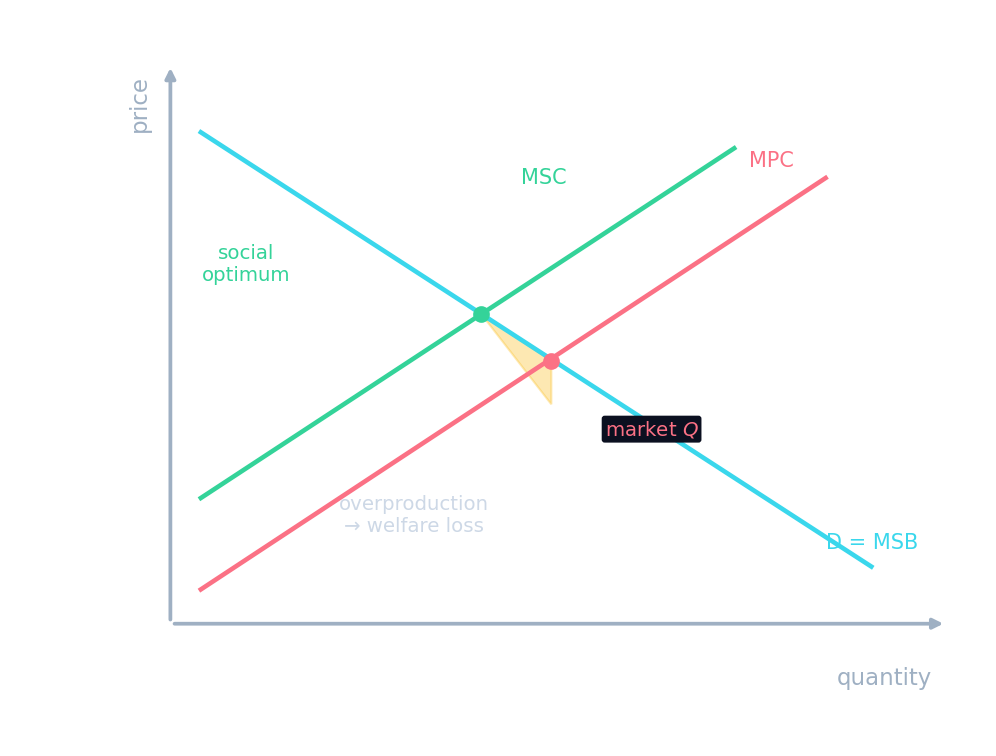
A tax set to the external cost shifts the market toward the social optimum — closing the welfare loss.
When a market fails
An externality (like pollution) means the market price ignores a real cost — output ends up above the efficient level. Add the external cost to see the gap.
Tradable pollution permits work by:
Difficulty 1/5 · 100 coins + a small bonus on first completion today
A cap-and-trade system limits total emissions and prices them via a permit market.
Regulation 管制, permits and provision
- Regulation: rules and limits (emissions caps, bans, age limits).
- Tradable permits 可交易许可证: a cap on total pollution, with permits firms can buy and sell — a market-based fix.
- State provision 政府提供: the government supplies public/merit goods directly (defence, schooling).

Income inequality: informal settlements sit close to wealthier districts in many cities
Match each policy to the failure it tackles.
Difficulty 2/5 · 140 coins + a small bonus on first completion today
Tax curbs negative externalities; subsidy boosts positive ones; provision supplies public goods.
Evaluating policies
- Judge each by effectiveness (does it hit the optimum?), cost, administrative feasibility, and unintended consequences (e.g. a black market, or government failure).
No policy is free. Taxes are hard to set exactly; subsidies cost the taxpayer; regulation needs enforcement. Always weigh the cure against its own costs.

A progressive tax takes a higher rate from higher incomes
A policy can backfire through government ______ (unintended consequences that worsen welfare).
Difficulty 1/5 · 100 coins + a small bonus on first completion today
Government failure: intervention that does more harm than good.
You've got it
- tax negative externalities; subsidise positive ones; toward the social optimum
- regulation, tradable permits, and state provision are further tools
- evaluate by effectiveness, cost, feasibility and unintended consequences