Sigma and pi bonds
Introduced| English | Meaning |
|---|---|
| sigma/ˈsɪɡmə/ | sigma |
| pi/paɪ/ | pi |
| bond length/bɒnd leŋθ/ | The equilibrium distance between the nuclei of two bonded atoms. |
| hybridisation/ˌhaɪbrɪdaɪˈzeɪʃn/ | The mathematical combination of atomic orbitals on the same atom to form new orbitals used to describe bonding. |
| bond energy/bɒnd ˈenədʒi/ | The energy required to break one mole of a specified covalent bond in gaseous molecules. |
Two ways to overlap
- Covalent bonds form when orbitals overlap.
- The way they overlap gives a sigma σ键 or a pi π键 bond.
- Bond strength links to bond length 键长.
A pi bond is formed by the sideways overlap of p orbitals.
Difficulty 1/5 · 100 coins + a small bonus on first completion today
Sigma bonds form by end-on overlap.
Two kinds of overlap
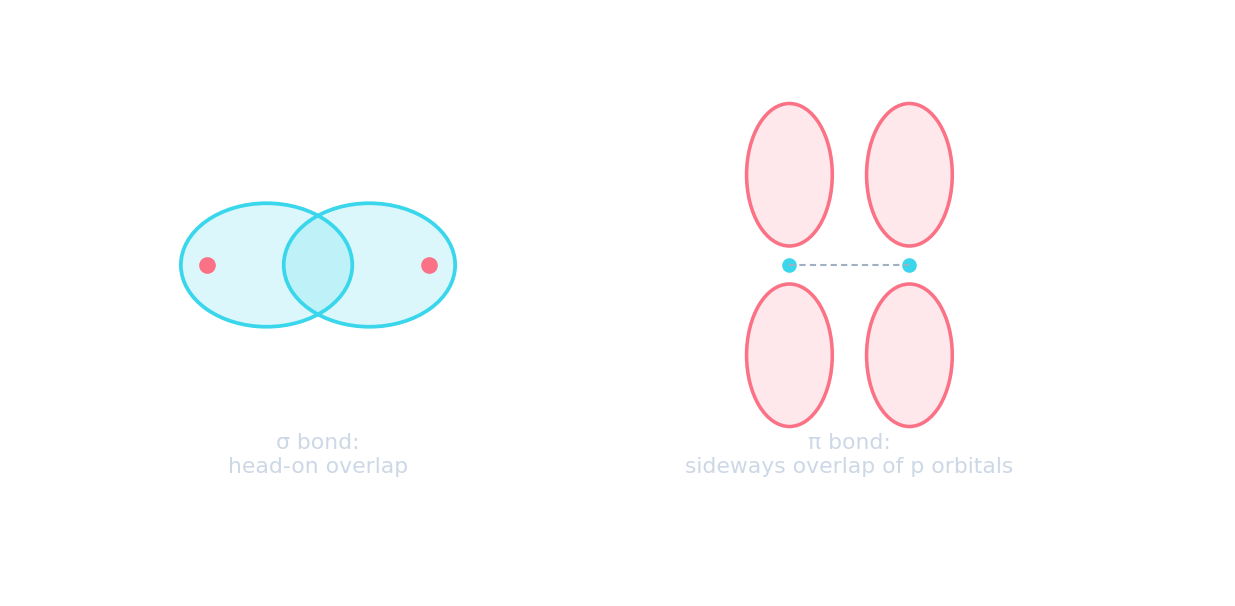
- a sigma (σ) bond forms by head-on overlap between the two atoms.
- a pi (π) bond forms by the sideways overlap of two p orbitals (above and below).
- single = 1σ; double = 1σ + 1π; triple = 1σ + 2π.
Single, double and the shared pairs
A single bond is one shared pair (a σ bond); switch to O₂ to see a double bond — a σ plus a second shared pair, the π bond.
A pi (π) bond forms by:
Difficulty 1/5 · 100 coins + a small bonus on first completion today
A σ bond is head-on overlap; a π bond is the sideways overlap of p orbitals.
A double bond consists of:
Difficulty 1/5 · 100 coins + a small bonus on first completion today
A single bond is 1σ; a double is 1σ + 1π; a triple is 1σ + 2π.
Match each bond/overlap to what it is.
Difficulty 2/5 · 140 coins + a small bonus on first completion today
A single bond is one σ; a double bond is a σ plus a π (sideways p-orbital overlap).
Hybridisation 杂化
- Hybridisation mixes orbitals in a shell into new, equal ones:
- sp → 2 orbitals (linear),
- sp² → 3 orbitals (flat, e.g. $\text{C}_2\text{H}_4$),
- sp³ → 4 orbitals (e.g. $\text{CH}_4$).
Methane (CH₄) uses which hybridisation?
Difficulty 1/5 · 100 coins + a small bonus on first completion today
CH₄ is tetrahedral with four equal bonds, from sp³ hybridisation.
Bond energy 键能 and length
- bond energy = energy to break one mole of a bond (gas state).
- bond length = distance between the two bonded nuclei.
- A shorter bond is usually stronger: triple > double > single.
Which bond is the shortest and strongest?
Difficulty 1/5 · 100 coins + a small bonus on first completion today
Shorter bonds are stronger: triple > double > single in both strength and shortness.
You've got it
- σ = head-on overlap; π = sideways p-orbital overlap
- single = 1σ; double = 1σ + 1π; triple = 1σ + 2π
- hybridisation: sp (linear), sp² (flat), sp³ (tetrahedral)
- shorter bond → stronger (triple > double > single)