The genetic code and protein synthesis
Introduced| English | Meaning |
|---|---|
| gene/dʒiːn/ | A DNA sequence that contributes to a functional product, such as a protein or RNA molecule. |
| transcription/trænˈskrɪpʃn/ | The production of an RNA molecule using a DNA sequence as its template. |
| translation/trænˈsleɪʃn/ | The synthesis of a polypeptide using the sequence of codons in messenger RNA at a ribosome. |
| triplet/ˈtrɪplɪt/ | A sequence of three DNA nucleotides that corresponds to one codon in the genetic code. |
| degenerate/dɪˈdʒenəreɪt/ | Describing the genetic code because more than one codon can specify the same amino acid. |
| exon/eɡˈzɒn/ | A region of a gene retained in the mature RNA after processing, which may include coding or untranslated sequence. |
| intron/ɪnˈtrɒn/ | A region transcribed into an initial RNA molecule and removed during RNA splicing. |
| codon/ˈkəʊdɒn/ | A sequence of three nucleotides in mRNA that specifies an amino acid or a translation stop signal. |
| anticodon/ˌæntɪˈkəʊdɒn/ | A sequence of three nucleotides in tRNA that pairs with a complementary codon in mRNA. |
From gene 基因 to protein
- A gene is a length of DNA that codes for one polypeptide.
- The cell reads the code in two stages: transcription 转录, then translation 翻译.
- First, let's crack the code itself.
A gene is a sequence of DNA that codes for:
Difficulty 1/5 · 100 coins + a small bonus on first completion today
A gene is a length of DNA that codes for a single polypeptide.
The genetic code
- The code is read in triplets 三联体 — groups of three bases.
- Each triplet codes for one amino acid, or signals start/stop.
- It is universal (nearly all life uses the same triplets) and degenerate 简并: there are 64 triplets but only 20 amino acids, so most amino acids have more than one triplet.
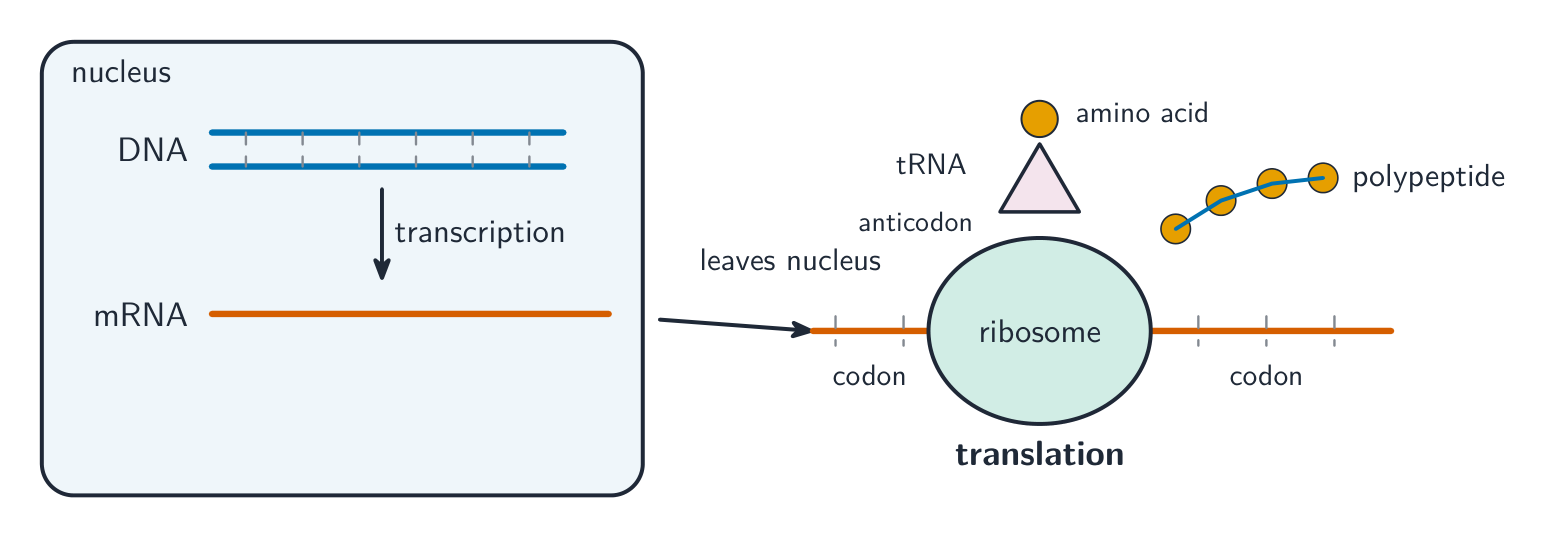
Protein synthesis: transcription then translation
From gene to protein
Step through the central dogma: the DNA template is transcribed into mRNA by base pairing (A→U, T→A, G→C, C→G), then read in codons and translated into a chain of amino acids.
The genetic code is "degenerate", which means:
Difficulty 1/5 · 100 coins + a small bonus on first completion today
There are 64 possible triplets but only 20 common amino acids, so most amino acids have several triplets.
A group of three mRNA bases that codes for one amino acid is called a ______.
Difficulty 1/5 · 100 coins + a small bonus on first completion today
Three bases = one codon (triplet); the matching three bases on a tRNA are its anticodon.
Transcription (in the nucleus)
- The gene is copied into mRNA.
- The DNA strand copied is the template strand; RNA polymerase joins RNA nucleotides that pair with it (uracil pairs with adenine).
- In eukaryotes the first transcript has coding exons 外显子 and non-coding introns 内含子 — the introns are removed and the exons joined to make the finished mRNA.

Introns are cut out and the coding exons spliced together to make the mature mRNA
During transcription:
Difficulty 1/5 · 100 coins + a small bonus on first completion today
Transcription makes mRNA from the DNA template strand, catalysed by RNA polymerase, in the nucleus.
In a eukaryote, the non-coding introns are removed and the coding exons joined before the mRNA leaves the nucleus.
Difficulty 1/5 · 100 coins + a small bonus on first completion today
This splicing produces the mature mRNA — introns out, exons joined.
Translation (at the ribosome)
- The mRNA leaves the nucleus and attaches to a ribosome.
- It is read in codons 密码子 (one triplet of mRNA bases at a time).
- tRNA molecules bring amino acids; each has an anticodon 反密码子 that pairs with the matching codon.
- The ribosome joins the amino acids with peptide bonds, building the polypeptide.
Put the steps from gene to protein in order.
Difficulty 3/5 · 200 coins + a small bonus on first completion today
Transcription (nucleus) → splice → mRNA out → translation (ribosome) → protein.
Match each term to its meaning.
Difficulty 2/5 · 140 coins + a small bonus on first completion today
Transcription writes the message (mRNA); translation reads it (protein); codon/anticodon pair at the ribosome.
During translation, tRNA molecules:
Difficulty 1/5 · 100 coins + a small bonus on first completion today
Each tRNA carries an amino acid and has an anticodon that pairs with a matching mRNA codon at the ribosome.
You've got it
- a gene codes for one polypeptide; the code is read in triplets (universal + degenerate: 64 → 20)
- transcription (nucleus): DNA template → mRNA by RNA polymerase; introns removed, exons joined
- translation (ribosome): codons read; tRNA anticodons bring amino acids
- amino acids joined by peptide bonds into the polypeptide