| English | 의미 |
|---|---|
| transformer/trænsˈfɔːmə/ | 변압기 |
| primary/ˈpraɪməri/ | 일차 |
| secondary/ˈsekəndəri/ | 이차 |
| step-up/step ʌp/ | 승압 |
| step-down/step daʊn/ | 감압 |
| transmission/trænˈsmɪʃn/ | 송전 |
전국으로 전력 송출하기
- 발전소는 도시에서 멀리 떨어져 있지만, 전송 중 에너지 손실이 거의 없습니다.
- 그 비결은 변압기로, 교류 전압의 크기를 변경합니다.
- 이를 통해 매우 높은 전압으로 전력을 보낼 수 있으며, 이것이 손실을 줄이는 원인입니다.
변압기
- 변압기는 연성 철심 위에 두 개의 코일을 가집니다: 일차(입력) 와 이차(출력) 입니다.
- 일차에 흐르는 교류가 철심에 변화하는 자기장을 만들어, 이차에 유도된 교류 기전력이 발생합니다.
- 전압과 권선 수는 다음과 같은 관계에 있습니다:
- 이는 교류(a.c.) 에서만 작동하며, 일정한 직류(d.c.)는 변화하는 자기장을 만들지 못합니다.
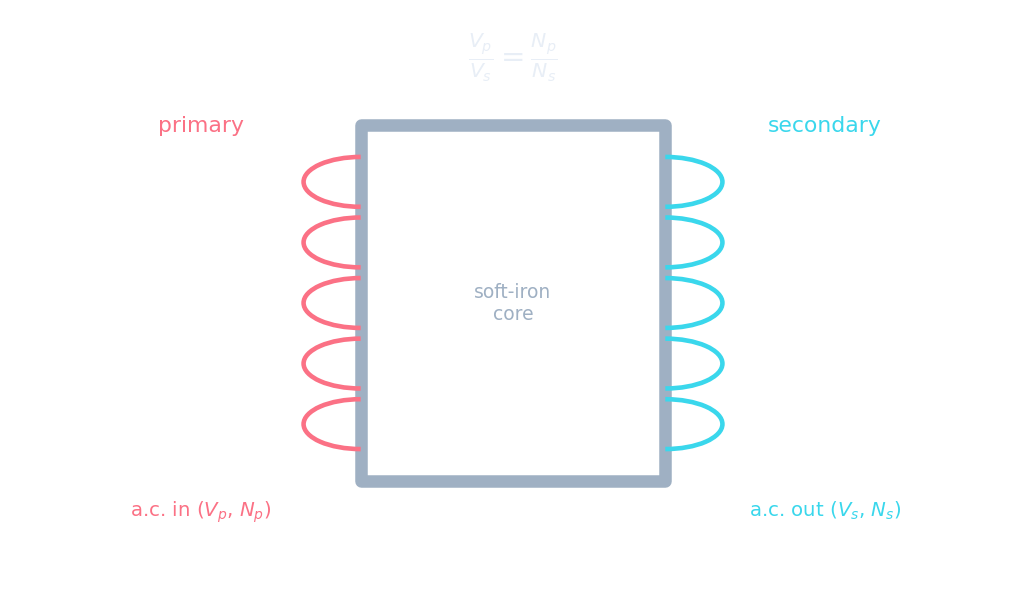
The transformer equation
Vs/Vp = Ns/Np
The voltage ratio equals the turns ratio — more turns on the secondary steps the voltage up.
A transformer works with a steady direct current (d.c.).
난이도 1/5 · 100 코인 + 오늘 첫 완료 시 소액 보너스
A transformer needs a changing magnetic field, so it works on a.c. only. A steady d.c. makes no change and induces nothing.
A transformer has $1000$ turns on the primary and $50$ on the secondary. The primary voltage is $240\ \text{V}$. What is the secondary voltage, in V?
난이도 2/5 · 140 코인 + 오늘 첫 완료 시 소액 보너스
$V_s = V_p \times \dfrac{N_s}{N_p} = 240 \times \dfrac{50}{1000} = 12\ \text{V}$ — a step-down transformer.
승압 및 강압
- 이차의 권선 수가 많으면 → 승압 변압기(전압 상승).
- 이차의 권선 수가 적으면 → 강압 변압기(전압 감소).
- 효율이 100%라면, 입력 전력 = 출력 전력:
- 따라서 승압 변압기는 전압을 높이지만 전류를 낮춥니다.

실제 변압기는 교류 공급의 전압을 변경합니다
Transformer
Add turns to the secondary to step the voltage up, fewer to step it down — Vs/Vp = Ns/Np, exactly how the grid moves power efficiently.
A step-up transformer has:
난이도 1/5 · 100 코인 + 오늘 첫 완료 시 소액 보너스
More secondary turns gives a higher output voltage — a step-up transformer.
A 100%-efficient step-up transformer raises the voltage and lowers the current.
난이도 1/5 · 100 코인 + 오늘 첫 완료 시 소액 보너스
Power is conserved ($I_p V_p = I_s V_s$), so if the voltage goes up the current must come down.
송전을 위해 고전압을 사용하는 이유
- 케이블에서 열로 손실되는 전력은 $P = I^2 R$ ($R$ = 케이블 저항)이다.
- 승압 변압기는 전압을 높여 동일한 전력($P = IV$)으로 전류를 낮춘다.
- 전류가 작아지면 케이블에서의 전력 손실이 훨씬 줄어든다.
- 강압 변압기가 전압을 낮춰 가정용 전압으로 변경한 후 공급된다.
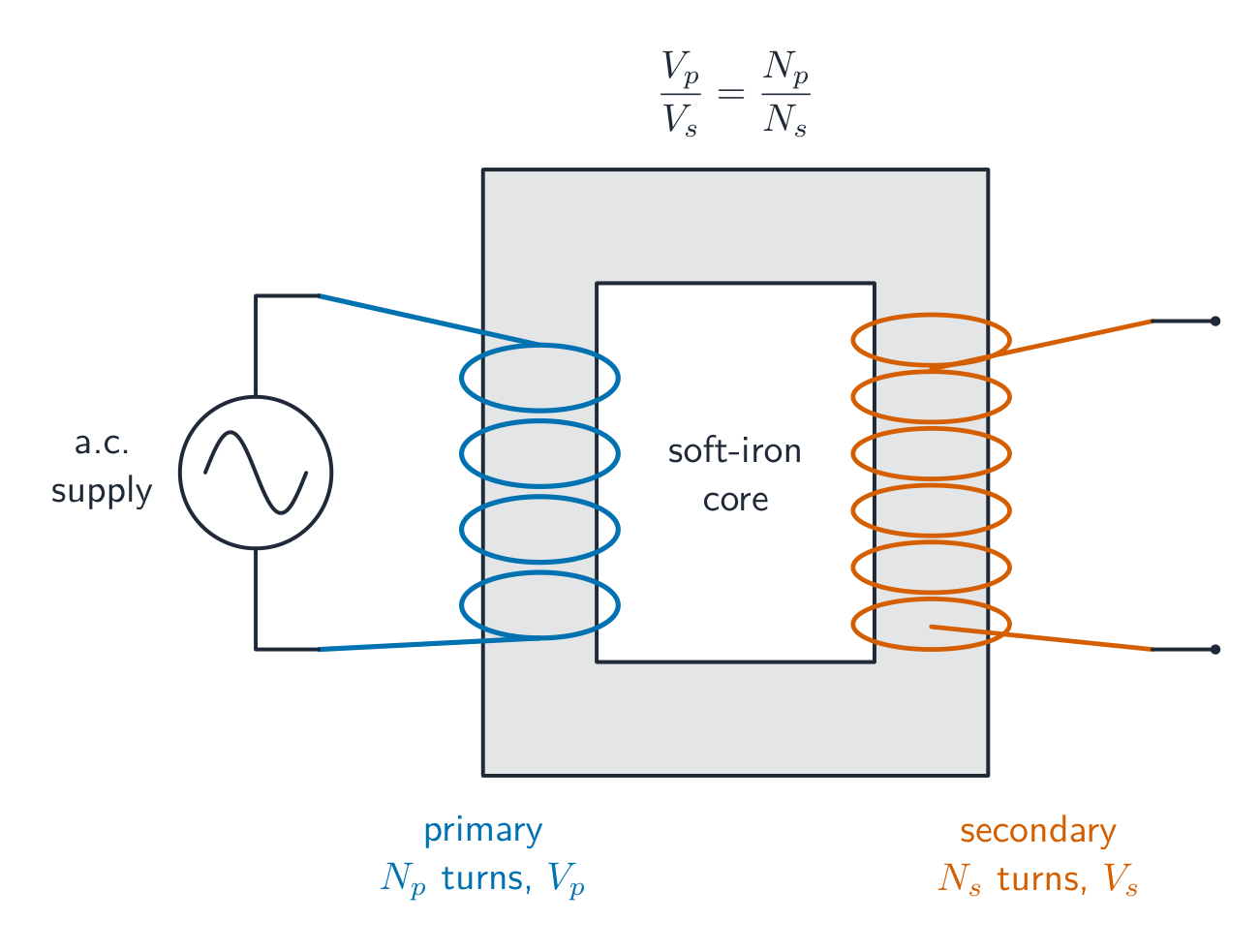
변압기
Why is electricity sent across the country at very high voltage?
난이도 1/5 · 100 코인 + 오늘 첫 완료 시 소액 보너스
For a given power, raising the voltage lowers the current. Since the heat loss is $I^2R$, a smaller current wastes far less power.
A cable carries a current of $20\ \text{A}$ and has a resistance of $5.0\ \Omega$. How much power is wasted as heat, in W?
난이도 2/5 · 140 코인 + 오늘 첫 완료 시 소액 보너스
$P = I^2 R = 20^2 \times 5.0 = 400 \times 5.0 = 2000\ \text{W}$. Lowering the current would cut this sharply.
이해했습니다
- 변압기: $\dfrac{V_p}{V_s} = \dfrac{N_p}{N_s}$; 교류(ac)만 작동함
- 이차 코일 도수 증가 = 승압 (V↑); 감소 = 강압 (V↓)
- 100% 효율: $I_p V_p = I_s V_s$ — 승압은 V를 높이고 I를 낮춤
- 고전압 → 저전류로 송전하여 케이블의 $I^2R$ 손실을 줄임