| English | 의미 |
|---|---|
| standard form/ˈstændəd fɔːm/ | 표준형 |
| integer/ˈɪntɪdʒə/ | 정수 |
From atoms to galaxies
- The width of a hydrogen atom is about $0.000\,000\,000\,106$ metres.
- The distance to the nearest star is about $40\,000\,000\,000\,000$ metres.
- Writing numbers like that is painful — and error-prone. Standard form 科学记数法 fixes both problems.
표준형 경로(route)
크거나 작은 숫자를 a x 10^n 형태로 바꿉니다.
The format $A \times 10^n$
- Standard form writes any number as $A \times 10^n$, where:
- $1 \leq A < 10$ (the "front number" has exactly one digit before the decimal point),
- $n$ is an integer 整数 (positive for big numbers, negative for small ones).
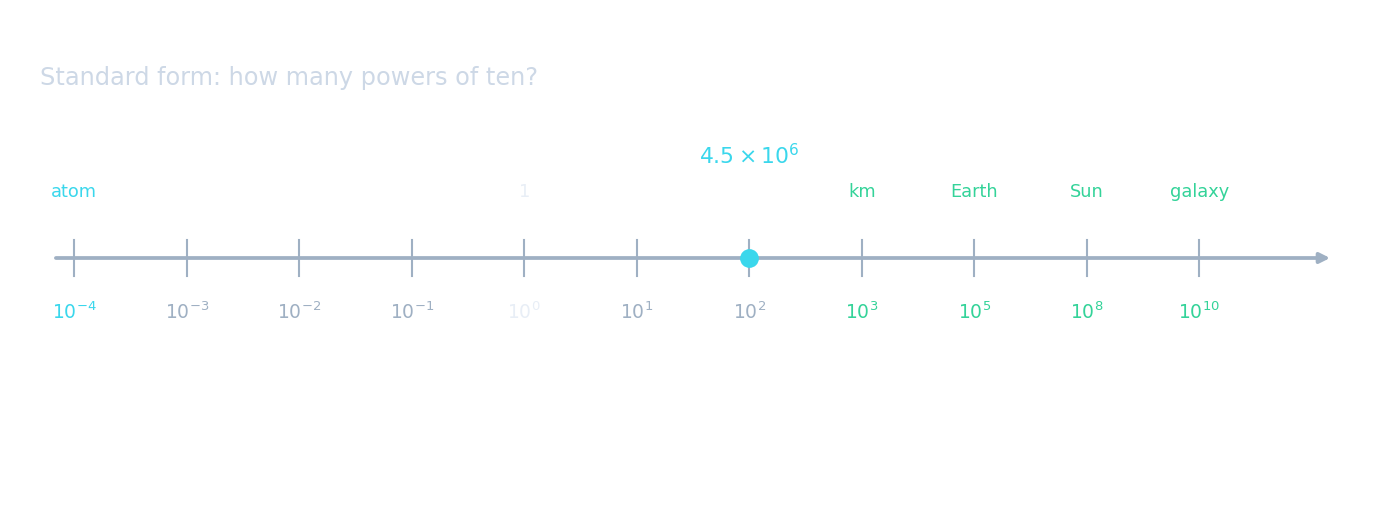
Each tick is ten times bigger than the last. Standard form tells you which tick a number sits near.
표준형에서 앞의 숫자 A는 다음 조건을 만족해야 합니다: 1 ≤ A < 10.
난이도 1/5 · 100 코인 + 오늘 첫 완료 시 소액 보너스
정의에 따라, A는 1 이상(포함)이고 10 미만(불포함) 사이입니다 — 소수점 앞에 정확히 한 자리 숫자가 있습니다.
Converting big and small numbers
- Big numbers: count how many places the decimal moves left → positive power.
- $4\,500\,000 = 4.5 \times 10^6$ (point moves 6 places left).
- Small numbers (less than 1): count how many places the decimal moves right → negative power.
- $0.000\,72 = 7.2 \times 10^{-4}$ (point moves 4 places right).
Quick method. Write the first non-zero digit, then a decimal point, then the remaining significant digits. Count the places you moved: that's $n$.

A galaxy: huge distances are written compactly in standard form
4 500 000을 A × 10ⁿ으로 쓰시오. 지수 n은 무엇인가?
난이도 2/5 · 140 코인 + 오늘 첫 완료 시 소액 보너스
4 500 000 = 4.5 × 10⁶이므로, n = 6입니다.
0.00072를 표준형 A × 10ⁿ으로 쓰시오. n은 무엇인가?
난이도 2/5 · 140 코인 + 오늘 첫 완료 시 소액 보너스
0.00072 = 7.2 × 10⁻⁴이므로, n = −4입니다.
Calculating in standard form
- Multiply: multiply the fronts, add the powers.
- $(3 \times 10^5) \times (2 \times 10^{-2}) = 6 \times 10^3$.
- Divide: divide the fronts, subtract the powers.
- $(8 \times 10^7) \div (4 \times 10^3) = 2 \times 10^4$.
Adjust if needed. After multiplying, the front number might be $\geq 10$. Adjust: $15 \times 10^3 = 1.5 \times 10^4$.
(3 × 10⁵) × (2 × 10⁻²) = A × 10³. A는 무엇인가?
난이도 2/5 · 140 코인 + 오늘 첫 완료 시 소액 보너스
3 × 2 = 6이고 10⁵ × 10⁻² = 10³이므로, 답은 6 × 10³입니다.
(8 × 10⁷) ÷ (4 × 10³) = A × 10ⁿ. n은 무엇인가?
난이도 2/5 · 140 코인 + 오늘 첫 완료 시 소액 보너스
8 ÷ 4 = 2이고 10⁷ ÷ 10³ = 10⁴이므로, n = 4입니다.
5 × 10³ × 3 × 10²의 올바른 표준형은 무엇인가?
난이도 1/5 · 100 코인 + 오늘 첫 완료 시 소액 보너스
5 × 3 = 15이고 10³ × 10² = 10⁵이므로, 15 × 10⁵이 됩니다. 조정: 1.5 × 10⁶.
Why scientists love standard form
- The speed of light: $3.0 \times 10^8$ m/s — three hundred million metres every second.
- A DNA helix width: $2.0 \times 10^{-9}$ m — two billionths of a metre.
- Compare like quantities with the same units. A length of $2.0\times10^{-6}$ m is $1000$ times a length of $2.0\times10^{-9}$ m; speed cannot be compared with width.
Adding needs a common power
- For addition, first write both numbers with the same power of ten: $3.2\times10^5+7\times10^4=(3.2+0.7)10^5=3.9\times10^5$.
- Renormalise after calculating: $(8\times10^3)(4\times10^2)=32\times10^5=3.2\times10^6$. Core calculations in standard form are on calculator Paper 3.
(3.2 × 10⁵ + 7 × 10⁴) / 10⁵을 계산하시오.
난이도 2/5 · 140 코인 + 오늘 첫 완료 시 소액 보너스
같은 지수를 사용한다: 3.2 + 0.7 = 3.9.
You've got it
- standard form $= A \times 10^n$ with $1 \leq A < 10$
- big numbers → positive $n$; small numbers $(< 1)$ → negative $n$
- multiply: fronts $\times$, powers $+$; divide: fronts $\div$, powers $-$
- $4\,500\,000 = 4.5 \times 10^6$; $\;0.000\,72 = 7.2 \times 10^{-4}$