| English | 의미 |
|---|---|
| rational/ˈræʃənl/ | 유리수 |
| irrational/ɪˈræʃənl/ | 무리수 |
| natural numbers/ˈnætʃərəl ˈnʌmbəz/ | 자연수 |
| integers/ˈɪntɪdʒəz/ | 정수 |
| factor/ˈfæktə/ | 인수 |
| multiple/ˈmʌltɪpl/ | 배수 |
| prime/praɪm/ | 소수 |
| prime factorisation/praɪm ˌfæktəraɪˈzeɪʃn/ | 소인수분해 |
| HCF/ˌeɪtʃ siː ˈef/ | 최대공약수 |
| LCM/ˌel siː ˈem/ | 최소공배수 |
| reciprocal/rɪˈsɪprəkl/ | 역수 |
A question that stumped the ancient Greeks
- Is every number a fraction? The Greeks thought yes — until someone proved $\sqrt{2}$ cannot be written as $\dfrac{a}{b}$.
- Legend says the discoverer was thrown overboard for revealing this uncomfortable truth.
- Today we sort numbers into families, and that split — rational 有理数 vs irrational 无理数 — is still the big one.
The number families
- Natural numbers 自然数 $\mathbb{N} = \{1, 2, 3, \dots\}$ — the counting numbers (some definitions include $0$).
- Integers 整数 $\mathbb{Z} = \{\dots, -2, -1, 0, 1, 2, \dots\}$ — whole numbers, positive, negative and zero.
- Rational numbers $\mathbb{Q}$ — anything that can be written $\dfrac{a}{b}$ where $a, b$ are integers and $b \neq 0$.
- Irrational numbers — everything else ($\pi$, $\sqrt{2}$, $e$): they cannot be expressed as a fraction.
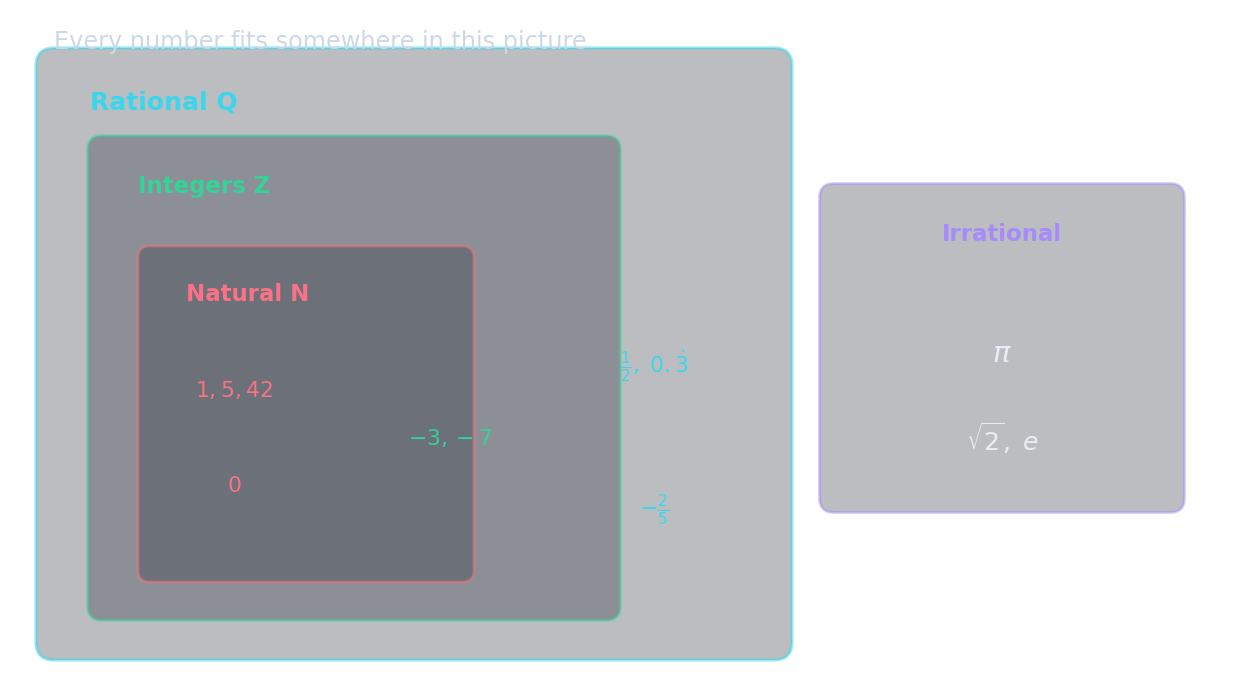
Natural → Integer → Rational, each a bigger family. Irrational numbers live outside.
숫자의 집합
모든 세는 정수는 합수(rational number)이며, 모든 합수는 정수(integers)입니다 — 숫자 집합이 어떻게 중첩되고 합집합(union) 및 교집합(intersection)이 어떻게 결합되는지 확인하십시오.
각 숫자를 해당 가장 작은 숫자 가족에 매칭하시오.
난이도 2/5 · 140 코인 + 오늘 첫 완료 시 소액 보너스
−5와 0은 정수(whole numbers, 음수를 포함함)입니다. 3/7은 합수(rational, 정수의 분수)입니다. √3은 무리수(irrational, a/b로 쓸 수 없음)입니다.
Factors 因数, multiples 倍数 and primes 质数
- A factor of $n$ divides into $n$ exactly. Factors of $12$: $1, 2, 3, 4, 6, 12$.
- A multiple of $n$ is $n \times$ an integer. Multiples of $5$: $5, 10, 15, 20, \dots$.
- A prime has exactly two factors: $1$ and itself.
- $2, 3, 5, 7, 11, 13, \dots$ are prime. $1$ is not prime (only one factor).
1 is NOT prime. A prime must have exactly two distinct factors. $1$ has only one factor (itself), so it fails the definition.

Every natural number is an integer, every integer is rational, and every rational is real; irrational numbers like $\pi$ and $\sqrt{2}$ are real but not rational
다음 중 소수(prime number)는 무엇입니까?
난이도 1/5 · 100 코인 + 오늘 첫 완료 시 소액 보너스
13은 정확히 두 개의 약수(1과 13)를 가집니다. 1은 소수가 아닙니다; 9 = 3×3; 15 = 3×5.
숫자 1은 소수입니다.
난이도 1/5 · 100 코인 + 오늘 첫 완료 시 소액 보너스
1은 오직 하나의 약수(자신 자신)만을 가집니다. 소수는 정확히 두 개의 서로 다른 약수를 가져야 합니다.
가장 작은 소수는 ______ 입니다.
난이도 1/5 · 100 코인 + 오늘 첫 완료 시 소액 보너스
2는 가장 작고(그리고 유일한 짝수인) 소수입니다.
Prime factorisation 质因数分解, HCF 最大公因数 and LCM 最小公倍数
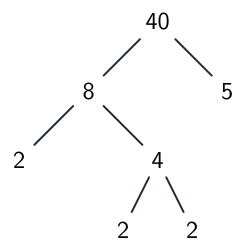
- Write any number as a product of primes: $72 = 2^3 \times 3^2$, $120 = 2^3 \times 3 \times 5$.
- HCF (highest common factor): take the lowest power of each shared prime.
- HCF of $72$ and $120$ $= 2^3 \times 3 = 24$.
- LCM (lowest common multiple): take the highest power of every prime that appears.
- LCM of $72$ and $120$ $= 2^3 \times 3^2 \times 5 = 360$.

Keep splitting until every branch ends on a prime (circled); collecting them gives $72 = 2^3 \times 3^2$
Quick check. HCF × LCM should equal the product of the two numbers: $24 \times 360 = 8640$ and $72 \times 120 = 8640$. ✓
72와 120의 최대공약수(HCF)를 구하시오. (72 = 2³×3², 120 = 2³×3×5)
난이도 2/5 · 140 코인 + 오늘 첫 완료 시 소액 보너스
공통된 지수의 최소값을 취합니다: 2³ × 3 = 8 × 3 = 24.
72와 120의 최소공배수(LCM)를 구하시오.
난이도 2/5 · 140 코인 + 오늘 첫 완료 시 소액 보너스
최대 지수를 취합니다: 2³ × 3² × 5 = 8 × 9 × 5 = 360.
Fun fact
- There are infinitely many primes (Euclid proved this around 300 BC).
- The largest known prime (as of 2024) has over 41 million digits — it's $2^{136{,}279{,}841} - 1$, a Mersenne prime.
Reciprocals and place value
- The reciprocal 倒数 of a nonzero number multiplies it to 1: for $3/7$ it is $7/3$, since $(3/7)(7/3)=1$. Zero has no reciprocal.
- Group large numbers into thousands: 6000042 is six million and forty-two. $6\,000\,042=6(1\,000\,000)+42$; the zeros hold the missing place values.
5/9의 역수를 구하시오.
난이도 2/5 · 140 코인 + 오늘 첫 완료 시 소액 보너스
역수는 9/5 = 1.8; 여기에 5/9를 곱하면 1가 됩니다.
You've got it
- natural $\mathbb{N}$ → integer $\mathbb{Z}$ → rational $\mathbb{Q}$; irrational numbers live outside
- prime = exactly two factors ($1$ is not prime)
- HCF = lowest shared prime powers; LCM = highest prime powers of every prime
- $72 = 2^3 \times 3^2$, $120 = 2^3 \times 3 \times 5$ → HCF $24$, LCM $360$