| English | 의미 |
|---|---|
| production/prəˈdʌkʃn/ | 생산 |
| inputs/ˈɪnpʊts/ | 投入 |
| outputs/ˈaʊtpʊts/ | 산출물 |
| productivity/ˌprɒdəkˈtɪvɪti/ | 생산성 |
| job production/dʒɒb prəˈdʌkʃn/ | 조달 생산 |
| batch production/bætʃ prəˈdʌkʃn/ | 배치 생산 |
| flow production/fləʊ prəˈdʌkʃn/ | 연속 생산 |
| lean production/liːn prəˈdʌkʃn/ | 린 생산 |
| waste/weɪst/ | 낭비 |
| just-in-time/dʒʌst ɪn taɪm/ | Just-in-time (Just-in-Time) |
Making the product
- Turning raw materials into finished goods (or delivering a service) is production 生产 — the heart of operations.
- How a business produces affects its cost, quality and speed.
6 workers produce 300 units a day. What is productivity (units per worker)?
난이도 2/5 · 140 코인 + 오늘 첫 완료 시 소액 보너스
300 ÷ 6 = 50 units per worker.
Inputs 投入 to outputs 产出
- Production turns inputs (materials, labour, machines) into outputs (goods or services).
- Productivity 生产率 = output per worker — a key measure of efficiency.
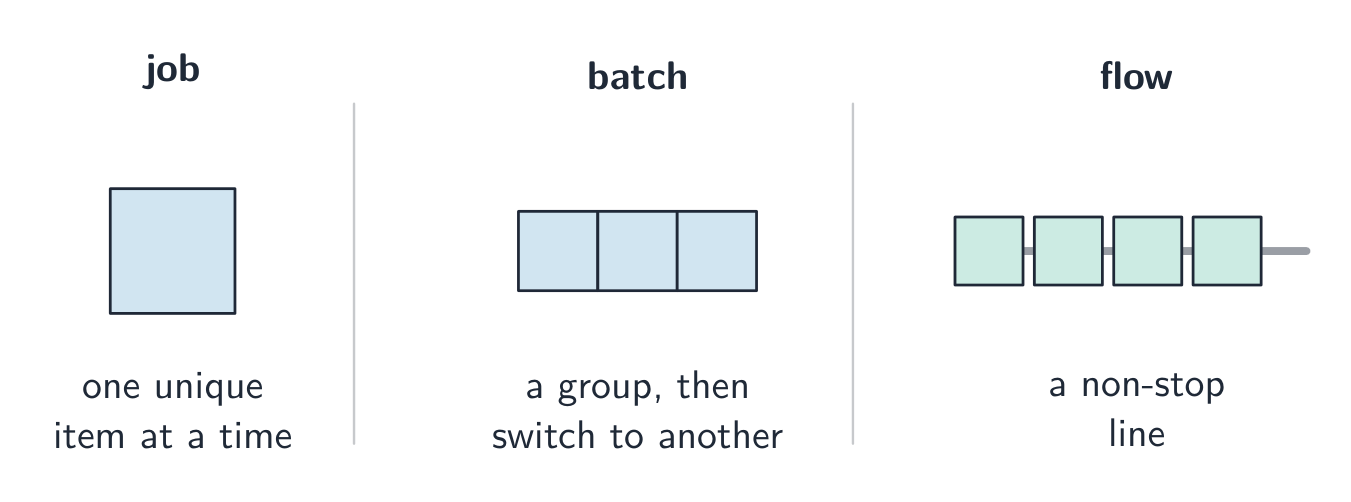
The three methods of production
Methods of production
A business picks job, batch or flow production to suit its product and order size.
Making a single, unique product to order is:
난이도 1/5 · 100 코인 + 오늘 첫 완료 시 소액 보너스
Job production makes one bespoke item at a time.
Continuous mass production on an assembly line is:
난이도 1/5 · 100 코인 + 오늘 첫 완료 시 소액 보너스
Flow production runs continuously at low unit cost.
Methods of production
- Job production 单件生产: one unique item at a time (a wedding cake). High quality, high cost.
- Batch production 批量生产: groups of identical items in stages (loaves of bread).
- Flow production 流水线生产: continuous mass production on a line (bottled drinks). Low unit cost.
Worked example. 5 workers make 200 units a day → productivity = 200 ÷ 5 = 40 units per worker. A new machine lifts output to 300 with the same 5 workers → productivity rises to 60.

A car assembly line: making many identical products on a moving line
Just-in-time production aims to hold large buffer stocks of materials.
난이도 1/5 · 100 코인 + 오늘 첫 완료 시 소액 보너스
False. JIT brings materials in only as they are needed, so it aims to hold as little stock as possible and cut storage costs.
Production that aims to cut all forms of waste is called ______ production.
난이도 1/5 · 100 코인 + 오늘 첫 완료 시 소액 보너스
Lean production minimises waste while keeping quality.
Lean production 精益生产
- Lean production cuts waste 浪费 of all kinds (time, materials, stock) while keeping quality.
- Just-in-time 准时制 (JIT) keeps almost no stock; materials arrive as needed.
You've got it
- production turns inputs into outputs; productivity = output per worker
- methods: job (one-off), batch (groups), flow (continuous mass)
- lean production cuts waste; JIT holds almost no stock
Write from productivity of 60
- Eight workers produce 480 units in a day.
- Find productivity. Just-in-time production keeps very little stock, so a late delivery can stop the line.
Eight workers produce 480 units in a day. What is productivity, and what risk comes with just-in-time production?
Productivity here is output per worker. Just-in-time trades stock for the risk of a supply delay.
What is the productivity?
난이도 1/5 · 100 코인 + 오늘 첫 완료 시 소액 보너스
480 divided by 8 is 60 units per worker. Other options — 50 units per worker (the lesson example's result for 6 workers and 300 units); 480 units (the total output).