| English | 의미 |
|---|---|
| Neurodevelopmental disorders/ˌnjuːrəʊdˈveləpmentl dɪˈsɔːdəz/ | Glossary {"sense": "신경발달장애", "subject": "AP 심리학", "term": "Neurodevelopmental disorders"} |
| Schizophrenic spectrum disorders/ˌskɪtsəˈfrenɪk ˈspektrəm dɪˈsɔːdəz/ | Glossary {"sense": "조현증 스펙트럼 장애", "subject": "AP 심리학", "term": "Schizophrenic spectrum disorders"} |
| delusions/dɪˈluːʒnz/ | Glossary {"sense": "환각적 사고", "subject": "AP 심리학", "term": "delusions"} |
| hallucinations/həˌluːsɪˈneɪʃnz/ | Glossary {"sense": "환각", "subject": "AP 심리학", "term": "hallucinations"} |
| Depressive disorders/dɪˈpresɪv dɪˈsɔːdəz/ | Glossary {"sense": "우울 장애", "subject": "AP 심리학", "term": "Depressive disorders"} |
| Bipolar disorders/baɪˈpəʊlə dɪˈsɔːdəz/ | 양극성 장애 |
| mania/ˈmeɪnɪə/ | 조광 |
| Anxiety disorders/æŋˈzaɪəti dɪˈsɔːdəz/ | 불안 장애 |
| Obsessive-compulsive and related disorders/ɒbˈsesɪv kəmˈpʌlsɪv ænd rɪˈleɪtɪd dɪˈsɔːdəz/ | 강박 및 관련 장애 |
| obsessions/ɒbˈseʃnz/ | 강박적 사고 |
| compulsions/kəmˈpʌlʃnz/ | 강박적 행동 |
| Dissociative disorders/dɪˈsəʊsɪətɪv dɪˈsɔːdəz/ | 해리 장애 |
| Trauma and stressor-related disorders/ˈtrɔːmə ænd ˈstresə rɪˈleɪtɪd dɪˈsɔːdəz/ | 创伤 및 스트레스 관련 장애 |
| Personality disorders/ˌpɜːsəˈnælɪti dɪˈsɔːdəz/ | 인격 장애 |
| Feeding and eating disorders/ˈfiːdɪŋ ænd ˈiːtɪŋ dɪˈsɔːdəz/ | 음식 섭취 장애 |
Categories defined by what they have in common
- The disorders in a category share a defining feature, not a cause.
- That is why one category can have many proposed causes at once.
- Learn the defining feature first; the causes attach to it afterwards.
Neurodevelopmental and schizophrenic spectrum
- Neurodevelopmental disorders 神经发育障碍 have onset during the developmental period; causes may be environmental, physiological or genetic.
- Schizophrenic spectrum disorders 精神分裂症谱系障碍 are characterised by issues in one or more of five areas: delusions 妄想, hallucinations 幻觉, disorganised speech, disorganised behaviour and negative symptoms.
- Proposed causes for the second include genetic and biological links such as prenatal virus exposure or neurotransmitter imbalance.
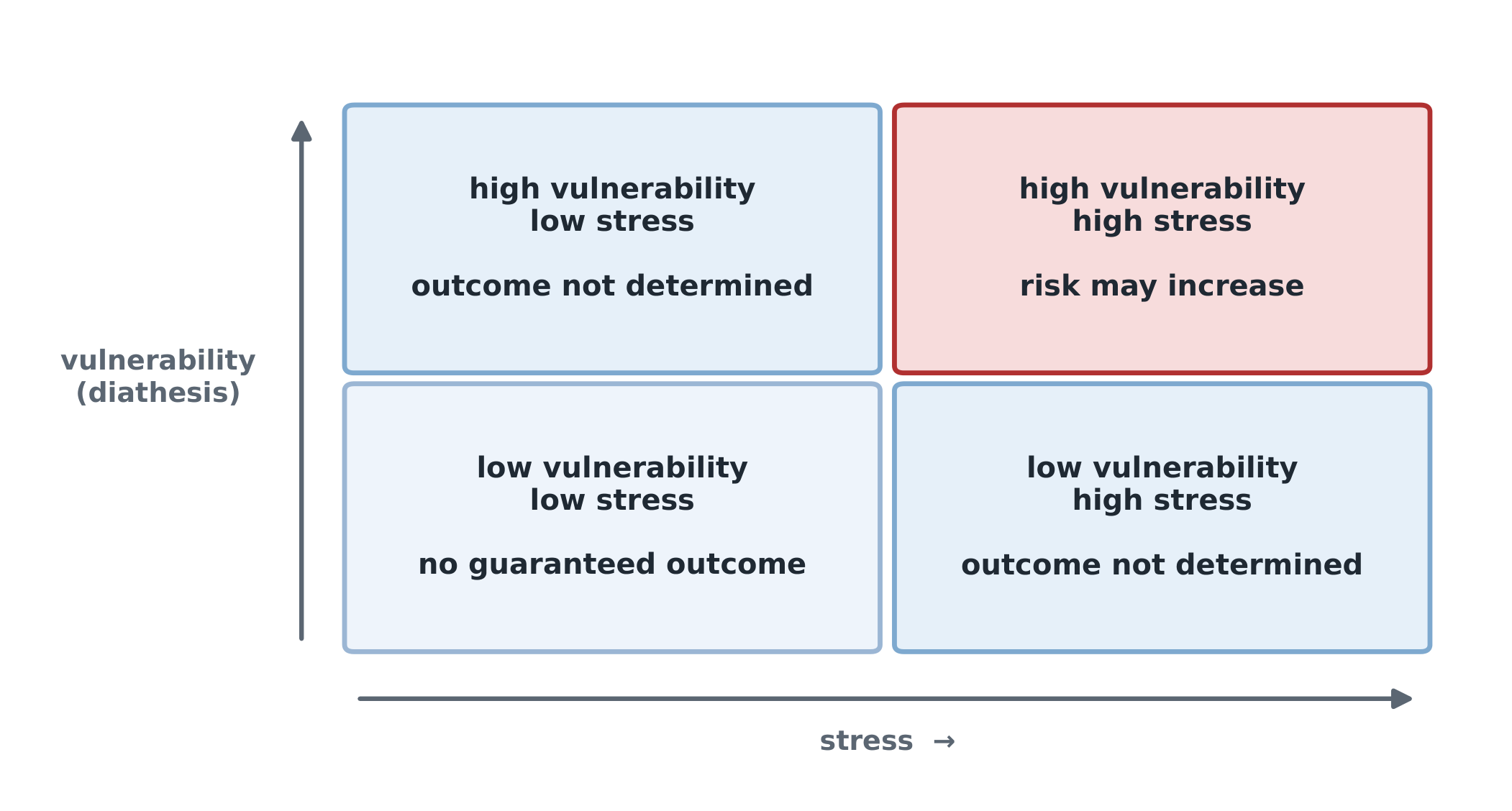
Vulnerability and stress interact; the diagram illustrates a model, not measured probabilities or a diagnosis
Select all the areas that characterise schizophrenic spectrum disorders.
난이도 2/5 · 140 코인 + 오늘 첫 완료 시 소액 보너스
Mania belongs to bipolar disorders, not the schizophrenic spectrum.
Mood and anxiety
- Depressive disorders 抑郁障碍 involve sad, empty or irritable mood with physical and cognitive changes.
- Bipolar disorders 双相障碍 involve periods of mania 躁狂 and periods of depression.
- Anxiety disorders 焦虑障碍 involve excessive fear or anxiety with related disturbances to behaviour.
Which category's defining feature?
Match each defining feature to its category.
The defining feature of bipolar disorders is...
난이도 1/5 · 100 코인 + 오늘 첫 완료 시 소액 보너스
Mania is what distinguishes bipolar from a depressive disorder.
Do not use a diagnostic term casually or apply it to yourself or others from a description. The CED states that diagnosis requires specialised training and evidence-based tools — these categories are for understanding research, not for labelling people.
Intrusive thoughts in obsessive-compulsive disorders are called ____.
난이도 1/5 · 100 코인 + 오늘 첫 완료 시 소액 보너스
Obsessions are the thoughts; compulsions are the repetitive behaviours.
Match each category to what it requires.
난이도 2/5 · 140 코인 + 오늘 첫 완료 시 소액 보너스
Each category is defined by a feature, and the causes attach to the feature afterwards.
Obsessive-compulsive, dissociative and trauma-related
- Obsessive-compulsive and related disorders 强迫及相关障碍 involve obsessions 强迫思维 (intrusive thoughts) and compulsions 强迫行为 (repetitive behaviours).
- Dissociative disorders 分离障碍 involve dissociation from consciousness, memory, identity or perception.
- Trauma and stressor-related disorders 创伤及应激相关障碍 require exposure to a traumatic or stressful event.
Personality disorders fall into three clusters.
난이도 1/5 · 100 코인 + 오늘 첫 완료 시 소액 보너스
They involve enduring patterns of inner experience and behaviour, grouped into three clusters.
Eating and personality disorders
- Feeding and eating disorders 进食障碍 involve altered consumption or absorption of food that impairs health.
- Personality disorders 人格障碍 fall into three clusters and involve enduring patterns of inner experience and behaviour.
- For most categories the CED gives the same list of possible causes: biological, genetic, social, cultural, behavioural or cognitive.
Two people both avoid crowded places. One does so after a traumatic event and re-experiences it — trauma and stressor-related. The other has intrusive thoughts and performs a repetitive routine before leaving — obsessive-compulsive. The same visible behaviour, two different defining features.
Each category is defined by a shared feature, not a shared cause. Schizophrenic spectrum covers five areas including delusions and hallucinations; bipolar requires periods of mania; obsessive-compulsive requires obsessions and compulsions; trauma-related requires an event. Causes are usually listed as biological, genetic, social, cultural, behavioural or cognitive.
Write from two weeks of low mood and no mania
- Low mood lasts two weeks and there is no period of mania. Another person hears a voice that is not present.
- Say what bipolar requires, and separate a hallucination from a delusion.
Low mood lasts two weeks and mania is absent. Another person hears a voice that is not there. What can this lesson say, and how is a hallucination different from a delusion?
A category here is defined by its stated feature. Low mood without mania misses the bipolar feature.
What is the voice that is not present?
난이도 1/5 · 100 코인 + 오늘 첫 완료 시 소액 보너스
A perception without the stimulus is a hallucination. Mania was absent.