| English | 의미 |
|---|---|
| price elasticity of supply/praɪs ɪlæˈstɪsɪti ɒv səˈplaɪ/ | 공급 가격 탄력성 |
| midpoint (arc) method/ˈmɪdpɔɪnt ˈmeθəd/ | 중간점(호)법 |
| elastic/ɪˈlæstɪk/ | 탄력적임 |
| perfectly inelastic/ˈpɜːfektlɪ ɪnɪˈlæstɪk/ | 완전 비탄력적임 |
| inelastic/ɪnɪˈlæstɪk/ | 비탄력적임 |
| perfectly elastic/ˈpɜːfektlɪ ɪˈlæstɪk/ | 완전 탄력적임 |
| time horizon/taɪm həˈraɪzn/ | 시간 범위 |
| spare capacity/speə kəˈpæsɪti/ | 여유 생산 능력 |
Can sellers react in time?
- A price jump is an invitation to sell more — but can sellers actually do it?
- A baker can bake extra loaves by tonight; an oil field takes years to expand.
- How quickly quantity supplied responds to price is its own kind of elasticity.
- It is called price elasticity of supply 供给价格弹性 (PES).
Measuring PES
- PES answers: "if price changes by 1%, by what % does quantity supplied change?"
- Formula: $\text{PES} = \dfrac{\%\,\Delta\,\text{quantity supplied}}{\%\,\Delta\,\text{price}}$.
- Because price and quantity supplied move together, PES is normally positive.
- Use the same midpoint (arc) method 中点法 as PED: divide each change by the average of the two values.
Price elasticity of supply is normally:
난이도 1/5 · 100 코인 + 오늘 첫 완료 시 소액 보너스
Supply obeys a direct relationship, so PES is positive.
Price rises causing a 30% rise in quantity supplied and a 10% rise in price. What is PES?
난이도 2/5 · 140 코인 + 오늘 첫 완료 시 소액 보너스
$\text{PES} = 30\% \div 10\% = 3$ — elastic supply.
From elastic to perfectly inelastic
- Elastic 富有弹性: $\text{PES} > 1$ — output changes a lot. Inelastic 缺乏弹性: $\text{PES} < 1$ — output barely moves.
- Perfectly elastic 完全弹性: $\text{PES} = \infty$, a horizontal line — any amount at one price.
- Perfectly inelastic 完全无弹性: $\text{PES} = 0$, a vertical line — a fixed quantity no matter the price.
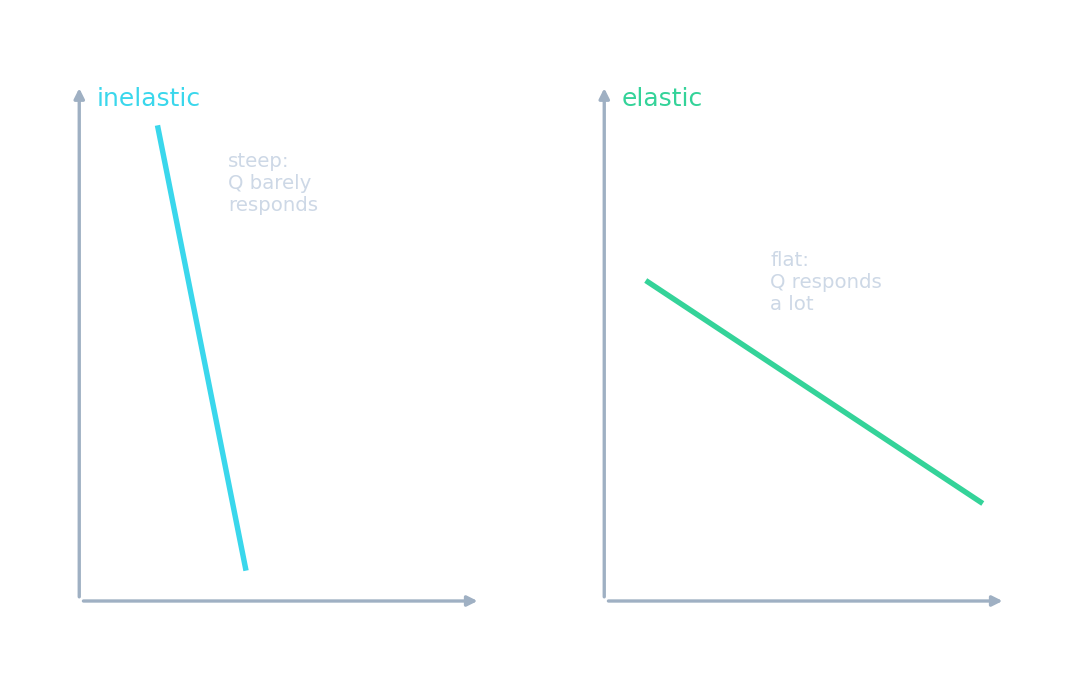
Elastic or inelastic supply?
Supply is more elastic when firms can change output quickly — with spare capacity or plenty of time. It is inelastic when quantity is fixed.
A supply curve drawn as a vertical line has a PES of:
난이도 1/5 · 100 코인 + 오늘 첫 완료 시 소액 보너스
A vertical supply means quantity is fixed no matter the price — PES = 0.
What makes supply elastic
- Time horizon 时间跨度: given more time, firms build, hire, and adjust — so supply is far more elastic in the long run.
- Spare capacity 闲置产能: idle machines and spare workers let a firm raise output quickly.
- With no spare capacity and no time, supply is stuck — inelastic.
Supply is usually more elastic in the long run than in the short run.
난이도 1/5 · 100 코인 + 오늘 첫 완료 시 소액 보너스
Given more time, firms can build capacity and hire, so output responds more.
Idle machines and unused workers give a firm ______ capacity, which makes supply more elastic.
난이도 1/5 · 100 코인 + 오늘 첫 완료 시 소액 보너스
Spare capacity lets output rise quickly when price rises.
Select all that make supply more elastic.
난이도 2/5 · 140 코인 + 오늘 첫 완료 시 소액 보너스
Time, spare capacity and easy storage all let quantity respond; a fixed quantity is inelastic.
Worked examples
1. The price rises from 10 to 12 and quantity supplied rises from 50 to 70. $\%\Delta Q = \dfrac{20}{60} = 33.3\%$ and $\%\Delta P = \dfrac{2}{11} = 18.2\%$, so $\text{PES} = \dfrac{33.3}{18.2} = 1.83$: elastic supply.
2. Supply is more elastic when firms have spare capacity or more time to adjust; a farm crop just before harvest is close to perfectly inelastic.
Quantity supplied rises by 12 percent when price rises by 8 percent. What is the price elasticity of supply, and is supply elastic?
12 divided by 8 is 1.5.
What is the price elasticity of supply?
난이도 1/5 · 100 코인 + 오늘 첫 완료 시 소액 보너스
12 divided by 8 is 1.5, and 1.5 is above 1.
PES = %ΔQ supplied ÷ %ΔP (normally positive, via the midpoint method). $\text{PES}>1$ is elastic, $<1$ inelastic; a horizontal curve is perfectly elastic, a vertical one perfectly inelastic. Supply is more elastic with more time and spare capacity.
Write from a supply elasticity of 1.5
- Quantity supplied rises by 12 percent when price rises by 8 percent.
- Find the price elasticity of supply.