Other Elasticities
Introduced| English |
|---|
| cross-price elasticity of demand/krɒs praɪs ɪlæˈstɪsɪti ɒv dɪˈmænd/ |
| substitutes/ˈsʌbstɪtjuːts/ |
| complements/ˈkɒmplɪmənts/ |
| income elasticity of demand/ˈɪŋkʌm ɪlæˈstɪsɪti ɒv dɪˈmænd/ |
| normal good/ˈnɔːml ɡʊd/ |
| inferior good/ɪnˈfɪərɪə ɡʊd/ |
What tea tells you about coffee
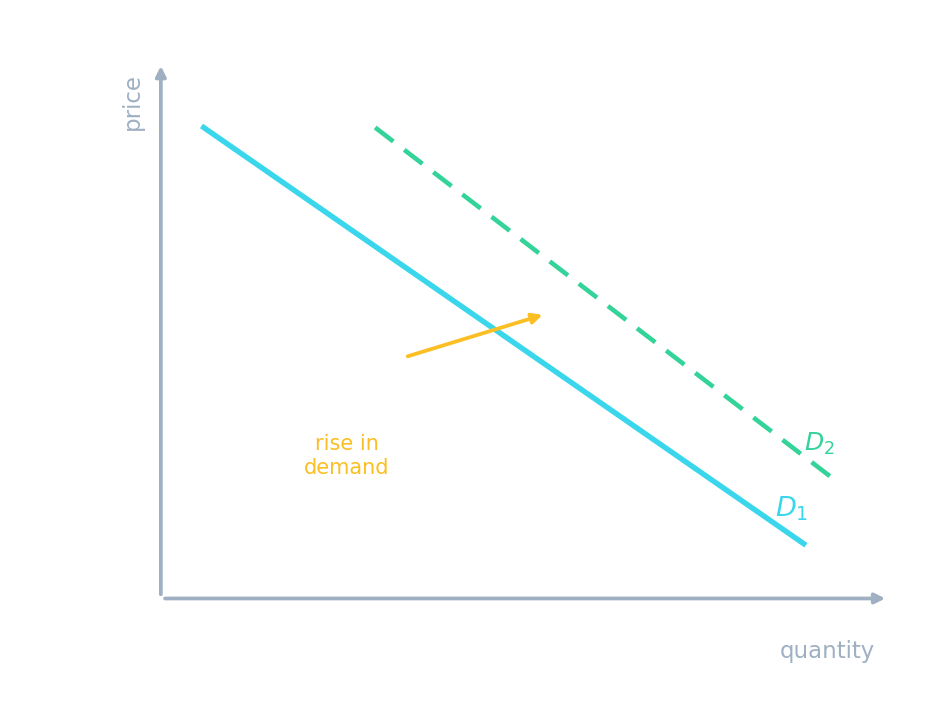
- When the price of tea jumps, something happens to coffee — its demand rises.
- When incomes rise, people buy more of some goods and less of others.
- Demand does not only react to a good's own price.
- Two more elasticities capture these other reactions.
Cross-price elasticity (XED)
- Cross-price elasticity of demand 交叉价格弹性 measures how demand for good X reacts to the price of good Y.
- Formula: $\text{XED} = \dfrac{\%\,\Delta\,Q_X}{\%\,\Delta\,P_Y}$.
- Positive XED → the goods are substitutes 替代品 (tea dearer → more coffee bought).
- Negative XED → the goods are complements 互补品 (printers dearer → less ink bought).
Two goods have a positive cross-price elasticity. They are:
Positive XED: a dearer Y sends buyers to X — the goods substitute for each other.
Printers and ink are complements, so their cross-price elasticity is negative.
A dearer printer lowers ink demand — a negative XED marks complements.
Income elasticity (YED)
- Income elasticity of demand 收入弹性 measures how demand reacts to a change in income.
- Formula: $\text{YED} = \dfrac{\%\,\Delta\,Q}{\%\,\Delta\,\text{income}}$.
- Positive YED → a normal good 正常商品 (buy more as income rises).
- Negative YED → an inferior good 低档商品 (buy less as income rises).
Read the sign
The sign of cross-price elasticity tells you substitutes (+) from complements (−); the sign of income elasticity tells you normal (+) from inferior (−) goods.
A good with a positive income elasticity of demand is a:
Positive YED: buyers want more as income rises — a normal good.
A good you buy less of as your income rises is called an ______ good.
An inferior good has a negative income elasticity of demand.
Read the sign, not just the size
- Worked idea. Income rises 10% and quantity of bus tickets demanded falls 5%.
- Then $\text{YED} = \dfrac{-5\%}{10\%} = -0.5$.
- The sign is negative, so bus travel is an inferior good here — richer people switch to taxis or cars.
- With these elasticities, the sign classifies the relationship; the size shows how strong it is.
Income rises 10% and quantity of bus tickets demanded falls 5%. What is the income elasticity of demand (keep the sign)?
$\text{YED} = -5\% \div 10\% = -0.5$; the negative sign means bus travel is an inferior good here.
Match each elasticity sign to what it tells you.
The sign does the classifying: substitutes/complements for XED, normal/inferior for YED.
XED = %ΔQ of X ÷ %ΔP of Y: positive → substitutes, negative → complements. YED = %ΔQ ÷ %Δincome: positive → normal good, negative → inferior good. Always read the sign first.