| English | 의미 |
|---|---|
| resistance/rɪˈzɪstəns/ | 저항 |
| Ohm's law/əʊmz lɔː/ | 옴의 법칙 |
| conductor/kənˈdʌktə/ | 도체 |
| filament lamp/ˈfɪləmənt læmp/ | 필라멘트 램프 |
| diode/ˈdaɪəʊd/ | 다이오드 |
| semiconductor/ˌsemɪkənˈdʌktə/ | 반도체 |
| lattice/ˈlætɪs/ | 격자 |
| resistivity/ˌriːzɪˈstɪvəti/ | 저항율 |
| thermistor/ˈθɜːmɪstə/ | 서미스터 |
Why the kettle element glows
- A kettle's element gets red-hot, but the cable feeding it stays cool.
- The element has a high resistance 电阻 — it turns electrical energy into heat.
- Resistance controls where the energy goes.
Resistance
- Resistance $R = \dfrac{V}{I}$, in ohms ($\Omega$): the p.d. across a component divided by the current in it.
- That is the definition, and it applies to every component. It depends on the conditions — especially the temperature.

Real fixed resistors: the coloured bands code the resistance value
저항(옴의 법칙)
V = R·I
옴의 법칙: 전압은 전류에 비례함 — 기울기가 저항 R임.
소자에 $12\ \text{V}$의 전위차가 걸리고, $3.0\ \text{A}$의 전류가 흐른다. 이 소자의 저항은?
난이도 2/5 · 140 코인 + 오늘 첫 완료 시 소액 보너스
$R = \dfrac{V}{I} = \dfrac{12}{3.0} = 4.0\ \Omega$.
Ohm's law 欧姆定律
- A conductor 导体 obeys Ohm's law when $I \propto V$ (at constant temperature) — so $R$ is constant.
- This is an experimental result, not the definition. $R = \dfrac{V}{I}$ works for any component.
일정한 온도의 옴 도체에서:
난이도 1/5 · 100 코인 + 오늘 첫 완료 시 소액 보너스
의 법칙: $I \propto V$이므로, $R = \dfrac{V}{I}$은 일정하고 $I$–$V$ 그래프는 원점을 지나는 직선이다.
I–V characteristics
- Metal wire (constant temp): straight line — constant $R$.
- Filament lamp 灯丝灯泡: curves over — heating raises $R$.
- Diode 二极管: passes current one way only (above ~0.7 V).

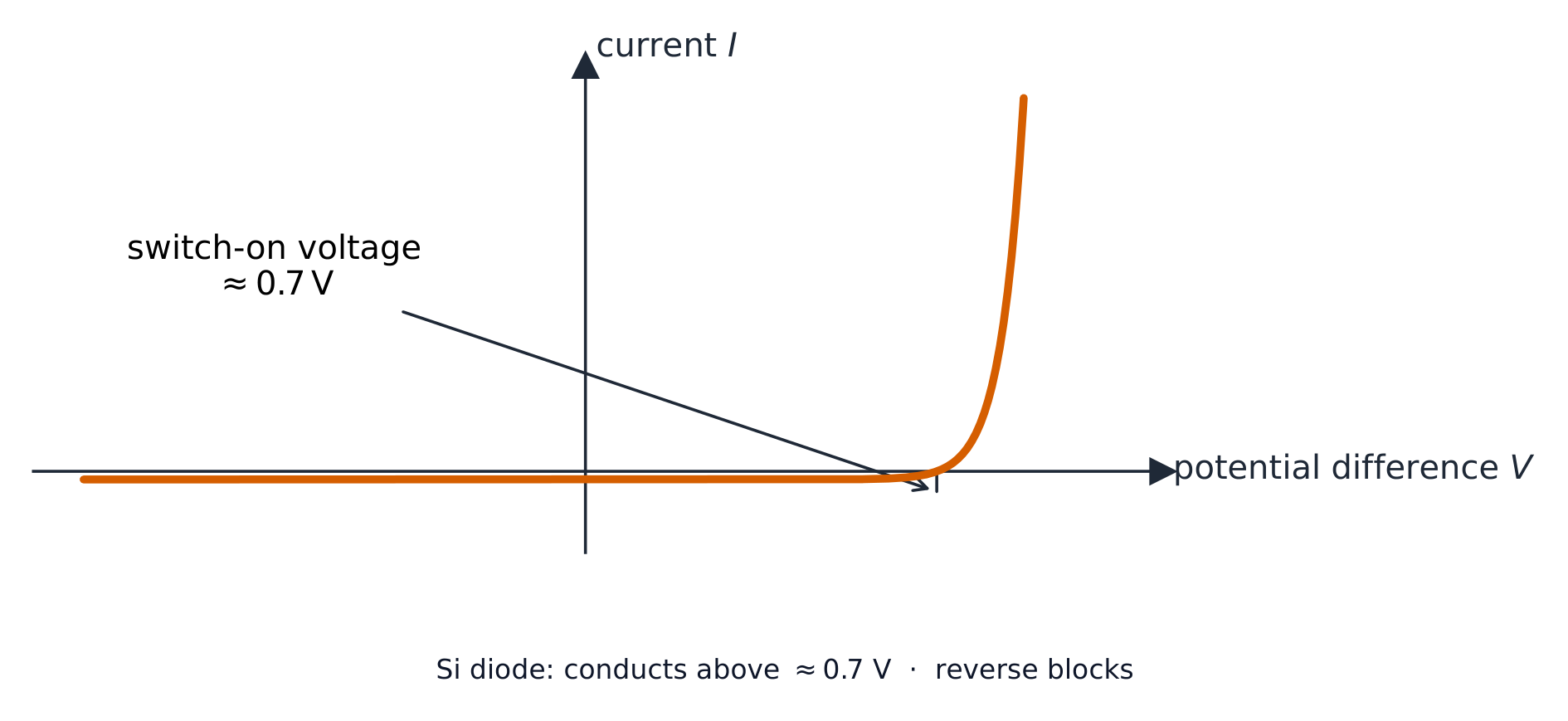
I-V characteristic of a semiconductor 半导体 diode
각 소자를 그 $I$–$V$ 특성 곡선과 매칭하시오.
난이도 2/5 · 140 코인 + 오늘 첫 완료 시 소액 보너스
상수 $R$ → 직선; 가열로 인해 $R$ 상승 → 곡선 평탄화; 다이오드는 역방향 전류를 차단함.
필라멘트 램프의 저항이 높은 전압에서 상승하는 이유는:
난이도 1/5 · 100 코인 + 오늘 첫 완료 시 소액 보너스
더 많은 전류가 필라멘트를 가열합니다. 금속에서는 격자 진동이 커지면 전자가 산란되어 $R$가 증가합니다.
Why the lamp's resistance rises
- The exam chain: a larger current → more heating → higher temperature → the metal ions in the lattice 晶格 vibrate more → the free electrons collide more often → resistance increases.
- Read $R$ off an $I$–$V$ graph as $\dfrac{V}{I}$ at that point — not as the gradient. Only for a straight line through the origin are the two the same.
필라멘트 램프의 저항이 전류에 따라 상승하는 이유에 대한 설명의 단계를 순서대로 배치하십시오.
난이도 3/5 · 200 코인 + 오늘 첫 완료 시 소액 보너스
가열 → 격자 진동 증가 → 충돌 빈도 증가 → 저항 증가. 각 연결부는 시험 설명에서 한 점의 가치임.
Resistivity 电阻率
- $R = \dfrac{\rho L}{A}$ — $\rho$ is the resistivity, a property of the material ($\Omega\cdot\text{m}$).
- Longer wire → more $R$; thicker wire → less $R$.
- To measure it: ammeter in series with the wire, voltmeter across it, a variable supply (or variable resistor) to take several readings; $R$ is the gradient of $V$ against $I$; measure $L$ with a rule and the diameter with a micrometer at several places.

A longer conductor has more resistance
저항에 영향을 미치는 요인: R = ρL/A
더 긴 전선은 저항이 크고, 더 굵은 전선(넓은 단면적)은 저항이 작음. 길이, 단면적, 금속 재질을 변경할 수 있음.
한 선의电阻率은 $2.0 \times 10^{-8}\ \Omega\cdot\text{m}$, 길이는 $10\ \text{m}$, 단면적은 $2.0 \times 10^{-6}\ \text{m}^2$입니다. 이 선의 저항을 구하세요.
난이도 2/5 · 140 코인 + 오늘 첫 완료 시 소액 보너스
$R = \dfrac{\rho L}{A} = \dfrac{2.0 \times 10^{-8} \times 10}{2.0 \times 10^{-6}} = 0.10\ \Omega$.
선의 길이를 두 배로 하면(동일한 재질과 단면적), 저항도 두 배가 됩니다.
난이도 1/5 · 100 코인 + 오늘 첫 완료 시 소액 보너스
$R = \dfrac{\rho L}{A}$이므로, $R \propto L$ — 길이 두 배, 저항 두 배.
Worked example: resistivity with its uncertainty
A nichrome wire of length $1.20\ \text{m}$ ($\pm 0.5\%$) and diameter $0.40\ \text{mm}$ ($\pm 2.5\%$) has $3.00\ \text{V}$ ($\pm 1\%$) across it when the current is $0.600\ \text{A}$ ($\pm 1\%$). Find the resistivity and its uncertainty.
- Resistance: $R = \dfrac{V}{I} = \dfrac{3.00}{0.600} = 5.00\ \Omega$.
- Area: $A = \dfrac{\pi d^{2}}{4} = \dfrac{\pi (0.40 \times 10^{-3})^{2}}{4} = 1.26 \times 10^{-7}\ \text{m}^{2}$.
- Resistivity: $\rho = \dfrac{RA}{L} = \dfrac{5.00 \times 1.26 \times 10^{-7}}{1.20} = 5.24 \times 10^{-7}\ \Omega\,\text{m}$.
- Percentage uncertainty: add them, counting the diameter twice because it is squared: $1 + 1 + 2(2.5) + 0.5 = 7.5\%$.
- Absolute uncertainty: $0.075 \times 5.24 \times 10^{-7} = 0.4 \times 10^{-7}$, so $\rho = (5.2 \pm 0.4) \times 10^{-7}\ \Omega\,\text{m}$.
- Check: the diameter dominates the uncertainty — which is why it is measured with a micrometer, several times, and averaged.
电阻率 측정 시 백분율 불확도는 다음과 같습니다: $V$ 2%, $I$ 1%, 직경 3%, 길이 1%. $\rho = \dfrac{RA}{L}$의 백분율 불확도는?
난이도 2/5 · 140 코인 + 오늘 첫 완료 시 소액 보너스
$\rho \propto \dfrac{V d^{2}}{I L}$이므로, $2 + 1 + 2(3) + 1 = 10\%$를 더합니다. 직경은 제곱되므로 두 번 반영됩니다.
$R = \dfrac{V}{I}$ is the definition and works for everything; Ohm's law is the special case where it stays constant. Resistance is not the gradient of an $I$–$V$ curve. The diameter is squared in $A = \dfrac{\pi d^{2}}{4}$, so its percentage uncertainty counts twice — and use the diameter in metres.
Light and heat sensors
- An LDR's resistance falls as light gets brighter (megaohms in the dark, hundreds of ohms in light).
- A thermistor 热敏电阻 (NTC)'s resistance falls as it gets hotter — both are semiconductors.
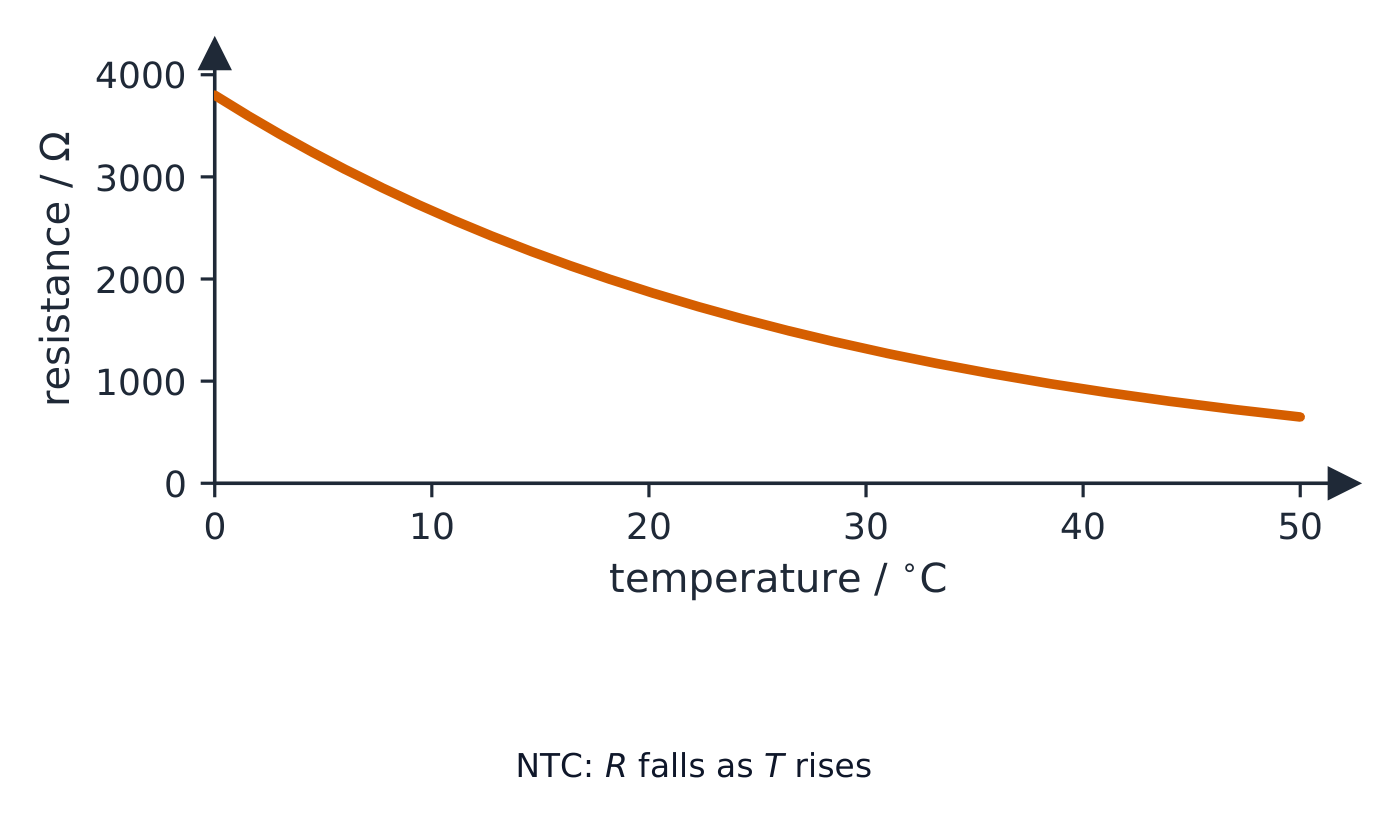
A thermistor's resistance drops sharply as it gets hotter — the basis of a temperature sensor
모든 참인 문장을 선택하십시오.
난이도 2/5 · 140 코인 + 오늘 첫 완료 시 소액 보너스
LDR 및 NTC 서미스터(반도체)는 빛/열이 많아지면 저항이 감소합니다. 금속은 그 반대입니다 — 온도가 오르면 저항이 증가합니다.
You've got it
- resistance $R = \dfrac{V}{I}$ (the definition, at a point — never a gradient); Ohm's law: $I \propto V$ at constant temperature
- filament lamp curves because heating makes the lattice vibrate more and electrons collide more; a diode is one-way
- resistivity $R = \dfrac{\rho L}{A}$, with the diameter's uncertainty counted twice; LDR ↓ with light, thermistor ↓ with heat