| English | 의미 |
|---|---|
| medium/ˈmiːdɪəm/ | 매질 |
| oscillate/ˈɒsɪleɪt/ | 진동 |
| progressive wave/prəˈɡresɪv weɪv/ | 진행파 |
| amplitude/ˈæmplɪtjuːd/ | 진폭 |
| wavelength/ˈweɪvleŋθ/ | 파장 |
| period/ˈpɪərɪəd/ | 주기 |
| frequency/ˈfriːkwənsi/ | 주파수 |
| phase difference/feɪz ˈdɪfrəns/ | 위상차 |
| in phase/ɪn feɪz/ | 동위 |
| out of phase/ˈaʊtəv feɪz/ | 반위 |
| time-base/taɪm beɪs/ | 시간 기준 |
| intensity/ɪnˈtensɪti/ | 강도 |
The stadium wave
- 스타디움의 '웨이브'에서는 사람들이 일어나 앉지만, 아무도 스타디움을 돌아다니지 않습니다.
- The wave travels; the people stay put.
- 파동은 물질 전체를 이동시키지 않으면서 에너지를 한 곳에서 다른 곳으로 전달합니다.
What a wave is
- 매질의 입자들은 고정된 평형 위치 주위로 진동합니다.
- 진동과 그 에너지만 이동합니다. 이를 전파라고 합니다.

디지털 오실로스코프가 시간에 따른 전압 신호를 그림
Progressive waves
y = a sin(bx + c)
A wave: a is amplitude, b sets the wavelength, c the phase.
A progressive wave carries energy without moving matter along overall.
난이도 1/5 · 100 코인 + 오늘 첫 완료 시 소액 보너스
Yes — the particles only oscillate about fixed points; the disturbance and its energy are what travel.
The key words
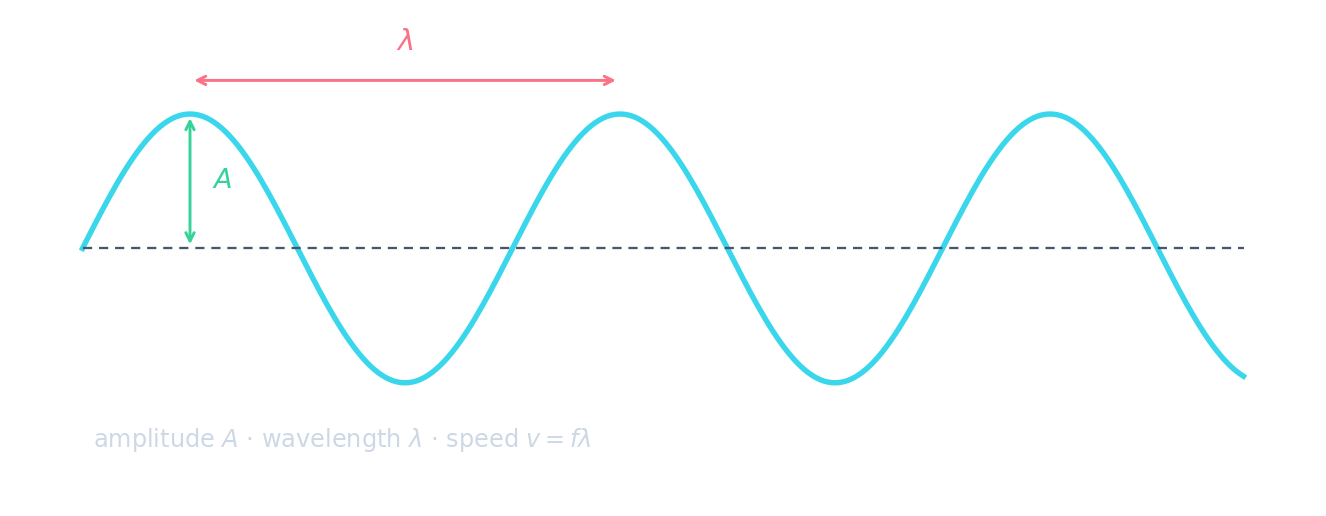
- 진폭 $A$ — 평형 위치로부터의 최대 변위; 파장 $\lambda$ — 반복되는 거리의 길이.
- 주기(period) $T$ — 한 주기당 걸리는 시간; 주파수(frequency) $f = \dfrac{1}{T}$ (단위: Hz).
A wave has a period of $0.020\ \text{s}$. What is its frequency?
난이도 2/5 · 140 코인 + 오늘 첫 완료 시 소액 보너스
$f = \dfrac{1}{T} = \dfrac{1}{0.020} = 50\ \text{Hz}$.
Two graphs that look the same
- 변위-거리 그래프는 특정 시간의 일 snapshot(일부)입니다. 반복 거리는 파장입니다.
- 변위-시간 그래프는 한 지점을 추적합니다. 반복 시간은 주기입니다.
- 같은 모양이지만 축이 다릅니다. 값을 읽기 전에 축 레이블을 먼저 확인하십시오.

변위-거리 그래프가 파동의 진폭과 파장을 보여줍니다; 축을 시간에 바꾼다면 동일한 모양은 주기를 나타냅니다
A graph of displacement against time for one point on a wave repeats every $4.0\ \text{ms}$. What does that $4.0\ \text{ms}$ tell you?
난이도 1/5 · 100 코인 + 오늘 첫 완료 시 소액 보너스
A time axis gives the period. $f = \dfrac{1}{T} = \dfrac{1}{4.0 \times 10^{-3}} = 250\ \text{Hz}$. The wavelength needs a distance axis.
Phase difference
- 한 파장 간격에 있는 점들은 함께 움직입니다 — 이들은 동위입니다.
- 반 파장 간격에 있는 점들은 정확히 반위입니다.
- 일반적으로, 분리 거리 $\Delta x$는 위상 차이 $\dfrac{\Delta x}{\lambda} \times 360^\circ$ (또는 $\times 2\pi$ rad)을 줍니다.

물결은 에너지를 바깥쪽으로 전달하는 전파입니다
Two points exactly one wavelength apart on a wave are:
난이도 1/5 · 100 코인 + 오늘 첫 완료 시 소액 보너스
One whole wavelength is one full cycle ($2\pi$), so the two points move together — in phase.
Match each separation along a wave to the phase difference between the two points.
난이도 2/5 · 140 코인 + 오늘 첫 완료 시 소액 보너스
Phase difference $= \dfrac{\Delta x}{\lambda} \times 360^\circ$, so each fraction of a wavelength is the same fraction of a full cycle.
파동 방정식
- 속도는 거리除以时间(거리를 시간으로 나눈 값)입니다. 한 주기 $T$ 동안 파동은 한 파장 $\lambda$만큼 진행하므로 $v = \dfrac{\lambda}{T}$입니다.
- $f = \dfrac{1}{T}$이므로, 이는 $v = f\lambda$이며 — 모든 전파에 적용됩니다.
A wave has frequency $50\ \text{Hz}$ and wavelength $4.0\ \text{m}$. What is its speed?
난이도 2/5 · 140 코인 + 오늘 첫 완료 시 소액 보너스
$v = f\lambda = 50 \times 4.0 = 200\ \dfrac{\text{m}}{\text{s}}$.
Worked example: reading an oscilloscope
마이크가 오실로스코프로 연결되었습니다. 시간 기저가 $0.20\ \dfrac{\text{ms}}{\text{div}}$로 설정되었고, $2.5$개의 완전한 사이클이 $10$개의 칸을 차지합니다. 소리의 파장은 $0.27\ \text{m}$로 측정되었습니다. 주파수와 소리 속도를 구하십시오.
- Time across the screen: $10 \times 0.20 = 2.0\ \text{ms}$.
- Period: $T = \dfrac{2.0\ \text{ms}}{2.5} = 0.80\ \text{ms} = 8.0 \times 10^{-4}\ \text{s}$.
- Frequency: $f = \dfrac{1}{T} = 1250\ \text{Hz}$.
- Speed: $v = f\lambda = 1250 \times 0.27 = 340\ \dfrac{\text{m}}{\text{s}}$.
- 검산: 공기 중의 음속은 약 $340\ \dfrac{\text{m}}{\text{s}}$이므로, 읽음값은 타당합니다. $2.5$개 사이클로 나누는 것을 잊으면 $500\ \text{Hz}$이 되어 음속이 $135\ \dfrac{\text{m}}{\text{s}}$이 되는데 — 이는 소리에 불가능합니다.
An oscilloscope time-base is $0.50\ \dfrac{\text{ms}}{\text{div}}$ and 4 complete cycles fill 8 divisions. What is the frequency of the signal, in Hz?
난이도 2/5 · 140 코인 + 오늘 첫 완료 시 소액 보너스
Screen time $= 8 \times 0.50 = 4.0\ \text{ms}$; one cycle takes $\dfrac{4.0}{4} = 1.0\ \text{ms}$, so $f = \dfrac{1}{1.0 \times 10^{-3}} = 1000\ \text{Hz}$.
주파수는 진원에 의해 고정됩니다. 파동이 다른 매질로 진입할 때, $f$은 그대로 유지되고 $v$과 $\lambda$는 함께 변합니다. 그리고 변위-시간 그래프는 주기를 보여주지, 파장을 보여주지 않습니다.
When a wave passes from air into water, its speed and wavelength change but its ____ stays the same.
난이도 1/5 · 100 코인 + 오늘 첫 완료 시 소액 보너스
The frequency is set by the source and cannot change at a boundary; $v = f\lambda$ then forces $\lambda$ to change with $v$.
Intensity
- Intensity is the power per unit area: $I = \dfrac{P}{A}$ (in $\dfrac{\text{W}}{\text{m}^2}$).
- It grows with the square of the amplitude: $I \propto A^{2}$.
If the amplitude of a wave doubles, its intensity becomes:
난이도 1/5 · 100 코인 + 오늘 첫 완료 시 소액 보너스
$I \propto A^{2}$, so doubling $A$ multiplies the intensity by $2^{2} = 4$.
Spreading from a point
- 점원(point source)은 구면 위에 에너지를 퍼뜨립니다: $I = \dfrac{P}{4\pi r^{2}}$, 따라서 $I \propto \dfrac{1}{r^{2}}$입니다.
- Double the distance → a quarter of the intensity.
A point source gives an intensity of $100\ \dfrac{\text{W}}{\text{m}^2}$ at distance $r$. What is the intensity at $2r$?
난이도 2/5 · 140 코인 + 오늘 첫 완료 시 소액 보너스
$I \propto \dfrac{1}{r^{2}}$, so at twice the distance the intensity is $\dfrac{100}{2^{2}} = 25\ \dfrac{\text{W}}{\text{m}^2}$.
Worked example: amplitude and distance
A small loudspeaker radiates $20\ \text{W}$ equally in all directions. Find the intensity $2.0\ \text{m}$ away, and say how the amplitude of the sound there compares with the amplitude at $4.0\ \text{m}$.
- Intensity at $2.0\ \text{m}$: $I = \dfrac{P}{4\pi r^{2}} = \dfrac{20}{4\pi \times 2.0^{2}} = 0.40\ \dfrac{\text{W}}{\text{m}^2}$.
- At $4.0\ \text{m}$ the distance has doubled, so the intensity is a quarter: $0.10\ \dfrac{\text{W}}{\text{m}^2}$.
- Amplitude: $I \propto A^{2}$, so a quarter of the intensity means half the amplitude.
- 검산: 강도가 $\dfrac{1}{r^{2}}$에 비례하여 감소하지만 진폭은 오직 $\dfrac{1}{r}$에 비례하여 감소합니다—강도 비율의 제곱근입니다.
이해했습니다
- 파동은 에너지를 전달하지 물질은 아닙니다; $f = \dfrac{1}{T}$; 주파수는 진동원에 의해 결정됩니다.
- the wave equation: $v = f\lambda$ (one wavelength per period)
- 위상차 $= \dfrac{\Delta x}{\lambda} \times 360^\circ$; 강도 $I = \dfrac{P}{A}$, $I \propto A^{2}$와 $I \propto \dfrac{1}{r^{2}}$은 점진원(point source)에서 유래함