| English | 의미 |
|---|---|
| sample/ˈsæmpl/ | 표본 |
| population/ˌpɒpjʊˈleɪʃn/ | 모집단 |
| stratified/ˈstrætɪfaɪd/ | 층화 |
| systematic/ˌsɪstəˈmætɪk/ | 계통 |
| cluster/ˈklʌstə/ | 군집 |
| sampling distribution/ˈsæmplɪŋ ˌdɪstrɪˈbjuːʃn/ | 표본분포 |
| standard error/ˈstændəd ˈerə/ | 표준오차 |
| Central Limit Theorem/ˈsentrəl ˈlɪmɪt ˈθɪərəm/ | 중심극한정리 |
| confidence interval/ˈkɒnfɪdəns ˈɪntəvl/ | 신뢰구간 |
The poll that predicted the election
- A survey of 1000 people can predict the voting behaviour of 60 million. How?
- Sampling 样本 lets you draw conclusions about a whole population 总体 from a small, carefully chosen subset. The mathematics behind it is the foundation of all statistical inference.
Populations and samples
- A population is the entire group you want to study. A sample is a small group from the population.
- Good sampling needs randomness — every member must have a known chance of being selected.
- Sampling methods: simple random, stratified 分层 (proportional from each subgroup), systematic 系统 (every $k$th member), cluster 整群.
Stratified sampling. A school has 600 boys and 400 girls. A stratified sample of 50: $\dfrac{600}{1000} \times 50 = 30$ boys and $\dfrac{400}{1000} \times 50 = 20$ girls.
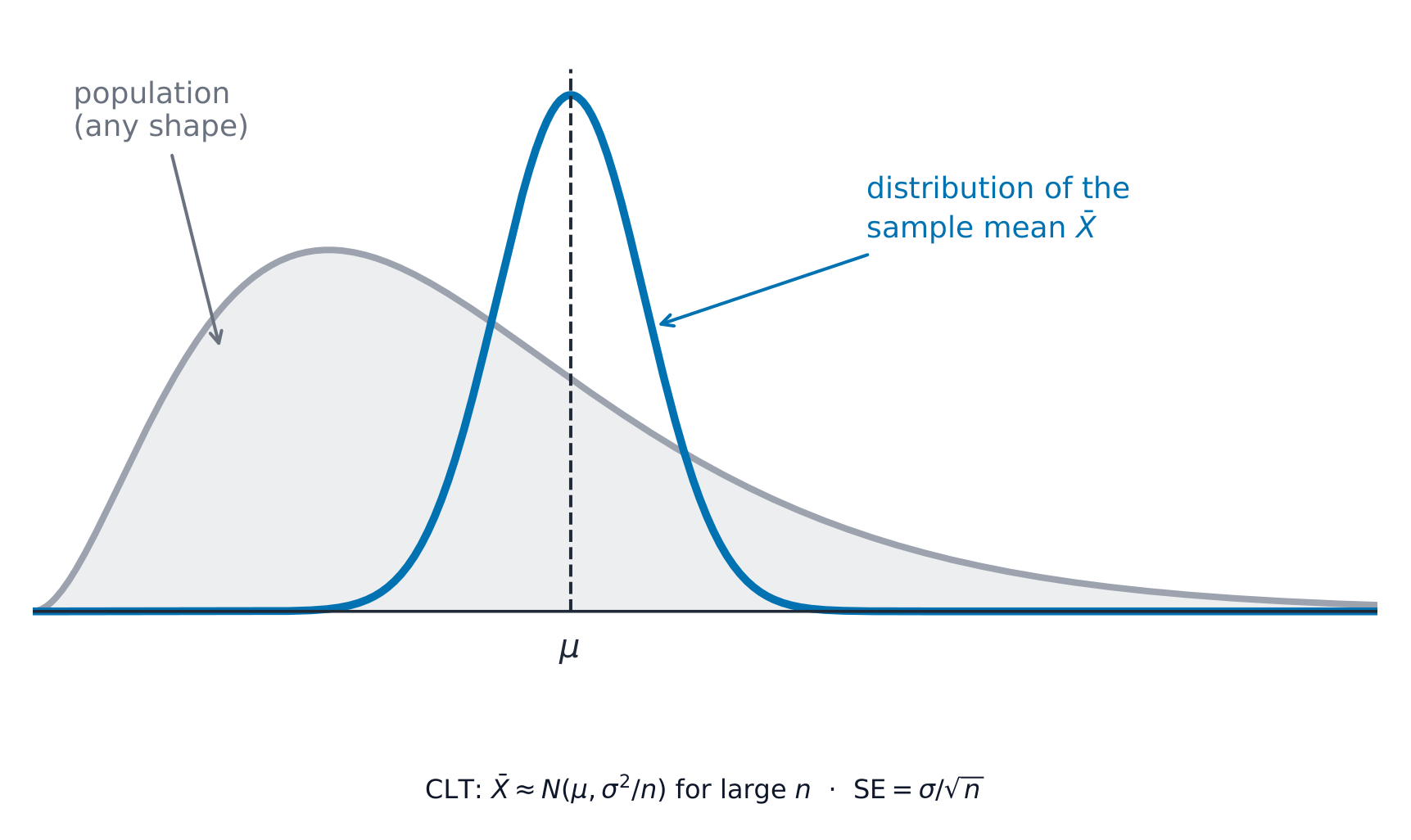
The sample mean is nearly normal whatever the population shape
The sampling distribution
X̄ ~ N(μ, σ²/n)
By the Central Limit Theorem, sample means follow a normal curve — narrower for bigger samples.
A school has 600 boys and 400 girls. A stratified sample of 50 needs how many boys?
난이도 2/5 · 140 코인 + 오늘 첫 완료 시 소액 보너스
(600/1000) × 50 = 30 boys.
The sampling distribution 抽样分布 of the mean
- The sample mean $\bar{X}$ is itself a random variable:
- The standard error 标准误 of the mean is $\dfrac{\sigma}{\sqrt{n}}$ — it shrinks as $n$ grows.

Statistics studies a sample to learn about a whole population
A population has σ = 8. For a sample of n = 64, what is Var(X̄) = σ²/n?
난이도 2/5 · 140 코인 + 오늘 첫 완료 시 소액 보너스
Var(X̄) = σ²/n = 64/64 = 1.
A population has σ = 10 and n = 25. The standard error σ/√n = ?
난이도 2/5 · 140 코인 + 오늘 첫 완료 시 소액 보너스
σ/√n = 10/√25 = 10/5 = 2.
Match each sampling idea to its meaning.
난이도 2/5 · 140 코인 + 오늘 첫 완료 시 소액 보너스
The CLT makes sample means normal; their spread is σ²/n, giving the confidence interval.
The Central Limit Theorem 中心极限定理
- By the Central Limit Theorem, for a large sample ($n \geq 30$), $\bar{X}$ is approximately normal, whatever the population's shape.
- This is one of the most powerful results in all of mathematics — it lets us use the normal distribution even when the data isn't normal.
CLT applies to the mean, not the data. The Central Limit Theorem says the distribution of $\bar{X}$ becomes normal — not the individual data points. The raw data can have any shape.

A 95% confidence interval 置信区间 reaches 1.96 standard errors each side of the sample mean
By the Central Limit Theorem, the sample mean is approximately normal for a large sample, whatever the population shape.
난이도 1/5 · 100 코인 + 오늘 첫 완료 시 소액 보너스
The CLT makes X̄ approximately normal as the sample size grows.
The Central Limit Theorem says the individual data points become normally distributed for large samples.
난이도 1/5 · 100 코인 + 오늘 첫 완료 시 소액 보너스
The CLT applies to the sample mean X̄, not the individual data points. The raw data can have any shape.
Confidence intervals
- A confidence interval gives a range that probably contains the true mean.
- For a normal population with known $\sigma$ (or a large sample), a 95% interval is:
- From a random sample find unbiased estimates of the mean and variance ('unbiased' = correct on average), and a confidence interval for a population proportion; random numbers help choose the sample.
A sample of n = 64 has σ = 8. What is the margin 1.96 × σ/√n for a 95% interval? (2 dp)
난이도 2/5 · 140 코인 + 오늘 첫 완료 시 소액 보너스
1.96 × 8/√64 = 1.96 × 8/8 = 1.96.
You've got it
- $E(\bar{X}) = \mu$, $\text{Var}(\bar{X}) = \dfrac{\sigma^2}{n}$; CLT makes $\bar X$ ≈ normal for large $n$
- a 95% confidence interval: $\bar{x} \pm 1.96\dfrac{\sigma}{\sqrt{n}}$
- good sampling needs randomness