| English | 의미 |
|---|---|
| function/ˈfʌŋkʃn/ | 함수 |
| domain/dəˈmeɪn/ | 정의역 |
| range/reɪndʒ/ | 값의 범위 |
| composition/ˌkɒmpəˈzɪʃn/ | 합성함수 |
| inverse/ɪnˈvɜːs/ | 역함수 |
| one-one/wʌn wʌn/ | 일대일 대응 |
The vending machine test
- A vending machine takes one code and gives exactly one snack. If code A7 sometimes gives crisps and sometimes chocolate, it's broken.
- A function 函数 works the same way: each input maps to exactly one output. This simple rule underpins all of calculus.
Functions, domain 定义域 and range 值域
- A function $f(x)$ sends each input to exactly one output.
- The domain = allowed inputs; the range = the outputs produced.
- Example: $f(x) = \sqrt{x}$ has domain $x \geq 0$ and range $f(x) \geq 0$.
Domain restrictions. $g(x) = \dfrac{1}{x-3}$ has domain $x \neq 3$ (division by zero is undefined). The range is all real numbers except $0$.
함수 탐색하기
y = ax³ + bx² + cx + d
함수는 각 입력을 정확히 하나의 출력로 변환합니다 — 계수를 드래그하여 곡선이 오르내림하는 지점을 관찰하세요.
f(x) = √(x − 4)의 정의역은:
난이도 1/5 · 100 코인 + 오늘 첫 완료 시 소액 보너스
제곱근 안의 식은 음수가 아니어야 합니다: x − 4 ≥ 0, 즉 x ≥ 4입니다.
Composition 复合 and inverses 反函数
- A function is one-one 一一对应 if different inputs always give different outputs — only then does it have an inverse $f^{-1}$.
- Composition $fg(x) = f(g(x))$ — do $g$ first, then $f$.
f(x) = x²이고 g(x) = x + 1일 때, fg(2) = f(g(2))는 얼마입니까?
난이도 2/5 · 140 코인 + 오늘 첫 완료 시 소액 보너스
g(2) = 3, then f(3) = 3² = 9입니다.
일대일 함수만이 역함수를 가집니다.
난이도 1/5 · 100 코인 + 오늘 첫 완료 시 소액 보너스
두 입력이 동일한 출력을 내면 역 규칙이 모호해지므로, 일대일 함수만 역함수가 가능합니다.
Finding an inverse
- To find $f^{-1}$: write $y = f(x)$, make $x$ the subject, then swap letters.
- Example: $f(x) = 2x + 6$ → $x = \dfrac{y-6}{2}$ → $f^{-1}(x) = \dfrac{x-6}{2}$.
- The graph of $y = f^{-1}(x)$ is the reflection of $y = f(x)$ in the line $y = x$.
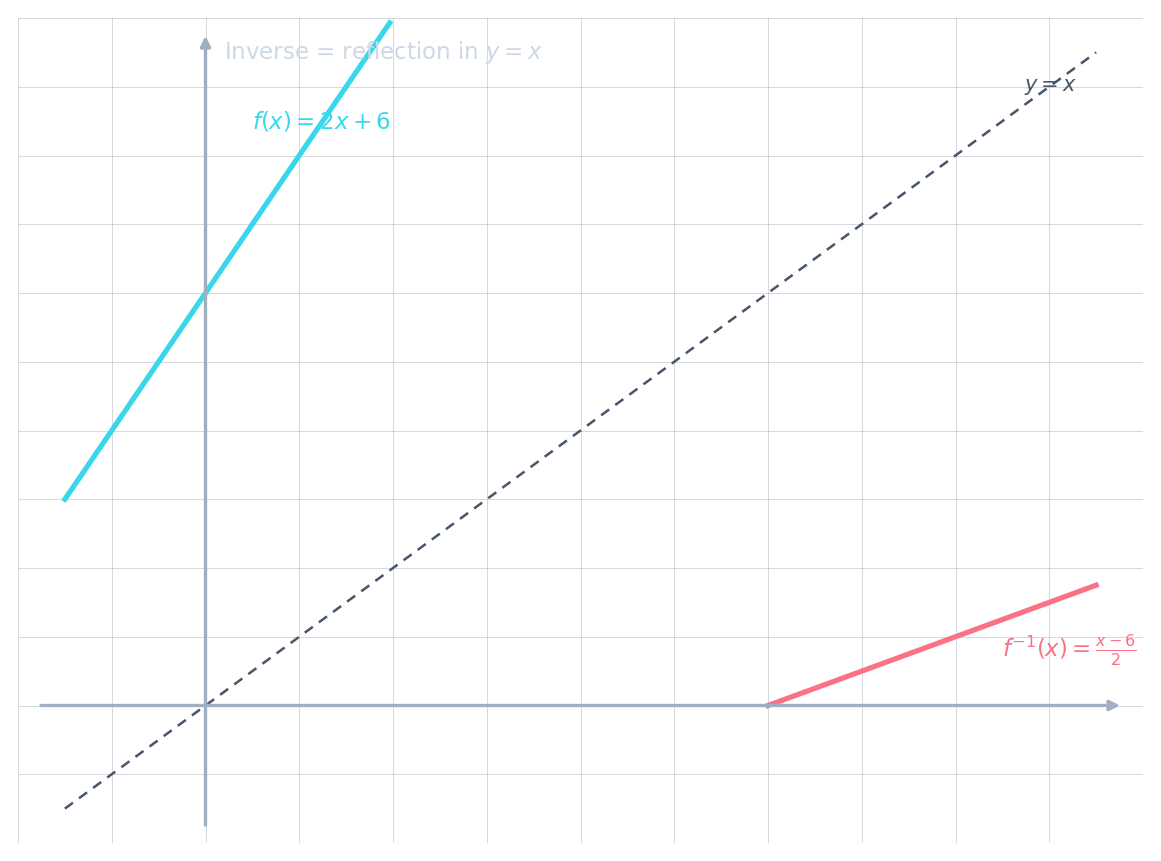
Inverse functions are reflections in $y = x$: the point $(a, b)$ on $f$ becomes $(b, a)$ on $f^{-1}$.
Not all functions have inverses. $f(x) = x^2$ is not one-one (both $2$ and $-2$ give $4$), so it has no inverse unless you restrict the domain to $x \geq 0$.
f(x) = 2x + 6에 대한 역함수는 f⁻¹(x) = (x − 6)/2입니다. f⁻¹(10)은 얼마입니까?
난이도 2/5 · 140 코인 + 오늘 첫 완료 시 소액 보너스
f⁻¹(10) = (10 − 6)/2 = 4/2 = 2.
y = f⁻¹(x)의 그래프는 y = f(x)의 그래프를 다음 직선에 대해 대칭移动한 것입니다:
난이도 1/5 · 100 코인 + 오늘 첫 완료 시 소액 보너스
역함수는 원래 그래프를 직선 y = x에 대해 대칭移动합니다; 점 (a, b)는 (b, a)로 바뀝니다.
Properties of inverses
- $f(f^{-1}(x)) = x$ and $f^{-1}(f(x)) = x$ — they undo each other.
- The domain of $f^{-1}$ is the range of $f$, and vice versa.
- Graphically: swap the axes.
- Know the composition of functions $fg(x)$ and graph transformations — a translation, a stretch, and reflections.

Adding to the output or input slides the curve; a multiplier stretches it
역함수가 있는 모든 함수 f에 대해 f(f⁻¹(x)) = x입니다.
난이도 1/5 · 100 코인 + 오늘 첫 완료 시 소액 보너스
함수를 적용한 후 역함수를 적용하면 원래 입력으로 돌아갑니다 — 서로 상쇄합니다.
You've got it
- function: each input → exactly one output; domain = inputs, range = outputs
- one-one functions have inverses; find $f^{-1}$ by swapping and solving
- composition $fg(x) = f(g(x))$ — do $g$ first, then $f$
- the graph of $f^{-1}$ is the reflection of $f$ in $y = x$