| English | 의미 |
|---|---|
| quadratic/kwɒˈdrætɪk/ | 이차 |
| root/ruːt/ | 근 |
| coefficient/ˌkəʊɪˈfɪʃənt/ | 계수 |
| cubic/ˈkjuːbɪk/ | 삼차 |
| substitution/ˌsʌbstɪˈtjuːʃn/ | 대입 |
The secret hidden in every equation
- Every quadratic 二次 equation hides two numbers — its roots 根. You can find their sum and product without solving the equation at all.
- These relationships between roots and coefficients 系数 unlock problems that would otherwise require messy algebra.
Roots of a quadratic
- For $ax^2 + bx + c = 0$ with roots $\alpha, \beta$:
Worked example. $2x^2 - 7x + 3 = 0$. Sum of roots $= \dfrac{7}{2}$, product $= \dfrac{3}{2}$. Check: roots are $3$ and $\dfrac{1}{2}$: sum $= 3.5$ ✓, product $= 1.5$ ✓.
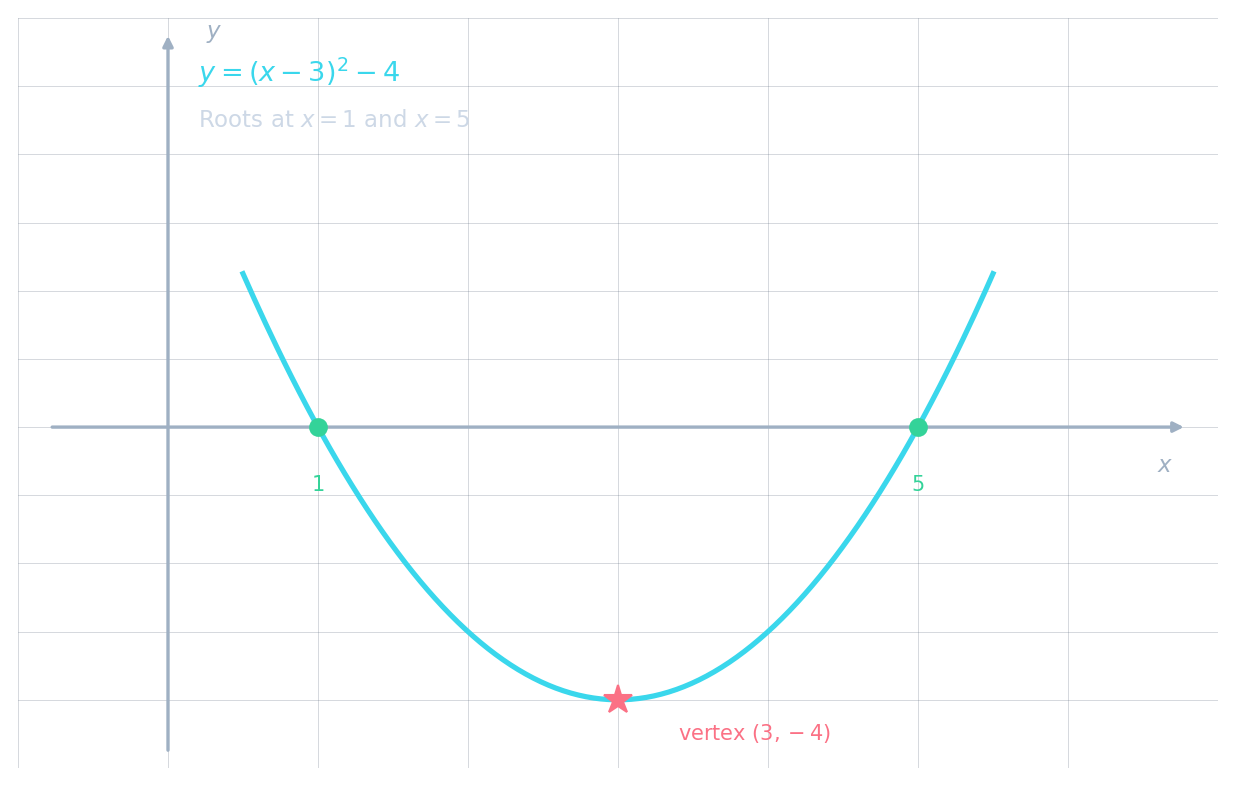
The roots of a quadratic and how they relate to its coefficients
다항식의 근
y = ax³ + bx² + cx + d
근은 곡선이 x축과 만나는 지점이며, 그 합과 곱은 계수와 관련됩니다.
x² − 5x + 6 = 0일 때, 근의 합 α + β = −b/a는?
난이도 2/5 · 140 코인 + 오늘 첫 완료 시 소액 보너스
α + β = −b/a = −(−5)/1 = 5.
x² − 5x + 6 = 0일 때, 근의 곱 αβ = c/a는?
난이도 2/5 · 140 코인 + 오늘 첫 완료 시 소액 보너스
αβ = c/a = 6/1 = 6.
Roots of a cubic 三次
- For a cubic $ax^3 + bx^2 + cx + d = 0$ with roots $\alpha, \beta, \gamma$:
- $\sum\alpha = -\dfrac{b}{a}$, $\sum\alpha\beta = \dfrac{c}{a}$, $\alpha\beta\gamma = -\dfrac{d}{a}$.
Watch the signs. The sum of roots is $-\dfrac{b}{a}$ (negative), and the product of three roots is $-\dfrac{d}{a}$ (also negative). Getting the signs wrong is the most common error.
x³ − 6x² + 11x − 6 = 0일 때, 근의 합 Σα = −b/a. 값을 구하시오.
난이도 2/5 · 140 코인 + 오늘 첫 완료 시 소액 보너스
Σα = −(−6)/1 = 6. (근은 1, 2, 3: 합은 6.)
ax³ + bx² + cx + d = 0일 때, 근의 곱 αβγ = d/a.
난이도 1/5 · 100 코인 + 오늘 첫 완료 시 소액 보너스
세 근의 곱은 αβγ = −d/a (음수)이며, d/a가 아닙니다.
각 근의 관계와 공식(최고차 계수 a)을 매칭하십시오.
난이도 2/5 · 140 코인 + 오늘 첫 완료 시 소액 보너스
이차: α+β = −b/a, αβ = c/a. 삼차: Σα = −b/a, αβγ = −d/a (차수에 따라 부호가 바뀜).
Transforming roots
- To find an equation whose roots are changed simply, use a substitution 代换 (e.g. $w = \alpha + 1$).
- Example: $x^2 - 5x + 6 = 0$ ($\alpha+\beta=5$, $\alpha\beta=6$) → roots $\alpha+1,\beta+1$ give sum $7$, product $12$, so $x^2 - 7x + 12 = 0$.
α + β = 5이고 αβ = 6일 때, (α+1)(β+1)의 값은?
난이도 2/5 · 140 코인 + 오늘 첫 완료 시 소액 보너스
(α+1)(β+1) = αβ + α + β + 1 = 6 + 5 + 1 = 12.
Worked example — finding $\alpha^2 + \beta^2$
- Given $x^2 - 5x + 6 = 0$: $\alpha + \beta = 5$, $\alpha\beta = 6$.
- $\alpha^2 + \beta^2 = (\alpha + \beta)^2 - 2\alpha\beta = 25 - 12 = 13$.
- Sums like $\sum\alpha$ are symmetric functions of the roots.
x² − 5x + 6 = 0일 때, α² + β² = (α+β)² − 2αβ. 값을 구하시오.
난이도 2/5 · 140 코인 + 오늘 첫 완료 시 소액 보너스
(α+β)² − 2αβ = 25 − 12 = 13.
You've got it
- quadratic: $\alpha+\beta = -\dfrac{b}{a}$, $\alpha\beta = \dfrac{c}{a}$
- cubic: $\sum\alpha = -\dfrac{b}{a}$, $\sum\alpha\beta = \dfrac{c}{a}$, $\alpha\beta\gamma = -\dfrac{d}{a}$
- transform roots with a substitution