according to按照 vs according to / basis根据 (in accordance with vs based on)
Form: according to按照 + rule / plan / order + action · according to / basis根据 + evidence / source + judgement
- according to按照company公司rule; to stipulate规定,according to / basis根据results (of an…调查结果,we / us我们to decide / decision决定to cancel取消这次activity; to exercise活动。 Ànzhào … gēnjù … – In line with company rules and based on the survey results, we've decided to cancel the event.
- please; to invite请according to按照order; sequence顺序to line up排队。 – Please queue in order.
- according to / basis根据weather forecast天气预报,tomorrow明天有雨。 – According to the forecast, it will rain tomorrow.
How it works. according to按照 ànzhào means following a standard: you act as the rule, plan or order says. according to / basis根据 gēnjù means resting on evidence or a source: a judgement or decision is drawn from it.
| according to按照 | according to / basis根据 |
|---|---|
| according to按照plan计划 · according to按照rule; to stipulate规定 · according to按照order; sequence顺序 | according to / basis根据to investigate; survey调查 · according to / basis根据research研究 · according to / basis根据he / him他(modifier / structural particle)的way of saying / account说法 |
| preposition only | also a noun: you你to have / there is有what什么according to / basis根据? |
Watch out
- Evidence takes according to / basis根据: wrong: according to按照research研究 → according to / basis根据research研究. according to / basis根据rule; to stipulate规定 is fine when justifying a decision.

to have to (be forced)不得不 vs to have no choice but to只好 (forced to vs only option)
Form: subject + to have no choice but to只好 / to have to (be forced)不得不 + verb
- not have / haven't没有car车(completed / change)了,we / us我们to have no choice but to只好to walk / to leave走to return回去。 Wǒmen zhǐhǎo zǒu huíqu. – There's no transport left, so we'll just have to walk back.
- company公司rule; to stipulate规定want / will / need要(of an employee) to clock…打卡,I / me我to have to (be forced)不得不to get up early早起。 – The company makes us clock in, so I have to get up early.
- I / me我to have to (be forced)不得不to admit承认,he / him他说得对。 – I have to admit he's right.
How it works. to have no choice but to只好 zhǐhǎo means the only option left: other options ran out and you accept it, resigned. to have to (be forced)不得不 bùdébù means being forced by rules, duty, health or pressure; it is a little more formal.
| to have no choice but to只好 | to have to (be forced)不得不 |
|---|---|
| no other choice remained | something forces you |
| shop商店to close (the door)关门(completed / change)了,I / me我to have no choice but to只好tomorrow明天again / then / (再…也) however再to buy买 | 他病(completed / change)了,to have to (be forced)不得不to be in hospital住院 |
Often both work (to rain下雨(completed / change)了,we / us我们to have no choice but to只好 / to have to (be forced)不得不待在家里); to have to (be forced)不得不 sounds more forced.
Watch out
- to have to (be forced)不得不to admit承认 is a fixed expression: "I have to admit".

continuously不断 vs incessant不停 (continually vs non-stop)
Form: continuously不断 + verb (ongoing change) · incessant不停 ((adverb -ly)地) + verb / verb + (measure word)个incessant不停 (non-stop action)
- city城市at / in在continuously不断to develop; development发展。 Chéngshì zài búduàn fāzhǎn. – The city keeps developing.
- upstairs楼上(modifier / structural particle)的dog狗叫个不停。 – The dog upstairs barks non-stop.
- rain雨incessant不停underground地下。 – The rain won't stop.
- we / us我们want / will / need要continuously不断to raise / improve提高oneself自己。 – We must keep improving ourselves.
How it works. continuously不断 búduàn "continually" describes progress or change over time (progress进步, to raise / improve提高, change / to change变化, to develop; development发展), and suits formal contexts. incessant不停 bùtíng "without stopping" describes an action with no pause; it has the special form verb + (measure word)个incessant不停.
| continuously不断 | incessant不停 |
|---|---|
| continuously不断to raise / improve提高 · continuously不断change / to change变化 | incessant不停地说 · 哭个incessant不停 |
| also before nouns: continuously不断(modifier / structural particle)的to work hard / effort努力 | mostly actions |
Watch out
- wrong: incessant不停to raise / improve提高 → continuously不断to raise / improve提高; wrong: 说个continuously不断 → 说个incessant不停.

instead (contrary to expectation)反而 vs but; yet却 (instead vs however)
Form: subject + but; yet却 + contrast · subject + instead (contrary to expectation)反而 + opposite result
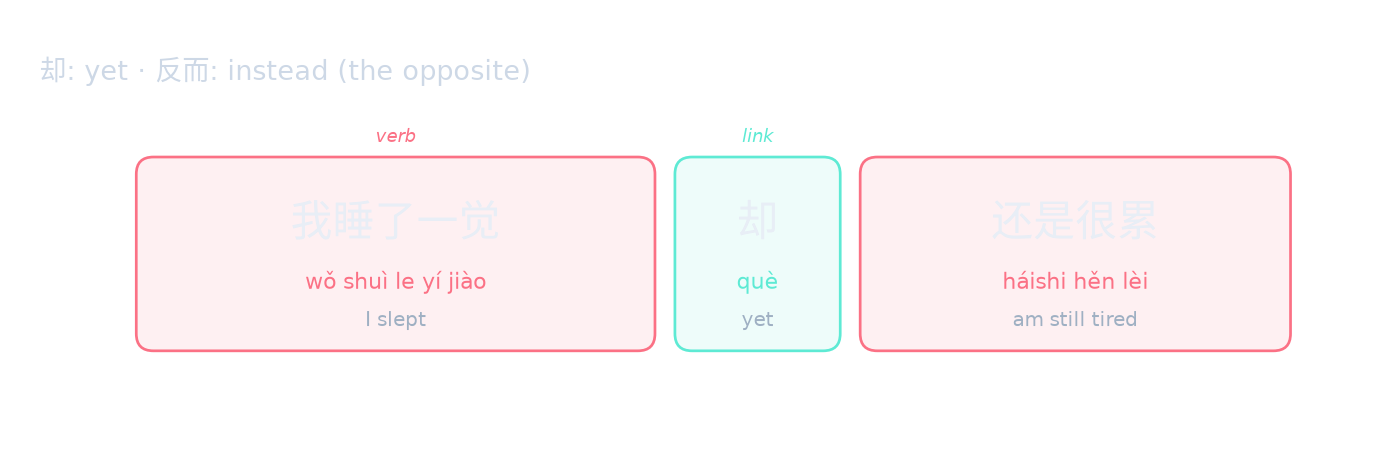
- I / me我to sleep睡(completed / change)了one / a一to feel觉,but; yet却or / still还是很累。 Wǒ shuìle yí jiào, què háishi hěn lèi. – I took a nap, yet I'm still tired.
- not only不但没好,instead (contrary to expectation)反而更累(completed / change)了。 – Far from feeling better, I'm actually more tired.
- he / him他degree / adjective linker很rich有钱,but; yet却not不happy快乐。 – He's rich but not happy.
- he / him他rich有钱(completed / change)了,instead (contrary to expectation)反而not不happy快乐(completed / change)了。 – Once he got rich, he became unhappier.
How it works. but; yet却 què marks a plain contrast, "but, yet": the second part doesn't match the first. instead (contrary to expectation)反而 fǎn'ér marks a reversal: the result went the opposite way from what was expected, often after not only不但not不 / not only不但not / haven't没. Both are adverbs after the subject.
| but; yet却 | instead (contrary to expectation)反而 |
|---|---|
| contrast | reversal of an expectation |
Watch out
- Neither starts the clause: wrong: but; yet却he / him他睡不着 → he / him他but; yet却睡不着.
at all / basic根本 vs on earth / in the end到底 (at all vs on earth)
Form: at all / basic根本 + not不 / not / haven't没 + verb (not at all) · on earth / in the end到底 + question (on earth) · on earth / in the end到底 + or / still还是 (after all)
- you你on earth / in the end到底to go去where哪儿(completed / change)了?I / me我at all / basic根本not不to be convinced相信you你at / in在library图书馆。 Nǐ dàodǐ qù nǎr le? Wǒ gēnběn bù xiāngxìn … – Where on earth did you go? I don't believe for a moment you were in the library.
- he / him他on earth / in the end到底or / still还是to come来(completed / change)了。 – He came after all.
- 根本原因to be / is是to lack缺少to communicate沟通。 – The root cause is a lack of communication.
How it works. at all / basic根本 gēnběn strengthens a negative statement ("not at all"), and as an adjective means "fundamental, root". on earth / in the end到底 dàodǐ strengthens a question ("on earth, exactly"); in a statement it means "after all, in the end".
| at all / basic根本 | on earth / in the end到底 |
|---|---|
| at all / basic根本not不to know知道 · at all / basic根本not / haven't没to go去 | you你on earth / in the end到底want / think / miss想how about怎么样? |
| 根本原因 (root cause) | on earth / in the end到底or / still还是to come来(completed / change)了 (after all) |
Watch out
- wrong: you你at all / basic根本to go去where哪儿(completed / change)了 → you你on earth / in the end到底to go去where哪儿(completed / change)了; wrong: I / me我on earth / in the end到底not不to know知道 → I / me我at all / basic根本not不to know知道.

according to / basis根据 vs according to据 (based on vs formal shorthand)
Form: according to / basis根据 + source / evidence · according to据 + reporting verb (it is said that据说, according to据to report / news report报道 …)
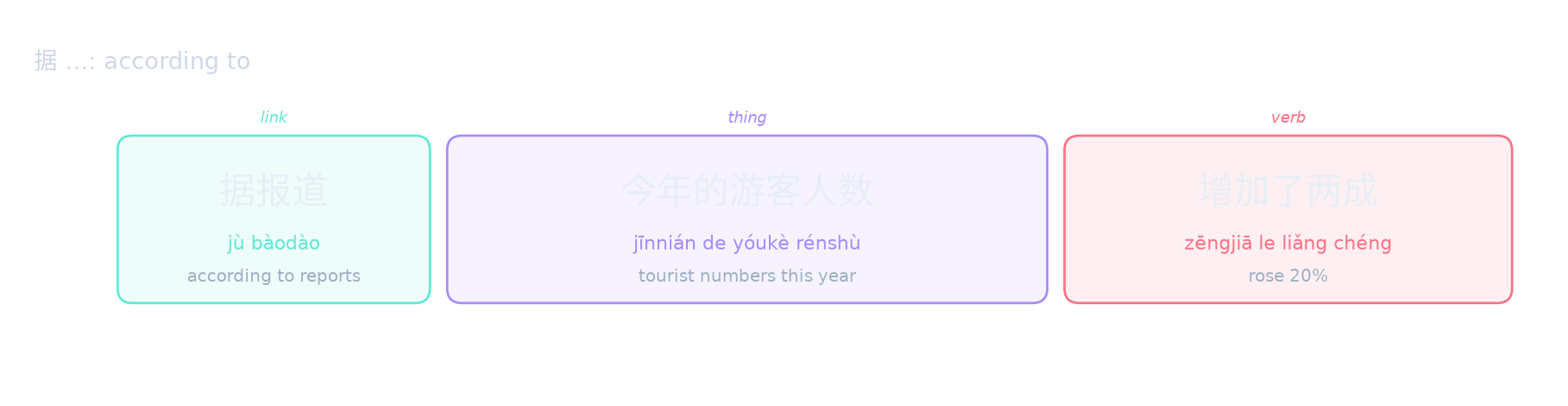
- according to据to report / news report报道,this year今年(modifier / structural particle)的traveler游客number of people人数to increase增加(completed / change)了两成。 Jù bàodào … – According to reports, tourist numbers are up 20% this year.
- it is said that据说he / him他want / will / need要to go abroad出国(completed / change)了。 – Word is he's going abroad.
- according to / basis根据这份report; to report报告,question / problem问题already已经to solve解决(completed / change)了。 – According to this report, the problem has been solved.
How it works. according to / basis根据 introduces any source or evidence, in speech and writing. according to据 jù is a compact formal form, mostly fixed before a verb of reporting. it is said that据说 is common even in speech; the others are formal.
| Phrase | Meaning |
|---|---|
| it is said that据说 | it is said |
| according to据to report / news report报道 | according to reports |
| according to statistics据统计 | according to statistics |
| according to据to understand了解 | it is understood |
Watch out
- Before an ordinary noun phrase, use according to / basis根据: according to / basis根据这份report; to report报告.
- Only according to / basis根据 is also a noun ("grounds").
- 两成 means 20% (one / a一to become / into成 = 10%).
to recover / restore恢复 vs to restore to the original state还原 (recover vs restore to original)
Form: to recover / restore恢复 + normal state · (把: marks the object)把 + thing + to restore to the original state还原 (to become / into成 …)
- father's father爷爷(modifier / structural particle)的body; health身体slowly慢慢to recover / restore恢复(completed / change)了。 Yéye de shēntǐ mànmàn huīfù le. – Grandpa's health has slowly recovered.
- underground railway地铁already已经to recover / restore恢复to run (a machine, system)运行。 – The subway is running again.
- they他们(把: marks the object)把老照片还原成(completed / change)了color彩色(modifier / structural particle)的appearance样子。 – They restored the old photo to its colour version.
- 这部film; movie电影to restore to the original state还原(completed / change)了history历史the truth about sth真相。 – The film recreates what really happened.
How it works. to recover / restore恢复 huīfù is a return to a normal state: health, order, traffic, business or a relationship. to restore to the original state还原 huányuán means getting back the original form or version of something: a scene, a picture, a story.
| to recover / restore恢复 | to restore to the original state还原 |
|---|---|
| 恢复健康 · 恢复正常 · to recover / restore恢复to be open (for business)营业 | to restore to the original state还原the scene; on the spot现场 · to restore to the original state还原history历史 · to restore to the original state还原old city district老城区(modifier / structural particle)的appearance样子 |
Watch out
- wrong: to restore to the original state还原health健康 → 恢复健康.

unexpectedly居然 vs instead (contrary to expectation)反而 (surprisingly vs instead)
Form: subject + unexpectedly居然 + surprising fact · subject + instead (contrary to expectation)反而 + opposite result
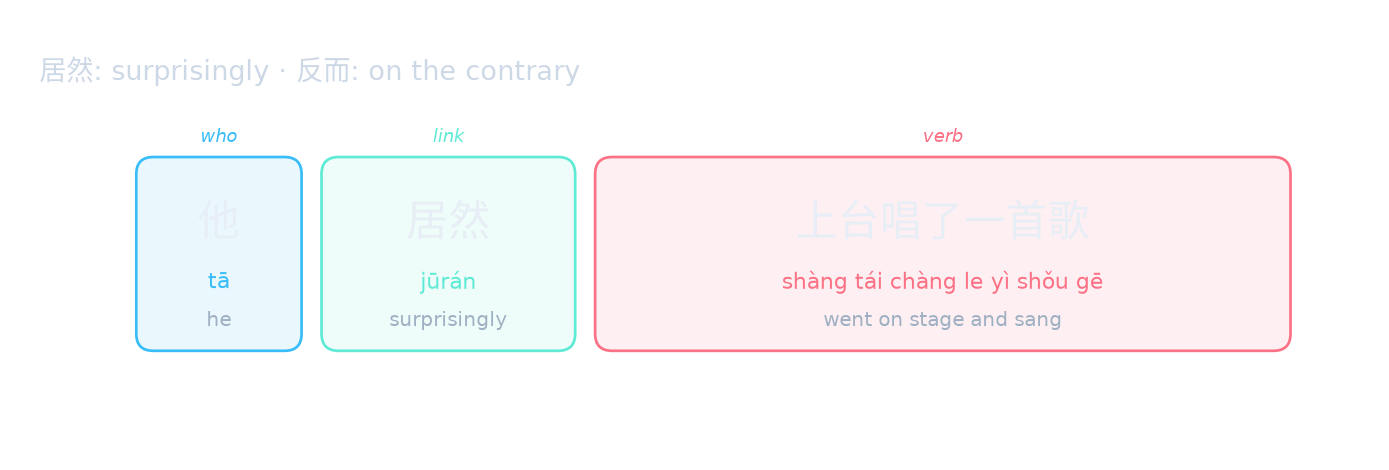
- he / him他unexpectedly居然to go on stage / take office上台to sing唱(completed / change)了一首歌! Tā jūrán shàng tái chàngle yì shǒu gē! – He actually went on stage and sang!
- everyone大家to think以为他会nervous紧张,he / him他instead (contrary to expectation)反而degree / adjective linker很to relax放松。 – Everyone expected him to be nervous, but he was relaxed instead.
- to eat吃(completed / change)了medicine药,instead (contrary to expectation)反而more更not不comfortable舒服(completed / change)了。 – After the medicine, I actually felt worse.
How it works. unexpectedly居然 jūrán (like unexpectedly竟然) marks any surprise, good or bad. instead (contrary to expectation)反而 says the result went in the opposite direction from a clear expectation.
| unexpectedly居然 / unexpectedly竟然 | instead (contrary to expectation)反而 |
|---|---|
| surprising | opposite of the expected result |
| she / her她unexpectedly居然can / will会to speak说Japanese language日语 | he / him他not only不但没生气,instead (contrary to expectation)反而to laugh笑(completed / change)了 |
Both can fit one situation: he / him他not only不但没生气,unexpectedly居然still / also / even还to laugh笑(completed / change)了 stresses the surprise; instead (contrary to expectation)反而to laugh笑(completed / change)了 stresses the reversal.
Watch out
- instead (contrary to expectation)反而 needs an expectation to reverse; unexpectedly居然 doesn't.
once; for a time一度 vs a period of time一时 (at one time vs for the moment)
Form: subject + once; for a time一度 + verb / adjective (a past phase) · a period of time一时 + verb (a brief moment)
- he / him他once; for a time一度to lose one's job; unemployment失业,then那时he / him他a period of time一时not不to know知道should该what's to be done怎么办。 Tā yídù shīyè …, yìshí bù zhīdào … – He was out of work for a time, and at first he didn't know what to do.
- this kind of这种game游戏once; for a time一度degree / adjective linker很popular; to be in fashion流行。 – This game was popular at one time.
- I / me我a period of time一时想不起来he / him他(modifier / structural particle)的name名字。 – I can't recall his name just now.
- he / him他一时冲动说错(completed / change)了words / speech话。 – He said the wrong thing on impulse.
How it works. once; for a time一度 yídù "at one time" marks a past phase that has since ended. a period of time一时 yìshí "for the moment" marks a brief moment, often a temporary failure (想不起来) or an impulse.
| once; for a time一度 | a period of time一时 |
|---|---|
| a past period: he / him他once; for a time一度to live (somewhere)住at / in在abroad国外 | a moment: a period of time一时to get angry生气 |
| 一年一度 (once a year) | a short time一时半会儿 (in a short while) |

all along / straight一直 vs always (up to now)一向 (continuously vs habitually)
Form: all along / straight一直 + verb (continuously, past or future) · always (up to now)一向 + predicate (habitually, past to now)
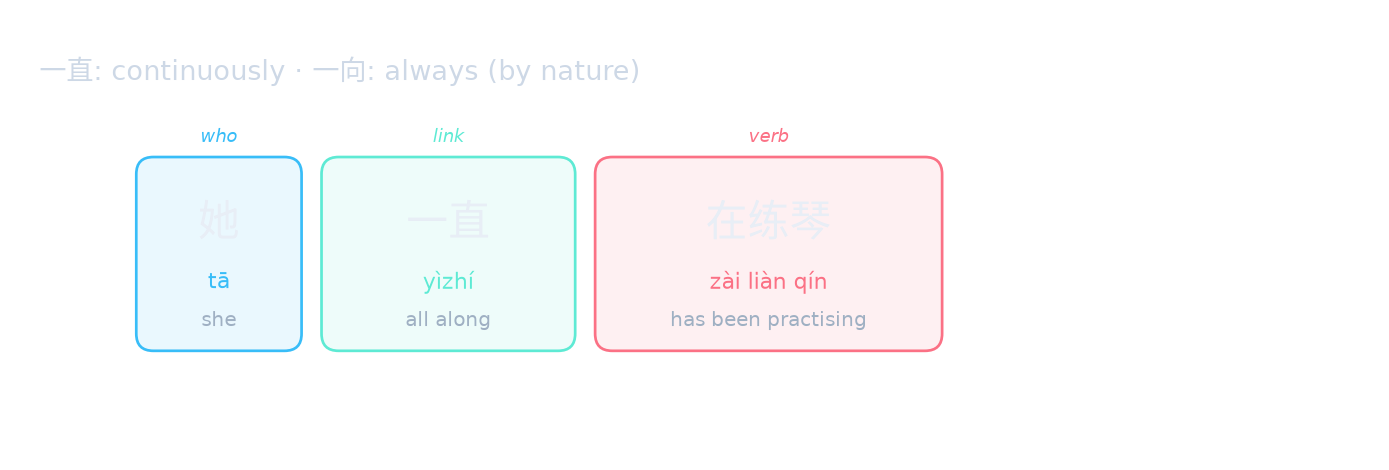
- she / her她all along / straight一直at / in在练琴,she / her她always (up to now)一向degree / adjective linker很to work hard / effort努力。 Tā yìzhí zài liàn qín, tā yíxiàng hěn nǔlì. – She's been practising the piano all morning; she's always been hard-working.
- 我会all along / straight一直to support支持you你。 – I'll always support you.
- all along / straight一直to walk / to leave走,then / just就to / arrive / (result: get)到(completed / change)了。 – Go straight on and you're there.
How it works. all along / straight一直 yìzhí means without a break over a stretch of time, in the past or future; it also means "straight on". always (up to now)一向 yíxiàng describes a long-standing habit or trait, from the past to now.
| all along / straight一直 | always (up to now)一向 | |
|---|---|---|
| ongoing activity (at / in在 + verb) | all along / straight一直at / in在to wait; and so on等 | — |
| future promise | can / will会all along / straight一直to wait; and so on等you你 | — |
| character trait | possible | always (up to now)一向degree / adjective linker很punctual准时 |
Watch out
- wrong: 我会always (up to now)一向to wait; and so on等you你 → 我会all along / straight一直to wait; and so on等you你.
- Both work for a lasting preference: he / him他all along / straight一直 / always (up to now)一向not不to like喜欢to eat吃spicy辣.
Practice without the models
Cover the teaching sections before you answer. The answers follow.
according to按照 vs according to / basis根据 (in accordance with vs based on)
1. Complete: “Please queue in order.” please; to invite请…………order; sequence顺序to line up排队。
2. “Based on the survey, most students like online classes.” Which fits? ____to investigate; survey调查,(great) majority大多数student学生to like喜欢online classes网课。
- A. according to按照
- B. pertaining to关于
- C. regarding对于
- D. according to / basis根据
3. Build: “What grounds do you have for saying that?”
Put in order: according to / basis根据? / to have / there is有what什么 / you你so much这么to speak说
4. True or false? according to / basis根据weather forecast天气预报 means “based on the weather forecast”. If false, correct it.
5. A company memo explains how a decision was made. Use according to按照 or according to / basis根据. Write your answer in Chinese, then say it aloud.
to have to (be forced)不得不 vs to have no choice but to只好 (forced to vs only option)
6. Complete: “I have to admit he was right.” I / me我…………to admit承认he / him他说得对。
7. “The restaurant was full, so we just had to eat at home.” Which sounds most natural?
- A. restaurant饭馆full满(completed / change)了,we / us我们to have to (be forced)不得不(yes/no ?)吗to be at home在家to eat吃。
- B. restaurant饭馆full满(completed / change)了,we / us我们to have no choice but to只好to be at home在家to eat吃。
- C. restaurant饭馆full满(completed / change)了,to have no choice but to只好we / us我们to be at home在家to eat吃(completed / change)了(yes/no ?)吗。
- D. restaurant饭馆full满(completed / change)了,we / us我们(degree marker)得must not不得to be at home在家to eat吃。
8. Build: “He was seriously ill and had to be hospitalised.”
Put in order: , / 他病(degree marker)得degree / adjective linker很heavy / important重 / to be in hospital住院。 / to have to (be forced)不得不
9. True or false? to have no choice but to只好 and to have to (be forced)不得不 can sometimes be used interchangeably. If false, correct it.
10. The last train has been cancelled and there are no taxis. Use to have to (be forced)不得不 or to have no choice but to只好. Write your answer in Chinese, then say it aloud.
continuously不断 vs incessant不停 (continually vs non-stop)
11. Complete (formal): “Our level keeps improving.” we / us我们(modifier / structural particle)的level水平at / in在…………to raise / improve提高。
12. Which is wrong?
- A. technology技术不断进步。
- B. he / him他to speak说(measure word)个continuously不断。
- C. rain雨incessant不停underground地下。
- D. he / him他to speak说(measure word)个incessant不停。
13. Build: “The baby cries non-stop.”
Put in order: incessant不停。 / child孩子 / (measure word)个 / to cry哭
14. True or false? continuously不断(modifier / structural particle)的to work hard / effort努力 means “constant effort”. If false, correct it.
15. A news report and a neighbour's complaint describe two kinds of "continually". Use continuously不断 or incessant不停. Write your answer in Chinese, then say it aloud.
instead (contrary to expectation)反而 vs but; yet却 (instead vs however)
16. Complete: “After the medicine, the illness got worse instead.” to eat吃(completed / change)了medicine药,illness / ill病…………更重(completed / change)了。
17. “He's clever, but he doesn't work hard.” Which fits? he / him他degree / adjective linker很intelligent聪明,____not不to work hard / effort努力。
- A. and so于是
- B. but; yet却
- C. therefore因此
- D. instead (contrary to expectation)反而
18. Build: “It's already spring, yet it's still cold.”
Put in order: , / weather天气but; yet却 / already已经spring (season)春天(completed / change)了 / still / also / even还degree / adjective linker很cold冷。
19. True or false? instead (contrary to expectation)反而 normally goes after the subject, before the verb. If false, correct it.
20. You took a nap to feel better, but woke up even more tired. Use instead (contrary to expectation)反而 or but; yet却. Write your answer in Chinese, then say it aloud.
at all / basic根本 vs on earth / in the end到底 (at all vs on earth)
21. Complete: “I don't know him at all.” I / me我…………not不to know (a person); to recognise认识he / him他。
22. “What on earth do you want?” Which fits? you你____want / think / miss想how about怎么样?
- A. originally本来
- B. according to / basis根据
- C. at all / basic根本
- D. on earth / in the end到底
23. Build: “The root cause is a lack of communication.”
Put in order: to be / is是 / 根本原因 / to communicate沟通。 / to lack缺少
24. True or false? he / him他on earth / in the end到底or / still还是to come来(completed / change)了 means “In the end he came after all.” If false, correct it.
25. Your friend keeps changing his story about where he was last night. Use at all / basic根本 or on earth / in the end到底. Write your answer in Chinese, then say it aloud.
according to / basis根据 vs according to据 (based on vs formal shorthand)
26. Complete: “It is said that he's going abroad.” …………to speak说he / him他want / will / need要to go abroad出国(completed / change)了。
27. Which is safer before a plain noun phrase? “based on this report”
- A. root根这份report; to report报告
- B. according to据这份report; to report报告
- C. according to / basis根据这份report; to report报告
- D. it is said that据说这份report; to report报告
28. Match each phrase to its meaning.
-
(1) according to据to report / news report报道
-
(2) according to statistics据统计
-
(3) it is said that据说
-
A. according to statistics
-
B. it is said
-
C. according to reports
29. True or false? according to据 can be used as a noun meaning “grounds”. If false, correct it.
30. You read a news story citing an official source. Use according to / basis根据 or according to据. Write your answer in Chinese, then say it aloud.
to recover / restore恢复 vs to restore to the original state还原 (recover vs restore to original)
31. Complete: “He has recovered his health.” he / him他already已经…………health健康(completed / change)了。
32. “The police reconstructed the accident scene.” Which fits? police警察____(completed / change)了事故现场。
- A. to recover / restore恢复
- B. to reply回复
- C. to restore to the original state还原
- D. to review复习
33. Build: “The shop resumes business next week.”
Put in order: shop商店 / to be open (for business)营业。 / next week下周 / to recover / restore恢复
34. True or false? to restore to the original state还原health健康 is the usual phrase for recovering health. If false, correct it.
35. After a week in hospital, your grandfather is walking again; meanwhile, technicians restore an old photo. Use to recover / restore恢复 or to restore to the original state还原. Write your answer in Chinese, then say it aloud.
unexpectedly居然 vs instead (contrary to expectation)反而 (surprisingly vs instead)
36. Complete: “She can actually speak Japanese!” she / her她…………can / will会to speak说Japanese language日语!
37. “After a day of rest, he was even more tired.” Which fits best? to rest休息(completed / change)了一天,he / him他____更累(completed / change)了。
- A. instead (contrary to expectation)反而
- B. unexpectedly居然
- C. of course当然
- D. as expected; sure enough果然
38. Build: “He actually got such an easy question wrong.”
Put in order: so much这么simple简单(modifier / structural particle)的question (in a test)题 / unexpectedly居然 / to make an error做错(completed / change)了。 / ,he / him他
39. True or false? instead (contrary to expectation)反而 always reverses an expectation. If false, correct it.
40. Your shy classmate surprised everyone at the talent show. Use unexpectedly居然 or instead (contrary to expectation)反而. Write your answer in Chinese, then say it aloud.
once; for a time一度 vs a period of time一时 (at one time vs for the moment)
41. Complete: “I can't recall his name just now.” he / him他(modifier / structural particle)的name名字I / me我…………想不起来。
42. “This song was once very popular.” Which fits? this这首歌____very非常popular; to be in fashion流行。
- A. a period of time一时
- B. once; for a time一度
- C. always (up to now)一向
- D. all along / straight一直
43. Build: “This problem can't be solved in a short while.”
Put in order: to solve解决 / this这个question / problem问题a short time一时半会儿 / (as a resultative verb…不了。
44. True or false? 一年一度 means “once a year”. If false, correct it.
45. Your uncle talks about a difficult period in his life and a moment of panic. Use once; for a time一度 or a period of time一时. Write your answer in Chinese, then say it aloud.
all along / straight一直 vs always (up to now)一向 (continuously vs habitually)
46. Promise: “I'll always support you.” 我会…………to support支持you你。
47. Which is wrong?
- A. he / him他always (up to now)一向degree / adjective linker很punctual准时。
- B. 我会always (up to now)一向to wait; and so on等you你。
- C. rain雨all along / straight一直at / in在down / next; to fall (rain), get off下。
- D. he / him他all along / straight一直at / in在练琴。
48. Build: “I will keep waiting for you.”
Put in order: all along / straight一直 / to wait; and so on等you你。 / 我会
49. True or false? he / him他all along / straight一直not不to like喜欢to eat吃spicy辣 and he / him他always (up to now)一向not不to like喜欢to eat吃spicy辣 are both acceptable. If false, correct it.
50. Your neighbour has been practising piano all morning; she has always been hard-working. Use all along / straight一直 or always (up to now)一向. Write your answer in Chinese, then say it aloud.
Answers and explanations
according to按照 vs according to / basis根据 (in accordance with vs based on)
1. according to按照
Following an order or rule = according to按照.
2. D. according to / basis根据
Evidence for a conclusion = according to / basis根据.
3. you你so much这么to speak说to have / there is有what什么according to / basis根据?
according to / basis根据 as a noun = grounds.
4. True.
according to / basis根据 introduces the source of a judgement.
5. Model answer: according to按照company公司rule; to stipulate规定,according to / basis根据results (of an…调查结果,we / us我们to decide / decision决定to cancel取消这次activity; to exercise活动。
Check your answer:
- To follow a rule, plan or order, use according to按照: according to按照plan计划to carry out进行 ("Proceed according to plan"). according to / basis根据rule; to stipulate规定 is also correct, but it justifies a decision: "on the basis of the rules".
- Evidence for a conclusion: according to / basis根据research研究, not according to按照research研究.
to have to (be forced)不得不 vs to have no choice but to只好 (forced to vs only option)
6. to have to (be forced)不得不
to have to (be forced)不得不to admit承认 is fixed.
7. B. restaurant饭馆full满(completed / change)了,we / us我们to have no choice but to只好to be at home在家to eat吃。
Options ran out, so to have no choice but to只好 fits naturally.
8. 他病(degree marker)得degree / adjective linker很heavy / important重,to have to (be forced)不得不to be in hospital住院。
Pressure of the situation = to have to (be forced)不得不.
9. True.
to have to (be forced)不得不 just sounds more forced.
10. Model answer: not have / haven't没有car车(completed / change)了,we / us我们to have no choice but to只好to walk / to leave走to return回去。company公司rule; to stipulate规定want / will / need要(of an employee) to clock…打卡,I / me我to have to (be forced)不得不to get up early早起。
Check your answer:
- Options ran out and you accept it → to have no choice but to只好. Something forces you (law, health, duty) → to have to (be forced)不得不.
- Both go after the subject: I / me我to have no choice but to只好…, I / me我to have to (be forced)不得不…; neither takes (yes/no ?)吗 in a statement.
continuously不断 vs incessant不停 (continually vs non-stop)
11. continuously不断
Improvement over time = continuously不断.
12. B. he / him他to speak说(measure word)个continuously不断。
Verb + (measure word)个 + incessant不停 means “non-stop” (he / him他to speak说(measure word)个incessant不停). continuously不断 does not fit this pattern; it works as an adverb before verbs like progress进步 or to raise / improve提高.
13. child孩子哭个incessant不停。
V + (measure word)个incessant不停.
14. True.
True. continuously不断 can also describe a noun with (modifier / structural particle)的: continuously不断(modifier / structural particle)的to work hard / effort努力 “constant effort”.
15. Model answer: city城市at / in在continuously不断to develop; development发展。upstairs楼上(modifier / structural particle)的dog狗叫个不停。
Check your answer:
- Development or improvement over time → continuously不断: continuously不断to raise / improve提高, not incessant不停to raise / improve提高.
- A physical action that won't stop → incessant不停: rain雨incessant不停underground地下, 说个incessant不停.
instead (contrary to expectation)反而 vs but; yet却 (instead vs however)
16. instead (contrary to expectation)反而
The opposite of the expected result = instead (contrary to expectation)反而.
17. B. but; yet却
but; yet却 marks a plain contrast after the subject: he / him他degree / adjective linker很intelligent聪明,but; yet却not不to work hard / effort努力. instead (contrary to expectation)反而 would mean the result goes against what was expected, and therefore因此 / and so于是 show result or sequence.
18. already已经spring (season)春天(completed / change)了,weather天气but; yet却still / also / even还degree / adjective linker很cold冷。
Subject + but; yet却 + predicate.
19. True.
True. instead (contrary to expectation)反而 is an adverb: he / him他instead (contrary to expectation)反而to laugh笑(completed / change)了.
20. Model answer: I / me我to sleep睡(completed / change)了one / a一to feel觉,but; yet却or / still还是很累;not only不但没好,instead (contrary to expectation)反而更累(completed / change)了。
Check your answer:
- A plain "but": but; yet却. The opposite of the expected result: instead (contrary to expectation)反而.
- Both normally follow the subject: he / him他but; yet却…, he / him他instead (contrary to expectation)反而….
at all / basic根本 vs on earth / in the end到底 (at all vs on earth)
21. at all / basic根本
at all / basic根本 + not不 = not at all.
22. D. on earth / in the end到底
on earth / in the end到底 strengthens questions.
23. 根本原因to be / is是to lack缺少to communicate沟通。
at all / basic根本 as an adjective: root.
24. True.
In statements, on earth / in the end到底 = after all.
25. Model answer: you你on earth / in the end到底to go去where哪儿(completed / change)了?I / me我at all / basic根本not不to be convinced相信you你at / in在library图书馆。
Check your answer:
- at all / basic根本 strengthens a negative statement; it does not go in questions as "on earth": you你at all / basic根本to go去where哪儿(completed / change)了 ✗.
- on earth / in the end到底 strengthens a question; it does not mean "not at all": for that, say I / me我at all / basic根本not不to know知道 – "I don't know at all."
according to / basis根据 vs according to据 (based on vs formal shorthand)
26. according to据
it is said that据说 = it is said.
27. C. according to / basis根据这份report; to report报告
Before a noun phrase, according to / basis根据 is the safe choice.
28. (1) C: according to据to report / news report报道 = according to reports; (2) A: according to statistics据统计 = according to statistics; (3) B: it is said that据说 = it is said
according to据 + reporting verb.
29. False.
False. On its own according to据 is a preposition, “according to” (according to据to report / news report报道). The noun “grounds, basis” is according to / basis根据 (you你to have / there is有what什么according to / basis根据?); according to据 has this meaning only inside compounds like evidence证据.
30. Model answer: according to据to report / news report报道,this year今年(modifier / structural particle)的traveler游客number of people人数to increase增加(completed / change)了两成。
Check your answer:
- according to据 usually takes a reporting verb directly: according to据to report / news report报道, according to statistics据统计. Before a plain noun phrase, according to / basis根据 is safer: according to / basis根据这份report; to report报告 – "According to this report."
- it is said that据说 is common even in speech; the other according to据 phrases are formal.
to recover / restore恢复 vs to restore to the original state还原 (recover vs restore to original)
31. to recover / restore恢复
Health returns to normal = to recover / restore恢复.
32. C. to restore to the original state还原
Reconstructing a scene as it originally was = to restore to the original state还原.
33. shop商店next week下周to recover / restore恢复to be open (for business)营业。
to recover / restore恢复to be open (for business)营业 = resume business.
34. False.
The usual phrase is 恢复健康.
35. Model answer: father's father爷爷(modifier / structural particle)的body; health身体slowly慢慢to recover / restore恢复(completed / change)了。they他们(把: marks the object)把老照片还原成(completed / change)了color彩色(modifier / structural particle)的appearance样子。
Check your answer:
- Health, order, activity → to recover / restore恢复: 恢复健康, not to restore to the original state还原health健康.
- A scene, picture or story back to its original → to restore to the original state还原: to restore to the original state还原history历史the truth about sth真相 – "Reconstruct the truth about history."
unexpectedly居然 vs instead (contrary to expectation)反而 (surprisingly vs instead)
36. unexpectedly居然
Surprise = unexpectedly居然.
37. A. instead (contrary to expectation)反而
The opposite of the expected result = instead (contrary to expectation)反而.
38. so much这么simple简单(modifier / structural particle)的question (in a test)题,he / him他unexpectedly居然to make an error做错(completed / change)了。
Subject + unexpectedly居然 + verb.
39. True.
True. instead (contrary to expectation)反而 always says the result goes against an expectation. unexpectedly居然 only marks the speaker's surprise and does not need a reversal.
40. Model answer: he / him他unexpectedly居然to go on stage / take office上台to sing唱(completed / change)了一首歌!everyone大家to think以为他会nervous紧张,he / him他instead (contrary to expectation)反而degree / adjective linker很to relax放松。
Check your answer:
- Any surprise → unexpectedly居然 / unexpectedly竟然. A result opposite to the expected one → instead (contrary to expectation)反而.
- unexpectedly居然 can describe good or bad surprises; instead (contrary to expectation)反而 always reverses an expectation.
once; for a time一度 vs a period of time一时 (at one time vs for the moment)
41. a period of time一时
A brief moment = a period of time一时.
42. B. once; for a time一度
once; for a time一度 marks a past phase that has since ended: this这首歌once; for a time一度very非常popular; to be in fashion流行 “was once very popular”. all along / straight一直 and always (up to now)一向 describe continuity up to now.
43. this这个question / problem问题a short time一时半会儿解决不了。
Topic + a short time一时半会儿 + verb + potential complement (as a resultative verb…不了.
44. True.
True. In 一年一度, degree / extent度 counts occasions, so the phrase means “once a year”, as in 一年一度(modifier / structural particle)的Spring Festival (Chinese…春节.
45. Model answer: he / him他once; for a time一度to lose one's job; unemployment失业,then那时he / him他a period of time一时not不to know知道should该what's to be done怎么办。
Check your answer:
- A past period that has ended → once; for a time一度: he / him他once; for a time一度to live (somewhere)住at / in在abroad国外 – "He lived abroad for a time."
- A brief moment or impulse → a period of time一时: a period of time一时to get angry生气说错(completed / change)了words / speech话 – "I said the wrong thing in a moment of anger."
all along / straight一直 vs always (up to now)一向 (continuously vs habitually)
46. all along / straight一直
Future promises take all along / straight一直.
47. B. 我会always (up to now)一向to wait; and so on等you你。
always (up to now)一向 does not look to the future.
48. 我会all along / straight一直to wait; and so on等you你。
can / will会 + all along / straight一直 + verb.
49. True.
For a long-standing preference, both work.
50. Model answer: she / her她all along / straight一直at / in在练琴,she / her她always (up to now)一向degree / adjective linker很to work hard / effort努力。
Check your answer:
- Future promises take all along / straight一直: 我会all along / straight一直to support支持you你 ("I will always support you"). always (up to now)一向 is past-to-present only.
- An ongoing activity (at / in在 + verb) usually takes all along / straight一直: all along / straight一直at / in在to wait; and so on等; always (up to now)一向 is about habits and traits.