Skip to content
Subjects
  • 1 Adjectives
    • 1.1 Indicating the whole with "quan"
    • 1.2 Negative adjectives with "-si le"

    Adjectives →

  • 2 Adverbs
    • 2.1 Approximations with "chabuduo"
    • 2.2 Assessing situations with "kanlai"
    • 2.3 Coincidence with "zhenghao"
    • 2.4 Declaring the only option with "zhihao"
    • 2.5 Emphasizing negation with "you"
    • 2.6 Emphatic adverb "ke"
    • 2.7 Expressing "all along" with "yuanlai"
    • 2.8 Expressing "almost" using "chadian"
    • 2.9 Expressing "always" with "conglai"
    • 2.10 Expressing "as a result" with "jieguo"
    • 2.11 Expressing "enough" with "gou"
    • 2.12 Expressing "even" with "shenzhi"
    • 2.13 Expressing "had better" with "haishi"
    • 2.14 Expressing "had better" with "zuihao"
    • 2.15 Expressing "have to" with "budebu"
    • 2.16 Expressing "in the end" with "daodi"
    • 2.17 Expressing "in the end" with "jiujing"
    • 2.18 Expressing "just" with "gang"
    • 2.19 Expressing "one by one" with "yi"
    • 2.20 Expressing "originally" with "benlai"
    • 2.21 Expressing "small quantity" with "jiu"
    • 2.22 Expressing "to make certain" with "qianwan"
    • 2.23 Expressing concern with "kongpa"
    • 2.24 Expressing the unexpected with "jingran"
    • 2.25 Rhetorical questions with "nandao"
    • 2.26 Sequencing with "xian" and "zai"
    • 2.27 Using "ye" and "dou" together

    Adverbs →

  • 3 Adverbs with Adjectives
    • 3.1 Expressing "quite" with "ting"

    Adverbs with Adjectives →

  • 4 Auxiliary Words
    • 4.1 Ending a non-exhaustive list with "shenme de"
    • 4.2 Non-exhaustive lists with "dengdeng"

    Auxiliary Words →

  • 5 Conjunctions
    • 5.1 A softer "but" with "buguo"
    • 5.2 Expressing "and then" with "yushi"
    • 5.3 Expressing "in addition" with "haiyou"
    • 5.4 Expressing "in addition" with "lingwai"
    • 5.5 Expressing "in addition" with "zaishuo"
    • 5.6 Two words for "but"
    • 5.7 Using "er" to explain contrasting ideas
    • 5.8 Using "lai" to connect two verb phrases

    Conjunctions →

  • 6 Nouns
    • 6.1 Expressing "within (it/them)" with "qizhong"

    Nouns →

  • 7 Numbers

    Fractions with minute / point / to divide分fēn(of — literary)之zhī

    Form: bottom number + minute / point / to divide分fēn(of — literary)之zhī + top number · percent百分之bǎi fēn zhī + number

    • one fifth五分之一wǔ fēn zhī yī(modifier / structural particle)的destudent学生xué shēngto walk走路zǒu lùto go to school上学shàng xué。 Wǔ fēn zhī yī de xuésheng zǒulù shàngxué. – One fifth of the students walk to school.
    • 三分之二sān fēn zhī èr(modifier / structural particle)的deperson人rén – two thirds of the people
    • we / us我们wǒ men(modifier / structural particle)的deachievement成绩chéng jìto raise / improve提高tí gāo(completed / change)了le百分之二十bǎi fēn zhī èr shí。 Wǒmen de chéngjì tígāole bǎi fēn zhī èrshí. – Our scores rose by 20%.

    How it works. Chinese says the bottom number first: "of five parts, one" = one fifth五分之一wǔ fēn zhī yī. Per cent works the same way, with hundred百bǎi (a hundred) at the bottom. Before a noun, add (modifier / structural particle)的de.

    Value Chinese
    1/3 one third三分之一sān fēn zhī yī
    3/4 四分之三sì fēn zhī sān
    2/5 五分之二wǔ fēn zhī èr
    4/3 somewhat三分sān fēn之四zhī sì
    50% 百分之五十bǎi fēn zhī wǔ shí
    100% a hundred percent百分之百bǎi fēn zhī bǎi

    In speech, a half is usually half一半yí bàn: half一半yí bàn(modifier / structural particle)的destudent学生xué shēng. To ask "what fraction?", say somewhat几分jǐ fēn(of — literary)之zhīhow many / a few几jǐ.

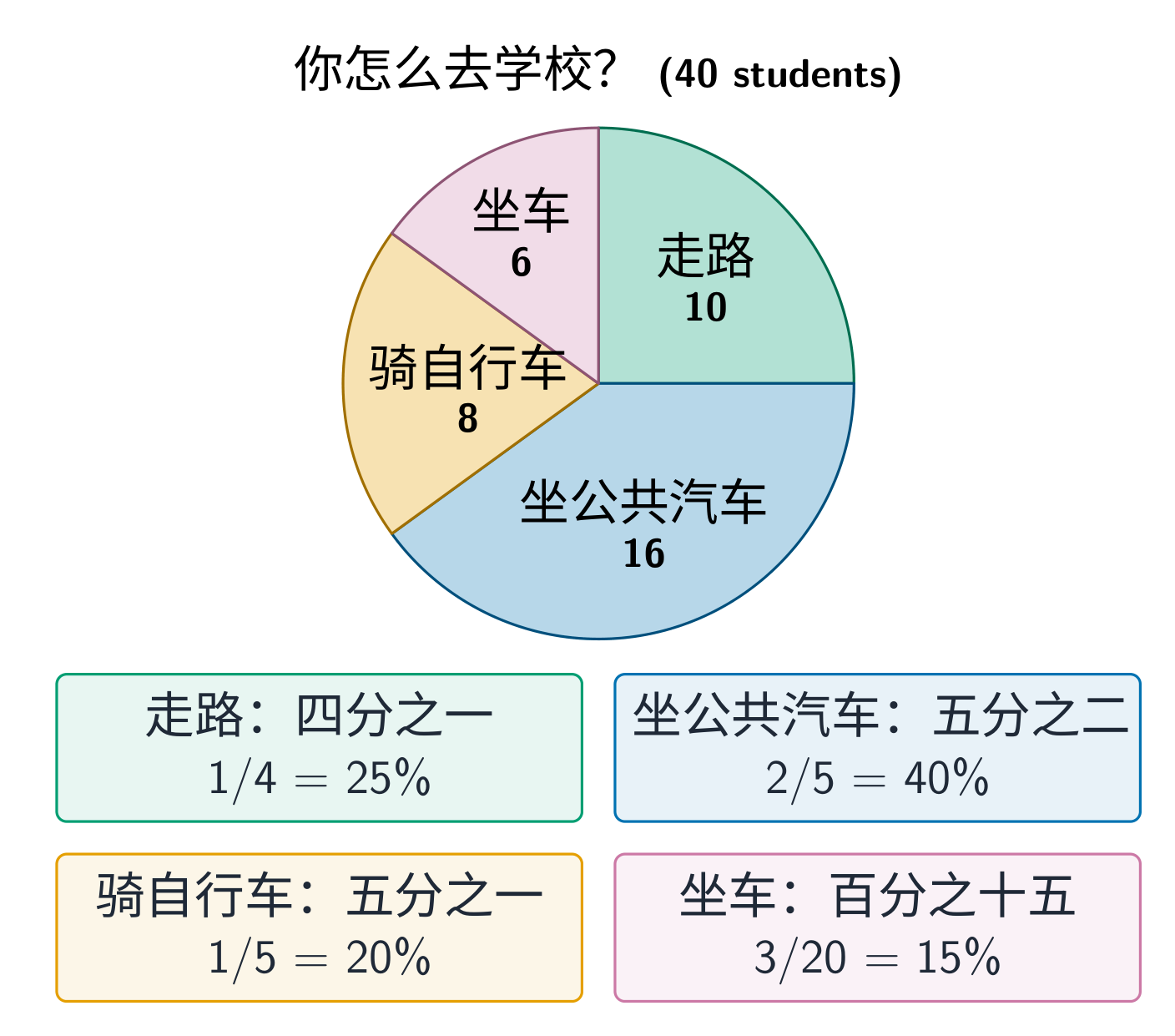
    Reading data with to take possession of占zhàn. A to take possession of占zhàn + fraction / % = "A makes up …". Divide the part by the total, then say the bottom number first: 16 of 40 students → 16 ÷ 40 = 2/5 → to sit / to take (a bus …)坐zuòbus公共汽车gōng gòng qì chē(modifier / structural particle)的destudent学生xué shēngto take possession of占zhàn五分之二wǔ fēn zhī èr,also也yěexactly就是jiù shì百分之四十bǎi fēn zhī sì shí。

    Discounts with to give a discount打折dǎ zhé. to hit / play / make (a call)打dǎ N to fold折zhé means you pay N tenths of the price: to hit / play / make (a call)打dǎ八折bā zhé = pay 80% (20% off), to hit / play / make (a call)打dǎ五折wǔ zhé = half price. 200 yuan to hit / play / make (a call)打dǎ八折bā zhé → 160 yuan.

    Watch out

    • 3/4 is 四分之三sì fēn zhī sān; wrong: somewhat三分sān fēn之四zhī sì is 4/3.
    • wrong: fifty五十wǔ shípercent百分之bǎi fēn zhī → 百分之五十bǎi fēn zhī wǔ shí.
    • to hit / play / make (a call)打dǎ八折bā zhé is not "80% off": you pay 80%.
    B 分之 A: A out of B (fractions)
    A class survey of 40 students as a pie chart

    Practice without the models

    Cover the teaching sections before you answer. The answers follow.

    1. Write 2/5 in Chinese: …………

    2. Look at the chart: 8 of the 40 students cycle. to ride骑qíbicycle自行车zì xíng chē(modifier / structural particle)的destudent学生xué shēngto take possession of占zhàn…………。 (a fraction in Chinese)

    3. the whole class全班quán bān二十个èr shí gèstudent学生xué shēng,五个wǔ gè戴眼镜dài yǎn jìng。戴眼镜dài yǎn jìng(modifier / structural particle)的destudent学生xué shēngto take possession of占zhànpercent百分之bǎi fēn zhīhow many / how much多少duō shao?

    • A. 百分之二十五bǎi fēn zhī èr shí wǔ
    • B. 百分之二十bǎi fēn zhī èr shí
    • C. 百分之五bǎi fēn zhī wǔ

    4. A 100-yuan book is to hit / play / make (a call)打dǎ10% off (price)九折jiǔ zhé. How much do you pay?

    • A. 9 yuan
    • B. 90 yuan
    • C. 10 yuan

    5. Shoes cost 300 yuan and are to hit / play / make (a call)打dǎ七折qī zhé. You pay ………… yuan. (number)

    6. Build: “The shop is having a sale; everything is half price.”

    Put in order: shop商店shāng diàn / all / both都dōuto hit / play / make (a call)打dǎ五折wǔ zhé。 / in the middle of正在zhèng zàito give a discount打折dǎ zhé, / all所有suǒ yǒuthing; stuff东西dōng xī

    7. What is somewhat三分sān fēn之四zhī sì?

    • A. 3.4
    • B. 3/4
    • C. 4/3
    • D. 34%

    8. Match each expression to its value.

    • (1) 百分之五十bǎi fēn zhī wǔ shí

    • (2) one-quarter四分之一sì fēn zhī yī

    • (3) 三分之二sān fēn zhī èr

    • (4) a hundred percent百分之百bǎi fēn zhī bǎi

    • A. 50%

    • B. 1/4

    • C. 100%

    • D. 2/3

    9. True or false? In speech, half一半yí bàn is usually used for one half. If false, correct it.

    10. Describe the survey chart in two sentences: one fraction with minute / point / to divide分fēn(of — literary)之zhī and one percentage with to take possession of占zhàn … percent百分之bǎi fēn zhī. Say it aloud, then write it. Then describe your own class (invent the numbers). Use Fractions with minute / point / to divide分fēn(of — literary)之zhī. Write your answer in Chinese, then say it aloud.

    Answers and explanations

    1. 五分之二wǔ fēn zhī èr

    Denominator first: 五分之二wǔ fēn zhī èr.

    2. one fifth五分之一wǔ fēn zhī yī

    8 ÷ 40 = 1/5 → one fifth五分之一wǔ fēn zhī yī (= 百分之二十bǎi fēn zhī èr shí).

    3. A. 百分之二十五bǎi fēn zhī èr shí wǔ

    5 ÷ 20 = 1/4 = 25% → 百分之二十五bǎi fēn zhī èr shí wǔ.

    4. B. 90 yuan

    to hit / play / make (a call)打dǎ10% off (price)九折jiǔ zhé = pay 9/10 of the price, so 90 yuan.

    5. 210

    300 × 0.7 = 210 – to hit / play / make (a call)打dǎ七折qī zhé is 30% off.

    6. shop商店shāng diànin the middle of正在zhèng zàito give a discount打折dǎ zhé,all所有suǒ yǒuthing; stuff东西dōng xīall / both都dōuto hit / play / make (a call)打dǎ五折wǔ zhé。

    to hit / play / make (a call)打dǎ五折wǔ zhé = half price.

    7. C. 4/3

    The first number is the denominator: 4/3.

    8. (1) A: 百分之五十bǎi fēn zhī wǔ shí = 50%; (2) B: one-quarter四分之一sì fēn zhī yī = 1/4; (3) D: 三分之二sān fēn zhī èr = 2/3; (4) C: a hundred percent百分之百bǎi fēn zhī bǎi = 100%

    B minute / point / to divide分fēn(of — literary)之zhī A = A/B; percent百分之bǎi fēn zhī N = N%.

    9. True.

    half一半yí bàn(modifier / structural particle)的destudent学生xué shēng is more natural than one half二分之一èr fēn zhī yī(modifier / structural particle)的destudent学生xué shēng.

    10. Model answer: we / us我们wǒ men班有bān yǒu四十个sì shí gèstudent学生xué shēng,one fifth五分之一wǔ fēn zhī yī(modifier / structural particle)的destudent学生xué shēngto walk走路zǒu lùto go to school上学shàng xué,to sit / to take (a bus …)坐zuòbus公共汽车gōng gòng qì chē(modifier / structural particle)的destudent学生xué shēngmost最zuìmany; much多duō,to take possession of占zhàn百分之四十bǎi fēn zhī sì shí。

    Check your answer:

    • Say the denominator first: 3/4 = 四分之三sì fēn zhī sān, not somewhat三分sān fēn之四zhī sì (that is 4/3).
    • 50% is 百分之五十bǎi fēn zhī wǔ shí, not fifty五十wǔ shípercent百分之bǎi fēn zhī.
  • 8 Particles
    • 8.1 Advanced yes-no questions with "ma"
    • 8.2 Reviewing options with "ba"
    • 8.3 Using "de" (modal particle)

    Particles →

  • 9 Prepositions
    • 9.1 Expressing "along with…" with "suizhe"
    • 9.2 Idiomatic phrases with "zai"

    Prepositions →

  • 10 Sentence Patterns
    • 10.1 Emphasizing a negation with "bing"

    Sentence Patterns →

  • 11 Sentence patterns
    • 11.1 Using "yi... wei..."

    Sentence patterns →

  • 12 Verbs
    • 12.1 Causative verbs
    • 12.2 Expressing "it depends" with "kan"
    • 12.3 Expressing "it seems" with "haoxiang"
    • 12.4 Expressing "lies in" with "zaiyu"
    • 12.5 Expressing "mistakenly think that" with "yiwei"
    • 12.6 Expressing "through" with "tongguo"
    • 12.7 Expressing "to come from" with "laizi"
    • 12.8 Using "lai" as a dummy verb

    Verbs →

  • 13 Auxiliary verbs
    • 13.1 Expressing "don't need to" with "buyong"
    • 13.2 Expressing "must" with "dei"

    Auxiliary verbs →

  • 14 Verb phrases
    • 14.1 Combining verbs with "bing"
    • 14.2 Doing something less with "shao"
    • 14.3 Doing something more with "duo"
    • 14.4 Emphasizing the doer of an action with "you"
    • 14.5 Expressing "moreover" with "bingqie"
    • 14.6 Expressing "never" with "conglai"
    • 14.7 Expressing "to be worth" doing with "zhide"
    • 14.8 Expressing "until" with "dao"
    • 14.9 Indicating negative impact with "haide"
    • 14.10 Separable verb
    • 14.11 Using "zhe" when "verbing away"

    Verb phrases →

  • 15 "But" Statements
    • 15.1 Expressing "although" with "jinguan"
    • 15.2 Expressing contrariness with "dao"
    • 15.3 The "however" adverb "que"

    "But" Statements →

  • 16 "Even If" Statements
    • 16.1 Expressing "even if…" with "jishi"

    "Even If" Statements →

  • 17 "If" Statements
    • 17.1 Expressing "if… then…" with "yaoshi"

    "If" Statements →

  • 18 "No Matter" Statements
    • 18.1 Expressing "no matter" with "buguan"
    • 18.2 Expressing "no matter" with "wulun"

    "No Matter" Statements →

  • 19 Cause/Effect Statements
    • 19.1 Expressing "due to…" with "youyu"
    • 19.2 Expressing "since" with "jiran"
    • 19.3 Expressing "therefore" with "yinci"

    Cause/Effect Statements →

  • 20 Complements
    • 20.1 Advanced uses of direction complement "-qilai"
    • 20.2 Direction complement
    • 20.3 Direction complement "-qilai"
    • 20.4 Potential complement

    Complements →

  • 21 Conditional Statements
    • 21.1 Expressing "as long as" with "zhiyao"
    • 21.2 Expressing "unless" with "chufei"

    Conditional Statements →

  • 22 Noun Phrases
    • 22.1 Expressing "all" with "suoyou"
    • 22.2 Expressing "one of" with "zhiyi"
    • 22.3 Expressing "the other" with "lingwai"

    Noun Phrases →

  • 23 Sentence Patterns
    • 23.1 Advanced uses of "lian"
    • 23.2 Explaining purpose with "wei... er..."
    • 23.3 Expressing "any" with "renhe"
    • 23.4 Expressing "both… and…" with "ji...you"
    • 23.5 Expressing location with "zai... shang / xia / li"

    Sentence Patterns →

  • 24 Basic/Simple Sentence Patterns
    • 24.1 Expressing "even" with "lian" and "dou"
    • 24.2 Expressing "every" with question words
    • 24.3 Expressing "multiples" with "bei"
    • 24.4 Expressing "not at all" with "yidianr ye bu"
    • 24.5 Expressing not knowing how to do something using "hao"
    • 24.6 Phrases using "laishuo"

    Basic/Simple Sentence Patterns →

  • 25 Complex Sentence Patterns
    • 25.1 Conceding a point with "shi"
    • 25.2 Events in quick succession with "yi... jiu..."
    • 25.3 Expressing various aspects with "yi fangmian"

    Complex Sentence Patterns →

  • 26 Not only… but also…
    • 26.1 Many types of "not only... but also..."

    Not only… but also… →

  • 27 Comparing similar adverbs
    • 27.1 Comparing "benlai" and "yuanlai"
    • 27.2 Comparing "changchang" and "wangwang"
    • 27.3 Comparing "gang" and "gangcai"

    Comparing similar adverbs →

  • 28 Comparing similar prepositions
    • 28.1 Comparing "guanyu" and "duiyu"
    • 28.2 Comparing "li" and "cong"

    Comparing similar prepositions →

  • 29 Comparing similar separate functions
    • 29.1 Comparing "fan'er" and “xiangfan"
    • 29.2 Comparing "kending" "queding" and “yiding"
    • 29.3 Comparing "shihe" and "heshi"

    Comparing similar separate functions →

  • 30 Comparing similar time words
    • 30.1 Comparing "yihou" and "de shihou"

    Comparing similar time words →

Log in or create account

IGCSE, A-Level & AP