but不过 (a softer “but”)
Form: A,but不过 B (but, though) · but不过 + amount / noun (only)
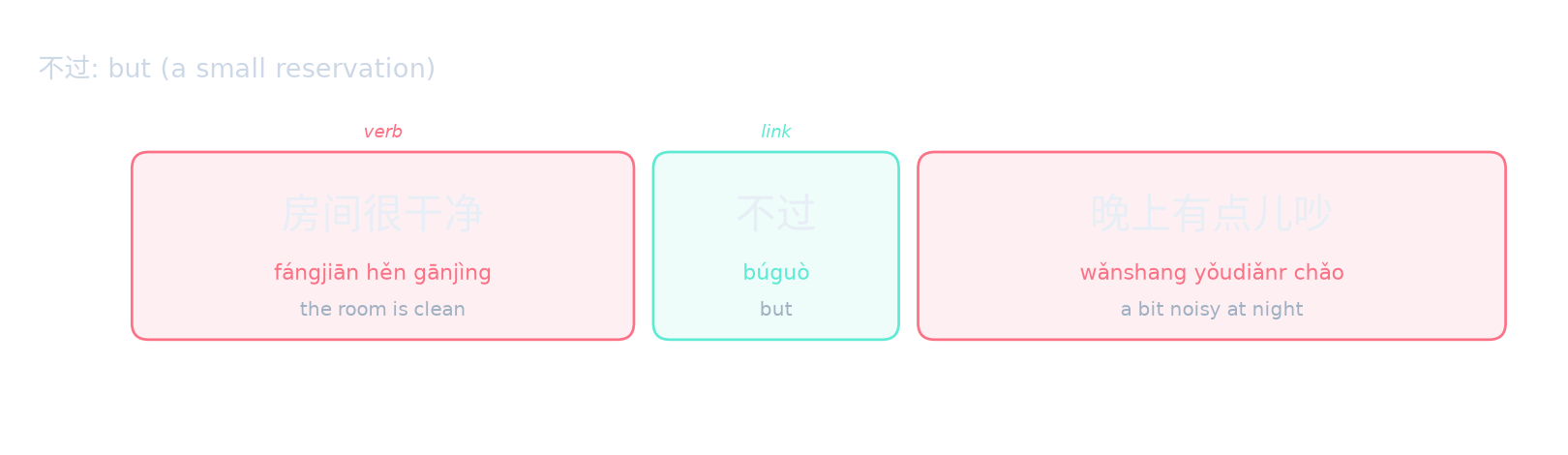
- room房间degree / adjective linker很clean干净,but不过evening晚上slightly有点儿noisy; to quarrel吵。 Fángjiān hěn gānjìng, búguò wǎnshang yǒudiǎnr chǎo. – The room was clean, though it was a bit noisy at night.
- you你can / may可以to use / with用I / me我(modifier / structural particle)的computer电脑,but不过don't别to download下载game游戏。 – You can use my computer, but don't download games.
- he / him他but不过to be / is是(measure word)个child孩子。 – He's only a child.
How it works. but不过 búguò adds a contrast or a small reservation, more gently than but但是. The first clause is usually positive; but不过 adds the limit. It starts its clause, before the subject. Before a noun or amount, but不过 means "only, merely": this这but不过to be / is是(measure word)个small小question / problem问题.
| but不过 | but但是 / but可是 |
|---|---|
| a small reservation | a clear contrast |
Watch out
- wrong: I / me我but不过today今天not / haven't没time时间 → but不过I / me我today今天not / haven't没time时间.
and so于是 (thereupon / and so)
Form: past event,and so于是 + what someone did next
- 雨停(completed / change)了,and so于是child孩子(plural)们to run跑出去玩(completed / change)了。 Yǔ tíng le, yúshì háizimen pǎo chūqu wán le. – The rain stopped, so the children ran out to play.
- he / him他hungry饿(completed / change)了,and so于是to go去to buy买(completed / change)了bread面包。 – He was hungry, so he went to buy some bread.
- he / him他to hear (sth said)听说那家店degree / adjective linker很famous有名,and so于是to decide / decision决定to go去试试。 – He heard the shop was famous, so he decided to try it.
How it works. and so于是 yúshì moves a story forward: the second event happens because of, and straight after, the first. It starts the second clause, before any new subject. It is for past narration: event, then reaction.
| so / therefore所以 | and so于是 |
|---|---|
| a logical result, any time | the next action in a past story |
| because因为to rain下雨,so / therefore所以competition比赛to cancel取消(completed / change)了 | to rain下雨(completed / change)了,and so于是we / us我们to return home回家(completed / change)了 |
Watch out
- Not for plans, rules or advice: wrong: if如果to rain下雨,and so于是we / us我们不去 → if如果to rain下雨,we / us我们then / just就not不to go去.

also / there is still还有 (also / and / what's more)
Form: A、B,also / there is still还有 C · also / there is still还有,+ new point
- to bring带passport护照、purse钱包,also / there is still还有mobile phone手机battery charger充电器。 Dài hùzhào, qiánbāo, hái yǒu shǒujī chōngdiànqì. – Bring your passport and wallet, and also your phone charger.
- I / me我to buy买(completed / change)了bread面包、milk牛奶,also / there is still还有egg鸡蛋。 – I bought bread and milk, and eggs too.
- also / there is still还有,you你别忘了to / for / give给mum; mother妈妈to make a telephone call打电话。 – Also, don't forget to call Mum.
How it works. also / there is still还有 hái yǒu adds one more item to a list, or one more point after a pause, often after a comma. and / with和 joins two nouns inside one phrase (bread面包and / with和milk牛奶); also / there is still还有 adds an afterthought.
Followed by an amount, still / also / even还 + to have / there is有 means "still have": I / me我also / there is still还有两个apple苹果. Check what follows: an amount (still have), or a new item or point (and also).

besides; other另外 (besides / in addition)
Form: besides; other另外,+ new point · subject + besides; other另外 + verb · besides; other另外((modifier / structural particle)的) + number + noun
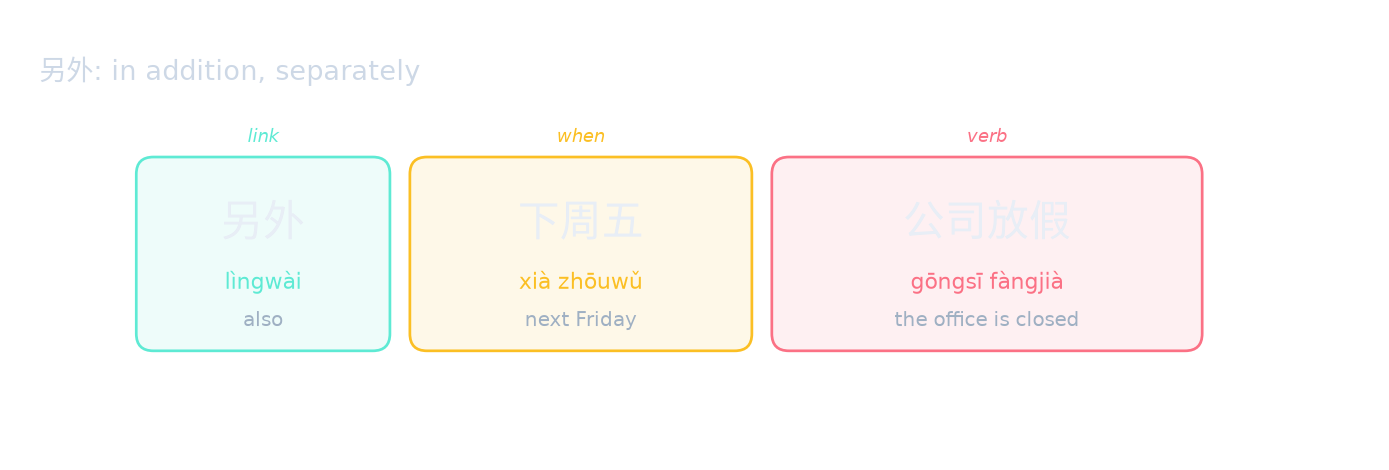
- besides; other另外,down / next; to fall (rain), get off下Friday周五company公司to have a holiday or…放假。 Lìngwài, xià zhōuwǔ gōngsī fàngjià. – Also, the company is closed next Friday.
- besides; other另外,请带identity card身份证。 – In addition, please bring your ID.
- I / me我besides; other另外to / for / give给you你to prepare; to plan to准备(completed / change)了一份。 – I've prepared an extra one for you.
- besides; other另外一个person人 / besides; other另外两个question / problem问题 – the other person / the other two questions
How it works. besides; other另外 lìngwài has three uses.
| Position | Meaning | Example |
|---|---|---|
| start of the sentence, with a comma | in addition (a separate point) | besides; other另外,…… |
| after the subject, before a verb | separately, on the side | he / him他besides; other另外还学Japanese language日语 |
| before a number or (modifier / structural particle)的 + noun | the other, another | besides; other另外一个person人 |
It is common in emails, meetings and instructions.
Watch out
- besides; other另外 adds something different. To add more of the same, use still / also / even还 or also也.
talk later / besides再说 (besides / what's more)
Form: reason 1,talk later / besides再说 + reason 2 · … after / from now on以后talk later / besides再说 (deal with it later)
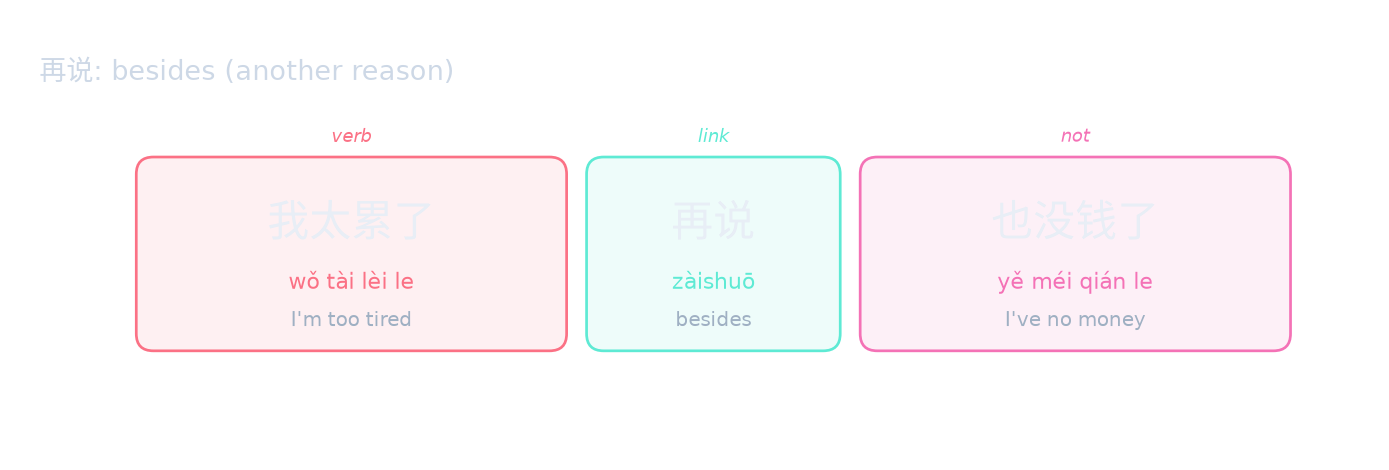
- 我太累(completed / change)了,talk later / besides再说also也not / haven't没money钱(completed / change)了。 Wǒ tài lèi le, zàishuō yě méi qián le. – I'm too tired, and besides, I'm out of money.
- 太晚(completed / change)了,talk later / besides再说shop商店also也to close (the door)关门(completed / change)了。 – It's too late, and besides, the shop is closed.
- 别买(completed / change)了,太贵(completed / change)了,talk later / besides再说you你already已经to have / there is有一个(completed / change)了。 – Don't buy it; it's too expensive, and besides, you already have one.
- 这件matter事after / from now on以后talk later / besides再说(suggestion)吧。 – Let's talk about it later.
How it works. talk later / besides再说 zàishuō starts a second clause to add a further reason, in conversation: "besides, what's more". The added reason often has also也 or still / also / even还. It is spoken; in writing use moreover而且 or besides此外.
At the end of a sentence, talk later / besides再说 means "we'll deal with it later": this这个question / problem问题tomorrow明天talk later / besides再说.
Watch out
- talk later / besides再说 adds reasons, not steps. "Then" in a sequence is then / after然后.
but可是 / but但是 (two words for “but”)
Form: (although虽然) A,but可是 / but但是 + B
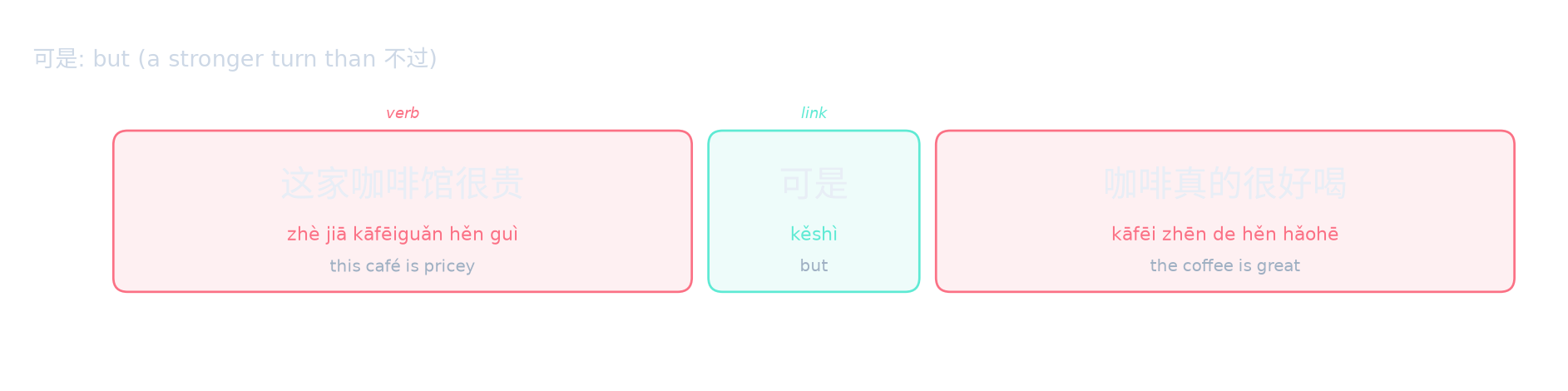
- 这家café咖啡馆degree / adjective linker很expensive贵,but可是coffee咖啡really真的degree / adjective linker很tasty (drinks)好喝。 Zhè jiā kāfēiguǎn hěn guì, kěshì kāfēi zhēn de hěn hǎohē. – This café is expensive, but the coffee is really good.
- I / me我want / think / miss想to go去,but可是mum; mother妈妈不让。 Wǒ xiǎng qù, kěshì māma bú ràng. – I want to go, but Mum won't let me.
- although虽然to rain下雨,but但是competition比赛照常进行。 – Although it was raining, the match went ahead.
How it works. Both start the second clause, before the subject, and both pair with although虽然. but; yet却 after the subject can strengthen the contrast: he / him他degree / adjective linker很intelligent聪明,but但是but; yet却not不to work hard / effort努力.
| but不过 | but可是 | but但是 |
|---|---|---|
| a small reservation | clear contrast, spoken, often with feeling | clear contrast, neutral, fits writing |
Watch out
- One "but" per contrast: wrong: although虽然……but可是but但是…….
- wrong: I / me我but但是not / haven't没to go去 → but但是I / me我not / haven't没to go去.
and / but而 (whereas / and yet)
Form: A,and / but而 B (whereas) · adjective + and / but而 + adjective (written "and")
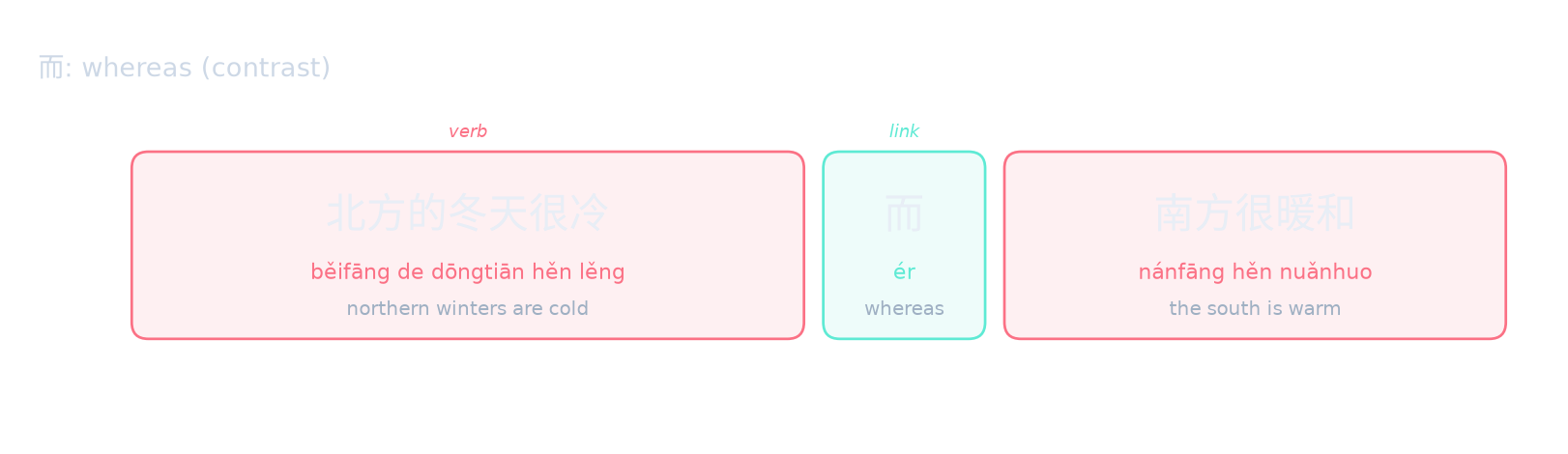
- north北方(modifier / structural particle)的winter冬天degree / adjective linker很cold冷,and / but而south南方degree / adjective linker很warm暖和。 Běifāng de dōngtiān hěn lěng, ér nánfāng hěn nuǎnhuo. – Winters in the north are cold, whereas the south is warm.
- 他学law法律,and / but而I / me我to study medicine学医。 – He studies law, while I study medicine.
- he / him他degree / adjective linker很rich有钱,and / but而life; to live生活but; yet却degree / adjective linker很simple简单。 – He's very rich, yet he lives very simply.
- this这个method方法simple简单and / but而effective有效。 – This method is simple and effective.
How it works. and / but而 ér sets two comparable facts side by side (two places, two people, two qualities). It is written and formal; it suits a newspaper article comparing two cities. With but; yet却 it contrasts a fact with an expectation. Between two adjectives, it means "and".
| but但是 | and / but而 |
|---|---|
| the second part goes against the first | often just sets two facts side by side |
| spoken and written | written, formal |
Watch out
- In chat, say but但是, but可是 or but; yet却 instead.
to use / with用 / to pass; through; by means of通过 … to come来 … (by means of …)
Form: to use / with用 + tool + (to come来) + verb · to pass; through; by means of通过 + method + (to come来) + verb
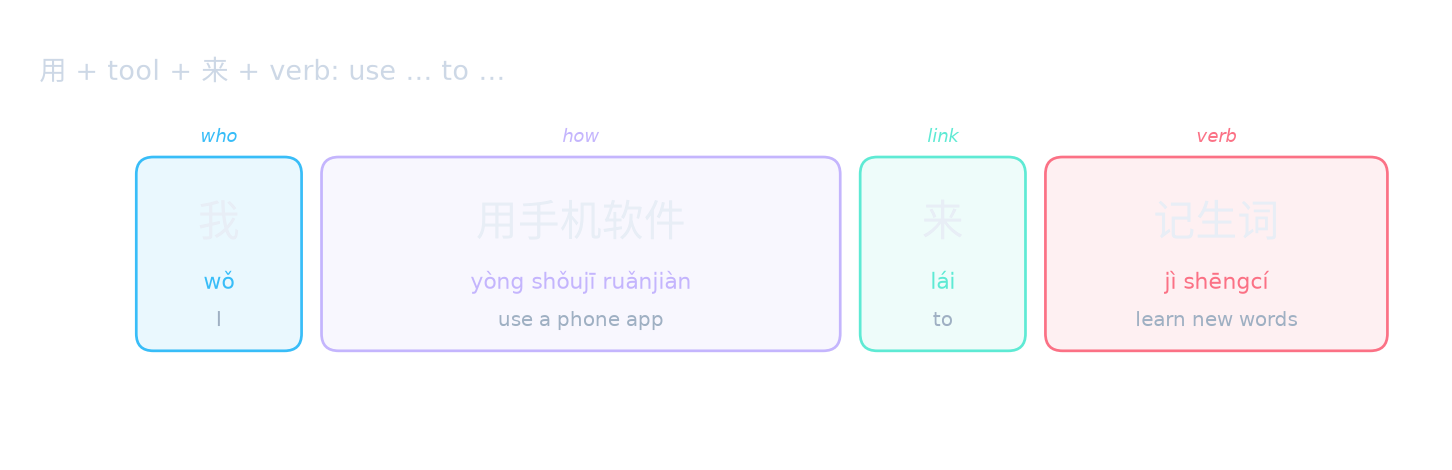
- 我用手机软件来记new word (in textbook)生词。 Wǒ yòng shǒujī ruǎnjiàn lái jì shēngcí. – I use a phone app to memorise new words.
- 我用dictionary词典来查new word (in textbook)生词。 – I use a dictionary to look up new words.
- he / him他to pass; through; by means of通过sports / to exercise运动to come来to lose weight减肥。 Tā tōngguò yùndòng lái jiǎnféi. – He loses weight through exercise.
- he / him他to pass; through; by means of通过friend朋友to introduce介绍to find找到(completed / change)了to work; job工作。 – He found the job through a friend's introduction.
How it works. The means comes first, then the action. to come来 here does not mean "come": it links the means to the purpose, and can be left out (我用mobile phone手机to record记new word (in textbook)生词).
| to use / with用 | to pass; through; by means of通过 |
|---|---|
| a concrete tool or language | a method, process or channel |
| to use / with用chopsticks筷子to have a meal吃饭, to use / with用Chinese language中文to write写 | to pass; through; by means of通过network网络to study; to learn学习, to pass; through; by means of通过friend朋友to introduce介绍 |
Watch out
- In this pattern the tool goes first: wrong: to have a meal吃饭to use / with用chopsticks筷子 → to use / with用chopsticks筷子to have a meal吃饭.
first of all首先 … next; secondly其次 … finally; last最后 (first, second, finally)
Form: first of all首先 …,next; secondly其次 …,finally; last最后 …
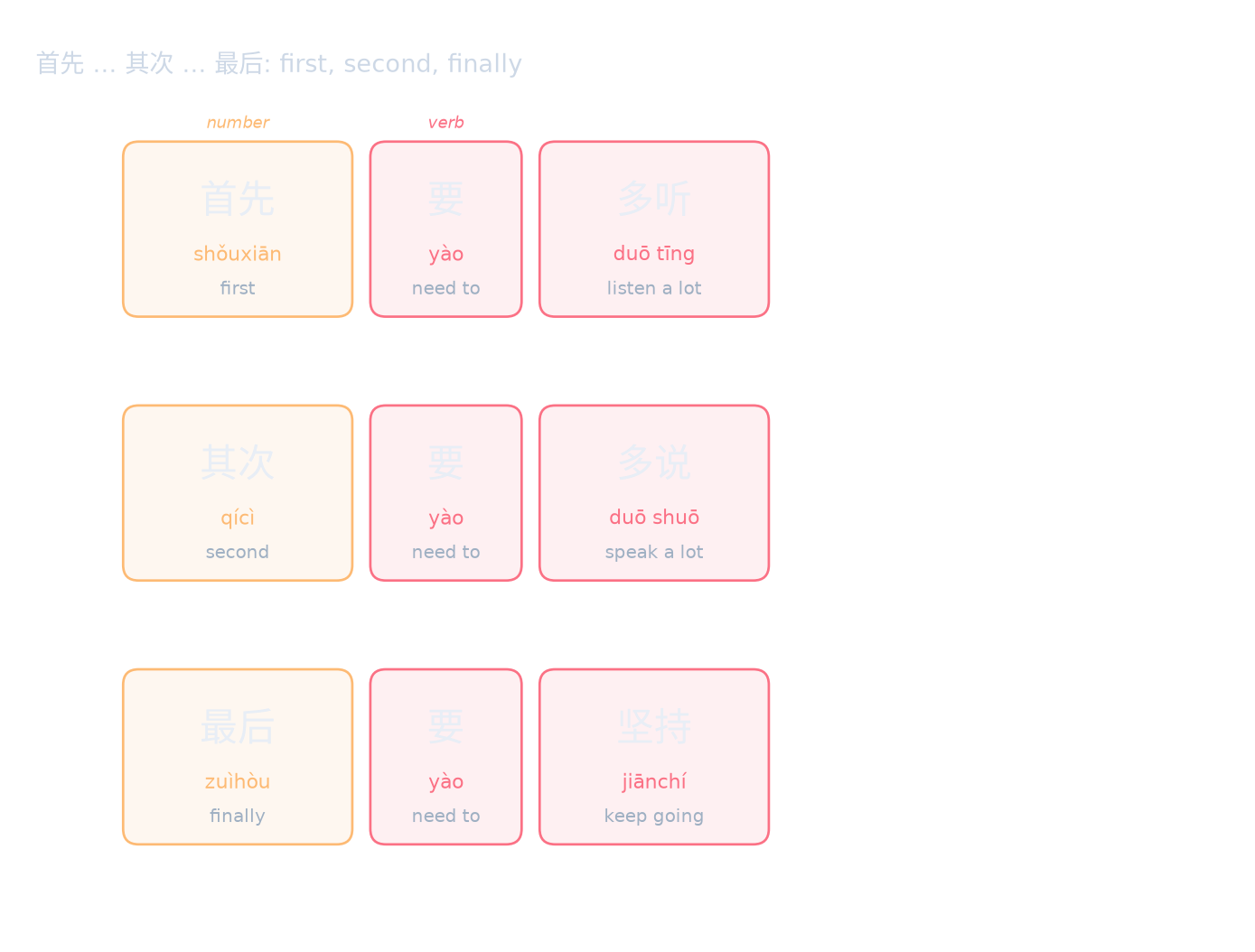
- first of all首先want / will / need要many; much多to listen to听,next; secondly其次want / will / need要many; much多to speak说,finally; last最后want / will / need要to keep at; to insist坚持。 Shǒuxiān yào duō tīng, qícì yào duō shuō, zuìhòu yào jiānchí. – First, listen a lot; second, speak a lot; finally, keep going.
- first of all首先to wash one's hands洗手,then / after然后切菜,then; next接着to stir-fry炒菜,finally; last最后to put / let go放condiment调料。 – First wash your hands, then cut the vegetables, next fry them, and finally add the seasoning.
- first of all首先,我要to thank感谢everyone大家。 – First of all, I'd like to thank everyone.
How it works. first of all首先, next; secondly其次 and finally; last最后 put points or steps in order. Each starts its own point. Add then / after然后 or then; next接着 for more steps.
| first of all首先 … next; secondly其次 … finally; last最后 | then / after然后 | to start开始 … later; afterwards后来 |
|---|---|---|
| first, second, finally (a list) | then (in a story) | at first … later |
Watch out
- wrong: I / me我to eat吃(completed / change)了breakfast早饭,next; secondly其次to go去to go to school上学 → I / me我to eat吃(completed / change)了breakfast早饭,then / after然后to go去to go to school上学.
- wrong: I / me我first of all首先not不habit / be used to习惯,later; afterwards后来… → I / me我to start开始not不habit / be used to习惯,later; afterwards后来….
for example例如 vs for example比如 (for example)
Form: general word,for example例如 / for example比如 + A、B (to wait; and so on等)
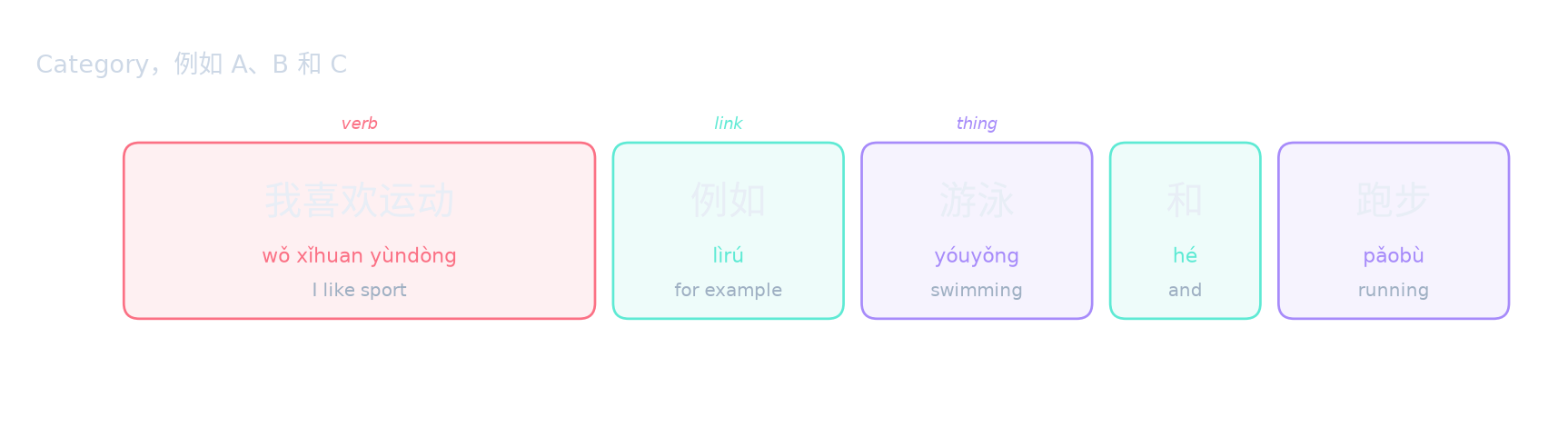
- I / me我to like喜欢sports / to exercise运动,for example例如to swim游泳and / with和to run; to jog跑步。 Wǒ xǐhuan yùndòng, lìrú yóuyǒng hé pǎobù. – I like sport, for example swimming and running.
- 很多fruit水果to / towards / correct对body; health身体good好,for example例如apple苹果、banana香蕉。 – Lots of fruit is good for you, for example apples and bananas.
- you你can / may可以to do; to make做a little点儿sports / to exercise运动,for example比如打打球。 – You could do some exercise, like playing a bit of ball.
How it works. Say the general group first, then for example例如 (a little formal) or for example比如 / for example比如说 (spoken) and the examples, separated by 、. End an incomplete list with to wait; and so on等. to resemble像 + noun + this way / so这样(modifier / structural particle)的 = like ….
| for example例如apple苹果、banana香蕉to wait; and so on等 | for example比如说 | to resemble像Beijing北京this way / so这样(modifier / structural particle)的city城市 |
|---|---|---|
| for example apples, bananas … | for example (speech) | cities like Beijing |
Watch out
- wrong: for example例如apple苹果,I / me我to like喜欢fruit水果 → I / me我to like喜欢fruit水果,for example例如apple苹果.
Practice without the models
Cover the teaching sections before you answer. The answers follow.
but不过 (a softer “but”)
1. Complete: “The film was good, though a bit long.” film; movie电影not bad / pretty good不错,…………slightly有点儿long长。
2. In this这but不过to be / is是(measure word)个small小question / problem问题, what does but不过 mean?
- A. but
- B. however much
- C. not even
- D. only, merely
3. Build: “You can use my computer, but don't download games.”
Put in order: you你can / may可以to use / with用I / me我(modifier / structural particle)的computer电脑 / don't别to download下载game游戏。 / but不过 / ,
4. True or false? but不过 sounds softer than but但是. If false, correct it.
5. A friend asks about the hotel you stayed in. It was clean and friendly, but noisy at night. Use but不过. Write your answer in Chinese, then say it aloud.
and so于是 (thereupon / and so)
6. Complete: “He was hungry, so he went to buy some bread.” he / him他hungry饿(completed / change)了,…………to go去to buy买(completed / change)了bread面包。
7. Which sentence uses and so于是 correctly?
- A. to get dark天黑(completed / change)了,and so于是we / us我们to return home回家(completed / change)了。
- B. you你should应该to rest休息,and so于是you你can / will会good好。
- C. if如果tomorrow明天to rain下雨,and so于是we / us我们不去。
- D. and so于是because因为to rain下雨,competition比赛to cancel取消(completed / change)了。
8. Build: “He heard the shop was famous, so he decided to try it.”
Put in order: he / him他to hear (sth said)听说那家店degree / adjective linker很famous有名 / , / to decide / decision决定to go去试试。 / and so于是
9. True or false? and so于是 is suitable for general rules about the future. If false, correct it.
10. You are reading a short story aloud: the rain stopped, and the children rushed outside. Use and so于是. Write your answer in Chinese, then say it aloud.
also / there is still还有 (also / and / what's more)
11. Add a point: “Also, tomorrow's meeting is at nine.” …………,tomorrow明天(modifier / structural particle)的can / will会九点to start开始。
12. In I / me我also / there is still还有两个apple苹果, what does also / there is still还有 mean?
- A. and also
- B. however
- C. still have
- D. besides
13. Build: “I bought bread and milk, and also eggs.”
Put in order: also / there is still还有 / I / me我to buy买(completed / change)了bread面包、milk牛奶 / egg鸡蛋。 / ,
14. True or false? also / there is still还有 often adds an afterthought after a comma. If false, correct it.
15. You are listing what to pack for a trip and suddenly remember an item. Use also / there is still还有. Write your answer in Chinese, then say it aloud.
besides; other另外 (besides / in addition)
16. Add a separate point: “In addition, please bring your ID.” …………,请带identity card身份证。
17. What does besides; other另外一个person人 mean?
- A. besides a person
- B. the other person
- C. every person
- D. one more time
18. Build: “He's also studying Japanese on the side.”
Put in order: besides; other另外 / he / him他 / Japanese language日语。 / 还学
19. True or false? besides; other另外 is used to add a different, separate point. If false, correct it.
20. Your manager finishes the main point of a meeting and then adds a separate item. Use besides; other另外. Write your answer in Chinese, then say it aloud.
talk later / besides再说 (besides / what's more)
21. Complete: “It's too late, and besides, the shop is closed.” 太晚(completed / change)了,…………shop商店also也to close (the door)关门(completed / change)了。
22. What does this这个question / problem问题tomorrow明天talk later / besides再说 mean?
- A. Say this question again tomorrow.
- B. Besides this question, tomorrow…
- C. This question was said yesterday.
- D. Let's deal with this question tomorrow.
23. Build: “Don't buy it – it's too expensive, and besides you already have one.”
Put in order: 别买(completed / change)了 / ,talk later / besides再说 / ,太贵(completed / change)了 / you你already已经to have / there is有一个(completed / change)了。
24. True or false? talk later / besides再说 is the usual linker for “then” in a sequence of steps. If false, correct it.
25. A friend wants to go out tonight, but you are tired and have no money left. Use talk later / besides再说. Write your answer in Chinese, then say it aloud.
but可是 / but但是 (two words for “but”)
26. Complete (written): “Although it was raining, the match went ahead.” although虽然to rain下雨,…………competition比赛照常进行。
27. Which sentence has correct word order?
- A. I / me我want / think / miss想to go去,not / haven't没time时间but但是。
- B. I / me我but但是not / haven't没to go去。
- C. I / me我want / think / miss想to go去,but但是not / haven't没time时间。
- D. but但是I / me我want / think / miss想to go去,not / haven't没time时间。
28. Build: “I want to go, but Mum won't let me.”
Put in order: , / mum; mother妈妈不让。 / but可是 / I / me我want / think / miss想to go去
29. True or false? but; yet却 can follow the subject to strengthen a contrast. If false, correct it.
30. You tell a friend the new café is expensive, but the coffee really is excellent. Use but可是 / but但是. Write your answer in Chinese, then say it aloud.
and / but而 (whereas / and yet)
31. Complete (written): “He likes coffee, whereas she likes tea.” he / him他to like喜欢coffee咖啡,…………she / her她to like喜欢tea茶。
32. Which context suits and / but而 best?
- A. Ordering food in a restaurant
- B. Greeting a neighbour
- C. A newspaper article comparing two cities
- D. A text message to a friend
33. Build: “This method is simple and effective.”
Put in order: and / but而 / simple简单 / effective有效。 / this这个method方法
34. True or false? and / but而 can simply set two facts side by side without a strong “but”. If false, correct it.
35. You are comparing the weather in two parts of China for a school project. Use and / but而. Write your answer in Chinese, then say it aloud.
to use / with用 / to pass; through; by means of通过 … to come来 … (by means of …)
36. Complete: “I use a dictionary to look up new words.” I / me我…………dictionary词典来查new word (in textbook)生词。
37. Which fits a method? “He found the job through a friend's introduction.” he / him他____friend朋友to introduce介绍to find找到(completed / change)了to work; job工作。
- A. with / and跟
- B. to pass; through; by means of通过
- C. to use / with用
- D. to / towards / correct对
38. Build: “He loses weight through exercise.”
Put in order: to lose weight减肥。 / to pass; through; by means of通过sports / to exercise运动 / he / him他 / to come来
39. True or false? In to use / with用mobile phone手机来记new word (in textbook)生词, to come来 means “come”. If false, correct it.
40. A classmate asks how you remember so many characters. Use to use / with用 / to pass; through; by means of通过 … to come来 …. Write your answer in Chinese, then say it aloud.
first of all首先 … next; secondly其次 … finally; last最后 (first, second, finally)
41. Put the words in the order they are used in a list.
Put in order: finally; last最后 / next; secondly其次 / first of all首先
42. Complete: “First, listen a lot; second, speak a lot.” first of all首先want / will / need要many; much多to listen to听,…………want / will / need要many; much多to speak说。
43. “I ate breakfast, then went to school.” (a story) Which word fits? I / me我to eat吃(completed / change)了breakfast早饭,____to go去to go to school上学。
- A. next; secondly其次
- B. then / after然后
44. “At first I wasn't used to it; later I got used to it.” Which is right?
- A. I / me我first of all首先not不habit / be used to习惯,later; afterwards后来habit / be used to习惯(completed / change)了。
- B. I / me我to start开始not不habit / be used to习惯,later; afterwards后来habit / be used to习惯(completed / change)了。
45. True or false? first of all首先,我要to thank感谢everyone大家 means "First of all, I'd like to thank everyone." If false, correct it.
46. A friend asks how to make a good first impression at a job interview. Give three tips with first of all首先, next; secondly其次 and finally; last最后. Use first of all首先 … next; secondly其次 … finally; last最后. Write your answer in Chinese, then say it aloud.
for example例如 vs for example比如 (for example)
47. Complete: “I like sport, for example swimming and running.” I / me我to like喜欢sports / to exercise运动,…………to swim游泳and / with和to run; to jog跑步。
48. The group hasn't been named yet. Which order is right?
- A. for example例如apple苹果,I / me我to like喜欢fruit水果。
- B. I / me我to like喜欢fruit水果,for example例如apple苹果。
49. Chatting with a friend – which sounds most natural?
- A. you你can / may可以to do; to make做a little点儿sports / to exercise运动,for example例如打打球to wait; and so on等。
- B. you你can / may可以to do; to make做a little点儿sports / to exercise运动,for example比如打打球。
50. Build: “Lots of fruit is good for you, for example apples and bananas.”
Put in order: 很多fruit水果to / towards / correct对body; health身体good好, / apple苹果、 / banana香蕉。 / for example例如
51. True or false? to resemble像 + noun + this way / so这样(modifier / structural particle)的 can mean "like …", as in to resemble像Beijing北京this way / so这样(modifier / structural particle)的major city大城市. If false, correct it.
52. Answer in two sentences: What do you do to relax? Give examples with for example比如 (speech) and then write the same idea with for example例如 … to wait; and so on等. Use for example例如 or for example比如. Write your answer in Chinese, then say it aloud.
Answers and explanations
but不过 (a softer “but”)
1. but不过
but不过 adds a soft reservation.
2. D. only, merely
Before a noun phrase, but不过 = only.
3. you你can / may可以to use / with用I / me我(modifier / structural particle)的computer电脑,but不过don't别to download下载game游戏。
Permission, then but不过 + limit.
4. True.
but不过 often adds a minor reservation.
5. Model answer: room房间degree / adjective linker很clean干净,but不过evening晚上slightly有点儿noisy; to quarrel吵。
Check your answer:
- but不过 starts its clause, before the subject: but不过I / me我today今天not / haven't没time时间, not I / me我but不过today今天not / haven't没time时间.
- Keep the reservation small: for a strong contrast, but但是 sounds more natural.
and so于是 (thereupon / and so)
6. and so于是
and so于是 tells what he did next.
7. A. to get dark天黑(completed / change)了,and so于是we / us我们to return home回家(completed / change)了。
and so于是 narrates the next past action.
8. he / him他to hear (sth said)听说那家店degree / adjective linker很famous有名,and so于是to decide / decision决定to go去试试。
Event, then and so于是 + decision.
9. False.
It narrates what happened next in the past.
10. Model answer: 雨停(completed / change)了,and so于是child孩子(plural)们to run跑出去玩(completed / change)了。
Check your answer:
- and so于是 tells what someone did next; it is not for plans, rules or advice: if如果to rain下雨,we / us我们then / just就not不to go去, not and so于是we / us我们不去.
- It starts the second clause, usually before the subject if there is a new one: and so于是we / us我们to return home回家(completed / change)了 – "So we went home."
also / there is still还有 (also / and / what's more)
11. also / there is still还有
also / there is still还有 at the start adds a new point.
12. C. still have
still / also / even还 + to have / there is有 + amount = still have.
13. I / me我to buy买(completed / change)了bread面包、milk牛奶,also / there is still还有egg鸡蛋。
List, then also / there is still还有 + one more item.
14. True.
It adds one more item or point.
15. Model answer: to bring带passport护照、purse钱包,also / there is still还有mobile phone手机battery charger充电器。
Check your answer:
- As a linker, also / there is still还有 = "and also": also / there is still还有一件matter事 ("There is one more thing"). As a verb phrase, still / also / even还 + to have / there is有 = "still have": I / me我also / there is still还有十块钱 – "I still have ten yuan."
- Ask: is it about what is left (still have) or about adding one more thing (and also: also / there is still还有一件matter事)?
besides; other另外 (besides / in addition)
16. besides; other另外
besides; other另外 introduces a new, separate point.
17. B. the other person
besides; other另外 + number + MW + noun = the other / another.
18. he / him他besides; other另外还学Japanese language日语。
Subject + besides; other另外 + verb phrase.
19. True.
For more of the same, use still / also / even还 or also也.
20. Model answer: besides; other另外,down / next; to fall (rain), get off下Friday周五company公司to have a holiday or…放假。
Check your answer:
- besides; other另外 adds a separate point or item (besides; other另外两个question / problem问题 = two other questions); inside one clause, still / also / even还 / also也 add more of the same.
- At the start of a sentence, put a comma after besides; other另外.
talk later / besides再说 (besides / what's more)
21. talk later / besides再说
talk later / besides再说 adds a further reason.
22. D. Let's deal with this question tomorrow.
talk later / besides再说 at the end postpones a matter.
23. 别买(completed / change)了,太贵(completed / change)了,talk later / besides再说you你already已经to have / there is有一个(completed / change)了。
Reason 1, talk later / besides再说 + reason 2.
24. False.
Sequences use then / after然后; talk later / besides再说 adds reasons.
25. Model answer: 我太累(completed / change)了,talk later / besides再说also也not / haven't没money钱(completed / change)了。
Check your answer:
- talk later / besides再说 adds a reason or argument; for "then" in a sequence, use then / after然后.
- It is spoken; in writing use moreover而且 or besides此外.
but可是 / but但是 (two words for “but”)
26. but但是
although虽然 pairs with but但是 / but可是.
27. C. I / me我want / think / miss想to go去,but但是not / haven't没time时间。
but但是 starts the contrasting clause.
28. I / me我want / think / miss想to go去,but可是mum; mother妈妈不让。
Clause 1, but可是 + clause 2.
29. True.
True. but; yet却 is an adverb after the subject that sharpens a contrast, often with but但是 or but可是: I / me我degree / adjective linker很tired累,but但是he / him他but; yet却degree / adjective linker很spirit / energetic精神.
30. Model answer: 这家café咖啡馆degree / adjective linker很expensive贵,but可是coffee咖啡really真的degree / adjective linker很tasty (drinks)好喝。
Check your answer:
- Do not double them: although虽然…but但是…, not although虽然…but可是but但是….
- Put but但是 / but可是 at the start of the clause, before the subject: but但是I / me我not / haven't没to go去, not I / me我but但是not / haven't没to go去.
and / but而 (whereas / and yet)
31. and / but而
and / but而 contrasts two comparable facts.
32. C. A newspaper article comparing two cities
and / but而 is written, formal style.
33. this这个method方法simple简单and / but而effective有效。
Adj + and / but而 + Adj.
34. True.
True. and / but而 can simply set two facts side by side (“while, whereas”): 他学law法律,and / but而I / me我to study medicine学医 “He studies law, while I study medicine.”
35. Model answer: north北方(modifier / structural particle)的winter冬天degree / adjective linker很cold冷,and / but而south南方degree / adjective linker很warm暖和。
Check your answer:
- and / but而 is written style; in chat say but但是, but可是 or just but; yet却.
- Both clauses should be comparable (two places, two people, two qualities) for the "whereas" meaning.
to use / with用 / to pass; through; by means of通过 … to come来 … (by means of …)
36. to use / with用
to use / with用 + tool + to come来 + action.
37. B. to pass; through; by means of通过
A method or channel takes to pass; through; by means of通过.
38. he / him他to pass; through; by means of通过sports / to exercise运动to come来to lose weight减肥。
to pass; through; by means of通过 + method + to come来 + purpose.
39. False.
to come来 links the means to the purpose here.
40. Model answer: 我用手机软件来记new word (in textbook)生词。
Check your answer:
- Order: to use / with用 + tool + (to come来) + action: to use / with用chopsticks筷子to have a meal吃饭, not to have a meal吃饭to use / with用chopsticks筷子 in this pattern.
- to come来 here is not "come"; it links the means to the purpose.
first of all首先 … next; secondly其次 … finally; last最后 (first, second, finally)
41. first of all首先next; secondly其次finally; last最后
first of all首先 (first), next; secondly其次 (second), finally; last最后 (finally).
42. next; secondly其次
next; secondly其次 = second, the next point.
43. B. then / after然后
For "then" in a story, use then / after然后. next; secondly其次 ranks points.
44. B. I / me我to start开始not不habit / be used to习惯,later; afterwards后来habit / be used to习惯(completed / change)了。
“At first … later” is to start开始 … later; afterwards后来. first of all首先 starts a list.
45. True.
first of all首先 can introduce the first and most important point.
46. Model answer: first of all首先want / will / need要punctual准时to / arrive / (result: get)到,next; secondly其次want / will / need要to wear穿(degree marker)得formal正式a little一点儿,finally; last最后to answer回答question / problem问题(modifier / structural particle)的time; when时候want / will / need要to have / there is有confident自信。
Check your answer:
- The three points start with first of all首先, next; secondly其次 and finally; last最后.
- Each point is a short, clear piece of advice.
- I said it aloud before comparing with the model.
Your answer need not copy the model. A partner or teacher must hear the spoken response to comment on pronunciation.
for example例如 vs for example比如 (for example)
47. for example例如
For example – for example例如 (or for example比如 in speech).
48. B. I / me我to like喜欢fruit水果,for example例如apple苹果。
The general word comes first, then for example例如 + the example.
49. B. you你can / may可以to do; to make做a little点儿sports / to exercise运动,for example比如打打球。
In speech, for example比如; for example例如 … to wait; and so on等 sounds written.
50. 很多fruit水果to / towards / correct对body; health身体good好,for example例如apple苹果、banana香蕉。
General word, then for example例如 + examples joined with 、.
51. True.
to resemble像 is used before a noun.
52. Model answer: I / me我to like喜欢to do; to make做some一些relaxed; easy轻松(modifier / structural particle)的matter事,for example比如to listen to听music音乐、to look at; to watch; to read看film; movie电影。(to write写:I / me我to relax放松(modifier / structural particle)的method方法很多,for example例如to listen to听music音乐、to look at; to watch; to read看film; movie电影、to go for a walk散步to wait; and so on等。)
Check your answer:
- The general idea comes before for example比如 / for example例如.
- Examples are separated with 、 and the written list ends with to wait; and so on等.
- I said it aloud before comparing with the model.
Your answer need not copy the model. A partner or teacher must hear the spoken response to comment on pronunciation.