Skip to content
Subjects

HSK 4 Grammar

  • 1 Adjectives
    • 1.1 Indicating the whole with "quan"
    • 1.2 Negative adjectives with "-si le"

    Adjectives →

  • 2 Adverbs
    • 2.1 Approximations with "chabuduo"
    • 2.2 Assessing situations with "kanlai"
    • 2.3 Coincidence with "zhenghao"
    • 2.4 Declaring the only option with "zhihao"
    • 2.5 Emphasizing negation with "you"
    • 2.6 Emphatic adverb "ke"
    • 2.7 Expressing "all along" with "yuanlai"
    • 2.8 Expressing "almost" using "chadian"
    • 2.9 Expressing "always" with "conglai"
    • 2.10 Expressing "as a result" with "jieguo"
    • 2.11 Expressing "enough" with "gou"
    • 2.12 Expressing "even" with "shenzhi"
    • 2.13 Expressing "had better" with "haishi"
    • 2.14 Expressing "had better" with "zuihao"
    • 2.15 Expressing "have to" with "budebu"
    • 2.16 Expressing "in the end" with "daodi"
    • 2.17 Expressing "in the end" with "jiujing"
    • 2.18 Expressing "just" with "gang"
    • 2.19 Expressing "one by one" with "yi"
    • 2.20 Expressing "originally" with "benlai"
    • 2.21 Expressing "small quantity" with "jiu"
    • 2.22 Expressing "to make certain" with "qianwan"
    • 2.23 Expressing concern with "kongpa"
    • 2.24 Expressing the unexpected with "jingran"
    • 2.25 Rhetorical questions with "nandao"
    • 2.26 Sequencing with "xian" and "zai"
    • 2.27 Using "ye" and "dou" together

    Adverbs →

  • 3 Adverbs with Adjectives
    • 3.1 Expressing "quite" with "ting"

    Adverbs with Adjectives →

  • 4 Auxiliary Words

    Noun, Noun + what什么shén me(modifier / structural particle)的de (…and so on)

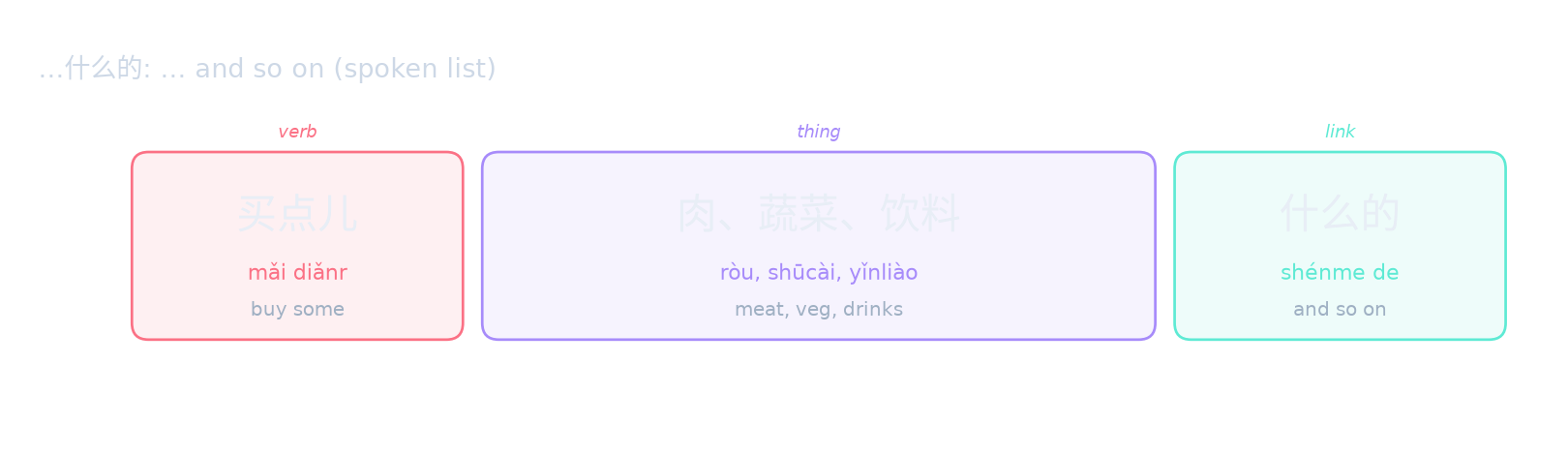
    Form: A、B (、C) + what什么shén me(modifier / structural particle)的de (spoken)

    • 买点儿mǎi diǎn érmeat肉ròu、vegetables蔬菜shū cài、drink饮料yǐn liàowhat什么shén me(modifier / structural particle)的de。 Mǎi diǎnr ròu, shūcài, yǐnliào shénmede. – Buy some meat, vegetables, drinks, that kind of thing.
    • I / me我wǒto like喜欢xǐ huanto read看书kàn shū、to listen to听tīngmusic音乐yīn yuèwhat什么shén me(modifier / structural particle)的de。 – I like reading, music and so on.
    • weekend周末zhōu mòI / me我wǒoften常常cháng chángto play ball打球dǎ qiú、to climb a mountain爬山pá shānwhat什么shén me(modifier / structural particle)的de。 – At weekends I often play ball, go hiking, things like that.

    How it works. what什么shén me(modifier / structural particle)的de shénmede closes an open list in casual speech: "… and so on, … that kind of thing". The items are only examples. Here what什么shén me does not mean "what", so there is no question mark.

    what什么shén me(modifier / structural particle)的de to wait; and so on等děng
    casual, at the end formal, written
    meat肉ròu、vegetables蔬菜shū càiwhat什么shén me(modifier / structural particle)的de apple苹果píng guǒ、banana香蕉xiāng jiāoto wait; and so on等děngfruit水果shuǐ guǒ

    Watch out

    • In a written report, use to wait; and so on等děng: he / him他tā去过qù guòBeijing北京běi jīng、Shanghai municipality…上海shàng hǎito wait; and so on等děngcity城市chéng shì.
    …什么的: … and so on (spoken list)

    … to wait; and so on等děng / et cetera等等děng děng (etc.)

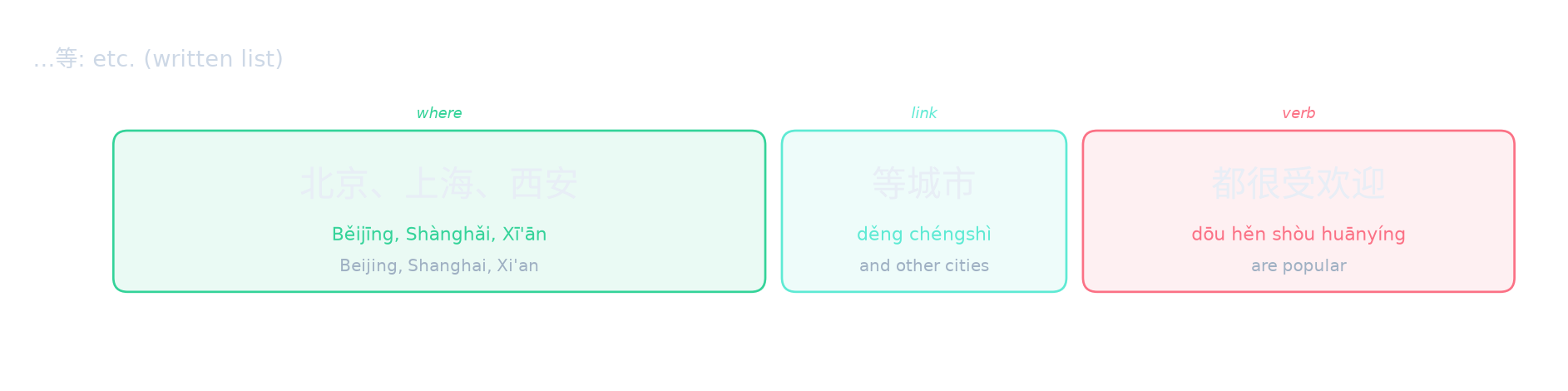
    Form: A、B + to wait; and so on等děng (+ summary noun) · A、B + et cetera等等děng děng · A、B、C + to wait; and so on等děng + number + noun

    • Beijing北京běi jīng、Shanghai municipality…上海shàng hǎi、Xi'an, sub-provincial city…西安xī ānto wait; and so on等děngcity城市chéng shìall / both都dōudegree / adjective linker很hěnpopular受欢迎shòu huān yíng。 Běijīng, Shànghǎi, Xī'ān děng chéngshì dōu hěn shòu huānyíng. – Cities such as Beijing, Shanghai and Xi'an are very popular.
    • China中国zhōng guóto have / there is有yǒu很多hěn duō传统节日chuán tǒng jié rì,for example比如bǐ rúSpring Festival (Chinese…春节chūn jié、the Mid-Autumn Festival on…中秋节zhōng qiū jiéet cetera等等děng děng。 – China has many traditional festivals, such as the Spring Festival, the Mid-Autumn Festival and so on.
    • Beijing北京běi jīng、Shanghai municipality…上海shàng hǎi、Guangzhou subprovincial…广州guǎng zhōuto wait; and so on等děng三个sān gècity城市chéng shì – the three cities of Beijing, Shanghai and Guangzhou

    How it works. to wait; and so on等děng děng is the written "etc.". It follows the list and can be followed by a noun that sums it up (to wait; and so on等děngfruit水果shuǐ guǒ, to wait; and so on等děngcity城市chéng shì). et cetera等等děng děng is a stronger "and so on and so forth", at the very end.

    to wait; and so on等děng + noun to wait; and so on等děng + number + noun
    an open list a closed list: exactly these
    apple苹果píng guǒ、banana香蕉xiāng jiāoto wait; and so on等děngfruit水果shuǐ guǒ Beijing北京běi jīng、Shanghai municipality…上海shàng hǎi、Guangzhou subprovincial…广州guǎng zhōuto wait; and so on等děng三个sān gècity城市chéng shì

    After a list of nouns, to wait; and so on等děng is "etc."; elsewhere it is the verb "wait": to wait; and so on等děng(used after a verb) give it…一下yī xià.

    …等: etc. (written list)

    Practice without the models

    Cover the teaching sections before you answer. The answers follow.

    Noun, Noun + what什么shén me(modifier / structural particle)的de (…and so on)

    1. Complete casually: “I like reading, music and so on.” I / me我wǒto like喜欢xǐ huanto read看书kàn shū、to listen to听tīngmusic音乐yīn yuè…………。

    2. Which suits a written report?

    • A. he / him他tā去过qù guòwhat什么shén me(modifier / structural particle)的deBeijing北京běi jīng、Shanghai municipality…上海shàng hǎi。
    • B. he / him他tā去过qù guòBeijing北京běi jīng、Shanghai municipality…上海shàng hǎiwhat什么shén me(modifier / structural particle)的decity城市chéng shì。
    • C. he / him他tā去过qù guòBeijing北京běi jīng、Shanghai municipality…上海shàng hǎiwhat什么shén me(modifier / structural particle)的de。
    • D. he / him他tā去过qù guòBeijing北京běi jīng、Shanghai municipality…上海shàng hǎito wait; and so on等děngcity城市chéng shì。

    3. Build: “At weekends I often play ball, go hiking, things like that.”

    Put in order: to play ball打球dǎ qiú、 / to climb a mountain爬山pá shān / what什么shén me(modifier / structural particle)的de。 / weekend周末zhōu mòI / me我wǒoften常常cháng cháng

    4. True or false? A sentence ending in what什么shén me(modifier / structural particle)的de needs a question mark. If false, correct it.

    5. Your roommate asks what to buy for the weekend barbecue. Use Noun, Noun + what什么shén me(modifier / structural particle)的de. Write your answer in Chinese, then say it aloud.

    … to wait; and so on等děng / et cetera等等děng děng (etc.)

    6. Complete (written): “apples, bananas and other fruit” apple苹果píng guǒ、banana香蕉xiāng jiāo…………fruit水果shuǐ guǒ

    7. What does Beijing北京běi jīng、Shanghai municipality…上海shàng hǎi、Guangzhou subprovincial…广州guǎng zhōuto wait; and so on等děng三个sān gècity城市chéng shì tell you?

    • A. There are more than three cities.
    • B. The list is incomplete.
    • C. The speaker is waiting for three cities.
    • D. There are exactly these three cities.

    8. Build: “Cities such as Beijing and Shanghai are very popular.”

    Put in order: popular受欢迎shòu huān yíng。 / Beijing北京běi jīng、Shanghai municipality…上海shàng hǎi / to wait; and so on等děngcity城市chéng shì / all / both都dōudegree / adjective linker很hěn

    9. True or false? to wait; and so on等děng is more formal than what什么shén me(modifier / structural particle)的de. If false, correct it.

    10. You read about which Chinese cities have the most visitors. Use … to wait; and so on等děng / et cetera等等děng děng. Write your answer in Chinese, then say it aloud.

    Answers and explanations

    Noun, Noun + what什么shén me(modifier / structural particle)的de (…and so on)

    1. what什么shén me(modifier / structural particle)的de

    what什么shén me(modifier / structural particle)的de ends an open list.

    2. D. he / him他tā去过qù guòBeijing北京běi jīng、Shanghai municipality…上海shàng hǎito wait; and so on等děngcity城市chéng shì。

    Writing uses to wait; and so on等děng + summary noun.

    3. weekend周末zhōu mòI / me我wǒoften常常cháng chángto play ball打球dǎ qiú、to climb a mountain爬山pá shānwhat什么shén me(modifier / structural particle)的de。

    List + what什么shén me(modifier / structural particle)的de.

    4. False.

    Here what什么shén me(modifier / structural particle)的de means “and so on”; it is a statement.

    5. Model answer: 买点儿mǎi diǎn érmeat肉ròu、vegetables蔬菜shū cài、drink饮料yǐn liàowhat什么shén me(modifier / structural particle)的de。

    Check your answer:

    • what什么shén me(modifier / structural particle)的de here is not "what"; it ends a list, so no question mark.
    • In writing use to wait; and so on等děng instead: Beijing北京běi jīng、Shanghai municipality…上海shàng hǎito wait; and so on等děngcity城市chéng shì – "Cities such as Beijing and Shanghai."

    … to wait; and so on等děng / et cetera等等děng děng (etc.)

    6. to wait; and so on等děng

    List + to wait; and so on等děng + summary noun.

    7. D. There are exactly these three cities.

    A number after to wait; and so on等děng closes the list.

    8. Beijing北京běi jīng、Shanghai municipality…上海shàng hǎito wait; and so on等děngcity城市chéng shìall / both都dōudegree / adjective linker很hěnpopular受欢迎shòu huān yíng。

    List + to wait; and so on等děng + noun + comment.

    9. True.

    to wait; and so on等děng suits writing; what什么shén me(modifier / structural particle)的de suits chat.

    10. Model answer: Beijing北京běi jīng、Shanghai municipality…上海shàng hǎi、Xi'an, sub-provincial city…西安xī ānto wait; and so on等děngcity城市chéng shìall / both都dōudegree / adjective linker很hěnpopular受欢迎shòu huān yíng。

    Check your answer:

    • to wait; and so on等děng is formal; in chat, what什么shén me(modifier / structural particle)的de sounds more natural.
    • With a number after to wait; and so on等děng, the number gives the total: Beijing北京běi jīng、Shanghai municipality…上海shàng hǎi、Guangzhou subprovincial…广州guǎng zhōuto wait; and so on等děng三个sān gècity城市chéng shì = these three cities.
  • 5 Conjunctions
    • 5.1 A softer "but" with "buguo"
    • 5.2 Expressing "and then" with "yushi"
    • 5.3 Expressing "in addition" with "haiyou"
    • 5.4 Expressing "in addition" with "lingwai"
    • 5.5 Expressing "in addition" with "zaishuo"
    • 5.6 Two words for "but"
    • 5.7 Using "er" to explain contrasting ideas
    • 5.8 Using "lai" to connect two verb phrases

    Conjunctions →

  • 6 Nouns
    • 6.1 Expressing "within (it/them)" with "qizhong"

    Nouns →

  • 7 Numbers
    • 7.1 Expressing fractions with "fenzhi"

    Numbers →

  • 8 Particles
    • 8.1 Advanced yes-no questions with "ma"
    • 8.2 Reviewing options with "ba"
    • 8.3 Using "de" (modal particle)

    Particles →

  • 9 Prepositions
    • 9.1 Expressing "along with…" with "suizhe"
    • 9.2 Idiomatic phrases with "zai"

    Prepositions →

  • 10 Sentence Patterns
    • 10.1 Emphasizing a negation with "bing"

    Sentence Patterns →

  • 11 Sentence patterns
    • 11.1 Using "yi... wei..."

    Sentence patterns →

  • 12 Verbs
    • 12.1 Causative verbs
    • 12.2 Expressing "it depends" with "kan"
    • 12.3 Expressing "it seems" with "haoxiang"
    • 12.4 Expressing "lies in" with "zaiyu"
    • 12.5 Expressing "mistakenly think that" with "yiwei"
    • 12.6 Expressing "through" with "tongguo"
    • 12.7 Expressing "to come from" with "laizi"
    • 12.8 Using "lai" as a dummy verb

    Verbs →

  • 13 Auxiliary verbs
    • 13.1 Expressing "don't need to" with "buyong"
    • 13.2 Expressing "must" with "dei"

    Auxiliary verbs →

  • 14 Verb phrases
    • 14.1 Combining verbs with "bing"
    • 14.2 Doing something less with "shao"
    • 14.3 Doing something more with "duo"
    • 14.4 Emphasizing the doer of an action with "you"
    • 14.5 Expressing "moreover" with "bingqie"
    • 14.6 Expressing "never" with "conglai"
    • 14.7 Expressing "to be worth" doing with "zhide"
    • 14.8 Expressing "until" with "dao"
    • 14.9 Indicating negative impact with "haide"
    • 14.10 Separable verb
    • 14.11 Using "zhe" when "verbing away"

    Verb phrases →

  • 15 "But" Statements
    • 15.1 Expressing "although" with "jinguan"
    • 15.2 Expressing contrariness with "dao"
    • 15.3 The "however" adverb "que"

    "But" Statements →

  • 16 "Even If" Statements
    • 16.1 Expressing "even if…" with "jishi"

    "Even If" Statements →

  • 17 "If" Statements
    • 17.1 Expressing "if… then…" with "yaoshi"

    "If" Statements →

  • 18 "No Matter" Statements
    • 18.1 Expressing "no matter" with "buguan"
    • 18.2 Expressing "no matter" with "wulun"

    "No Matter" Statements →

  • 19 Cause/Effect Statements
    • 19.1 Expressing "due to…" with "youyu"
    • 19.2 Expressing "since" with "jiran"
    • 19.3 Expressing "therefore" with "yinci"

    Cause/Effect Statements →

  • 20 Complements
    • 20.1 Advanced uses of direction complement "-qilai"
    • 20.2 Direction complement
    • 20.3 Direction complement "-qilai"
    • 20.4 Potential complement

    Complements →

  • 21 Conditional Statements
    • 21.1 Expressing "as long as" with "zhiyao"
    • 21.2 Expressing "unless" with "chufei"

    Conditional Statements →

  • 22 Noun Phrases
    • 22.1 Expressing "all" with "suoyou"
    • 22.2 Expressing "one of" with "zhiyi"
    • 22.3 Expressing "the other" with "lingwai"

    Noun Phrases →

  • 23 Sentence Patterns
    • 23.1 Advanced uses of "lian"
    • 23.2 Explaining purpose with "wei... er..."
    • 23.3 Expressing "any" with "renhe"
    • 23.4 Expressing "both… and…" with "ji...you"
    • 23.5 Expressing location with "zai... shang / xia / li"

    Sentence Patterns →

  • 24 Basic/Simple Sentence Patterns
    • 24.1 Expressing "even" with "lian" and "dou"
    • 24.2 Expressing "every" with question words
    • 24.3 Expressing "multiples" with "bei"
    • 24.4 Expressing "not at all" with "yidianr ye bu"
    • 24.5 Expressing not knowing how to do something using "hao"
    • 24.6 Phrases using "laishuo"

    Basic/Simple Sentence Patterns →

  • 25 Complex Sentence Patterns
    • 25.1 Conceding a point with "shi"
    • 25.2 Events in quick succession with "yi... jiu..."
    • 25.3 Expressing various aspects with "yi fangmian"

    Complex Sentence Patterns →

  • 26 Not only… but also…
    • 26.1 Many types of "not only... but also..."

    Not only… but also… →

  • 27 Comparing similar adverbs
    • 27.1 Comparing "benlai" and "yuanlai"
    • 27.2 Comparing "changchang" and "wangwang"
    • 27.3 Comparing "gang" and "gangcai"

    Comparing similar adverbs →

  • 28 Comparing similar prepositions
    • 28.1 Comparing "guanyu" and "duiyu"
    • 28.2 Comparing "li" and "cong"

    Comparing similar prepositions →

  • 29 Comparing similar separate functions
    • 29.1 Comparing "fan'er" and “xiangfan"
    • 29.2 Comparing "kending" "queding" and “yiding"
    • 29.3 Comparing "shihe" and "heshi"

    Comparing similar separate functions →

  • 30 Comparing similar time words
    • 30.1 Comparing "yihou" and "de shihou"

    Comparing similar time words →

Log in or create account

IGCSE, A-Level & AP