Skip to content
Subjects
  • 1 Adjectives
    • 1.1 Indicating the whole with "quan"
    • 1.2 Negative adjectives with "-si le"

    Adjectives →

  • 2 Adverbs
    • 2.1 Approximations with "chabuduo"
    • 2.2 Assessing situations with "kanlai"
    • 2.3 Coincidence with "zhenghao"
    • 2.4 Declaring the only option with "zhihao"
    • 2.5 Emphasizing negation with "you"
    • 2.6 Emphatic adverb "ke"
    • 2.7 Expressing "all along" with "yuanlai"
    • 2.8 Expressing "almost" using "chadian"
    • 2.9 Expressing "always" with "conglai"
    • 2.10 Expressing "as a result" with "jieguo"
    • 2.11 Expressing "enough" with "gou"
    • 2.12 Expressing "even" with "shenzhi"
    • 2.13 Expressing "had better" with "haishi"
    • 2.14 Expressing "had better" with "zuihao"
    • 2.15 Expressing "have to" with "budebu"
    • 2.16 Expressing "in the end" with "daodi"
    • 2.17 Expressing "in the end" with "jiujing"
    • 2.18 Expressing "just" with "gang"
    • 2.19 Expressing "one by one" with "yi"
    • 2.20 Expressing "originally" with "benlai"
    • 2.21 Expressing "small quantity" with "jiu"
    • 2.22 Expressing "to make certain" with "qianwan"
    • 2.23 Expressing concern with "kongpa"
    • 2.24 Expressing the unexpected with "jingran"
    • 2.25 Rhetorical questions with "nandao"
    • 2.26 Sequencing with "xian" and "zai"
    • 2.27 Using "ye" and "dou" together

    Adverbs →

  • 3 Adverbs with Adjectives
    • 3.1 Expressing "quite" with "ting"

    Adverbs with Adjectives →

  • 4 Auxiliary Words
    • 4.1 Ending a non-exhaustive list with "shenme de"
    • 4.2 Non-exhaustive lists with "dengdeng"

    Auxiliary Words →

  • 5 Conjunctions
    • 5.1 A softer "but" with "buguo"
    • 5.2 Expressing "and then" with "yushi"
    • 5.3 Expressing "in addition" with "haiyou"
    • 5.4 Expressing "in addition" with "lingwai"
    • 5.5 Expressing "in addition" with "zaishuo"
    • 5.6 Two words for "but"
    • 5.7 Using "er" to explain contrasting ideas
    • 5.8 Using "lai" to connect two verb phrases

    Conjunctions →

  • 6 Nouns
    • 6.1 Expressing "within (it/them)" with "qizhong"

    Nouns →

  • 7 Numbers
    • 7.1 Expressing fractions with "fenzhi"

    Numbers →

  • 8 Particles
    • 8.1 Advanced yes-no questions with "ma"
    • 8.2 Reviewing options with "ba"
    • 8.3 Using "de" (modal particle)

    Particles →

  • 9 Prepositions
    • 9.1 Expressing "along with…" with "suizhe"
    • 9.2 Idiomatic phrases with "zai"

    Prepositions →

  • 10 Sentence Patterns
    • 10.1 Emphasizing a negation with "bing"

    Sentence Patterns →

  • 11 Sentence patterns
    • 11.1 Using "yi... wei..."

    Sentence patterns →

  • 12 Verbs
    • 12.1 Causative verbs
    • 12.2 Expressing "it depends" with "kan"
    • 12.3 Expressing "it seems" with "haoxiang"
    • 12.4 Expressing "lies in" with "zaiyu"
    • 12.5 Expressing "mistakenly think that" with "yiwei"
    • 12.6 Expressing "through" with "tongguo"
    • 12.7 Expressing "to come from" with "laizi"
    • 12.8 Using "lai" as a dummy verb

    Verbs →

  • 13 Auxiliary verbs
    • 13.1 Expressing "don't need to" with "buyong"
    • 13.2 Expressing "must" with "dei"

    Auxiliary verbs →

  • 14 Verb phrases
    • 14.1 Combining verbs with "bing"
    • 14.2 Doing something less with "shao"
    • 14.3 Doing something more with "duo"
    • 14.4 Emphasizing the doer of an action with "you"
    • 14.5 Expressing "moreover" with "bingqie"
    • 14.6 Expressing "never" with "conglai"
    • 14.7 Expressing "to be worth" doing with "zhide"
    • 14.8 Expressing "until" with "dao"
    • 14.9 Indicating negative impact with "haide"
    • 14.10 Separable verb
    • 14.11 Using "zhe" when "verbing away"

    Verb phrases →

  • 15 "But" Statements
    • 15.1 Expressing "although" with "jinguan"
    • 15.2 Expressing contrariness with "dao"
    • 15.3 The "however" adverb "que"

    "But" Statements →

  • 16 "Even If" Statements
    • 16.1 Expressing "even if…" with "jishi"

    "Even If" Statements →

  • 17 "If" Statements
    • 17.1 Expressing "if… then…" with "yaoshi"

    "If" Statements →

  • 18 "No Matter" Statements
    • 18.1 Expressing "no matter" with "buguan"
    • 18.2 Expressing "no matter" with "wulun"

    "No Matter" Statements →

  • 19 Cause/Effect Statements
    • 19.1 Expressing "due to…" with "youyu"
    • 19.2 Expressing "since" with "jiran"
    • 19.3 Expressing "therefore" with "yinci"

    Cause/Effect Statements →

  • 20 Complements
    • 20.1 Advanced uses of direction complement "-qilai"
    • 20.2 Direction complement
    • 20.3 Direction complement "-qilai"
    • 20.4 Potential complement

    Complements →

  • 21 Conditional Statements
    • 21.1 Expressing "as long as" with "zhiyao"
    • 21.2 Expressing "unless" with "chufei"

    Conditional Statements →

  • 22 Noun Phrases
    • 22.1 Expressing "all" with "suoyou"
    • 22.2 Expressing "one of" with "zhiyi"
    • 22.3 Expressing "the other" with "lingwai"

    Noun Phrases →

  • 23 Sentence Patterns
    • 23.1 Advanced uses of "lian"
    • 23.2 Explaining purpose with "wei... er..."
    • 23.3 Expressing "any" with "renhe"
    • 23.4 Expressing "both… and…" with "ji...you"
    • 23.5 Expressing location with "zai... shang / xia / li"

    Sentence Patterns →

  • 24 Basic/Simple Sentence Patterns
    • 24.1 Expressing "even" with "lian" and "dou"
    • 24.2 Expressing "every" with question words
    • 24.3 Expressing "multiples" with "bei"
    • 24.4 Expressing "not at all" with "yidianr ye bu"
    • 24.5 Expressing not knowing how to do something using "hao"
    • 24.6 Phrases using "laishuo"

    Basic/Simple Sentence Patterns →

  • 25 Complex Sentence Patterns
    • 25.1 Conceding a point with "shi"
    • 25.2 Events in quick succession with "yi... jiu..."
    • 25.3 Expressing various aspects with "yi fangmian"

    Complex Sentence Patterns →

  • 26 Not only… but also…

    not only不但bù dàn / not just不仅bù jǐn … ,moreover而且ér qiě / still / also / even还hái / also也yě … (not only … but also)

    Form: not only不但bù dàn / not just不仅bù jǐn A,moreover而且ér qiě / still / also / even还hái / also也yě B · not only不但bù dànnot不bù A,instead (contrary to expectation)反而fǎn ér B

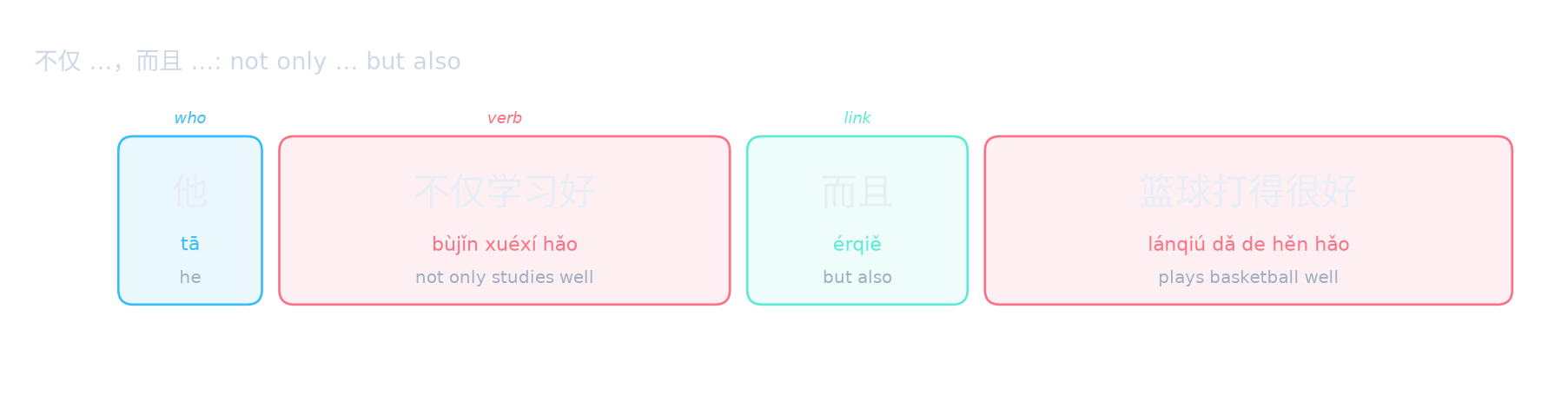
    • he / him他tānot just不仅bù jǐnto study; to learn学习xué xígood好hǎo,moreover而且ér qiěbasketball篮球lán qiúto hit / play / make (a call)打dǎ(degree marker)得dealso也yědegree / adjective linker很hěngood好hǎo。 Tā bùjǐn xuéxí hǎo, érqiě lánqiú dǎ de yě hěn hǎo. – Not only is he a good student, he's also great at basketball.
    • this这个zhè gemobile phone手机shǒu jīnot just不仅bù jǐncheap便宜pián yi,moreover而且ér qiěquality质量zhì liàngdegree / adjective linker很hěngood好hǎo。 Zhège shǒujī bùjǐn piányi, érqiě zhìliàng hěn hǎo. – This phone is not only cheap but also good quality.
    • not just不仅bù jǐnstudent学生xué shēngto like喜欢xǐ huanhe / him他tā,teacher老师lǎo shīalso也yěto like喜欢xǐ huanhe / him他tā。 Bùjǐn xuésheng xǐhuan tā, lǎoshī yě xǐhuan tā. – Not only do the students like him, the teachers do too.
    • she / her她tānot only不但bù dàncan / will会huìto speak说shuōEnglish (language)英语yīng yǔ,还会hái huìto speak说shuōFrench (language)法语fǎ yǔ。 Tā búdàn huì shuō Yīngyǔ, hái huì shuō Fǎyǔ. – She can speak not only English but French as well.
    • 这家zhè jiārestaurant饭馆fàn guǎnnot only不但bù dàndish (of food); vegetable菜càitasty好吃hǎo chī,moreover而且ér qiěservice / to serve服务fú wùalso也yědegree / adjective linker很hěnthoughtful周到zhōu dào。 Zhè jiā fànguǎn búdàn cài hǎochī, érqiě fúwù yě hěn zhōudào. – This restaurant not only has tasty food; the service is very attentive too.
    • to eat吃chī(completed / change)了lemedicine药yào,illness / ill病bìngnot only不但bù dàn没好méi hǎo,instead (contrary to expectation)反而fǎn ér更重gèng zhòng(completed / change)了le。 Chīle yào, bìng búdàn méi hǎo, fǎn'ér gèng zhòng le. – After the medicine, the illness not only didn't improve; it got worse.

    How it works. A and B point in the same direction, and B adds a further, often stronger, point: "not only A, but also B". not just不仅bù jǐn bùjǐn is a little more formal than not only不但bù dàn búdàn. The second half uses moreover而且ér qiě (the most complete), still / also / even还hái or also也yě, and moreover而且ér qiě often combines with still / also / even还hái or also也yě: moreover而且ér qiěstill / also / even还hái, moreover而且ér qiěalso也yě.

    Where not only不但bù dàn goes depends on the subjects. With one subject, the subject comes first: he / him他tānot only不但bù dànintelligent聪明cōng míng,moreover而且ér qiědegree / adjective linker很hěnto work hard / effort努力nǔ lì. With two different subjects, not only不但bù dàn comes first and each clause has its own subject: not only不但bù dànstudent学生xué shēngto like喜欢xǐ huanhe / him他tā,teacher老师lǎo shīalso也yěto like喜欢xǐ huanhe / him他tā.

    One subject Two subjects
    subject + not only不但bù dàn A,moreover而且ér qiě B not only不但bù dàn + subject 1 + A,subject 2 + also也yě B
    he / him他tānot only不但bù dànintelligent聪明cōng míng,moreover而且ér qiědegree / adjective linker很hěnto work hard / effort努力nǔ lì。 not just不仅bù jǐnstudent学生xué shēngto like喜欢xǐ huanhe / him他tā,teacher老师lǎo shīalso也yěto like喜欢xǐ huanhe / him他tā。

    not only不但bù dànnot不bù / not / haven't没méi……,instead (contrary to expectation)反而fǎn ér…… reverses an expectation: not only not A, but the opposite. rain雨yǔnot only不但bù dàn没停méi tíng,instead (contrary to expectation)反而fǎn ér越下yuè xià越大yuè dà.

    Watch out

    • For a contrast, use although虽然suī rán……but但是dàn shì……: wrong: this这个zhè gemobile phone手机shǒu jīnot only不但bù dàncheap便宜pián yi,moreover而且ér qiěquality质量zhì liàng很差hěn chà (cheap and bad is not a "further plus") → this这个zhè gemobile phone手机shǒu jīalthough虽然suī ráncheap便宜pián yi,but但是dàn shìquality质量zhì liàng很差hěn chà.
    • With one subject, do not put not only不但bù dàn before it: wrong: not only不但bù dànhe / him他tāintelligent聪明cōng míng,moreover而且ér qiědegree / adjective linker很hěnto work hard / effort努力nǔ lì → he / him他tānot only不但bù dànintelligent聪明cōng míng,moreover而且ér qiědegree / adjective linker很hěnto work hard / effort努力nǔ lì.
    • still / also / even还hái and also也yě go after the subject, before the verb: wrong: still / also / even还háishe / her她tācan / will会huìto speak说shuōFrench (language)法语fǎ yǔ → she / her她tāstill / also / even还háican / will会huìto speak说shuōFrench (language)法语fǎ yǔ.

    In a passage

    我家wǒ jiānearby附近fù jìn新开xīn kāi(completed / change)了leone (family / company)一家yì jiālibrary图书馆tú shū guǎn。这家zhè jiālibrary图书馆tú shū guǎnnot just不仅bù jǐnbook书shū很多hěn duō,moreover而且ér qiěenvironment环境huán jìngdegree / adjective linker很hěnquiet安静ān jìng。weekend周末zhōu mònot only不但bù dànstudent学生xué shēng来看lái kànbook书shū,很多hěn duōold man or woman老人lǎo rénalso也yěto come来láihere这里zhè lǐto look at; to watch; to read看kànnewspaper报纸bào zhǐ。library图书馆tú shū guǎnnot only不但bù dànnot不bùto charge a fee收费shōu fèi,still / also / even还háito provide提供tí gōngfree免费miǎn fèi(modifier / structural particle)的decoffee咖啡kā fēi。

    Read and notice. Find one sentence with one subject and one with two subjects. Where does not only不但bù dàn / not just不仅bù jǐn sit in each?

    不仅 …,而且 …: not only … but also

    Practice without the models

    Cover the teaching sections before you answer. The answers follow.

    1. Complete: “This phone is not only cheap but also good quality.” this这个zhè gemobile phone手机shǒu jīnot just不仅bù jǐncheap便宜pián yi,…………quality质量zhì liàngdegree / adjective linker很hěngood好hǎo。

    2. Which sentence is correct for two subjects?

    • A. not just不仅bù jǐnstudent学生xué shēngto like喜欢xǐ huanhe / him他tā,also也yěteacher老师lǎo shīto like喜欢xǐ huanhe / him他tā。
    • B. student学生xué shēngto like喜欢xǐ huanhe / him他tānot just不仅bù jǐn,teacher老师lǎo shīalso也yěto like喜欢xǐ huanhe / him他tā。
    • C. not just不仅bù jǐnstudent学生xué shēngto like喜欢xǐ huanhe / him他tā,moreover而且ér qiěteacher老师lǎo shīalso也yěto like喜欢xǐ huanhe / him他tā。

    3. Build: “The illness not only didn't improve, it got worse.”

    Put in order: , / illness / ill病bìngnot only不但bù dàn没好méi hǎo / 更重gèng zhòng(completed / change)了le。 / instead (contrary to expectation)反而fǎn ér

    4. True or false? With one subject, not only不但bù dàn comes after the subject. If false, correct it.

    5. You are introducing a new classmate who is a strong student and a great athlete. Use not only不但bù dàn / not just不仅bù jǐn … ,moreover而且ér qiě / still / also / even还hái / also也yě …. Write your answer in Chinese, then say it aloud.

    Answers and explanations

    1. moreover而且ér qiě

    not just不仅bù jǐn…moreover而且ér qiě….

    2. C. not just不仅bù jǐnstudent学生xué shēngto like喜欢xǐ huanhe / him他tā,moreover而且ér qiěteacher老师lǎo shīalso也yěto like喜欢xǐ huanhe / him他tā。

    With two subjects, not just不仅bù jǐn comes before the first one.

    3. illness / ill病bìngnot only不但bù dàn没好méi hǎo,instead (contrary to expectation)反而fǎn ér更重gèng zhòng(completed / change)了le。

    not only不但bù dànnot不bù/not / haven't没méi…,instead (contrary to expectation)反而fǎn ér….

    4. True.

    True. With one subject, not only不但bù dàn comes after it: he / him他tānot only不但bù dànintelligent聪明cōng míng,moreover而且ér qiědegree / adjective linker很hěnto work hard / effort努力nǔ lì. With two different subjects, not only不但bù dàn comes before the first subject.

    5. Model answer: he / him他tānot just不仅bù jǐnto study; to learn学习xué xígood好hǎo,moreover而且ér qiěbasketball篮球lán qiúto hit / play / make (a call)打dǎ(degree marker)得dealso也yědegree / adjective linker很hěngood好hǎo。

    Check your answer:

    • One subject: subject first, then not only不但bù dàn: he / him他tānot only不但bù dàn…. Two subjects: not only不但bù dàn first: not only不但bù dànhe / him他tā…,moreover而且ér qiěI / me我wǒalso也yě….
    • The two points go the same direction; for a contrast use but但是dàn shì.
  • 27 Comparing similar adverbs
    • 27.1 Comparing "benlai" and "yuanlai"
    • 27.2 Comparing "changchang" and "wangwang"
    • 27.3 Comparing "gang" and "gangcai"

    Comparing similar adverbs →

  • 28 Comparing similar prepositions
    • 28.1 Comparing "guanyu" and "duiyu"
    • 28.2 Comparing "li" and "cong"

    Comparing similar prepositions →

  • 29 Comparing similar separate functions
    • 29.1 Comparing "fan'er" and “xiangfan"
    • 29.2 Comparing "kending" "queding" and “yiding"
    • 29.3 Comparing "shihe" and "heshi"

    Comparing similar separate functions →

  • 30 Comparing similar time words
    • 30.1 Comparing "yihou" and "de shihou"

    Comparing similar time words →

Log in or create account

IGCSE, A-Level & AP