Adj + to be / is是 + Adj,but但是 … (concede, then object)
Form: X to be / is是 X,but但是 / but可是 / exactly就是 + objection
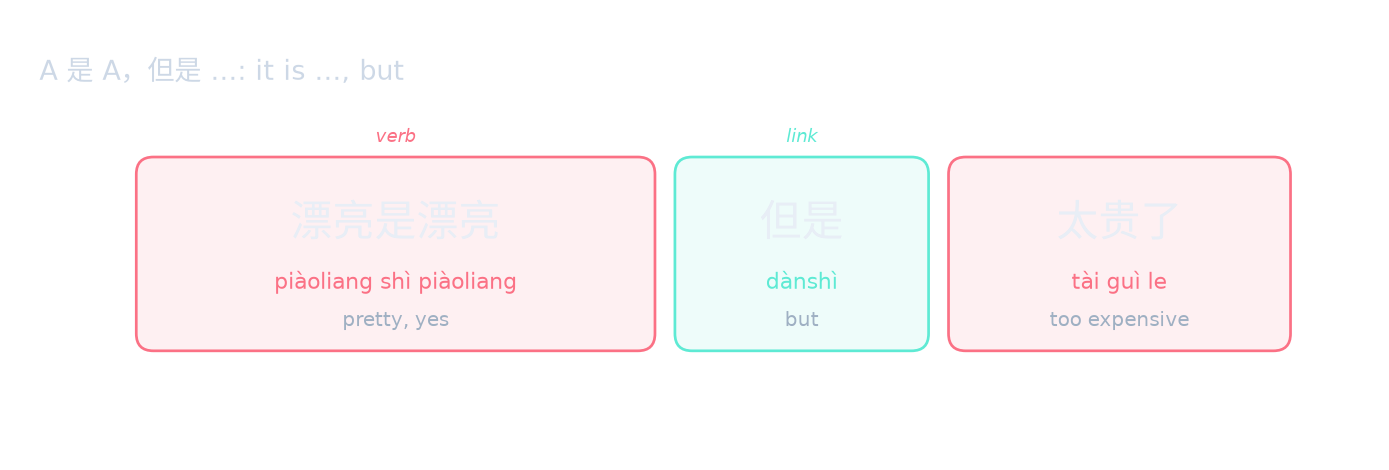
- pretty漂亮to be / is是pretty漂亮,but但是太贵(completed / change)了。 Piàoliang shì piàoliang, dànshì tài guì le. – It's pretty, all right, but it's too expensive.
- tasty好吃to be / is是tasty好吃,but但是太辣(completed / change)了。 – It's tasty, but it's too spicy.
- to go去to be / is是want / think / miss想to go去,but可是not / haven't没time时间。 – I do want to go, but I don't have time.
- this这本书I / me我to look at; to watch; to read看to be / is是to look at; to watch; to read看(completed / change)了,but但是not / haven't没to look at; to watch; to read看to understand懂。 – I did read the book, but I didn't understand it.
How it works. X to be / is是 X concedes a point ("it is …, admittedly"); the next clause brings the objection with but但是, but可是 or exactly就是. It sounds more conversational than although虽然……but但是……, and shows you have considered the point.
Watch out
- Repeat the identical word: wrong: 贵是degree / adjective linker很expensive贵 → 贵是expensive贵.
- The second clause must object: wrong: good好to be / is是good好,moreover而且…….
one / a一 … then / just就 … (as soon as / whenever)
Form: subject₁ + one / a一 + verb A,subject₂ + then / just就 + verb B
- doorbell门铃一响,it它then / just就to run跑past过去。 Ménlíng yì xiǎng, tā jiù pǎo guòqu. – As soon as the doorbell rings, it runs over.
- (used after a verb) give it…一下lesson课,he / him他then / just就to walk / to leave走(completed / change)了。 – As soon as class ended, he left.
- he / him他one / a一喝咖啡then / just就睡不着。 – Whenever he drinks coffee, he can't sleep.
- I / me我one / a一to look at; to watch; to read看then / just就to understand懂(completed / change)了。 – I understood the moment I looked.
How it works. B follows immediately after A. It describes one event ("as soon as") or a habit ("whenever"). one / a一 goes after the first subject, before its verb; then / just就 goes after the second subject.
| one / a一……then / just就…… | just now刚……then / just就…… |
|---|---|
| as soon as; also habits | had only just … when (one past event) |
| he / him他one / a一喝咖啡then / just就睡不着 | 我刚to / arrive / (result: get)到,he / him他then / just就to walk / to leave走(completed / change)了 |
Watch out
- wrong: one / a一I / me我to / arrive / (result: get)到 → I / me我一到; wrong: then / just就he / him他to walk / to leave走(completed / change)了 → he / him他then / just就to walk / to leave走(completed / change)了.

on the one hand一方面 … ,on the one hand一方面 … (on one hand / on the other)
Form: on the one hand一方面……,(other另)on the one hand一方面……
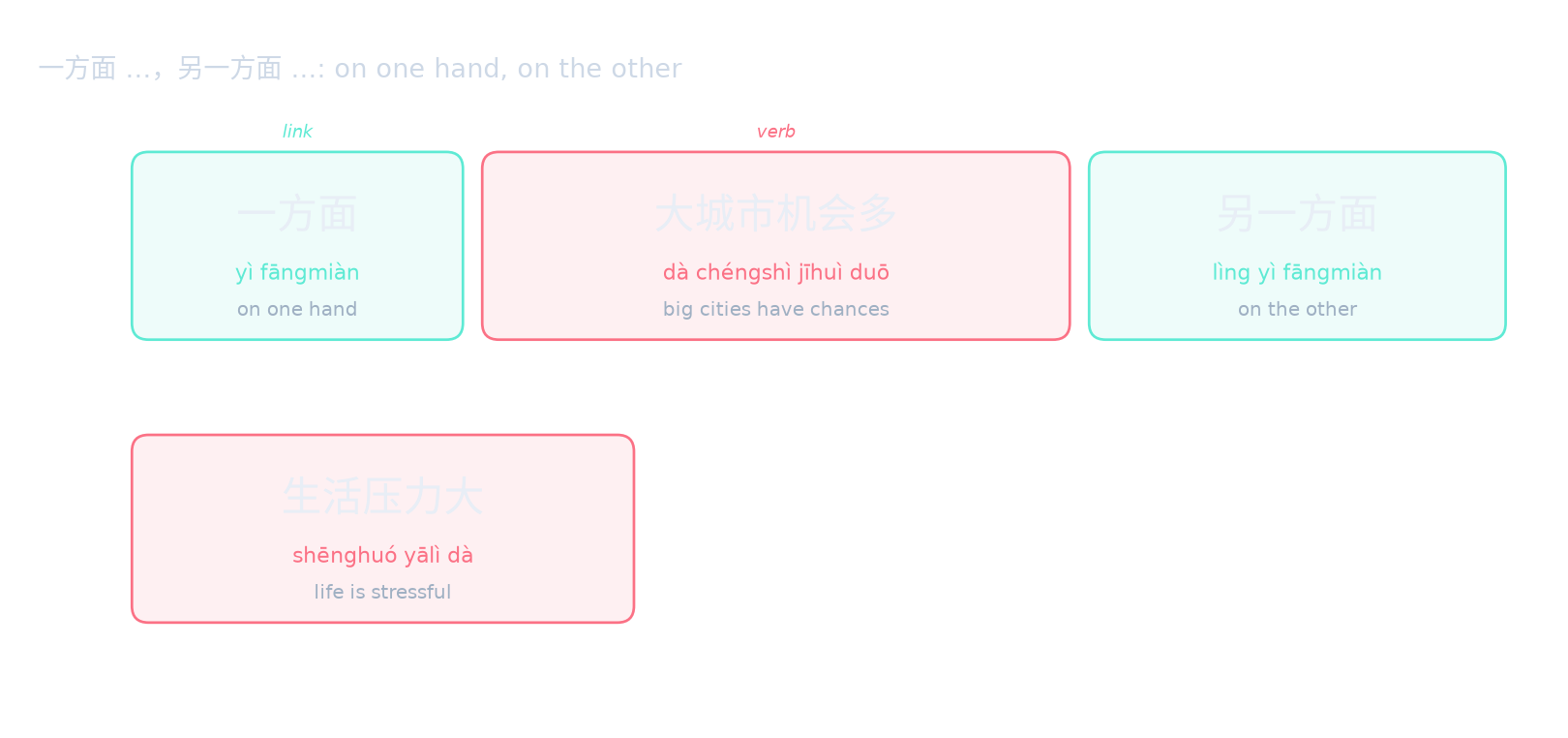
- on the one hand一方面,major city大城市opportunity机会many; much多;on the other hand另一方面,life; to live生活also也more更convenient方便。 Yì fāngmiàn, dà chéngshì jīhuì duō; lìng yì fāngmiàn, shēnghuó yě gèng fāngbiàn. – On the one hand, big cities have more opportunities; on the other, life is more convenient.
- on the one hand一方面to be / is是in order to为了to study; to learn学习,on the one hand一方面to be / is是in order to为了to make friends交朋友。 – Partly to study, partly to make friends.
- on the one hand一方面I / me我want / think / miss想to go去,on the other hand另一方面again又anxious担心to spend money花钱too太many; much多。 – On the one hand I want to go; on the other, I worry about spending too much.
How it works. on the one hand一方面 yì fāngmiàn presents two aspects or reasons with equal weight, in an argument or explanation. They can point the same way or contrast. Each half starts its own clause, and the two halves keep the same shape.
| on the one hand一方面……on the one hand一方面…… | not only不但……moreover而且…… |
|---|---|
| two points, equal weight | builds up to a stronger point |
Watch out
- on the one hand一方面 needs its partner clause: wrong: on the one hand一方面I / me我want / think / miss想to go去。 alone is incomplete.
Practice without the models
Cover the teaching sections before you answer. The answers follow.
Adj + to be / is是 + Adj,but但是 … (concede, then object)
1. Complete: “It's cheap, all right, but the quality is poor.” cheap便宜to be / is是…………,but但是quality质量no good不好。
2. Which sentence is correct?
- A. to be / is是tasty好吃tasty好吃,but但是太辣(completed / change)了。
- B. tasty好吃to be / is是tasty好吃,but但是太辣(completed / change)了。
- C. tasty好吃to be / is是tasty好吃,moreover而且太辣(completed / change)了。
- D. tasty好吃tasty好吃to be / is是,but但是太辣(completed / change)了。
3. Build: “I do want to go, but I don't have time.”
Put in order: but可是 / , / to go去to be / is是want / think / miss想to go去 / not / haven't没time时间。
4. True or false? pretty漂亮to be / is是pretty漂亮,but但是… concedes a point before objecting. If false, correct it.
5. Your friend loves a jacket in a shop. You agree it's pretty, but the price is crazy. Use Adj + to be / is是 + Adj,but但是 …. Write your answer in Chinese, then say it aloud.
one / a一 … then / just就 … (as soon as / whenever)
6. Complete: “As soon as class ended, he left.” (used after a verb) give it…一下lesson课,he / him他…………to walk / to leave走(completed / change)了。
7. Which sentence is correct?
- A. one / a一I / me我to / arrive / (result: get)到home / family / (measure: shops)家,then / just就he / him他to walk / to leave走(completed / change)了。
- B. I / me我to / arrive / (result: get)到home / family / (measure: shops)家one / a一,he / him他to walk / to leave走then / just就(completed / change)了。
- C. I / me我一到home / family / (measure: shops)家,he / him他then / just就to walk / to leave走(completed / change)了。
- D. I / me我一到home / family / (measure: shops)家,then / just就he / him他to walk / to leave走(completed / change)了。
8. Build: “Whenever he drinks coffee, he can't sleep.”
Put in order: 睡不着。 / he / him他 / then / just就 / one / a一喝咖啡
9. True or false? one / a一…then / just就… can describe a habit. If false, correct it.
10. Your friend's dog gets excited every time someone rings the doorbell. Use one / a一 … then / just就 …. Write your answer in Chinese, then say it aloud.
on the one hand一方面 … ,on the one hand一方面 … (on one hand / on the other)
11. Complete: “On the one hand it's cheap; on the other, it's close to home.” on the one hand一方面degree / adjective linker很cheap便宜,other另…………离家很近。
12. What is wrong with on the one hand一方面I / me我want / think / miss想to go去。?
- A. It needs (yes/no ?)吗
- B. Nothing
- C. on the one hand一方面 needs its partner clause
- D. on the one hand一方面 must come last
13. Build: “Partly to study, partly to make friends.”
Put in order: to make friends交朋友。 / on the one hand一方面to be / is是in order to为了 / , / on the one hand一方面to be / is是in order to为了to study; to learn学习
14. True or false? on the one hand一方面…on the one hand一方面… weighs two points equally. If false, correct it.
15. In a class debate, you explain why many young people move to big cities. Use on the one hand一方面 … ,on the one hand一方面 …. Write your answer in Chinese, then say it aloud.
Answers and explanations
Adj + to be / is是 + Adj,but但是 … (concede, then object)
1. cheap便宜
The same word repeats on both sides of to be / is是.
2. B. tasty好吃to be / is是tasty好吃,but但是太辣(completed / change)了。
tasty好吃to be / is是tasty好吃,but但是太辣(completed / change)了 is right: X to be / is是 X repeats the same word with no degree / adjective linker很, then a contrast with but但是. moreover而且 adds a point instead of objecting.
3. to go去to be / is是want / think / miss想to go去,but可是not / haven't没time时间。
A to be / is是 A,but可是 ….
4. True.
That is the purpose of the pattern.
5. Model answer: pretty漂亮to be / is是pretty漂亮,but但是太贵(completed / change)了。
Check your answer:
- Use the same word on both sides: 贵是expensive贵 (the second one can take degree / adjective linker很 or quite挺: 贵是挺贵(modifier / structural particle)的).
- The second clause must object; good好to be / is是good好,moreover而且… does not work.
one / a一 … then / just就 … (as soon as / whenever)
6. then / just就
one / a一 A,then / just就 B.
7. C. I / me我一到home / family / (measure: shops)家,he / him他then / just就to walk / to leave走(completed / change)了。
I / me我一到home / family / (measure: shops)家,he / him他then / just就to walk / to leave走(completed / change)了 is right: one / a一 and then / just就 each come after their own subject (I / me我one / a一…, he / him他then / just就…).
8. he / him他one / a一喝咖啡then / just就睡不着。
Subject + one / a一 + verb, then / just就 + result.
9. True.
It means whenever as well as as soon as.
10. Model answer: doorbell门铃一响,it它then / just就to run跑past过去。
Check your answer:
- one / a一 goes before the first verb, after its subject: I / me我一到, not one / a一I / me我to / arrive / (result: get)到.
- then / just就 goes after the second subject: he / him他then / just就to walk / to leave走(completed / change)了, not then / just就he / him他to walk / to leave走(completed / change)了.
on the one hand一方面 … ,on the one hand一方面 … (on one hand / on the other)
11. on the one hand一方面
on the one hand一方面…,on the other hand另一方面….
12. C. on the one hand一方面 needs its partner clause
on the one hand一方面 introduces one side and needs its partner: on the one hand一方面I / me我want / think / miss想to go去,on the other hand另一方面I / me我not have / haven't没有time时间. On its own the sentence is incomplete.
13. on the one hand一方面to be / is是in order to为了to study; to learn学习,on the one hand一方面to be / is是in order to为了to make friends交朋友。
Parallel halves.
14. True.
not only不但…moreover而且… builds up instead.
15. Model answer: on the one hand一方面,major city大城市opportunity机会many; much多;on the other hand另一方面,life; to live生活also也more更convenient方便。
Check your answer:
- Keep both halves in the same shape: on the one hand一方面to be / is是…,on the one hand一方面to be / is是….
- Do not use on the one hand一方面 alone; it needs its partner.