even连 … all / both都 / also也 (even)
Form: even连 + X + all / both都 / also也 + verb
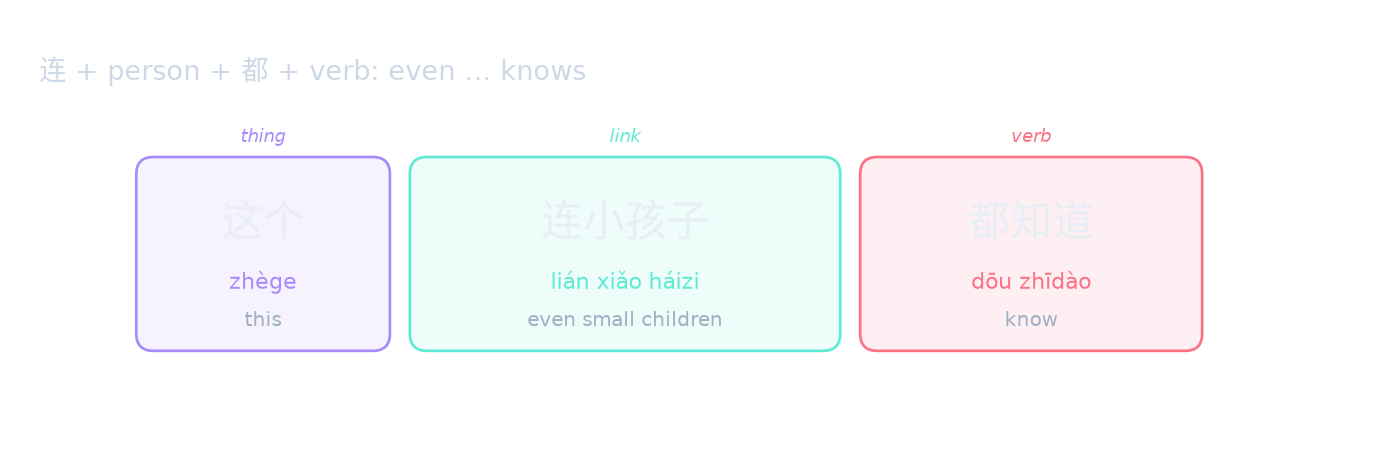
- this这个even连child小孩子all / both都to know知道! Zhège lián xiǎo háizi dōu zhīdào! – Even a small child knows that!
- even连I / me我grandma奶奶all / both都to use / with用Weixin or WeChat (mobile…微信。 – Even my grandma uses WeChat.
- even连teacher老师also也not不to know知道answer答案。 – Even the teacher doesn't know the answer.
- he / him他even连weekend周末all / both都at / in在to work; job工作。 – He works even at weekends.
How it works. even连 lián X all / both都 / also也 means "even X". X is the least likely case, which makes the statement strong. X can be the subject or an object moved forward, and the even连 phrase comes before the verb.
| Positive | Negative |
|---|---|
| even连child小孩子all / both都can / will会 (even a child can, so it's easy) | even连一个Chinese character字all / both都won't / can't不会to write写 (not even one, so it's hopeless) |
Watch out
- Keep all / both都 / also也: wrong: even连he / him他to come来(completed / change)了 → even连he / him他all / both都to come来(completed / change)了.
- X must be the surprising case; even连 + an ordinary item sounds odd.
Question Word + all / both都 (every)
Form: question word (+ noun) + all / both都 + (not不 / not / haven't没) + verb
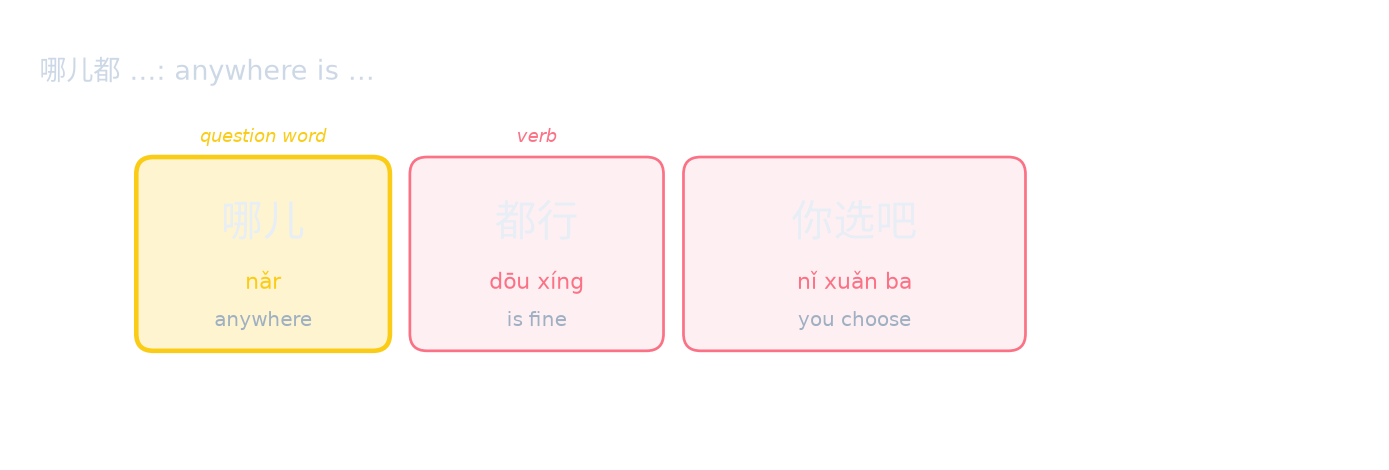
- where哪儿都行,you你to choose选(suggestion)吧。 Nǎr dōu xíng, nǐ xuǎn ba. – Anywhere is fine; you choose.
- he / him他what什么all / both都can / will会。 – He can do anything.
- what什么dish (of food); vegetable菜all / both都tasty好吃。 – Every dish is delicious.
- I / me我how / why怎么all / both都to look for; to give change找not reach / less than不到。 – I can't find it no matter how I look.
How it works. A question word before all / both都 means "every-, any-"; with a negative it means "no-". The question word moves before all / both都 and the verb. With a noun: which哪个 / what什么 + noun + all / both都.
| Question word + all / both都 | Meaning |
|---|---|
| who谁all / both都 | everyone |
| what什么all / both都 | everything |
| where哪儿all / both都 | everywhere |
| what什么time; when时候all / both都 | any time |
| how / why怎么all / both都 | however (you try) |
| Short, spoken | Spelled out |
|---|---|
| who谁all / both都can / may可以to come来 | no matter; regardless不管who谁to come来,I / me我all / both都to welcome欢迎 |
Watch out
- wrong: I / me我to eat吃what什么all / both都 → I / me我what什么all / both都to eat吃.
A to be / is是 B (modifier / structural particle)的 N times (as much); -fold倍 (N times)
Form: A to be / is是 B (modifier / structural particle)的 N times (as much); -fold倍 · A than / compared to比 B many; much多 N times (as much); -fold倍 · to increase增加(completed / change)了 N times (as much); -fold倍
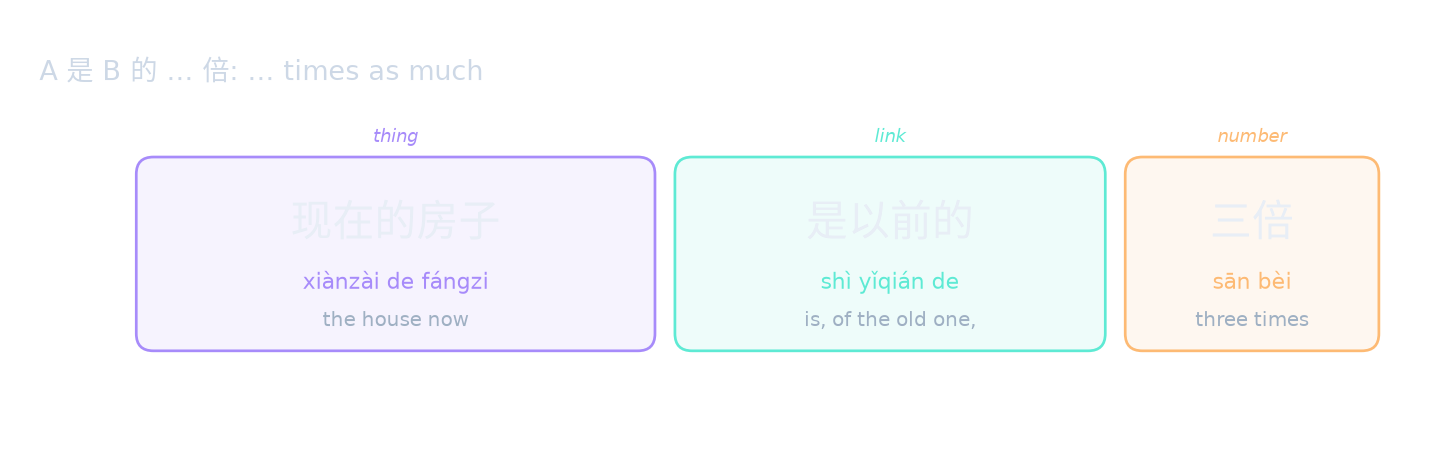
- now现在(modifier / structural particle)的house房子to be / is是before以前(modifier / structural particle)的triple三倍。 Xiànzài de fángzi shì yǐqián de sān bèi. – My place now is three times the size of my old one.
- she / her她(modifier / structural particle)的wages; salary工资to be / is是he / him他(modifier / structural particle)的twice as much两倍。 – Her salary is twice his.
- this这个city城市(modifier / structural particle)的population人口to be / is是that那个(modifier / structural particle)的twice as much两倍。 – This city's population is twice that city's.
- price价格to increase增加(completed / change)了一倍。 – The price has doubled.
How it works. times (as much); -fold倍 bèi counts multiples. The two patterns count differently.
| Pattern | Counts | B = 10, so A = |
|---|---|---|
| A to be / is是 B (modifier / structural particle)的twice as much两倍 | the total | 20 (×2) |
| A than / compared to比 B 多一倍 | the increase on top | 20 (×2) |
| A than / compared to比 B 多两倍 | the increase on top | 30 (×3, in careful usage) |
to increase增加(completed / change)了一倍 also counts the increase: it doubled. For "half as much", times (as much); -fold倍 is not used: A to be / is是 B (modifier / structural particle)的half一半.
Watch out
- times (as much); -fold倍 is multiples; measure word for times次 is occasions: wrong: I / me我去过triple三倍 → I / me我去过three times三次.
a bit一点 + also也 / all / both都 + not不 (not at all)
Form: a little一点儿 + also也 / all / both都 + not不 / not / haven't没 + adjective / verb
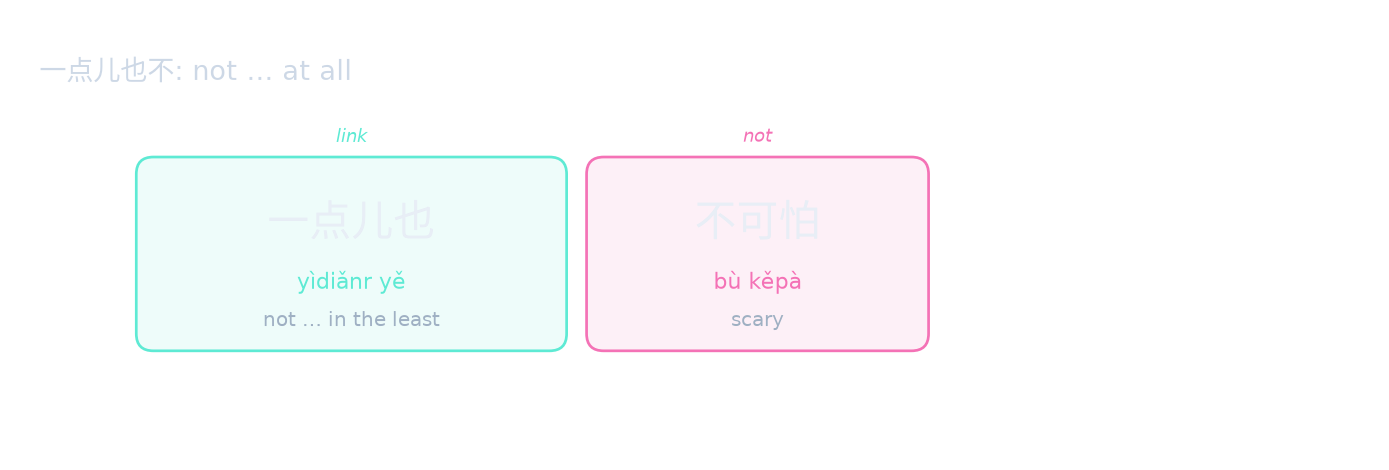
- a little一点儿also也not不terrible; scary可怕。 Yìdiǎnr yě bù kěpà. – It wasn't scary at all.
- this这个a little一点儿also也not不expensive贵。 – This isn't expensive at all.
- I / me我a little一点儿all / both都not不tired累。 – I'm not tired in the slightest.
- he / him他a little一点儿also也not / haven't没to change变,or / still还是like that那么young年轻。 – He hasn't changed at all; he still looks so young.
How it works. a little一点儿also也 / all / both都 + a negative is the strongest denial: "not … at all". It goes before not不 or not / haven't没, and it always needs one.
| slightly有点儿cold冷 | not不太冷 | a little一点儿also也not不cold冷 |
|---|---|---|
| a bit cold | not very cold | not cold at all |
Watch out
- wrong: not不a little一点儿cold冷 → a little一点儿also也not不cold冷.
- wrong: a little一点儿also也cold冷 is wrong; "a bit cold" is slightly有点儿cold冷.
not不to know知道 + embedded choice + good好 (unsure what is best)
Form: not不to know知道 + verb + question word + good好 · you你to speak说 + … + good好?
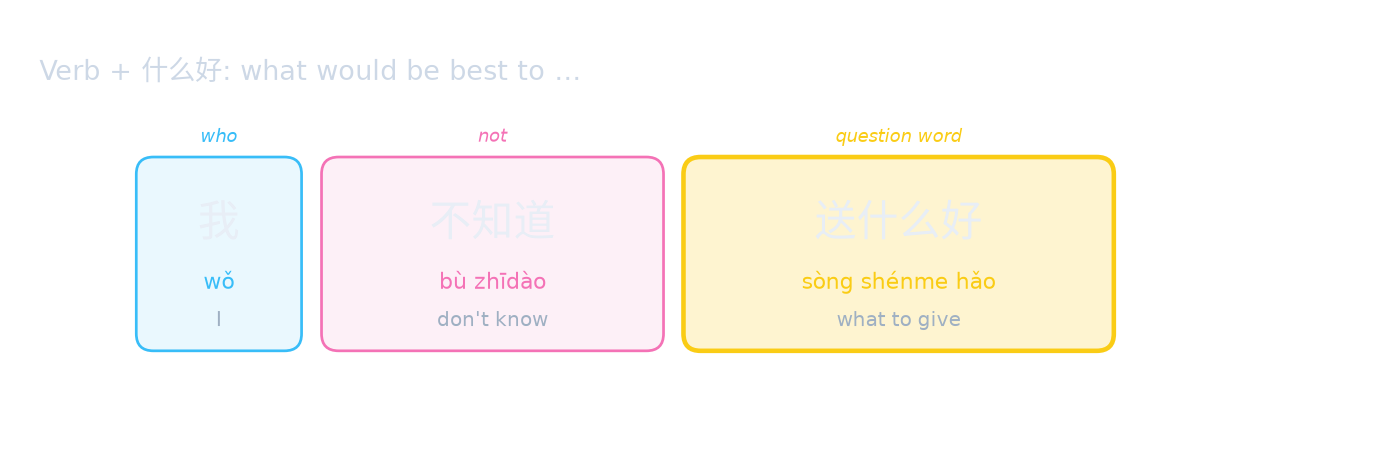
- I / me我not不to know知道to give (as a gift); to see off送what什么good好。 Wǒ bù zhīdào sòng shénme hǎo. – I don't know what would be best to give.
- he / him他not不to know知道what's to be done怎么办good好。 – He didn't know what to do.
- I / me我not不to know知道to go去Beijing北京good好or / still还是to go去Shanghai municipality…上海good好。 – I don't know whether it's better to go to Beijing or Shanghai.
- you你to speak说I / me我to buy买which哪个good好? – Which do you think I should buy?
How it works. good好 at the end of the embedded choice means "would be best". The question word sits inside the sentence, so a not不to know知道 sentence is a statement, with no question mark. To ask for advice, use you你to speak说 …good好? or you你to know知道……good好(yes/no ?)吗?
Watch out
- good好 goes at the end of the choice: wrong: not不to know知道good好to speak说what什么 → not不to know知道to speak说what什么good好.
to / towards / correct对 … 来说 (for / as far as … is concerned)
Form: to / towards / correct对 + person / group + 来说,judgement
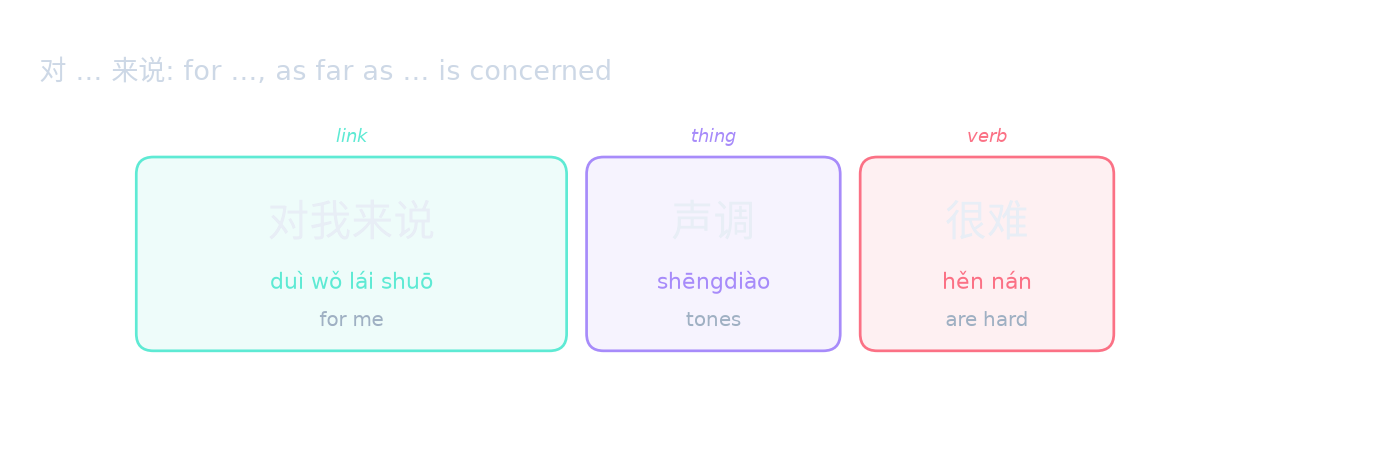
- to / towards / correct对I / me我来说,tone声调很难。 Duì wǒ láishuō, shēngdiào hěn nán. – For me, tones are hard.
- to / towards / correct对student学生来说,time时间most最important重要。 – For students, time is the most important thing.
- to / towards / correct对this这个city城市来说,to travel; tourism旅游degree / adjective linker很important重要。 – Tourism is very important for this city.
How it works. to / towards / correct对……来说 duì … láishuō gives the point of view from which something is judged: "for, as far as … is concerned". It usually starts the sentence, followed by a comma and the judgement.
| to / towards / correct对……来说 | at / in在……it seems (from this)看来 |
|---|---|
| how it matters to someone | someone's opinion |
| to / towards / correct对I / me我来说很难 | in my opinion在我看来,this这个means办法no good不好 |
Watch out
- Keep all three parts: to / towards / correct对I / me我to speak说 means "said to me".
Practice without the models
Cover the teaching sections before you answer. The answers follow.
even连 … all / both都 / also也 (even)
1. Complete: “Even my grandma uses WeChat.” …………I / me我grandma奶奶all / both都to use / with用Weixin or WeChat (mobile…微信。
2. Which sentence is correct?
- A. teacher老师even连also也not不to know知道。
- B. even连teacher老师also也not不to know知道。
- C. even连teacher老师not不to know知道。
- D. even连also也teacher老师not不to know知道。
3. Build: “He works even at weekends.”
Put in order: to work; job工作。 / all / both都at / in在 / he / him他 / even连weekend周末
4. True or false? even连child小孩子all / both都can / will会 suggests the task is easy. If false, correct it.
5. A friend doesn't know that you shouldn't touch a hot stove. Use even连 … all / both都 / also也. Write your answer in Chinese, then say it aloud.
Question Word + all / both都 (every)
6. Complete: “He can do anything.” he / him他…………all / both都can / will会。
7. Which says “Every dish is delicious”?
- A. dish (of food); vegetable菜what什么all / both都tasty好吃。
- B. all / both都what什么dish (of food); vegetable菜tasty好吃。
- C. tasty好吃what什么dish (of food); vegetable菜all / both都。
- D. what什么dish (of food); vegetable菜all / both都tasty好吃。
8. Build: “I can't find it no matter how I look.”
Put in order: to look for; to give change找 / I / me我 / not reach / less than不到。 / how / why怎么all / both都
9. True or false? who谁all / both都can / may可以to come来 means “Anyone can come.” If false, correct it.
10. Your friend asks where you want to eat. You are hungry and not fussy. Use Question Word + all / both都. Write your answer in Chinese, then say it aloud.
A to be / is是 B (modifier / structural particle)的 N times (as much); -fold倍 (N times)
11. Complete: “Her salary is twice his.” she / her她(modifier / structural particle)的wages; salary工资to be / is是he / him他(modifier / structural particle)的two两…………。
12. B has 10 books. 'A than / compared to比 B 多一倍' – how many does A have?
- A. 11
- B. 5
- C. 20
- D. 30
13. Build: “This city's population is twice that city's.”
Put in order: times (as much); -fold倍。 / this这个city城市(modifier / structural particle)的population人口 / two两 / to be / is是that那个(modifier / structural particle)的
14. True or false? I / me我去过triple三倍 means “I've been three times.” If false, correct it.
15. You compare your new flat with the tiny room you rented before. Use A to be / is是 B (modifier / structural particle)的 N times (as much); -fold倍. Write your answer in Chinese, then say it aloud.
a bit一点 + also也 / all / both都 + not不 (not at all)
16. Complete: “This isn't expensive at all.” this这个a little一点儿…………not不expensive贵。
17. Which is the strongest denial?
- A. a little一点儿also也不难。
- B. fairly / to compare比较difficult / hard难。
- C. 不太难。
- D. slightly有点儿difficult / hard难。
18. Build: “He hasn't changed at all.”
Put in order: also也not / haven't没 / he / him他 / a little一点儿 / to change变。
19. True or false? a little一点儿also也cold冷 means “a little cold”. If false, correct it.
20. A friend asks if the horror film was scary. You thought it was boring. Use a bit一点 + also也 / all / both都 + not不. Write your answer in Chinese, then say it aloud.
not不to know知道 + embedded choice + good好 (unsure what is best)
21. Complete: “I don't know what to say.” I / me我not不to know知道to speak说what什么…………。
22. Which sentence is correct?
- A. I / me我not不to know知道to ingratiate oneself买好which哪个。
- B. I / me我not不to know知道good好to buy买which哪个。
- C. good好I / me我not不to know知道to buy买which哪个。
- D. I / me我not不to know知道to buy买which哪个good好。
23. Build: “He didn't know what to do.”
Put in order: good好。 / what's to be done怎么办 / not不to know知道 / he / him他
24. True or false? you你to speak说I / me我to buy买which哪个good好? asks someone for advice. If false, correct it.
25. It's your mother's birthday tomorrow and you still haven't chosen a gift. Use not不to know知道 + embedded choice + good好. Write your answer in Chinese, then say it aloud.
to / towards / correct对 … 来说 (for / as far as … is concerned)
26. Complete: “For me, this isn't a problem.” to / towards / correct对I / me我…………,this这is not / no不是question / problem问题。
27. What does he / him他to / towards / correct对I / me我to speak说 mean?
- A. In his opinion
- B. As far as I'm concerned
- C. He said to me
- D. For him, I …
28. Build: “For students, time is the most important thing.”
Put in order: most最important重要。 / to / towards / correct对student学生来说 / , / time时间
29. True or false? in my opinion在我看来 introduces an opinion. If false, correct it.
30. Your classmate finds Chinese tones easy, but you don't. Use to / towards / correct对 … 来说. Write your answer in Chinese, then say it aloud.
Answers and explanations
even连 … all / both都 / also也 (even)
1. even连
even连 X all / both都 = even X.
2. B. even连teacher老师also也not不to know知道。
even连teacher老师also也not不to know知道 is right: even连 + X + also也/all / both都 + verb. Leaving out also也/all / both都 is wrong, and even连 must come directly before teacher老师.
3. he / him他even连weekend周末all / both都at / in在to work; job工作。
Subject + even连 X + all / both都 + verb.
4. True.
If even a child can, it must be easy.
5. Model answer: this这个even连child小孩子all / both都to know知道!
Check your answer:
- even连 needs all / both都 or also也 after X: even连he / him他all / both都to come来(completed / change)了, not even连he / him他to come来(completed / change)了.
- Choose X as the most surprising case; even连 + ordinary item sounds odd.
Question Word + all / both都 (every)
6. what什么
what什么 + all / both都 = everything / anything.
7. D. what什么dish (of food); vegetable菜all / both都tasty好吃。
Question word + noun + all / both都 means “every”: what什么dish (of food); vegetable菜all / both都tasty好吃 “Every dish is delicious.” what什么 must come directly before the noun, and all / both都 before the predicate.
8. I / me我how / why怎么all / both都to look for; to give change找not reach / less than不到。
how / why怎么 + all / both都 + potential complement.
9. True.
True. A question word before all / both都 means “any / every”: who谁all / both都can / may可以to come来 “Anyone can come.”
10. Model answer: where哪儿都行,you你to choose选(suggestion)吧。
Check your answer:
- I / me我what什么all / both都to eat吃, not I / me我to eat吃what什么all / both都: the QW moves before all / both都.
- With a noun: which哪个 / what什么 + noun + all / both都: what什么dish (of food); vegetable菜all / both都tasty好吃 – "Every dish is delicious."
A to be / is是 B (modifier / structural particle)的 N times (as much); -fold倍 (N times)
11. times (as much); -fold倍
A to be / is是 B (modifier / structural particle)的 N times (as much); -fold倍.
12. C. 20
One time more = double = 20.
13. this这个city城市(modifier / structural particle)的population人口to be / is是that那个(modifier / structural particle)的twice as much两倍。
A to be / is是 B (modifier / structural particle)的 N times (as much); -fold倍.
14. False.
False. times (as much); -fold倍 means “times” as a multiple (triple三倍 “three times as much”). Occasions are counted with measure word for times次: I / me我去过three times三次 “I've been three times.”
15. Model answer: now现在(modifier / structural particle)的house房子to be / is是before以前(modifier / structural particle)的triple三倍。
Check your answer:
- to be / is是…(modifier / structural particle)的twice as much两倍 = twice as much (×2), and so is than / compared to比…多一倍. In careful usage, than / compared to比…多两倍 = ×3.
- times (as much); -fold倍 is for increases; for "half as much", use half一半: A to be / is是 B (modifier / structural particle)的half一半.
a bit一点 + also也 / all / both都 + not不 (not at all)
16. also也
a little一点儿also也/all / both都 + not不.
17. A. a little一点儿also也不难。
a little一点儿also也not不 + adjective is the strongest denial: a little一点儿also也不难 “not difficult at all”. 不太难 is only “not very difficult”.
18. he / him他a little一点儿also也not / haven't没to change变。
a little一点儿 + also也not / haven't没 + verb.
19. False.
a little一点儿also也 needs a negative; “a bit cold” is slightly有点儿cold冷.
20. Model answer: a little一点儿also也not不terrible; scary可怕。
Check your answer:
- Put a little一点儿also也 before not不 / not / haven't没: a little一点儿also也not不cold冷, not not不a little一点儿cold冷.
- It needs a negative; a little一点儿also也cold冷 is wrong. "A bit cold" is slightly有点儿cold冷.
not不to know知道 + embedded choice + good好 (unsure what is best)
21. good好
not不to know知道 + verb + QW + good好.
22. D. I / me我not不to know知道to buy买which哪个good好。
I / me我not不to know知道to buy买which哪个good好 is right: good好 closes the embedded choice "which one would be best to buy", so it goes at the end.
23. he / him他not不to know知道what's to be done怎么办good好。
not不to know知道 + what's to be done怎么办 + good好.
24. True.
you你to speak说…good好? turns the dilemma into a question.
25. Model answer: I / me我not不to know知道to give (as a gift); to see off送what什么good好。
Check your answer:
- The question word is embedded, so there is no question mark: not不to know知道to buy买what什么good好。 – "I don't know what to buy."
- good好 goes at the end of the embedded choice, not after to know知道: not不to know知道to speak说what什么good好, not not不to know知道good好to speak说what什么.
to / towards / correct对 … 来说 (for / as far as … is concerned)
26. 来说
to / towards / correct对 X 来说.
27. C. He said to me
Without 来说, to / towards / correct对 + person + to speak说 = say to.
28. to / towards / correct对student学生来说,time时间most最important重要。
to / towards / correct对 X 来说, then the judgement.
29. True.
at / in在…it seems (from this)看来 = in someone's view.
30. Model answer: to / towards / correct对I / me我来说,tone声调很难。
Check your answer:
- Use the full frame to / towards / correct对…来说: to / towards / correct对I / me我来说, not to / towards / correct对I / me我to speak说 (that means "said to me").
- The judgement follows: to / towards / correct对he / him他来说,this这is not / no不是question / problem问题 – "For him, this isn't a problem."