even连 … all / both都 … not不 / not / haven't没 (not even)
Form: even连 + X + all / both都 / also也 + not不 / not / haven't没 + verb · even连 + verb + all / both都not / haven't没 + verb
- I / me我today今天busy忙(degree marker)得even连a mouthful一口water水all / both都not / haven't没to drink喝。 Wǒ jīntiān máng de lián yì kǒu shuǐ dōu méi hē. – I was so busy today I didn't even have a sip of water.
- he / him他even连I / me我(modifier / structural particle)的name名字all / both都not不to know知道。 – He doesn't even know my name.
- he / him他even连一个Chinese character字all / both都not / haven't没to write写。 – He didn't write a single character.
- he / him他even连want / think / miss想all / both都not / haven't没want / think / miss想then / just就to agree; to promise答应(completed / change)了。 – He agreed without even thinking.
How it works. X is the smallest or easiest thing, and still it didn't happen: "not even X". The even连 phrase moves before the verb, and all / both都 or also也 must follow it. Repeating the verb (even连to look at; to watch; to read看all / both都not / haven't没to look at; to watch; to read看, 连想all / both都not / haven't没want / think / miss想) shows how little care was taken.
Watch out
- wrong: not / haven't没to eat吃连饭 → 连饭all / both都not / haven't没to eat吃.
- Keep all / both都 / also也: wrong: 连水not / haven't没to drink喝 → 连水all / both都not / haven't没to drink喝.

for / (wéi) to be为 … and / but而 … (for the sake of)
Form: for / (wéi) to be为((completed / change)了) + goal / cause + and / but而 + action / feeling (formal)
- he / him他in order to为了up / on / last; to get on, attend上university大学and / but而to work hard / effort努力to work; job工作。 Tā wèile shàng dàxué ér nǔlì gōngzuò. – He works hard in order to go to university.
- for / (wéi) to be为dream; to dream of梦想and / but而to strive奋斗。 – Strive for your dreams.
- everyone大家all / both都for / (wéi) to be为he / him他(modifier / structural particle)的to succeed; success成功and / but而happy; glad高兴。 – Everyone was happy about his success.
- don't不要for / (wéi) to be为trifle小事and / but而to get angry生气。 – Don't get angry over small things.
How it works. for / (wéi) to be为……and / but而…… ties a purpose (or a cause of a feeling) tightly to an action in one phrase. Here for / (wéi) to be为 is read wèi, and and / but而 does not mean "but": it links the purpose to the verb. It suits speeches, slogans and writing.
| in order to为了 + goal,clause | for / (wéi) to be为……and / but而 + verb |
|---|---|
| everyday | formal, one tight phrase |
| in order to为了up / on / last; to get on, attend上university大学,he / him他to work hard / effort努力to work; job工作 | he / him他for / (wéi) to be为up / on / last; to get on, attend上university大学and / but而to work hard / effort努力to work; job工作 |

any任何 + Noun + all / both都 / also也 (any)
Form: any任何 + noun + all / both都 / also也 · not不 / not / haven't没 + verb + any任何 + noun
- to have / there is有any任何question / problem问题,all / both都can / may可以to ask问I / me我。 Yǒu rènhé wèntí, dōu kěyǐ wèn wǒ. – If you have any questions at all, you can ask me.
- 任何人all / both都can / may可以to participate参加。 – Anyone can take part.
- I / me我won't / can't不会to tell告诉任何人。 – I won't tell anyone.
- any任何time; when时候you你all / both都can / may可以to / for / give给I / me我to make a telephone call打电话。 – You can call me any time.
How it works. any任何 rènhé "any (at all)" goes before a noun. As the subject it needs all / both都 or also也. After a negative verb it means "no … at all": he / him他not have / haven't没有any任何question / problem问题.
| Spoken | More formal |
|---|---|
| who谁all / both都can / may可以to come来 | 任何人all / both都can / may可以to come来 |
Watch out
- wrong: 任何人to know知道 → 任何人all / both都to know知道.
- any任何 never stands alone: 任何人, any任何thing; stuff东西.

(既…又) both / since既 … also也 / again又 … (both … and …)
Form: subject + (既…又) both / since既 A again又 / also也 B
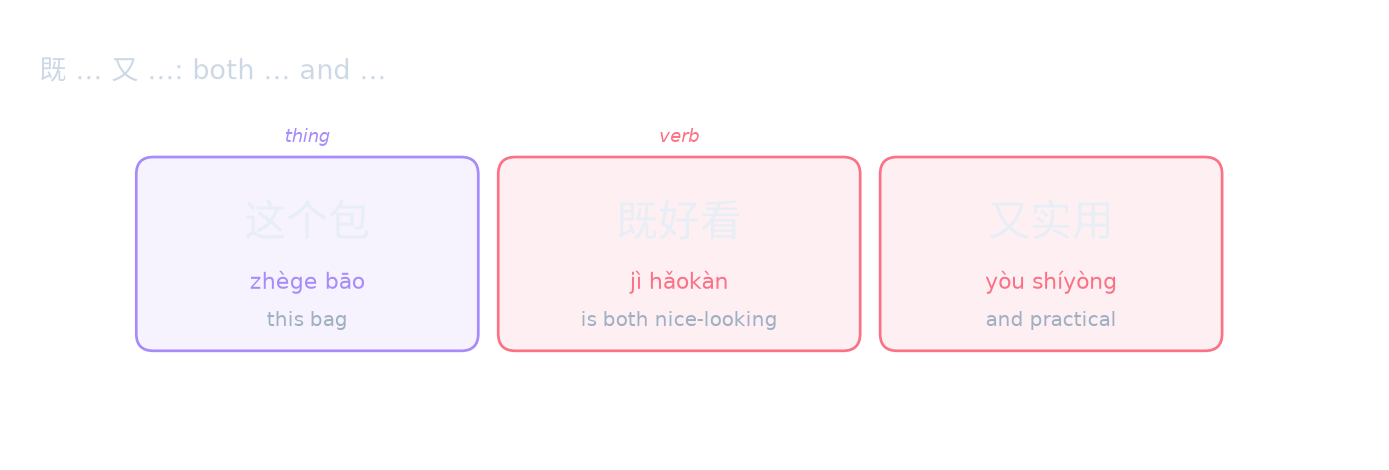
- this这个bag / to wrap包(既…又) both / since既good-looking好看again又practical实用。 Zhège bāo jì hǎokàn yòu shíyòng. – This bag is both good-looking and practical.
- this这个dish (of food); vegetable菜(既…又) both / since既cheap便宜again又tasty好吃。 – This dish is both cheap and tasty.
- he / him他(既…又) both / since既to be / is是teacher老师,also也to be / is是author作家。 – He is both a teacher and a writer.
- we / us我们(既…又) both / since既want / will / need要to study; to learn学习,also也want / will / need要to rest休息。 – We need both to study and to rest.
How it works. (既…又) both / since既 jì A again又 / also也 B joins two qualities, roles or actions of the same subject, with equal weight. It is a little more formal and balanced than again又……again又…….
| (既…又) both / since既……again又…… | not only不但……moreover而且…… |
|---|---|
| two points, equal weight | builds up: the second is stronger |
| (既…又) both / since既tall; high高again又thin瘦 | not only不但cheap便宜,moreover而且quality质量degree / adjective linker很good好 |
Watch out
- One subject only: wrong: he / him他(既…又) both / since既……,she / her她again又…….
- The two should fit together; for a contrast, use but但是.
at / in在 + Place + up / on / last; to get on, attend上 / down / next; to fall (rain), get off下 / inside; in里 / beside; next to旁边 (location)
Form: at / in在 + noun + up / on / last; to get on, attend上 / down / next; to fall (rain), get off下 / inside; in里 / beside; next to旁边 · verb + at / in在 + place
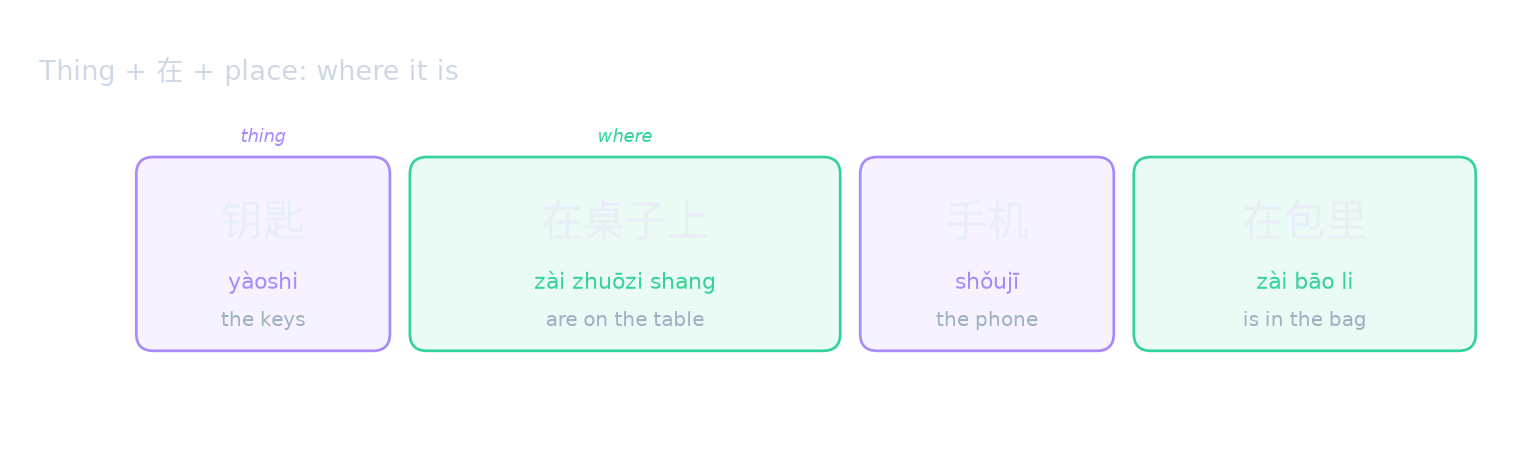
- key钥匙at / in在table桌子up / on / last; to get on, attend上,mobile phone手机at / in在bag / to wrap包inside; in里。 Yàoshi zài zhuōzi shang, shǒujī zài bāo li. – The keys are on the table, and the phone is in the bag.
- he / him他at / in在library图书馆inside; in里to read看书。 – He's reading in the library.
- (把: marks the object)把book书放在table桌子up / on / last; to get on, attend上。 Bǎ shū fàng zài zhuōzi shang. – Put the book on the table.
How it works. An ordinary object becomes a place with a location word: table桌子up / on / last; to get on, attend上 (on), 床下 (under), bag / to wrap包inside; in里 (in), door门beside; next to旁边 (beside). The at / in在 phrase goes before a verb (where it happens) or after to put / let go放, to live (somewhere)住, to sit / to take (a bus …)坐 (where it ends up).
| Needs a location word | No location word |
|---|---|
| ordinary objects: at / in在schoolbag书包inside; in里 | place names and places: at / in在Beijing北京, at / in在school学校 |
Fixed abstract places: at / in在online网上 (online), at / in在television电视up / on / last; to get on, attend上 (on TV), at / in在newspaper报纸up / on / last; to get on, attend上 (in the newspaper), at / in在in one's heart / mind心里, 在生活中.
Watch out
- wrong: at / in在schoolbag书包 → at / in在schoolbag书包inside; in里; wrong: at / in在Beijing北京inside; in里 → at / in在Beijing北京.
Practice without the models
Cover the teaching sections before you answer. The answers follow.
even连 … all / both都 … not不 / not / haven't没 (not even)
1. Complete: “He doesn't even know my name.” he / him他…………I / me我(modifier / structural particle)的name名字all / both都not不to know知道。
2. Which sentence is correct?
- A. he / him他not / haven't没to eat吃even连breakfast早饭。
- B. he / him他even连breakfast早饭not / haven't没to eat吃。
- C. even连he / him他all / both都breakfast早饭not / haven't没to eat吃。
- D. he / him他even连breakfast早饭all / both都not / haven't没to eat吃。
3. Build: “He agreed without even thinking.”
Put in order: then / just就 / all / both都not / haven't没want / think / miss想 / he / him他even连want / think / miss想 / to agree; to promise答应(completed / change)了。
4. True or false? he / him他even连一个Chinese character字all / both都not / haven't没to write写 means he wrote a lot. If false, correct it.
5. You were so busy at work that you didn't have a single break. Use even连 … all / both都 … not不 / not / haven't没. Write your answer in Chinese, then say it aloud.
for / (wéi) to be为 … and / but而 … (for the sake of)
6. Complete (formal): “Strive for your dreams.” for / (wéi) to be为dream; to dream of梦想…………to strive奋斗。
7. In don't不要for / (wéi) to be为trifle小事and / but而to get angry生气, what does and / but而 do?
- A. means “but”
- B. links the cause to the feeling
- C. asks a question
- D. means “and then later”
8. Build: “Everyone was happy about his success.”
Put in order: everyone大家all / both都 / happy; glad高兴。 / and / but而 / for / (wéi) to be为he / him他(modifier / structural particle)的to succeed; success成功
9. True or false? in order to为了…,… is the more everyday form. If false, correct it.
10. Your cousin works two jobs to save for university. Use for / (wéi) to be为 … and / but而 …. Write your answer in Chinese, then say it aloud.
any任何 + Noun + all / both都 / also也 (any)
11. Complete: “Anyone can take part.” …………person人all / both都can / may可以to participate参加。
12. Which sentence is correct?
- A. person人any任何all / both都to know知道这件matter事。
- B. 任何人all / both都to know知道这件matter事。
- C. any任何all / both都person人to know知道这件matter事。
- D. 任何人to know知道这件matter事。
13. Build: “I won't tell anyone.”
Put in order: won't / can't不会to tell告诉 / I / me我 / person人。 / any任何
14. True or false? who谁all / both都can / may可以to come来 is a spoken way to say 任何人all / both都can / may可以to come来. If false, correct it.
15. At the end of the lesson your teacher wants to be sure everyone understood. Use any任何 + Noun + all / both都 / also也. Write your answer in Chinese, then say it aloud.
(既…又) both / since既 … also也 / again又 … (both … and …)
16. Complete: “This dish is both cheap and tasty.” this这个dish (of food); vegetable菜(既…又) both / since既cheap便宜…………tasty好吃。
17. Which sentence is correct?
- A. he / him他(既…又) both / since既tall; high高again又thin瘦。
- B. he / him他tall; high高(既…又) both / since既again又thin瘦。
- C. (既…又) both / since既he / him他tall; high高again又thin瘦。
- D. he / him他(既…又) both / since既tall; high高,she / her她again又thin瘦。
18. Build: “He is both a teacher and a writer.”
Put in order: he / him他(既…又) both / since既to be / is是teacher老师 / also也to be / is是 / , / author作家。
19. True or false? not only不但…moreover而且… usually makes the second point stronger. If false, correct it.
20. You are recommending a backpack to a friend. Use (既…又) both / since既 … also也 / again又 …. Write your answer in Chinese, then say it aloud.
at / in在 + Place + up / on / last; to get on, attend上 / down / next; to fall (rain), get off下 / inside; in里 / beside; next to旁边 (location)
21. Complete: “The phone is in the bag.” mobile phone手机at / in在bag / to wrap包…………。
22. Which is correct?
- A. he / him他Beijing北京at / in在to work; job工作。
- B. he / him他at / in在table桌子to work; job工作。
- C. he / him他at / in在Beijing北京inside; in里to work; job工作。
- D. he / him他at / in在Beijing北京to work; job工作。
23. Build: “Put the book on the table.”
Put in order: up / on / last; to get on, attend上。 / table桌子 / (把: marks the object)把book书 / 放在
24. True or false? at / in在online网上 means “online”. If false, correct it.
25. You can't find your keys and your roommate helps you look. Use at / in在 + Place + up / on / last; to get on, attend上 / down / next; to fall (rain), get off下 / inside; in里 / beside; next to旁边. Write your answer in Chinese, then say it aloud.
Answers and explanations
even连 … all / both都 … not不 / not / haven't没 (not even)
1. even连
even连 X all / both都 + negative = not even X.
2. D. he / him他even连breakfast早饭all / both都not / haven't没to eat吃。
he / him他even连breakfast早饭all / both都not / haven't没to eat吃 is right: even连 + X + all / both都/also也 + not / haven't没 + verb. Without all / both都 the sentence is incomplete, and even连 must come right before the item it stresses.
3. he / him他even连want / think / miss想all / both都not / haven't没want / think / miss想then / just就to agree; to promise答应(completed / change)了。
even连 + V + all / both都not / haven't没 + V + then / just就….
4. False.
He didn't write a single character.
5. Model answer: I / me我today今天busy忙(degree marker)得even连a mouthful一口water水all / both都not / haven't没to drink喝。
Check your answer:
- The even连 phrase comes before the verb: 连饭all / both都not / haven't没to eat吃, not not / haven't没to eat吃连饭.
- Keep all / both都 / also也: 连水not / haven't没to drink喝 is incomplete; say 连水all / both都not / haven't没to drink喝 – "I didn't even drink water."
for / (wéi) to be为 … and / but而 … (for the sake of)
6. and / but而
for / (wéi) to be为 A and / but而 B links the purpose and the action.
7. B. links the cause to the feeling
In for / (wéi) to be为 + cause + and / but而 + verb, and / but而 links the cause to the reaction: don't不要for / (wéi) to be为trifle小事and / but而to get angry生气 “Don't get angry over small things.” It does not mean “but” here.
8. everyone大家all / both都for / (wéi) to be为he / him他(modifier / structural particle)的to succeed; success成功and / but而happy; glad高兴。
for / (wéi) to be为 + cause + and / but而 + feeling.
9. True.
True. in order to为了…,… is the everyday way to state a purpose. for / (wéi) to be为…and / but而… is more formal and written.
10. Model answer: he / him他in order to为了up / on / last; to get on, attend上university大学and / but而to work hard / effort努力to work; job工作。
Check your answer:
- In this pattern for / (wéi) to be为 is read wèi ("for"); it is written or formal speech. In chat, in order to为了…, I / me我… is enough.
- and / but而 does not mean "but" here; it links the purpose or cause to the action.
any任何 + Noun + all / both都 / also也 (any)
11. any任何
any任何 + noun + all / both都.
12. B. 任何人all / both都to know知道这件matter事。
任何人all / both都to know知道这件matter事 is right: any任何 + noun as the subject needs all / both都 before the verb, and any任何 always comes before its noun.
13. I / me我won't / can't不会to tell告诉任何人。
Negative verb + any任何 + noun.
14. True.
QW + all / both都 is the spoken equivalent.
15. Model answer: to have / there is有any任何question / problem问题,all / both都can / may可以to ask问I / me我。
Check your answer:
- As a subject, any任何 + noun needs all / both都 / also也: 任何人all / both都to know知道, not 任何人to know知道.
- any任何 goes before a noun only; it does not stand alone: 任何人, not just any任何.
(既…又) both / since既 … also也 / again又 … (both … and …)
16. again又
(既…又) both / since既 A again又 B ((既…又) both / since既 A also也 B is also correct).
17. A. he / him他(既…又) both / since既tall; high高again又thin瘦。
he / him他(既…又) both / since既tall; high高again又thin瘦 is right: (既…又) both / since既 A again又 B describes one subject, with both words after it. A second subject (she / her她) breaks the pattern.
18. he / him他(既…又) both / since既to be / is是teacher老师,also也to be / is是author作家。
(既…又) both / since既to be / is是…,also也to be / is是….
19. True.
It builds up; (既…又) both / since既…again又… gives equal weight.
20. Model answer: this这个bag / to wrap包(既…又) both / since既good-looking好看again又practical实用。
Check your answer:
- Both parts belong to one subject: he / him他(既…又) both / since既…again又…, not he / him他(既…又) both / since既…,she / her她again又….
- Usually both qualities point the same way ((既…又) both / since既cheap便宜again又tasty好吃); for a clear contrast, use but但是 (degree / adjective linker很cheap便宜,but但是not不tasty好吃).
at / in在 + Place + up / on / last; to get on, attend上 / down / next; to fall (rain), get off下 / inside; in里 / beside; next to旁边 (location)
21. inside; in里
at / in在 + noun + inside; in里 = in.
22. D. he / him他at / in在Beijing北京to work; job工作。
Place names take no location word.
23. (把: marks the object)把book书放在table桌子up / on / last; to get on, attend上。
Verb + at / in在 + noun + up / on / last; to get on, attend上.
24. True.
It is a fixed abstract location.
25. Model answer: key钥匙at / in在table桌子up / on / last; to get on, attend上,mobile phone手机at / in在bag / to wrap包inside; in里。
Check your answer:
- Ordinary objects need it: at / in在schoolbag书包inside; in里, not at / in在schoolbag书包.
- Place names never take inside; in里: at / in在Beijing北京, not at / in在Beijing北京inside; in里. Places like school学校 can go either way: at / in在school学校 / at / in在school学校inside; in里.