all所有((modifier / structural particle)的) + Noun (all)
Form: all所有((modifier / structural particle)的) + noun + all / both都 + verb · verb + all所有(modifier / structural particle)的 + noun
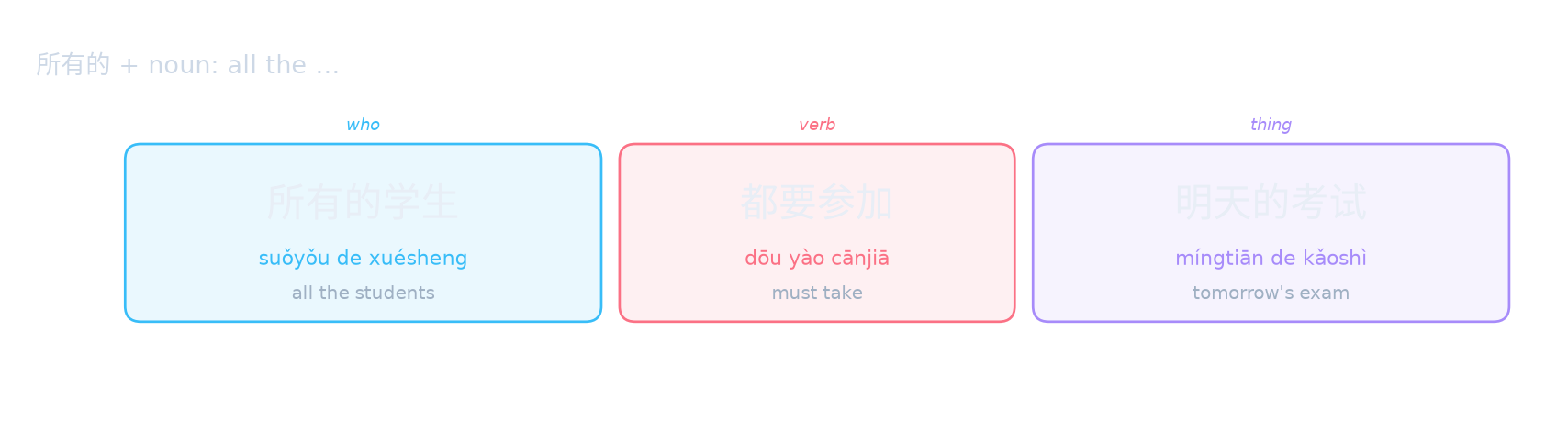
- all所有(modifier / structural particle)的student学生all / both都want / will / need要to participate参加tomorrow明天(modifier / structural particle)的exam; to take an exam考试。 Suǒyǒu de xuésheng dōu yào cānjiā míngtiān de kǎoshì. – All students must take tomorrow's exam.
- 所有人all / both都to agree同意(completed / change)了。 – Everyone agreed.
- I / me我看过all所有(modifier / structural particle)的book书。 – I've read all the books.
- everything一切all / both都can / will会good好(modifier / structural particle)的。 – Everything will be fine.
How it works. all所有((modifier / structural particle)的) suǒyǒu (de) + noun covers every member of a group; (modifier / structural particle)的 is optional. As the subject, it needs all / both都 before the verb. As the object, all / both都 is not needed; with the books as the topic, all / both都 alone does the job: these这些book书I / me我all / both都看过.
| all所有 | everything一切 | all; whole全部 |
|---|---|---|
| all the … (before a noun) | everything, often abstract | the whole, all of it |
| all所有(modifier / structural particle)的question / problem问题 | everything一切all / both都can / will会good好(modifier / structural particle)的 | money钱all; whole全部花完(completed / change)了 |
Watch out
- wrong: all所有(modifier / structural particle)的人来(completed / change)了 → all所有(modifier / structural particle)的person人all / both都to come来(completed / change)了.
- all所有 goes before a noun, not a verb: wrong: we / us我们all所有to go去 → we / us我们all / both都to go去.
… one of (sth)之一 (one of)
Form: (most最 + adjective + (modifier / structural particle)的) + group + one of (sth)之一
- the Great Wall长城to be / is是world世界up / on / last; to get on, attend上most最famous有名(modifier / structural particle)的building; architecture建筑one of (sth)之一。 Chángchéng shì shìjiè shang zuì yǒumíng de jiànzhù zhī yī. – The Great Wall is one of the most famous structures in the world.
- she / her她to be / is是I / me我had better; best最好(modifier / structural particle)的friend朋友one of (sth)之一。 – She is one of my best friends.
- weather天气no good不好to be / is是competition比赛to cancel取消(modifier / structural particle)的reason; cause原因one of (sth)之一。 – Bad weather was one of the reasons the match was cancelled.
- panda熊猫to be / is是China中国(modifier / structural particle)的symbol; to symbolise象征one of (sth)之一。 – The panda is one of China's symbols.
How it works. one of (sth)之一 zhī yī "one of" goes at the end, after the group. among (them)其中one of (sth)之一 means "one of them": 这三本书,among (them)其中one of (sth)之一to be / is是I / me我to write写(modifier / structural particle)的. The same (of — literary)之 appears in fractions: one third三分之一 (one third).
Watch out
- wrong: one of (sth)之一had better; best最好(modifier / structural particle)的friend朋友 → had better; best最好(modifier / structural particle)的friend朋友one of (sth)之一.
- No 一个: wrong: 一个reason; cause原因one of (sth)之一 → reason; cause原因one of (sth)之一.

besides; other另外 + Number + MW + Noun (another)
Form: besides; other另外 + (number) + measure word + noun · besides; other另外(modifier / structural particle)的 + noun
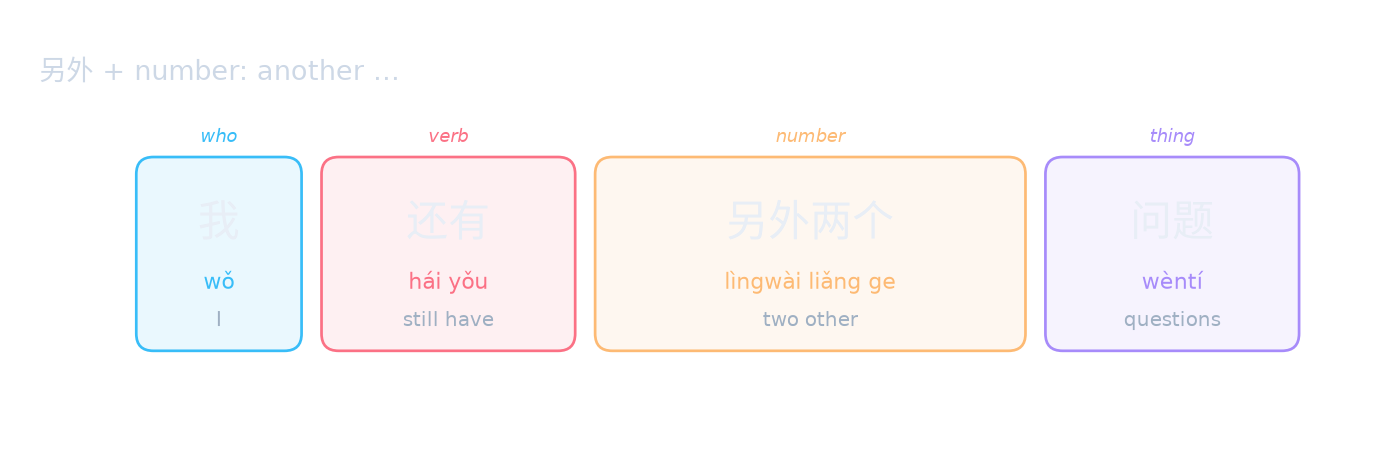
- I / me我also / there is still还有besides; other另外两个question / problem问题。 Wǒ hái yǒu lìngwài liǎng ge wèntí. – I have another two questions.
- this这个to be / is是I / me我(modifier / structural particle)的,besides; other另外一个to be / is是I / me我younger brother弟弟(modifier / structural particle)的。 – This one is mine; the other one is my brother's.
- 三个人里,一个to be / is是teacher老师,besides; other另外两个to be / is是student学生。 – Of the three, one is a teacher and the other two are students.
How it works. Before a number and measure word, besides; other另外 means "another, the other": it picks out the rest of a group after one has been mentioned. besides; other另外(modifier / structural particle)的means办法 means "another way". At the start of a sentence with a comma, besides; other另外 means "in addition".
| besides; other另外 + number | else别的 | other其他 |
|---|---|---|
| the other / another (counted) | any other | the others, the rest |
| besides; other另外两个student学生 | you你also / there is still还有else别的question / problem问题(yes/no ?)吗? | 其他人all / both都to walk / to leave走(completed / change)了 |
Watch out
- wrong: 两个besides; other另外 → besides; other另外两个.
Practice without the models
Cover the teaching sections before you answer. The answers follow.
all所有((modifier / structural particle)的) + Noun (all)
1. Complete: “All the shops are closed.” all所有(modifier / structural particle)的shop商店…………to close (the door)关门(completed / change)了。
2. Which sentence is correct?
- A. we / us我们all所有to come来(completed / change)了。
- B. all所有(modifier / structural particle)的person人all / both都to come来(completed / change)了。
- C. 所有人(modifier / structural particle)的all / both都to come来(completed / change)了。
- D. person人all所有all / both都to come来(completed / change)了。
3. Build: “I've read all the books.”
Put in order: I / me我 / book书。 / all所有(modifier / structural particle)的 / 看过
4. True or false? everything一切all / both都can / will会good好(modifier / structural particle)的 means “Everything will be fine.” If false, correct it.
5. Your teacher makes an announcement to the whole school. Use all所有. Write your answer in Chinese, then say it aloud.
… one of (sth)之一 (one of)
6. Complete: “She is one of my best friends.” she / her她to be / is是I / me我had better; best最好(modifier / structural particle)的friend朋友…………。
7. Which phrase is correct?
- A. 一个China中国最大(modifier / structural particle)的city城市one of (sth)之一
- B. China中国最大(modifier / structural particle)的city城市one of (sth)之一
- C. China中国one of (sth)之一最大(modifier / structural particle)的city城市
- D. one of (sth)之一China中国最大(modifier / structural particle)的city城市
8. Build: “The panda is one of China's symbols.”
Put in order: panda熊猫 / one of (sth)之一。 / to be / is是 / China中国(modifier / structural particle)的symbol; to symbolise象征
9. True or false? among (them)其中one of (sth)之一 means “one of them”. If false, correct it.
10. You are introducing China's great sights to visiting friends. Use … one of (sth)之一. Write your answer in Chinese, then say it aloud.
besides; other另外 + Number + MW + Noun (another)
11. Complete: “This one is mine; the other one is my brother's.” this这个to be / is是I / me我(modifier / structural particle)的,…………一个to be / is是I / me我younger brother弟弟(modifier / structural particle)的。
12. Which phrase is correct?
- A. besides; other另外两个student学生
- B. besides; other另外student学生两个
- C. 两个besides; other另外student学生
- D. 两个student学生besides; other另外
13. Build: “One is a teacher; the other two are students.”
Put in order: besides; other另外两个 / to be / is是student学生。 / , / 一个to be / is是teacher老师
14. True or false? you你also / there is still还有else别的question / problem问题(yes/no ?)吗 asks about any other questions. If false, correct it.
15. You have answered the first question in an interview, and the interviewer has more. Use besides; other另外 + Number + MW + Noun. Write your answer in Chinese, then say it aloud.
Answers and explanations
all所有((modifier / structural particle)的) + Noun (all)
1. all / both都
all所有 + noun as subject takes all / both都.
2. B. all所有(modifier / structural particle)的person人all / both都to come来(completed / change)了。
all所有(modifier / structural particle)的person人all / both都to come来(completed / change)了 is right: all所有(modifier / structural particle)的 + noun is a whole group, so the verb needs all / both都. all所有 cannot follow the noun, and we / us我们all所有 is not used.
3. I / me我看过all所有(modifier / structural particle)的book书。
all所有(modifier / structural particle)的 + noun as the object.
4. True.
everything一切 = everything (often abstract).
5. Model answer: all所有(modifier / structural particle)的student学生all / both都want / will / need要to participate参加tomorrow明天(modifier / structural particle)的exam; to take an exam考试。
Check your answer:
- As a subject, all所有 + noun almost always takes all / both都: say all所有(modifier / structural particle)的person人all / both都to come来(completed / change)了.
- all所有 goes before a noun; it is not an adverb: we / us我们all / both都to go去, not we / us我们all所有to go去.
… one of (sth)之一 (one of)
6. one of (sth)之一
Group + one of (sth)之一 = one of.
7. B. China中国最大(modifier / structural particle)的city城市one of (sth)之一
The group comes first, one of (sth)之一 last.
8. panda熊猫to be / is是China中国(modifier / structural particle)的symbol; to symbolise象征one of (sth)之一。
X to be / is是 + group + one of (sth)之一.
9. True.
among (them)其中 refers back to the group.
10. Model answer: the Great Wall长城to be / is是world世界up / on / last; to get on, attend上most最famous有名(modifier / structural particle)的building; architecture建筑one of (sth)之一。
Check your answer:
- Say had better; best最好(modifier / structural particle)的friend朋友one of (sth)之一, not one of (sth)之一had better; best最好(modifier / structural particle)的friend朋友 (English word order).
- Do not add 一个: reason; cause原因one of (sth)之一, not 一个reason; cause原因one of (sth)之一.
besides; other另外 + Number + MW + Noun (another)
11. besides; other另外
besides; other另外 + number + MW = the other one.
12. A. besides; other另外两个student学生
besides; other另外 comes before the number.
13. 一个to be / is是teacher老师,besides; other另外两个to be / is是student学生。
besides; other另外 picks out the remaining members.
14. True.
True. else别的 means “other, any other”: you你also / there is still还有else别的question / problem问题(yes/no ?)吗? “Do you have any other questions?”
15. Model answer: I / me我also / there is still还有besides; other另外两个question / problem问题。
Check your answer:
- Put besides; other另外 before the number: besides; other另外两个, not 两个besides; other另外.
- besides; other另外 + noun phrase = the other / another; besides; other另外,… at the start = in addition (a new point).