Skip to content
Subjects
  • 1 Adjectives
    • 1.1 Indicating the whole with "quan"
    • 1.2 Negative adjectives with "-si le"

    Adjectives →

  • 2 Adverbs
    • 2.1 Approximations with "chabuduo"
    • 2.2 Assessing situations with "kanlai"
    • 2.3 Coincidence with "zhenghao"
    • 2.4 Declaring the only option with "zhihao"
    • 2.5 Emphasizing negation with "you"
    • 2.6 Emphatic adverb "ke"
    • 2.7 Expressing "all along" with "yuanlai"
    • 2.8 Expressing "almost" using "chadian"
    • 2.9 Expressing "always" with "conglai"
    • 2.10 Expressing "as a result" with "jieguo"
    • 2.11 Expressing "enough" with "gou"
    • 2.12 Expressing "even" with "shenzhi"
    • 2.13 Expressing "had better" with "haishi"
    • 2.14 Expressing "had better" with "zuihao"
    • 2.15 Expressing "have to" with "budebu"
    • 2.16 Expressing "in the end" with "daodi"
    • 2.17 Expressing "in the end" with "jiujing"
    • 2.18 Expressing "just" with "gang"
    • 2.19 Expressing "one by one" with "yi"
    • 2.20 Expressing "originally" with "benlai"
    • 2.21 Expressing "small quantity" with "jiu"
    • 2.22 Expressing "to make certain" with "qianwan"
    • 2.23 Expressing concern with "kongpa"
    • 2.24 Expressing the unexpected with "jingran"
    • 2.25 Rhetorical questions with "nandao"
    • 2.26 Sequencing with "xian" and "zai"
    • 2.27 Using "ye" and "dou" together

    Adverbs →

  • 3 Adverbs with Adjectives
    • 3.1 Expressing "quite" with "ting"

    Adverbs with Adjectives →

  • 4 Auxiliary Words
    • 4.1 Ending a non-exhaustive list with "shenme de"
    • 4.2 Non-exhaustive lists with "dengdeng"

    Auxiliary Words →

  • 5 Conjunctions
    • 5.1 A softer "but" with "buguo"
    • 5.2 Expressing "and then" with "yushi"
    • 5.3 Expressing "in addition" with "haiyou"
    • 5.4 Expressing "in addition" with "lingwai"
    • 5.5 Expressing "in addition" with "zaishuo"
    • 5.6 Two words for "but"
    • 5.7 Using "er" to explain contrasting ideas
    • 5.8 Using "lai" to connect two verb phrases

    Conjunctions →

  • 6 Nouns
    • 6.1 Expressing "within (it/them)" with "qizhong"

    Nouns →

  • 7 Numbers
    • 7.1 Expressing fractions with "fenzhi"

    Numbers →

  • 8 Particles
    • 8.1 Advanced yes-no questions with "ma"
    • 8.2 Reviewing options with "ba"
    • 8.3 Using "de" (modal particle)

    Particles →

  • 9 Prepositions
    • 9.1 Expressing "along with…" with "suizhe"
    • 9.2 Idiomatic phrases with "zai"

    Prepositions →

  • 10 Sentence Patterns
    • 10.1 Emphasizing a negation with "bing"

    Sentence Patterns →

  • 11 Sentence patterns
    • 11.1 Using "yi... wei..."

    Sentence patterns →

  • 12 Verbs
    • 12.1 Causative verbs
    • 12.2 Expressing "it depends" with "kan"
    • 12.3 Expressing "it seems" with "haoxiang"
    • 12.4 Expressing "lies in" with "zaiyu"
    • 12.5 Expressing "mistakenly think that" with "yiwei"
    • 12.6 Expressing "through" with "tongguo"
    • 12.7 Expressing "to come from" with "laizi"
    • 12.8 Using "lai" as a dummy verb

    Verbs →

  • 13 Auxiliary verbs
    • 13.1 Expressing "don't need to" with "buyong"
    • 13.2 Expressing "must" with "dei"

    Auxiliary verbs →

  • 14 Verb phrases
    • 14.1 Combining verbs with "bing"
    • 14.2 Doing something less with "shao"
    • 14.3 Doing something more with "duo"
    • 14.4 Emphasizing the doer of an action with "you"
    • 14.5 Expressing "moreover" with "bingqie"
    • 14.6 Expressing "never" with "conglai"
    • 14.7 Expressing "to be worth" doing with "zhide"
    • 14.8 Expressing "until" with "dao"
    • 14.9 Indicating negative impact with "haide"
    • 14.10 Separable verb
    • 14.11 Using "zhe" when "verbing away"

    Verb phrases →

  • 15 "But" Statements
    • 15.1 Expressing "although" with "jinguan"
    • 15.2 Expressing contrariness with "dao"
    • 15.3 The "however" adverb "que"

    "But" Statements →

  • 16 "Even If" Statements
    • 16.1 Expressing "even if…" with "jishi"

    "Even If" Statements →

  • 17 "If" Statements
    • 17.1 Expressing "if… then…" with "yaoshi"

    "If" Statements →

  • 18 "No Matter" Statements
    • 18.1 Expressing "no matter" with "buguan"
    • 18.2 Expressing "no matter" with "wulun"

    "No Matter" Statements →

  • 19 Cause/Effect Statements
    • 19.1 Expressing "due to…" with "youyu"
    • 19.2 Expressing "since" with "jiran"
    • 19.3 Expressing "therefore" with "yinci"

    Cause/Effect Statements →

  • 20 Complements
    • 20.1 Advanced uses of direction complement "-qilai"
    • 20.2 Direction complement
    • 20.3 Direction complement "-qilai"
    • 20.4 Potential complement

    Complements →

  • 21 Conditional Statements

    as long as只要zhǐ yào … ,then / just就jiù … (as long as)

    Form: as long as只要zhǐ yào + condition,(subject +) then / just就jiù + result

    • as long as只要zhǐ yàoevery day每天měi tiānto practice练习liàn xíhalf of sth半个bàn gèhour小时xiǎo shí,you你nǐthen / just就jiùdefinitely / certain一定yí dìngcan / be able to能néngto pass; through; by means of通过tōng guò。 Zhǐyào měi tiān liànxí bàn ge xiǎoshí, nǐ jiù yídìng néng tōngguò. – As long as you practise half an hour every day, you'll definitely pass.
    • as long as只要zhǐ yàoto have / there is有yǒunetwork网络wǎng luò,at / in在zàiwhere哪儿nǎrall / both都dōucan / be able to能néngto work; job工作gōng zuò。 – As long as there's internet, you can work anywhere.
    • as long as只要zhǐ yàoyou你nǐnot不bùto speak说shuō,then / just就jiùnot / haven't没méiperson人rénto know知道zhī dào。 – As long as you don't tell, nobody will know.

    How it works. as long as只要zhǐ yào zhǐyào says the condition is enough to bring about the result. then / just就jiù follows the subject of the result clause.

    as long as只要zhǐ yào A,then / just就jiù B only (if) / only have只有zhǐ yǒu A,only then / not until才cái B
    A is sufficient A is necessary
    as long as只要zhǐ yàoto have / there is有yǒuticket票piào,then / just就jiùcan / be able to能néngto go in进去jìn qù (a ticket is all you need) only (if) / only have只有zhǐ yǒuto have / there is有yǒuticket票piào,only then can / talent才能cái néngto go in进去jìn qù (no ticket, no entry)

    Watch out

    • as long as只要zhǐ yào pairs with then / just就jiù, not only then / not until才cái: wrong: as long as只要zhǐ yàoto work hard / effort努力nǔ lìonly then can / talent才能cái néngto succeed; success成功chéng gōng → as long as只要zhǐ yàoto work hard / effort努力nǔ lìthen / just就jiùcan / be able to能néngto succeed; success成功chéng gōng.
    只要 …,就 …: as long as

    only if除非chú fēi … ,only then / not until才cái … (only if / unless)

    Form: only if除非chú fēi A,only then / not until才cái B (only if) · only if除非chú fēi A,otherwise否则fǒu zé / otherwise; or else不然bù rán B (unless)

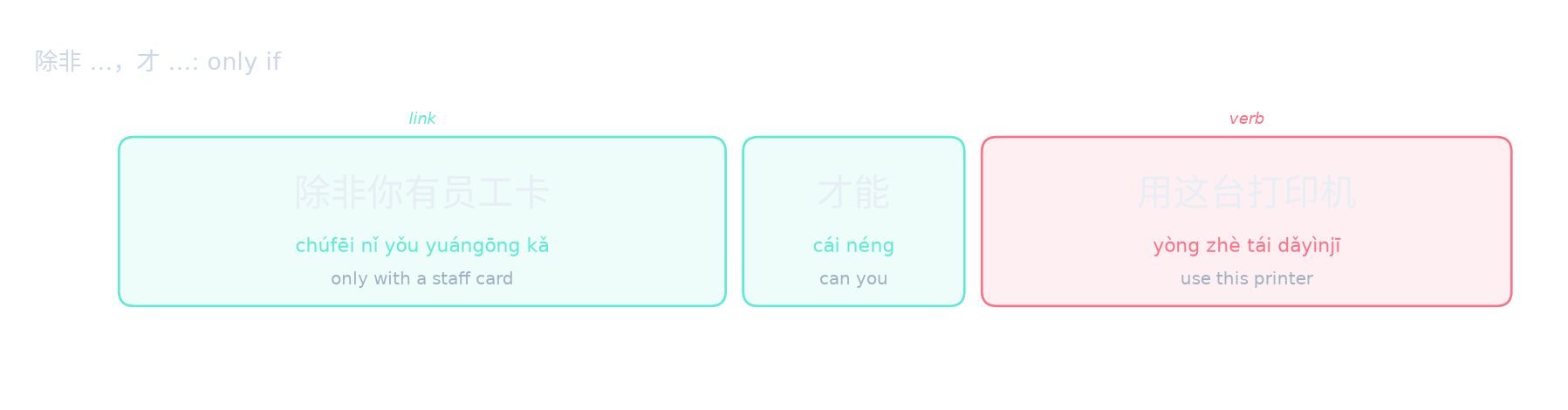
    • only if除非chú fēiyou你nǐto have / there is有yǒustaff员工yuán gōngto block卡kǎ,only then can / talent才能cái néngto use / with用yòng这台zhè táiprinter打印机dǎ yìn jī。 Chúfēi nǐ yǒu yuángōng kǎ, cái néng yòng zhè tái dǎyìnjī. – Only if you have a staff card can you use this printer.
    • only if除非chú fēiyou你nǐto go去qù,I / me我wǒonly then / not until才cáito go去qù。 – I'll go only if you go.
    • only if除非chú fēidown / next; to fall (rain), get off下xiàheavy rain大雨dà yǔ,otherwise否则fǒu zécompetition比赛bǐ sài照常进行zhào cháng jìn xíng。 – Unless it rains heavily, the match goes ahead.
    • only if除非chú fēiyou你nǐfast; soon快kuàia little一点儿yì diǎnr,otherwise否则fǒu zéthen / just就jiùcan't keep up with赶不上gǎn bù shàngtrain火车huǒ chē(completed / change)了le。 – Unless you hurry, you'll miss the train.

    How it works. only if除非chú fēi chúfēi is about the one condition that matters. The second half decides the logic.

    only if除非chú fēi A,only then / not until才cái B only if除非chú fēi A,otherwise否则fǒu zé B
    B only if A (like only (if) / only have只有zhǐ yǒu……only then / not until才cái) if A doesn't happen, B will
    only if除非chú fēi他来tā lái,I / me我wǒonly then / not until才cáito go去qù only if除非chú fēidown / next; to fall (rain), get off下xiàheavy rain大雨dà yǔ,otherwise否则fǒu zé照常进行zhào cháng jìn xíng

    Without only then / not until才cái or otherwise否则fǒu zé, a only if除非chú fēi sentence can be unclear, so always add one.

    Watch out

    • only if除非chú fēi (only if, unless) is not besides除了chú le (except, besides): besides除了chú lehe / him他tā,everyone大家dà jiāall / both都dōuto come来lái(completed / change)了le.
    除非 …,才 …: only if

    Practice without the models

    Cover the teaching sections before you answer. The answers follow.

    as long as只要zhǐ yào … ,then / just就jiù … (as long as)

    1. Complete: “As long as you work hard, you can learn it well.” as long as只要zhǐ yàoto work hard / effort努力nǔ lì,you你nǐ…………can / be able to能néngto learn well学好xué hǎo。

    2. Which sentence is correct?

    • A. as long as只要zhǐ yàoto have / there is有yǒutime时间shí jiān,I / me我wǒonly then / not until才cáito go去qù。
    • B. as long as只要zhǐ yàoto have / there is有yǒutime时间shí jiān,then / just就jiùI / me我wǒto go去qù。
    • C. as long as只要zhǐ yàoto have / there is有yǒutime时间shí jiān,I / me我wǒthen / just就jiùto go去qù。
    • D. only (if) / only have只有zhǐ yǒuto have / there is有yǒutime时间shí jiān,I / me我wǒthen / just就jiùto go去qù。

    3. Build: “As long as you don't tell, nobody will know.”

    Put in order: , / as long as只要zhǐ yàoyou你nǐnot不bùto speak说shuō / not / haven't没méiperson人rénto know知道zhī dào。 / then / just就jiù

    4. True or false? only (if) / only have只有zhǐ yǒu…only then / not until才cái… makes the condition necessary; it does not automatically make that condition sufficient. If false, correct it.

    5. A classmate worries about failing the speaking test. You think daily practice is enough. Use as long as只要zhǐ yào … ,then / just就jiù …. Write your answer in Chinese, then say it aloud.

    only if除非chú fēi … ,only then / not until才cái … (only if / unless)

    6. Complete: “Unless you hurry, you'll miss the train.” only if除非chú fēiyou你nǐfast; soon快kuàia little一点儿yì diǎnr,…………then / just就jiùcan't keep up with赶不上gǎn bù shàngtrain火车huǒ chē(completed / change)了le。

    7. What does only if除非chú fēiyou你nǐto go去qù,I / me我wǒonly then / not until才cáito go去qù mean?

    • A. I won't go if you go.
    • B. I'll go only if you go.
    • C. I'll go whether or not you go.
    • D. Except for you, I'll go.

    8. Build: “Unless it rains heavily, the match goes ahead.”

    Put in order: 照常进行zhào cháng jìn xíng。 / ,otherwise否则fǒu zé / only if除非chú fēidown / next; to fall (rain), get off下xiàheavy rain大雨dà yǔ / competition比赛bǐ sài

    9. True or false? only if除非chú fēi and besides除了chú le mean the same. If false, correct it.

    10. The office printer only works for staff with a card. Use only if除非chú fēi … ,only then / not until才cái …. Write your answer in Chinese, then say it aloud.

    Answers and explanations

    as long as只要zhǐ yào … ,then / just就jiù … (as long as)

    1. then / just就jiù

    as long as只要zhǐ yào pairs with then / just就jiù.

    2. C. as long as只要zhǐ yàoto have / there is有yǒutime时间shí jiān,I / me我wǒthen / just就jiùto go去qù。

    as long as只要zhǐ yàoto have / there is有yǒutime时间shí jiān,I / me我wǒthen / just就jiùto go去qù is right: as long as只要zhǐ yào ("as long as") pairs with then / just就jiù after the subject. only then / not until才cái belongs with only (if) / only have只有zhǐ yǒu, a stricter condition.

    3. as long as只要zhǐ yàoyou你nǐnot不bùto speak说shuō,then / just就jiùnot / haven't没méiperson人rénto know知道zhī dào。

    as long as只要zhǐ yào + condition, then / just就jiù + result.

    4. True.

    A necessary condition can coexist with other requirements. as long as只要zhǐ yào instead presents a sufficient condition.

    5. Model answer: as long as只要zhǐ yàoevery day每天měi tiānto practice练习liàn xíhalf of sth半个bàn gèhour小时xiǎo shí,you你nǐthen / just就jiùdefinitely / certain一定yí dìngcan / be able to能néngto pass; through; by means of通过tōng guò。

    Check your answer:

    • as long as只要zhǐ yào says the condition is sufficient; "only if" (a necessary condition) is only (if) / only have只有zhǐ yǒu…only then / not until才cái….
    • Pair as long as只要zhǐ yào with then / just就jiù, not only then / not until才cái: as long as只要zhǐ yàoto work hard / effort努力nǔ lìthen / just就jiùcan / be able to能néngto succeed; success成功chéng gōng, not as long as只要zhǐ yàoto work hard / effort努力nǔ lìonly then can / talent才能cái néngto succeed; success成功chéng gōng.

    only if除非chú fēi … ,only then / not until才cái … (only if / unless)

    6. otherwise否则fǒu zé

    only if除非chú fēi A,otherwise否则fǒu zé B = unless A, B.

    7. B. I'll go only if you go.

    only if除非chú fēi A,only then / not until才cái B means “only if A, then B”: only if除非chú fēiyou你nǐto go去qù,I / me我wǒonly then / not until才cáito go去qù “I'll go only if you go.” It does not mean “except for”.

    8. only if除非chú fēidown / next; to fall (rain), get off下xiàheavy rain大雨dà yǔ,otherwise否则fǒu zécompetition比赛bǐ sài照常进行zhào cháng jìn xíng。

    only if除非chú fēi A,otherwise否则fǒu zé B.

    9. False.

    besides除了chú le = except; only if除非chú fēi = only if / unless.

    10. Model answer: only if除非chú fēiyou你nǐto have / there is有yǒustaff员工yuán gōngto block卡kǎ,only then can / talent才能cái néngto use / with用yòng这台zhè táiprinter打印机dǎ yìn jī。

    Check your answer:

    • With only then / not until才cái: only if除非chú fēi A,only then / not until才cái B – B only if A. With otherwise否则fǒu zé: only if除非chú fēi A,otherwise否则fǒu zé B – B unless A. Do not mix the logic.
    • only if除非chú fēidown / next; to fall (rain), get off下xiàheavy rain大雨dà yǔ,we / us我们wǒ menall / both都dōuto go去qù (without otherwise否则fǒu zé) is ambiguous; use otherwise否则fǒu zé or otherwise; or else不然bù rán to make "unless" clear.
  • 22 Noun Phrases
    • 22.1 Expressing "all" with "suoyou"
    • 22.2 Expressing "one of" with "zhiyi"
    • 22.3 Expressing "the other" with "lingwai"

    Noun Phrases →

  • 23 Sentence Patterns
    • 23.1 Advanced uses of "lian"
    • 23.2 Explaining purpose with "wei... er..."
    • 23.3 Expressing "any" with "renhe"
    • 23.4 Expressing "both… and…" with "ji...you"
    • 23.5 Expressing location with "zai... shang / xia / li"

    Sentence Patterns →

  • 24 Basic/Simple Sentence Patterns
    • 24.1 Expressing "even" with "lian" and "dou"
    • 24.2 Expressing "every" with question words
    • 24.3 Expressing "multiples" with "bei"
    • 24.4 Expressing "not at all" with "yidianr ye bu"
    • 24.5 Expressing not knowing how to do something using "hao"
    • 24.6 Phrases using "laishuo"

    Basic/Simple Sentence Patterns →

  • 25 Complex Sentence Patterns
    • 25.1 Conceding a point with "shi"
    • 25.2 Events in quick succession with "yi... jiu..."
    • 25.3 Expressing various aspects with "yi fangmian"

    Complex Sentence Patterns →

  • 26 Not only… but also…
    • 26.1 Many types of "not only... but also..."

    Not only… but also… →

  • 27 Comparing similar adverbs
    • 27.1 Comparing "benlai" and "yuanlai"
    • 27.2 Comparing "changchang" and "wangwang"
    • 27.3 Comparing "gang" and "gangcai"

    Comparing similar adverbs →

  • 28 Comparing similar prepositions
    • 28.1 Comparing "guanyu" and "duiyu"
    • 28.2 Comparing "li" and "cong"

    Comparing similar prepositions →

  • 29 Comparing similar separate functions
    • 29.1 Comparing "fan'er" and “xiangfan"
    • 29.2 Comparing "kending" "queding" and “yiding"
    • 29.3 Comparing "shihe" and "heshi"

    Comparing similar separate functions →

  • 30 Comparing similar time words
    • 30.1 Comparing "yihou" and "de shihou"

    Comparing similar time words →

Log in or create account

IGCSE, A-Level & AP