Skip to content
Subjects

HSK 4 Grammar

  • 1 Adjectives
    • 1.1 Indicating the whole with "quan"
    • 1.2 Negative adjectives with "-si le"

    Adjectives →

  • 2 Adverbs
    • 2.1 Approximations with "chabuduo"
    • 2.2 Assessing situations with "kanlai"
    • 2.3 Coincidence with "zhenghao"
    • 2.4 Declaring the only option with "zhihao"
    • 2.5 Emphasizing negation with "you"
    • 2.6 Emphatic adverb "ke"
    • 2.7 Expressing "all along" with "yuanlai"
    • 2.8 Expressing "almost" using "chadian"
    • 2.9 Expressing "always" with "conglai"
    • 2.10 Expressing "as a result" with "jieguo"
    • 2.11 Expressing "enough" with "gou"
    • 2.12 Expressing "even" with "shenzhi"
    • 2.13 Expressing "had better" with "haishi"
    • 2.14 Expressing "had better" with "zuihao"
    • 2.15 Expressing "have to" with "budebu"
    • 2.16 Expressing "in the end" with "daodi"
    • 2.17 Expressing "in the end" with "jiujing"
    • 2.18 Expressing "just" with "gang"
    • 2.19 Expressing "one by one" with "yi"
    • 2.20 Expressing "originally" with "benlai"
    • 2.21 Expressing "small quantity" with "jiu"
    • 2.22 Expressing "to make certain" with "qianwan"
    • 2.23 Expressing concern with "kongpa"
    • 2.24 Expressing the unexpected with "jingran"
    • 2.25 Rhetorical questions with "nandao"
    • 2.26 Sequencing with "xian" and "zai"
    • 2.27 Using "ye" and "dou" together

    Adverbs →

  • 3 Adverbs with Adjectives
    • 3.1 Expressing "quite" with "ting"

    Adverbs with Adjectives →

  • 4 Auxiliary Words
    • 4.1 Ending a non-exhaustive list with "shenme de"
    • 4.2 Non-exhaustive lists with "dengdeng"

    Auxiliary Words →

  • 5 Conjunctions
    • 5.1 A softer "but" with "buguo"
    • 5.2 Expressing "and then" with "yushi"
    • 5.3 Expressing "in addition" with "haiyou"
    • 5.4 Expressing "in addition" with "lingwai"
    • 5.5 Expressing "in addition" with "zaishuo"
    • 5.6 Two words for "but"
    • 5.7 Using "er" to explain contrasting ideas
    • 5.8 Using "lai" to connect two verb phrases

    Conjunctions →

  • 6 Nouns
    • 6.1 Expressing "within (it/them)" with "qizhong"

    Nouns →

  • 7 Numbers
    • 7.1 Expressing fractions with "fenzhi"

    Numbers →

  • 8 Particles
    • 8.1 Advanced yes-no questions with "ma"
    • 8.2 Reviewing options with "ba"
    • 8.3 Using "de" (modal particle)

    Particles →

  • 9 Prepositions
    • 9.1 Expressing "along with…" with "suizhe"
    • 9.2 Idiomatic phrases with "zai"

    Prepositions →

  • 10 Sentence Patterns
    • 10.1 Emphasizing a negation with "bing"

    Sentence Patterns →

  • 11 Sentence patterns
    • 11.1 Using "yi... wei..."

    Sentence patterns →

  • 12 Verbs
    • 12.1 Causative verbs
    • 12.2 Expressing "it depends" with "kan"
    • 12.3 Expressing "it seems" with "haoxiang"
    • 12.4 Expressing "lies in" with "zaiyu"
    • 12.5 Expressing "mistakenly think that" with "yiwei"
    • 12.6 Expressing "through" with "tongguo"
    • 12.7 Expressing "to come from" with "laizi"
    • 12.8 Using "lai" as a dummy verb

    Verbs →

  • 13 Auxiliary verbs
    • 13.1 Expressing "don't need to" with "buyong"
    • 13.2 Expressing "must" with "dei"

    Auxiliary verbs →

  • 14 Verb phrases
    • 14.1 Combining verbs with "bing"
    • 14.2 Doing something less with "shao"
    • 14.3 Doing something more with "duo"
    • 14.4 Emphasizing the doer of an action with "you"
    • 14.5 Expressing "moreover" with "bingqie"
    • 14.6 Expressing "never" with "conglai"
    • 14.7 Expressing "to be worth" doing with "zhide"
    • 14.8 Expressing "until" with "dao"
    • 14.9 Indicating negative impact with "haide"
    • 14.10 Separable verb
    • 14.11 Using "zhe" when "verbing away"

    Verb phrases →

  • 15 "But" Statements
    • 15.1 Expressing "although" with "jinguan"
    • 15.2 Expressing contrariness with "dao"
    • 15.3 The "however" adverb "que"

    "But" Statements →

  • 16 "Even If" Statements
    • 16.1 Expressing "even if…" with "jishi"

    "Even If" Statements →

  • 17 "If" Statements
    • 17.1 Expressing "if… then…" with "yaoshi"

    "If" Statements →

  • 18 "No Matter" Statements
    • 18.1 Expressing "no matter" with "buguan"
    • 18.2 Expressing "no matter" with "wulun"

    "No Matter" Statements →

  • 19 Cause/Effect Statements

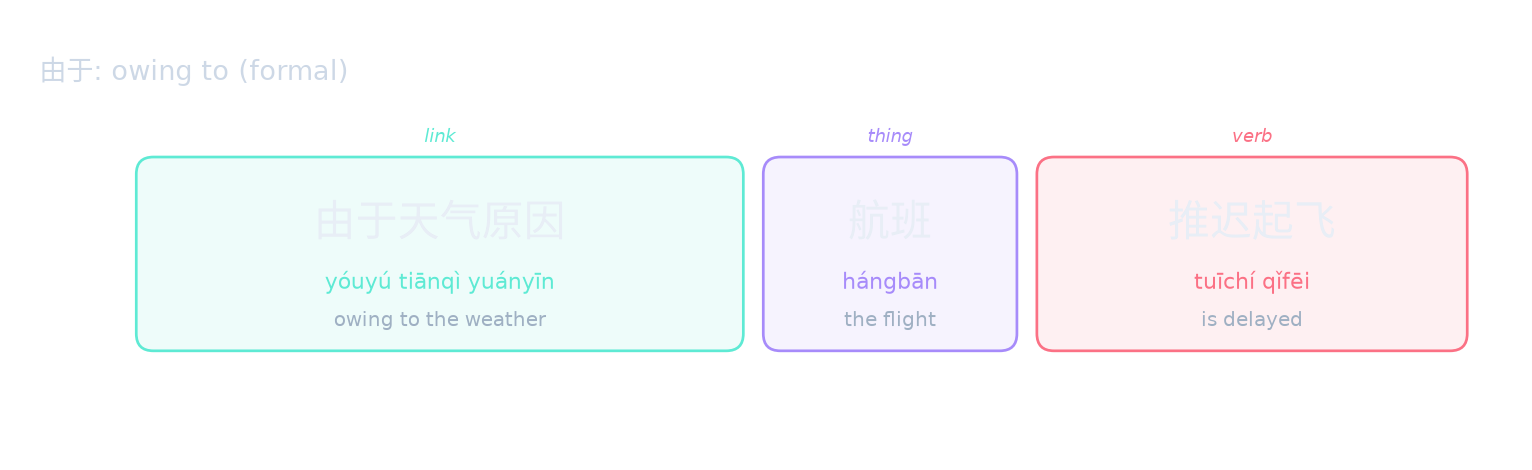
    due to由于yóu yú (due to / owing to)

    Form: due to由于yóu yú + cause,(so / therefore所以suǒ yǐ / therefore因此yīn cǐ) + result (formal)

    • due to由于yóu yúweather天气tiān qìreason; cause原因yuán yīn,flight航班háng bānto postpone推迟tuī chíto take off起飞qǐ fēi。 Yóuyú tiānqì yuányīn, hángbān tuīchí qǐfēi. – Due to the weather, the flight's departure has been delayed.
    • due to由于yóu yúweather天气tiān qìno good不好bù hǎo,activity; to exercise活动huó dòngto cancel取消qǔ xiāo。 – Owing to bad weather, the event is cancelled.
    • due to由于yóu yú准备充分zhǔn bèi chōng fèn,therefore因此yīn cǐcompetition比赛bǐ sàidegree / adjective linker很hěnsmoothly顺利shùn lì。 – Because we prepared well, the competition went smoothly.

    How it works. due to由于yóu yú yóuyú is the formal "because, due to", common in notices, news and writing. It takes a noun phrase (due to由于yóu yútime时间shí jiānrelation / to affect关系guān xì) or a clause (due to由于yóu yúhe / him他tāto fall ill生病shēng bìng(completed / change)了le), and normally starts the sentence. It can pair with so / therefore所以suǒ yǐ or therefore因此yīn cǐ.

    because因为yīn wèi due to由于yóu yú
    everyday formal
    can follow the result: I / me我wǒnot / haven't没méito go去qù,because因为yīn wèito rain下雨xià yǔ(completed / change)了le starts the sentence; pairs with therefore因此yīn cǐ
    由于: owing to (formal)

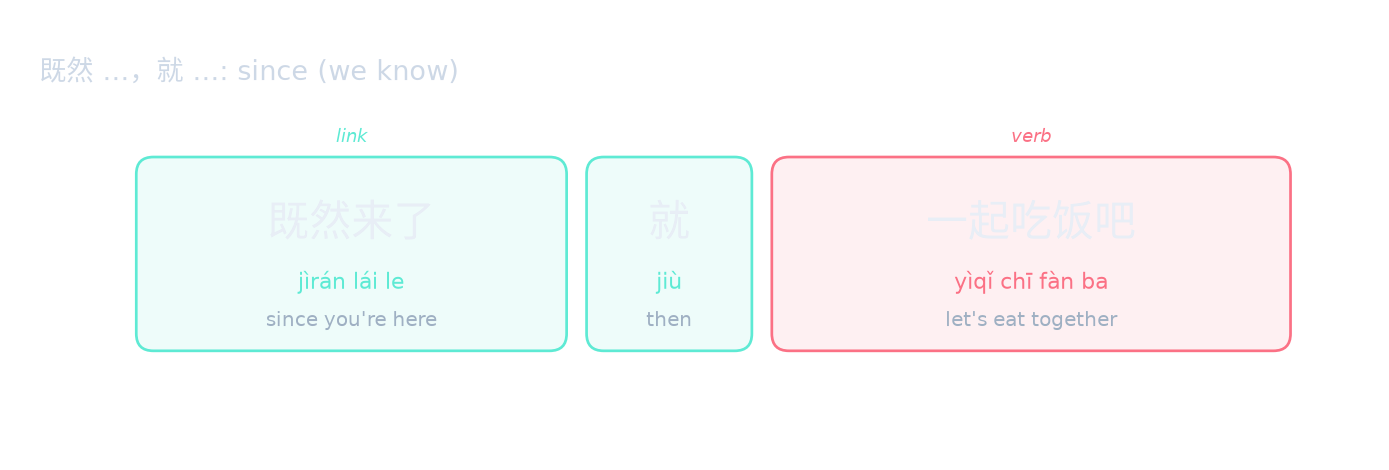
    since既然jì rán … ,then / just就jiù … (since / now that)

    Form: since既然jì rán + known fact,(subject +) then / just就jiù + suggestion / decision

    • since既然jì ránto come来lái(completed / change)了le,then / just就jiùtogether一起yì qǐto have a meal吃饭chī fàn(suggestion)吧ba! Jìrán lái le, jiù yìqǐ chī fàn ba! – Since you're here, stay and eat with us!
    • since既然jì rányou你nǐillness / ill病bìng(completed / change)了le,then / just就jiùto return home回家huí jiāto rest休息xiū xī(suggestion)吧ba。 – Since you're ill, go home and rest.
    • since既然jì rányou你nǐalready已经yǐ jīngto decide / decision决定jué dìng(completed / change)了le,I / me我wǒthen / just就jiùnot不bùmany; much多duōto speak说shuō(completed / change)了le。 – Since you've already decided, I won't say any more.

    How it works. since既然jì rán jìrán "since, now that" starts from a fact both people already know. The second clause draws a conclusion: a suggestion ((suggestion)吧ba), a decision, or a question (why?为什么wèi shén mestill / also / even还hái……?). then / just就jiù goes after the subject.

    if如果rú guǒ because因为yīn wèi since既然jì rán
    a possibility explains why it happened a known fact → what to do now
    if如果rú guǒyou你nǐto come来lái,…… because因为yīn wèito rain下雨xià yǔ,competition比赛bǐ sàito cancel取消qǔ xiāo(completed / change)了le since既然jì ránto rain下雨xià yǔ(completed / change)了le,we / us我们wǒ menthen / just就jiùto be at home在家zài jiāto look at; to watch; to read看kàn电影吧diàn yǐng ba

    Watch out

    • since既然jì rán pairs with then / just就jiù, not so / therefore所以suǒ yǐ: since既然jì ránto rain下雨xià yǔ(completed / change)了le,we / us我们wǒ menthen / just就jiù别去了bié qù le.
    既然 …,就 …: since (we know)

    therefore因此yīn cǐ (therefore / for this reason)

    Form: cause,therefore因此yīn cǐ + result · subject + therefore因此yīn cǐ + verb

    • new新xīn产品价格chǎn pǐn jià gélow低dī,therefore因此yīn cǐdegree / adjective linker很hěnpopular受欢迎shòu huān yíng。 Xīn chǎnpǐn jiàgé dī, yīncǐ hěn shòu huānyíng. – The new product is cheap, and therefore very popular.
    • he / him他tāevery day每天měi tiānto practice练习liàn xí,therefore因此yīn cǐprogress进步jìn bù很快hěn kuài。 – He practises every day and therefore improves fast.
    • 这次zhè cìexam; to take an exam考试kǎo shìdegree / adjective linker很hěnimportant重要zhòng yào。therefore因此yīn cǐ,everyone大家dà jiāwant / will / need要yàoconscientious认真rèn zhēnto review复习fù xí。 – This exam is important. Therefore, everyone must revise carefully.

    How it works. therefore因此yīn cǐ yīncǐ "therefore, for this reason" gives a logical consequence. It is formal. It starts the result clause, follows its subject (he / him他tātherefore因此yīn cǐto decide / decision决定jué dìng……), or starts a new sentence with a comma.

    so / therefore所以suǒ yǐ therefore因此yīn cǐ and so于是yú shì
    everyday "so" formal "therefore" the next action in a story

    Watch out

    • In careful writing, pair due to由于yóu yú……,therefore因此yīn cǐ…… or because因为yīn wèi……,so / therefore所以suǒ yǐ……; avoid because因为yīn wèi……,therefore因此yīn cǐ…….
    因此: therefore (written)

    Practice without the models

    Cover the teaching sections before you answer. The answers follow.

    due to由于yóu yú (due to / owing to)

    1. Complete (notice): “Due to the bad weather, the event is cancelled.” …………weather天气tiān qìno good不好bù hǎo,activity; to exercise活动huó dòngto cancel取消qǔ xiāo。

    2. Which word can naturally follow the result? I / me我wǒnot / haven't没méito go去qù,____to rain下雨xià yǔ(completed / change)了le。

    • A. due to由于yóu yú
    • B. and so于是yú shì
    • C. therefore因此yīn cǐ
    • D. because因为yīn wèi

    3. Build: “Because we prepared well, the competition went smoothly.”

    Put in order: therefore因此yīn cǐ / competition比赛bǐ sàidegree / adjective linker很hěnsmoothly顺利shùn lì。 / due to由于yóu yú准备充分zhǔn bèi chōng fèn / ,

    4. True or false? due to由于yóu yú sounds more formal than because因为yīn wèi. If false, correct it.

    5. An airport announcement explains why your flight is late. Use due to由于yóu yú. Write your answer in Chinese, then say it aloud.

    since既然jì rán … ,then / just就jiù … (since / now that)

    6. Complete: “Since you're ill, go home and rest.” …………you你nǐillness / ill病bìng(completed / change)了le,then / just就jiùto return home回家huí jiāto rest休息xiū xī(suggestion)吧ba。

    7. Which sentence is correct?

    • A. since既然jì ránto rain下雨xià yǔ(completed / change)了le,so / therefore所以suǒ yǐwe / us我们wǒ men别去了bié qù le。
    • B. since既然jì ránto rain下雨xià yǔ(completed / change)了le,we / us我们wǒ menthen / just就jiù别去了bié qù le。
    • C. we / us我们wǒ menthen / just就jiù别去了bié qù le,since既然jì ránso / therefore所以suǒ yǐto rain下雨xià yǔ。
    • D. since既然jì rántomorrow明天míng tiānmaybe / possible可能kě néngto rain下雨xià yǔ,then / just就jiùwe / us我们wǒ men别去bié qù。

    8. Build: “Since you've decided, I won't say any more.”

    Put in order: I / me我wǒthen / just就jiù / , / since既然jì rányou你nǐalready已经yǐ jīngto decide / decision决定jué dìng(completed / change)了le / not不bùmany; much多duōto speak说shuō(completed / change)了le。

    9. True or false? since既然jì rán is the right word for a situation that may or may not happen. If false, correct it.

    10. Your friend drops by just as you are cooking dinner. Use since既然jì rán … ,then / just就jiù …. Write your answer in Chinese, then say it aloud.

    therefore因此yīn cǐ (therefore / for this reason)

    11. Complete (written): “He practises daily and therefore improves fast.” he / him他tāevery day每天měi tiānto practice练习liàn xí,…………progress进步jìn bù很快hěn kuài。

    12. Which pair suits careful writing?

    • A. due to由于yóu yú…,therefore因此yīn cǐ…
    • B. if如果rú guǒ…,therefore因此yīn cǐ…
    • C. since既然jì rán…,therefore因此yīn cǐ…
    • D. because因为yīn wèi…,but但是dàn shì…

    13. Build: “Therefore, everyone must revise carefully.”

    Put in order: everyone大家dà jiāwant / will / need要yào / therefore因此yīn cǐ / , / conscientious认真rèn zhēnto review复习fù xí。

    14. True or false? In casual conversation, so / therefore所以suǒ yǐ sounds more natural than therefore因此yīn cǐ. If false, correct it.

    15. You are writing a report on why sales of a new drink went up. Use therefore因此yīn cǐ. Write your answer in Chinese, then say it aloud.

    Answers and explanations

    due to由于yóu yú (due to / owing to)

    1. due to由于yóu yú

    due to由于yóu yú + cause, then the result.

    2. D. because因为yīn wèi

    because因为yīn wèi can follow the result; due to由于yóu yú normally starts the sentence.

    3. due to由于yóu yú准备充分zhǔn bèi chōng fèn,therefore因此yīn cǐcompetition比赛bǐ sàidegree / adjective linker很hěnsmoothly顺利shùn lì。

    due to由于yóu yú…,therefore因此yīn cǐ….

    4. True.

    It suits notices, news and writing.

    5. Model answer: due to由于yóu yúweather天气tiān qìreason; cause原因yuán yīn,flight航班háng bānto postpone推迟tuī chíto take off起飞qǐ fēi。

    Check your answer:

    • due to由于yóu yú introduces the cause before the result; "the result, due to由于yóu yú cause" is less natural than with because因为yīn wèi.
    • In everyday conversation, because因为yīn wèi sounds more natural than due to由于yóu yú.

    since既然jì rán … ,then / just就jiù … (since / now that)

    6. since既然jì rán

    since既然jì rán + known fact, then / just就jiù + suggestion.

    7. B. since既然jì ránto rain下雨xià yǔ(completed / change)了le,we / us我们wǒ menthen / just就jiù别去了bié qù le。

    since既然jì ránto rain下雨xià yǔ(completed / change)了le,we / us我们wǒ menthen / just就jiù别去了bié qù le is right: since既然jì rán pairs with then / just就jiù after the subject. so / therefore所以suǒ yǐ does not pair with since既然jì rán, and then / just就jiù cannot come before we / us我们wǒ men.

    8. since既然jì rányou你nǐalready已经yǐ jīngto decide / decision决定jué dìng(completed / change)了le,I / me我wǒthen / just就jiùnot不bùmany; much多duōto speak说shuō(completed / change)了le。

    since既然jì rán + fact, subject + then / just就jiù + decision.

    9. False.

    Possibilities take if如果rú guǒ; since既然jì rán needs a known fact.

    10. Model answer: since既然jì ránto come来lái(completed / change)了le,then / just就jiùtogether一起yì qǐto have a meal吃饭chī fàn(suggestion)吧ba!

    Check your answer:

    • since既然jì rán needs a fact that is already true and known; for a possibility use if如果rú guǒ: if如果rú guǒyou你nǐto come来lái,… .
    • Pair it with then / just就jiù (or that那nà / still / also / even还hái), not so / therefore所以suǒ yǐ: since既然jì ránto rain下雨xià yǔ(completed / change)了le,we / us我们wǒ menthen / just就jiù别去了bié qù le – "Since it's raining, let's not go."

    therefore因此yīn cǐ (therefore / for this reason)

    11. therefore因此yīn cǐ

    therefore因此yīn cǐ gives the logical consequence.

    12. A. due to由于yóu yú…,therefore因此yīn cǐ…

    due to由于yóu yú…therefore因此yīn cǐ… is the standard written pair.

    13. therefore因此yīn cǐ,everyone大家dà jiāwant / will / need要yàoconscientious认真rèn zhēnto review复习fù xí。

    therefore因此yīn cǐ can open a new sentence.

    14. True.

    True. therefore因此yīn cǐ is formal and written; in casual conversation so / therefore所以suǒ yǐ is the natural word for “so, therefore”.

    15. Model answer: new新xīn产品价格chǎn pǐn jià gélow低dī,therefore因此yīn cǐdegree / adjective linker很hěnpopular受欢迎shòu huān yíng。

    Check your answer:

    • In writing, due to由于yóu yú…,therefore因此yīn cǐ… is the standard pair; in speech, because因为yīn wèi…,so / therefore所以suǒ yǐ….
    • therefore因此yīn cǐ is formal; in chat, so / therefore所以suǒ yǐ is more natural.
  • 20 Complements
    • 20.1 Advanced uses of direction complement "-qilai"
    • 20.2 Direction complement
    • 20.3 Direction complement "-qilai"
    • 20.4 Potential complement

    Complements →

  • 21 Conditional Statements
    • 21.1 Expressing "as long as" with "zhiyao"
    • 21.2 Expressing "unless" with "chufei"

    Conditional Statements →

  • 22 Noun Phrases
    • 22.1 Expressing "all" with "suoyou"
    • 22.2 Expressing "one of" with "zhiyi"
    • 22.3 Expressing "the other" with "lingwai"

    Noun Phrases →

  • 23 Sentence Patterns
    • 23.1 Advanced uses of "lian"
    • 23.2 Explaining purpose with "wei... er..."
    • 23.3 Expressing "any" with "renhe"
    • 23.4 Expressing "both… and…" with "ji...you"
    • 23.5 Expressing location with "zai... shang / xia / li"

    Sentence Patterns →

  • 24 Basic/Simple Sentence Patterns
    • 24.1 Expressing "even" with "lian" and "dou"
    • 24.2 Expressing "every" with question words
    • 24.3 Expressing "multiples" with "bei"
    • 24.4 Expressing "not at all" with "yidianr ye bu"
    • 24.5 Expressing not knowing how to do something using "hao"
    • 24.6 Phrases using "laishuo"

    Basic/Simple Sentence Patterns →

  • 25 Complex Sentence Patterns
    • 25.1 Conceding a point with "shi"
    • 25.2 Events in quick succession with "yi... jiu..."
    • 25.3 Expressing various aspects with "yi fangmian"

    Complex Sentence Patterns →

  • 26 Not only… but also…
    • 26.1 Many types of "not only... but also..."

    Not only… but also… →

  • 27 Comparing similar adverbs
    • 27.1 Comparing "benlai" and "yuanlai"
    • 27.2 Comparing "changchang" and "wangwang"
    • 27.3 Comparing "gang" and "gangcai"

    Comparing similar adverbs →

  • 28 Comparing similar prepositions
    • 28.1 Comparing "guanyu" and "duiyu"
    • 28.2 Comparing "li" and "cong"

    Comparing similar prepositions →

  • 29 Comparing similar separate functions
    • 29.1 Comparing "fan'er" and “xiangfan"
    • 29.2 Comparing "kending" "queding" and “yiding"
    • 29.3 Comparing "shihe" and "heshi"

    Comparing similar separate functions →

  • 30 Comparing similar time words
    • 30.1 Comparing "yihou" and "de shihou"

    Comparing similar time words →

Log in or create account

IGCSE, A-Level & AP