to let / make让 / to call / be called / (animals) cry, bark叫 / please; to invite请 / to make使 (causative)
Form: A + to let / make让 / to call / be called / (animals) cry, bark叫 / please; to invite请 / to make使 + B + verb · to let / make让 / to make使 + B + feeling
- manager经理to let / make让I / me我to notify / notice通知everyone大家Friday星期五to hand in; to make (friends)交report; to report报告。 Jīnglǐ ràng wǒ tōngzhī dàjiā xīngqīwǔ jiāo bàogào. – The manager asked me to tell everyone to hand in their reports on Friday.
- he / him他if (coming after a…的话to let / make让I / me我degree / adjective linker很moved (emotionally); to move感动。 Tā de huà ràng wǒ hěn gǎndòng. – What he said moved me deeply.
- this这个news; message消息to make使everyone大家very非常surprised吃惊。 – The news greatly surprised everyone.
- doctor医生不让he / him他to drink (alcohol)喝酒。 – The doctor won't let him drink.
How it works. B is the object of the first verb and the doer of the second.
| Verb | Use | Register |
|---|---|---|
| to let / make让 | let, make, ask; cause a feeling | everyday |
| to call / be called / (animals) cry, bark叫 | tell someone to | spoken, direct |
| please; to invite请 | invite, ask politely | polite: we / us我们want / think / miss想please; to invite请to rule王professor教授to come来to do; to make做report; to report报告 |
| to make使 | cause a change of state | written |
不让 / not / haven't没to let / make让 refuse or didn't ask; to let / make让……don't别…… tells someone not to: mum; mother妈妈to let / make让我别to play玩mobile phone手机.
Watch out
- to make使 is not for permission: wrong: mum; mother妈妈to make使I / me我to go去 → mum; mother妈妈to let / make让I / me我to go去.
- To a teacher, please; to invite请you (polite)您…… sounds right; to call / be called / (animals) cry, bark叫you (polite)您…… sounds rude.

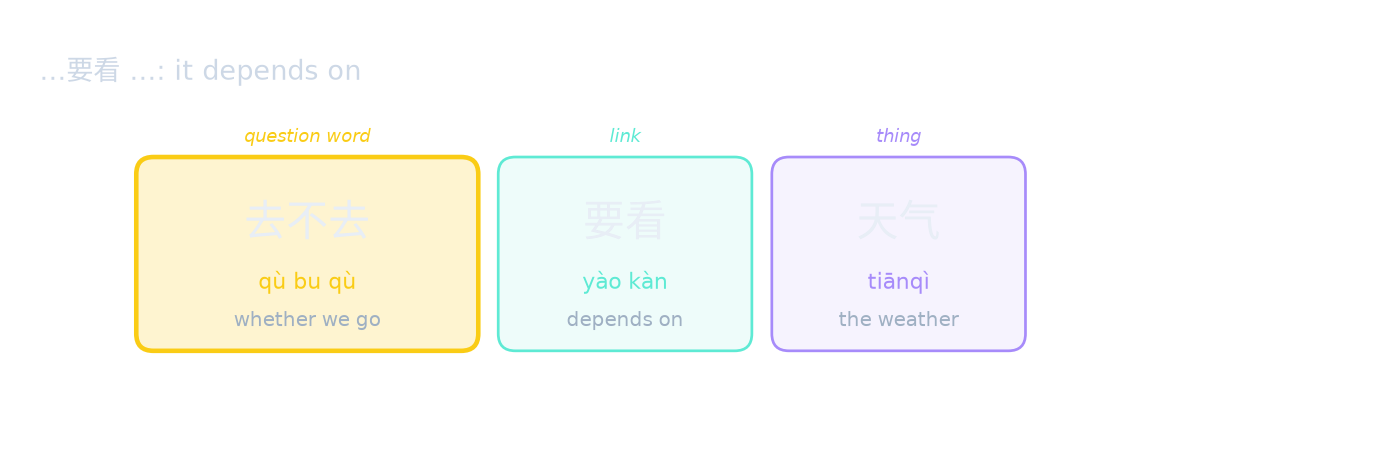
want / will / need要to look at; to watch; to read看 / (degree marker)得to look at; to watch; to read看 (it depends on)
Form: undecided matter + want / will / need要to look at; to watch; to read看 / (degree marker)得to look at; to watch; to read看 + deciding factor
- 去不去want / will / need要to look at; to watch; to read看weather天气。 Qù bu qù yào kàn tiānqì. – Whether we go depends on the weather.
- A: you你tomorrow明天to come来(yes/no ?)吗? B: (degree marker)得to look at; to watch; to read看situation情况。 Děi kàn qíngkuàng. – "Are you coming tomorrow?" "It depends."
- achievement成绩OK? / good or not好不好,want / will / need要to look at; to watch; to read看you你to work hard / effort努力not不to work hard / effort努力。 – Whether your results are good depends on whether you work hard.
How it works. Put what is undecided first, often as A-not-A or with a question word (去不去, what什么time; when时候, how about怎么样), then want / will / need要to look at; to watch; to read看 / (degree marker)得to look at; to watch; to read看 + the factor that decides it. In (degree marker)得to look at; to watch; to read看, (degree marker)得 is read děi ("must").
| Spoken | Written |
|---|---|
| want / will / need要to look at; to watch; to read看 / (degree marker)得to look at; to watch; to read看 | to hinge on取决于 |
| result; as a result结果want / will / need要to look at; to watch; to read看everyone大家(modifier / structural particle)的to work hard / effort努力 | result; as a result结果to hinge on取决于everyone大家(modifier / structural particle)的to work hard / effort努力 |
Watch out
- In most speech the undecided part comes first: wrong: want / will / need要to look at; to watch; to read看weather天气去不去 → 去不去want / will / need要to look at; to watch; to read看weather天气.
to seem; as if好像 (it seems / as if)
Form: subject + to seem; as if好像 + guess · A + to seem; as if好像 + B + the same一样 (+ adjective)
- he / him他to seem; as if好像not不太高兴。 Tā hǎoxiàng bú tài gāoxìng. – He seems a bit unhappy.
- shop商店to seem; as if好像to close (the door)关门(completed / change)了。 – It seems the shop is closed.
- I / me我to seem; as if好像to see / meet见(experienced)过he / him他。 – I think I've seen him somewhere.
- here这儿(modifier / structural particle)的winter冬天to seem; as if好像spring (season)春天the same一样warm暖和。 – Winter here is as warm as spring.
How it works. to seem; as if好像 hǎoxiàng gives a soft guess from what you notice: "it seems, apparently". It goes after the subject or at the start (to seem; as if好像want / will / need要to rain下雨(completed / change)了). With the same一样, it compares: "as if, like": he / him他happy; glad高兴(degree marker)得to seem; as if好像(measure word)个child孩子the same一样.
| to seem; as if好像 | it seems (from this)看来 | seemingly看起来 |
|---|---|---|
| a soft guess | a conclusion from evidence | an impression from looks |
| he / him他to seem; as if好像to fall ill生病(completed / change)了 | he / him他not / haven't没to come来,it seems (from this)看来to be / is是to fall ill生病(completed / change)了 | he / him他seemingly看起来很累 |
Watch out
- to seem; as if好像 is tentative, so not with definitely / certain一定: wrong: he / him他to seem; as if好像definitely / certain一定illness / ill病(completed / change)了 → he / him他to seem; as if好像illness / ill病(completed / change)了.

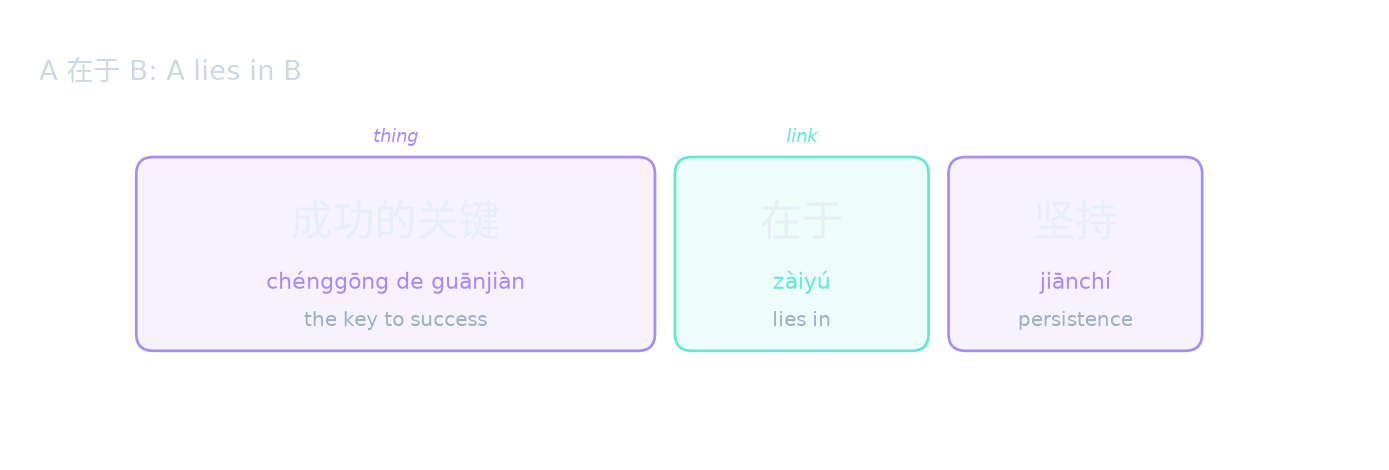
to rest with在于 (lies in / consists in)
Form: abstract subject (key (point)关键 / question / problem问题 / reason; cause原因 / difference区别) + to rest with在于 + B
- to succeed; success成功(modifier / structural particle)的关键在于to keep at; to insist坚持。 Chénggōng de guānjiàn zàiyú jiānchí. – The key to success lies in perseverance.
- this这两个method方法(modifier / structural particle)的difference区别to rest with在于speed速度。 – The difference between the two methods lies in speed.
- question / problem问题to rest with在于money钱not enough不够。 – The problem is that there isn't enough money.
- to learn well学好foreign language外语to rest with在于many; much多to practice练习。 – Learning a language well comes down to plenty of practice.
How it works. to rest with在于 zàiyú names where the key point, problem, reason or difference lies. The subject is abstract, and the style is formal. In speech, main主要to be / is是…… often replaces it: question / problem问题main主要to be / is是time时间not enough不够.
| at / in在 + place | to be / is是 | to rest with在于 |
|---|---|---|
| be located | states identity | stresses where the point lies |
| he / him他at / in在Beijing北京 | key (point)关键to be / is是to keep at; to insist坚持 | 关键在于to keep at; to insist坚持 |
Watch out
- Not for places: wrong: he / him他to rest with在于Beijing北京 → he / him他at / in在Beijing北京.
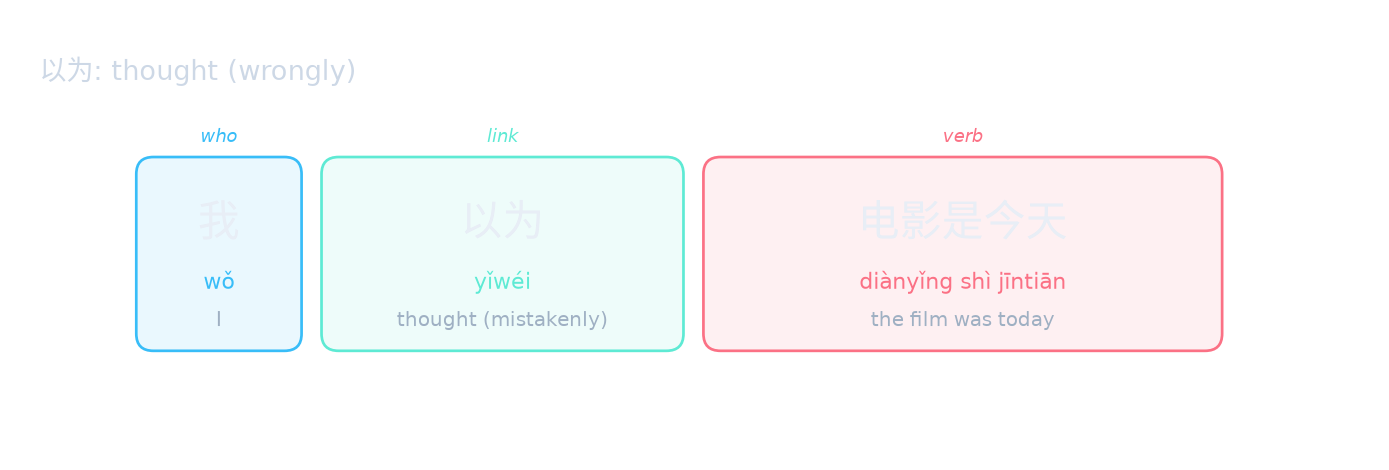
to think以为 (mistakenly think)
Form: subject + (still / also / even还) to think以为 + belief,(originally / so it turns out原来 / didn't expect没想到) + truth
- I / me我to think以为film; movie电影to be / is是today今天! Wǒ yǐwéi diànyǐng shì jīntiān! – I thought the film was today! (it wasn't)
- I / me我to think以为he / him他to be / is是China中国person人,originally / so it turns out原来he / him他to be / is是Japan日本person人。 – I thought he was Chinese, but it turns out he's Japanese.
- I / me我to think以为you你already已经to walk / to leave走(completed / change)了,didn't expect没想到you你still / also / even还at / in在。 – I thought you'd already left; I didn't expect you'd still be here.
- I / me我still / also / even还to think以为you你not不to come来(completed / change)了。 – And here I was thinking you weren't coming.
How it works. to think以为 yǐwéi reports a belief that turned out to be wrong. A second clause often gives the truth, with originally / so it turns out原来 or didn't expect没想到. still / also / even还to think以为 stresses the mistake.
| to think / believe认为 | to feel / think觉得 | to think以为 |
|---|---|---|
| a considered opinion | feel, think (everyday) | thought, wrongly |
| I / me我to think / believe认为this这个means办法degree / adjective linker很good好 | I / me我to feel / think觉得slightly有点儿cold冷 | I / me我to think以为you你to be / is是teacher老师 |
Watch out
- In a debate, "I think this plan is reasonable" is I / me我to think / believe认为…, not I / me我to think以为….
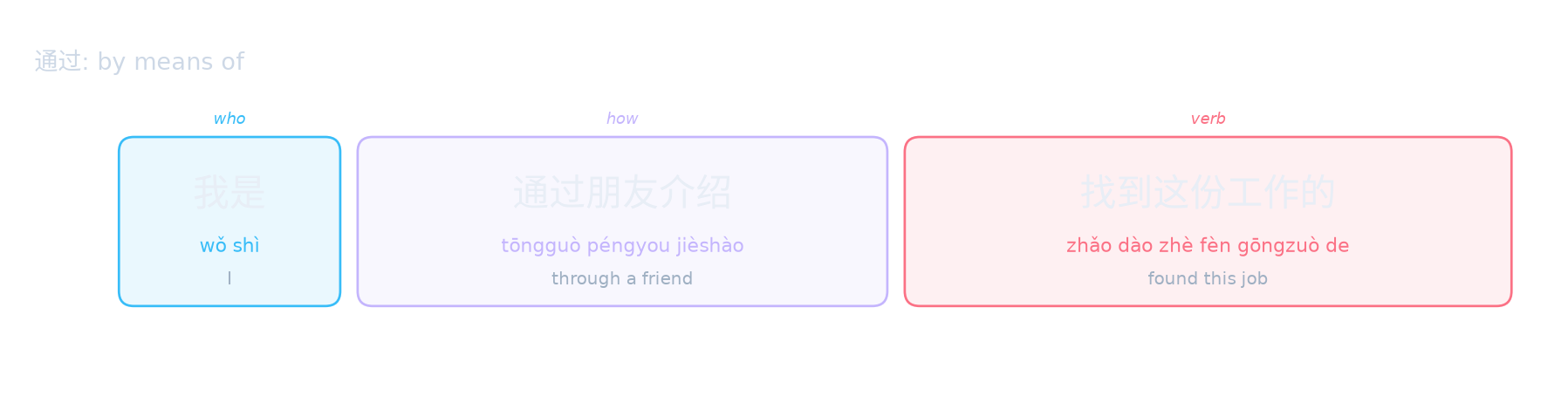
to pass; through; by means of通过 (through / by means of)
Form: to pass; through; by means of通过 + means,subject + result · subject + to pass; through; by means of通过 + exam / place
- I / me我to be / is是to pass; through; by means of通过friend朋友to introduce介绍to find找到这份to work; job工作(modifier / structural particle)的。 Wǒ shì tōngguò péngyou jièshào zhǎodào zhè fèn gōngzuò de. – I found this job through a friend's introduction.
- to pass; through; by means of通过这次activity; to exercise活动,everyone大家each other互相to understand了解(completed / change)了。 – Through this event, everyone got to know each other.
- he / him他to pass; through; by means of通过(completed / change)了exam; to take an exam考试。 Tā tōngguòle kǎoshì. – He passed the exam.
- car or other vehicle…车子to pass; through; by means of通过(completed / change)了big bridge大桥。 – The car crossed the bridge.
How it works. Before a verb or at the start, to pass; through; by means of通过 means "through, by means of": how a result is reached. As a verb, it means "pass" (an exam, a test, a vote) or "go through" a place.
| to pass; through; by means of通过 | to pass / process经过 |
|---|---|
| the means | a process gone through |
| to pass; through; by means of通过network网络to buy tickets买票 | to pass / process经过三年(modifier / structural particle)的to work hard / effort努力 |
Watch out
- After a to pass; through; by means of通过 phrase, the result still needs a subject: wrong: to pass; through; by means of通过to study; to learn学习,to make使I / me我progress进步(completed / change)了 → to pass; through; by means of通过to study; to learn学习,I / me我progress进步(completed / change)了很多. This is a classic exam trap.
to come from来自 (come from)
Form: subject + to come from来自 + place / source (formal)
- these这些student学生to come from来自十多个country国家。 Zhèxiē xuésheng láizì shí duō ge guójiā. – These students come from more than ten countries.
- she / her她to come from来自Peking University北京大学。 – She is from Peking University.
- this这个news; message消息to come from来自one (family / company)一家newspaper报纸。 – This news comes from a newspaper.
- he / him他(modifier / structural particle)的pressure压力main主要to come from来自to work; job工作。 – His stress comes mainly from work.
How it works. to come from来自 láizì "come from" is the formal alternative to from从……to come来. The place or source follows directly. It suits introductions and writing; in conversation, I / me我是从China中国to come来(modifier / structural particle)的 or I / me我to be / is是China中国person人 is more natural.
Watch out
- No from从 and no to come来 at the end: wrong: to come from来自from从China中国, wrong: to come from来自China中国to come来 → to come from来自China中国.

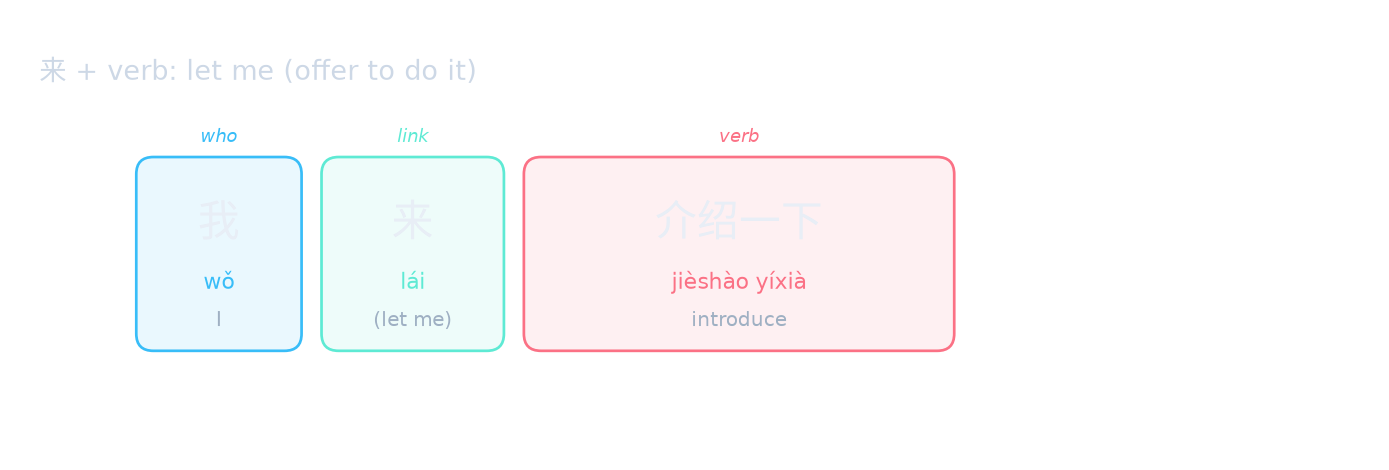
to come来 as a dummy verb (I'll do it)
Form: (I / me我) to come来 (+ verb) · to come来 + amount + item (ordering)
- 我来(suggestion)吧! Wǒ lái ba! – Let me do it!
- 我来to pay money付钱! – Let me pay!
- 我来to introduce介绍(used after a verb) give it…一下。 – Let me introduce (him).
- to come来一碗beef noodle soup牛肉面。 Lái yì wǎn niúròu miàn. – A bowl of beef noodles, please.
How it works. In casual speech, to come来 can stand in for the real action: "let me take care of it". The action is clear from the situation (carrying, paying, introducing). In a restaurant, to come来 + amount means "bring me": to come来两瓶beer啤酒, 再来一个!
| 我来to do; to make做 | I / me我to go去to buy买 |
|---|---|
| I'll take it on, here | I'll go off and buy it |
Watch out
- Here to come来 does not mean "come": 我来(suggestion)吧 is "let me do it".
Practice without the models
Cover the teaching sections before you answer. The answers follow.
to let / make让 / to call / be called / (animals) cry, bark叫 / please; to invite请 / to make使 (causative)
1. Complete: “His words moved me deeply.” he / him他if (coming after a…的话…………I / me我degree / adjective linker很moved (emotionally); to move感动。
2. You invite your professor to give a talk. Which verb fits? we / us我们want / think / miss想___to rule王professor教授to come来to do; to make做report; to report报告。
- A. to call / be called / (animals) cry, bark叫
- B. to make使
- C. please; to invite请
- D. to let / make让
3. Build: “The doctor won't let him drink.”
Put in order: doctor医生 / to drink (alcohol)喝酒。 / he / him他 / 不让
4. True or false? to make使 is the usual verb for giving permission in conversation. If false, correct it.
5. Your manager wants the report by Friday and tells you to inform the team. Use to let / make让 / to call / be called / (animals) cry, bark叫 / please; to invite请 / to make使. Write your answer in Chinese, then say it aloud.
want / will / need要to look at; to watch; to read看 / (degree marker)得to look at; to watch; to read看 (it depends on)
6. Complete: “Whether we go depends on the weather.” 去不去…………weather天气。
7. How is (degree marker)得 read in (degree marker)得to look at; to watch; to read看situation情况?
- A. děi
- B. dé
- C. de
- D. dì
8. Build: “Whether your results are good depends on whether you work hard.”
Put in order: achievement成绩OK? / good or not好不好 / want / will / need要to look at; to watch; to read看you你 / to work hard / effort努力not不to work hard / effort努力。 / ,
9. True or false? to hinge on取决于 is the formal written equivalent of want / will / need要to look at; to watch; to read看. If false, correct it.
10. Your friend asks if the hike is still on for Saturday. Use want / will / need要to look at; to watch; to read看 / (degree marker)得to look at; to watch; to read看. Write your answer in Chinese, then say it aloud.
to seem; as if好像 (it seems / as if)
11. Complete: “It seems the shop is closed.” shop商店…………to close (the door)关门(completed / change)了。
12. Which sentence is natural?
- A. he / him他to seem; as if好像to fall ill生病(completed / change)了。
- B. to seem; as if好像he / him他definitely / certain一定to fall ill生病。
- C. he / him他to seem; as if好像definitely / certain一定to fall ill生病(completed / change)了。
- D. he / him他to fall ill生病to seem; as if好像(completed / change)了。
13. Build: “Winter here is as warm as spring.”
Put in order: here这儿(modifier / structural particle)的winter冬天 / to seem; as if好像spring (season)春天 / warm暖和。 / the same一样
14. True or false? I / me我to seem; as if好像to see / meet见(experienced)过he / him他 means “I think I've seen him before.” If false, correct it.
15. Your roommate has been quiet all evening and didn't eat dinner. Use to seem; as if好像. Write your answer in Chinese, then say it aloud.
to rest with在于 (lies in / consists in)
16. Complete: “The problem lies in a lack of money.” question / problem问题…………money钱not enough不够。
17. Which sentence is correct?
- A. I / me我(modifier / structural particle)的home / family / (measure: shops)家to rest with在于Shanghai municipality…上海。
- B. he / him他to rest with在于school学校to study; to learn学习。
- C. to rest with在于he / him他to be / is是teacher老师。
- D. to succeed; success成功(modifier / structural particle)的关键在于to work hard / effort努力。
18. Build: “The difference lies in speed.”
Put in order: to rest with在于 / speed速度。 / difference区别
19. True or false? key (point)关键to be / is是to keep at; to insist坚持 and 关键在于to keep at; to insist坚持 have similar meanings. If false, correct it.
20. In an interview, a famous athlete is asked why she keeps winning. Use to rest with在于. Write your answer in Chinese, then say it aloud.
to think以为 (mistakenly think)
21. Complete: “I thought you were a teacher (but you're not).” I / me我…………you你to be / is是teacher老师。
22. In a debate: “I think this plan is reasonable.” Which verb fits?
- A. originally / so it turns out原来
- B. to think / believe认为
- C. to think以为
- D. to seem; as if好像
23. Build: “I thought you'd already left.”
Put in order: you你 / already已经 / I / me我to think以为 / to walk / to leave走(completed / change)了。
24. True or false? I / me我still / also / even还to think以为you你not不to come来(completed / change)了 suggests the speaker was wrong. If false, correct it.
25. You arrive at the cinema and the staff tell you your film was yesterday. Use to think以为. Write your answer in Chinese, then say it aloud.
to pass; through; by means of通过 (through / by means of)
26. Complete: “Through this event, everyone got to know each other.” …………这次activity; to exercise活动,everyone大家each other互相to understand了解(completed / change)了。
27. Which sentence is correct?
- A. to pass; through; by means of通过to study; to learn学习,to make使I / me我progress进步(completed / change)了很多。
- B. I / me我to pass; through; by means of通过to study; to learn学习to make使progress进步(completed / change)了。
- C. to pass; through; by means of通过to study; to learn学习,progress进步(completed / change)了很多to make使I / me我。
- D. to pass; through; by means of通过to study; to learn学习,I / me我progress进步(completed / change)了很多。
28. Build: “He passed the exam.”
Put in order: exam; to take an exam考试。 / to pass; through; by means of通过(completed / change)了 / he / him他
29. True or false? to pass / process经过 stresses a process; to pass; through; by means of通过 stresses the means. If false, correct it.
30. A friend asks how you got your new job so quickly. Use to pass; through; by means of通过. Write your answer in Chinese, then say it aloud.
to come from来自 (come from)
31. Complete (formal introduction): “She comes from Canada.” she / her她…………Canada加拿大。
32. Which is correct?
- A. he / him他from从to come from来自United Kingdom 联合王国英国。
- B. he / him他to come from来自United Kingdom 联合王国英国to come来。
- C. he / him他to come from来自from从United Kingdom 联合王国英国。
- D. he / him他to come from来自United Kingdom 联合王国英国。
33. Build: “His stress comes mainly from work.”
Put in order: to come from来自 / main主要 / to work; job工作。 / he / him他(modifier / structural particle)的pressure压力
34. True or false? to come from来自 sounds more formal than 是从…to come来(modifier / structural particle)的. If false, correct it.
35. Your summer camp has students from all over the world. Use to come from来自. Write your answer in Chinese, then say it aloud.
to come来 as a dummy verb (I'll do it)
36. Offer to pay: “Let me pay!” I / me我…………to pay money付钱!
37. In a restaurant, what does to come来两瓶beer啤酒 mean?
- A. Two bottles of beer are coming.
- B. Two bottles of beer, please.
- C. Beer comes in two bottles.
- D. Come and drink two beers.
38. Build: “Let me introduce (him/her) briefly.”
Put in order: to come来 / to introduce介绍 / I / me我 / (used after a verb) give it…一下。
39. True or false? 我来(suggestion)吧 here means “let me come”. If false, correct it.
40. Your grandmother is struggling with a heavy box. You step in. Use to come来 as a dummy verb. Write your answer in Chinese, then say it aloud.
Answers and explanations
to let / make让 / to call / be called / (animals) cry, bark叫 / please; to invite请 / to make使 (causative)
1. to let / make让
to let / make让/to make使 + person + feeling.
2. C. please; to invite请
please; to invite请 is the polite invitation.
3. doctor医生不让he / him他to drink (alcohol)喝酒。
A + 不让 + B + verb.
4. False.
Permission is to let / make让; to make使 is formal and causes a change.
5. Model answer: manager经理to let / make让I / me我to notify / notice通知everyone大家Friday星期五to hand in; to make (friends)交report; to report报告。
Check your answer:
- please; to invite请 is for polite invitations; to your teacher, please; to invite请you (polite)您… sounds right, to call / be called / (animals) cry, bark叫you (polite)您… sounds rude.
- to make使 needs a cause and a change of state, usually in writing; do not use it for permission: mum; mother妈妈to let / make让I / me我to go去, not mum; mother妈妈to make使I / me我to go去.
want / will / need要to look at; to watch; to read看 / (degree marker)得to look at; to watch; to read看 (it depends on)
6. want / will / need要to look at; to watch; to read看
Undecided matter + want / will / need要to look at; to watch; to read看 + factor.
7. A. děi
Here (degree marker)得 means “must, have to” and is read děi: (degree marker)得to look at; to watch; to read看situation情况 “It depends on the situation.” As a particle after a verb it is de; dé means “obtain”.
8. achievement成绩OK? / good or not好不好,want / will / need要to look at; to watch; to read看you你to work hard / effort努力not不to work hard / effort努力。
Undecided matter + want / will / need要to look at; to watch; to read看 + factor.
9. True.
result; as a result结果to hinge on取决于… = the result depends on ….
10. Model answer: 去不去want / will / need要to look at; to watch; to read看weather天气。
Check your answer:
- Put the undecided matter first, then want / will / need要to look at; to watch; to read看 + factor: 去不去want / will / need要to look at; to watch; to read看weather天气, not want / will / need要to look at; to watch; to read看weather天气去不去 in most speech.
- In (degree marker)得to look at; to watch; to read看, (degree marker)得 is read děi ("must"), not de.
to seem; as if好像 (it seems / as if)
11. to seem; as if好像
to seem; as if好像 + guess.
12. A. he / him他to seem; as if好像to fall ill生病(completed / change)了。
to seem; as if好像 is tentative and does not combine with definitely / certain一定.
13. here这儿(modifier / structural particle)的winter冬天to seem; as if好像spring (season)春天the same一样warm暖和。
A + to seem; as if好像 + B + the same一样 + Adj.
14. True.
to seem; as if好像 softens the memory into a guess.
15. Model answer: he / him他to seem; as if好像not不太高兴。
Check your answer:
- to seem; as if好像 softens what you say; do not pair it with definitely / certain一定 (certainly): he / him他to seem; as if好像illness / ill病(completed / change)了, not he / him他to seem; as if好像definitely / certain一定illness / ill病(completed / change)了.
- For a looks-based impression, seemingly看起来 is also possible: he / him他seemingly看起来很累 – "He looks tired."
to rest with在于 (lies in / consists in)
16. to rest with在于
Abstract subject + to rest with在于 + where it lies.
17. D. to succeed; success成功(modifier / structural particle)的关键在于to work hard / effort努力。
to succeed; success成功(modifier / structural particle)的关键在于to work hard / effort努力 is right: to rest with在于 means "lies in" and links an abstract subject (key (point)关键, question / problem问题) to its cause. It does not mean "is in" a place, so it cannot replace at / in在.
18. difference区别to rest with在于speed速度。
A + to rest with在于 + B.
19. True.
to rest with在于 stresses that the point lies there; to be / is是 states it.
20. Model answer: to succeed; success成功(modifier / structural particle)的关键在于to keep at; to insist坚持。
Check your answer:
- to rest with在于 needs an abstract subject (key, problem, difference); not he / him他to rest with在于Beijing北京 for "he is in Beijing".
- It is formal; in speech, main主要to be / is是… often replaces it: question / problem问题main主要to be / is是time时间not enough不够 – "The main problem is that there is not enough time."
to think以为 (mistakenly think)
21. to think以为
to think以为 marks a mistaken belief.
22. B. to think / believe认为
A considered opinion takes to think / believe认为; to think以为 suggests a mistake.
23. I / me我to think以为you你already已经to walk / to leave走(completed / change)了。
to think以为 + mistaken belief.
24. True.
The person did come; the belief was mistaken.
25. Model answer: I / me我to think以为film; movie电影to be / is是today今天!
Check your answer:
- For a considered opinion, use to think / believe认为: I / me我to think / believe认为this这个means办法degree / adjective linker很good好 – "I think this method is good." to think以为 suggests the belief was wrong.
- Do not use to think以为 for a correct belief that you are stating as fact.
to pass; through; by means of通过 (through / by means of)
26. to pass; through; by means of通过
to pass; through; by means of通过 + means, then the result.
27. D. to pass; through; by means of通过to study; to learn学习,I / me我progress进步(completed / change)了很多。
The result clause needs its own subject; to pass; through; by means of通过…,to make使… has none.
28. he / him他to pass; through; by means of通过(completed / change)了exam; to take an exam考试。
to pass; through; by means of通过 as a verb = pass.
29. True.
That is the key difference.
30. Model answer: I / me我to be / is是to pass; through; by means of通过friend朋友to introduce介绍to find找到这份to work; job工作(modifier / structural particle)的。
Check your answer:
- A sentence starting with to pass; through; by means of通过… still needs a subject in the result: to pass; through; by means of通过to study; to learn学习,I / me我progress进步(completed / change)了, not to pass; through; by means of通过to study; to learn学习,to make使I / me我progress进步(completed / change)了.
- That missing-subject error is a classic exam trap: after to pass; through; by means of通过 / to pass / process经过 …, check that the main clause has a subject.
to come from来自 (come from)
31. to come from来自
to come from来自 + place.
32. D. he / him他to come from来自United Kingdom 联合王国英国。
to come from来自 takes the place directly.
33. he / him他(modifier / structural particle)的pressure压力main主要to come from来自to work; job工作。
Subject + main主要 + to come from来自 + source.
34. True.
to come from来自 suits introductions and writing.
35. Model answer: these这些student学生to come from来自十多个country国家。
Check your answer:
- Say to come from来自China中国, not to come from来自from从China中国 or to come from来自China中国to come来.
- to come from来自 is formal; in conversation, I / me我是从China中国to come来(modifier / structural particle)的 or I / me我to be / is是China中国person人 is more natural.
to come来 as a dummy verb (I'll do it)
36. to come来
我来 + verb = let me do it.
37. B. Two bottles of beer, please.
to come来 + item = bring me / I'll have.
38. 我来to introduce介绍(used after a verb) give it…一下。
我来 + verb + (used after a verb) give it…一下.
39. False.
It means “let me (do it)”.
40. Model answer: 我来(suggestion)吧!
Check your answer:
- This to come来 is spoken; the real action must be clear from context (carrying, paying, ordering).
- It does not mean "come" here: 我来(suggestion)吧 is "let me (do it)", not "let me come".