These are selected topics, not the whole syllabus, and every example is fictional. Stress depends on perceived demands against perceived resources.
English narration · English + 中文 subtitles burned in
7.1
Scope and prerequisites
This handout teaches C.1 Individual differences for the course first assessed in 2026: what personality is and how it is explained and measured, whether personality predicts sports performance, mental toughness and perfectionism, and how talent develops, including the relative age effect and early specialisation. It also explains how to compare people fairly using questionnaire data. Sections marked AHL are for Higher Level only. Personality traits, mental toughness and fair measurement are shared; social learning/personality development and the extended confidence, health and attribution material develop HL objectives. Talent-selection and participation models are explicitly identified extensions.
Prerequisites: none beyond the course so far. Units C.2 to C.5 build on the idea that athletes differ in how they think, feel and learn.
7.2
Personality
Born in January
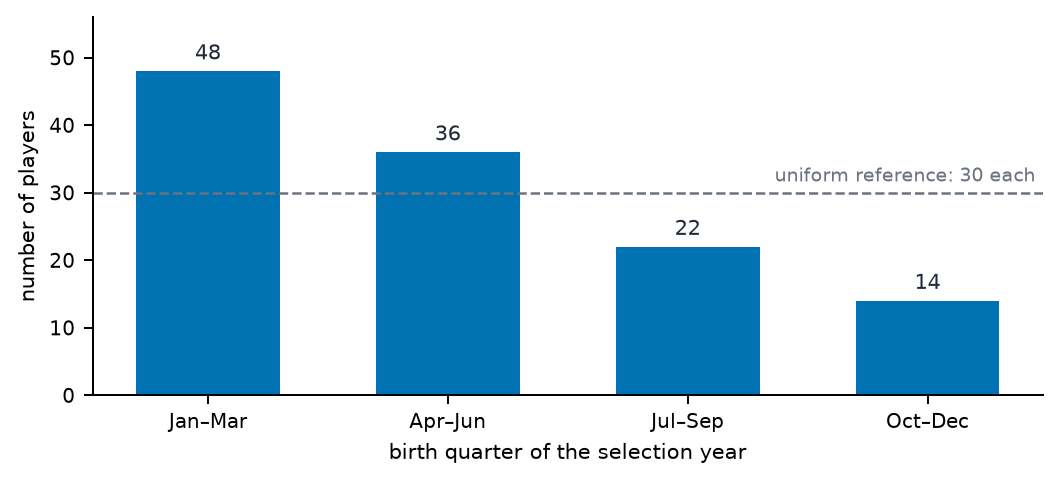
In the academy used below, 48 of 120 selected players were born in January–March and 14 in October–December. Those counts describe a selected sample. To investigate selection bias, we also need the eligible population's birth distribution and the selection cut-off. Relative chronological age, biological maturity, prior coaching and selection decisions can interact, but the counts alone do not measure those mechanisms. This unit asks how we describe individual differences without turning a score or group pattern into a label or inevitable outcome.
What personality is
Personality 人格 is the set of characteristics that make a person unique and that influence how they behave across many situations. As a historical organizing model, Hollander described it in three layers; this is an extension alongside the syllabus emphasis on trait patterns and the Big Five:
the psychological core: deep, stable values, beliefs and self-image;
typical responses: the usual way a person reacts, such as staying calm under pressure;
role-related behaviour: how a person acts in a particular situation or role, such as a team captain; this layer changes most easily.
Hollander's layers: more stable inside, more changeable outside
Trait theory
Trait theory 特质理论 describes relatively enduring patterns of thinking, feeling and behaviour. Enduring does not mean unchangeable, wholly inherited or identical behaviour in every situation. Biological inheritance and environmental experience both contribute. Trait measures summarize tendencies; they are not deterministic forecasts of a match result.
The Big Five personality traits, each a scale between two poles
Eysenck described two main dimensions:
Extraversion–introversion: extroverts 外向者 are sociable, lively and seek excitement; introverts 内向者 are quiet, reserved and prefer calm. Historical sport accounts proposed links with team/individual activities and arousal, but these are not rules for placing a particular athlete in a sport.
Neuroticism–stability: higher neuroticism scores indicate a greater tendency to experience negative emotion; lower scores indicate greater emotional stability. A trait score is not a mental-health diagnosis.
The most widely used model today is the Big Five 大五人格:
Trait
High scorers tend to be
Possible link with sport
Openness
Curious, imaginative
Trying new sports and techniques
Conscientiousness 尽责性
Organised, hard-working, self-disciplined
Training adherence; following a rehabilitation plan
Extraversion
Sociable, energetic
Team sports; enjoying crowds
Agreeableness
Cooperative, trusting
Team cohesion; may be less aggressive
Neuroticism 神经质
Anxious, moody
Higher competitive anxiety (unit C.4)
Limitation: traits alone cannot specify behaviour in every situation. Compare context, learning history and current state rather than claiming that all trait approaches deny environmental influences.
The interactionist approach
The interactionist approach 交互作用观 considers person and context together: behaviour depends on the person's traits and the situation, often written as Lewin's equation, behaviour = f(personality, environment). A normally calm player may become aggressive in a high-stakes derby when provoked. This is a useful interaction model, not a claim that one equation precisely predicts behaviour. It prompts the coach to consider the athlete, context and their interaction.
Does personality predict performance?
There are two views:
Credulous view: personality does predict performance, so it could be used to select athletes.
Sceptical view: personality explains only a small part of performance, and should not be used for selection.
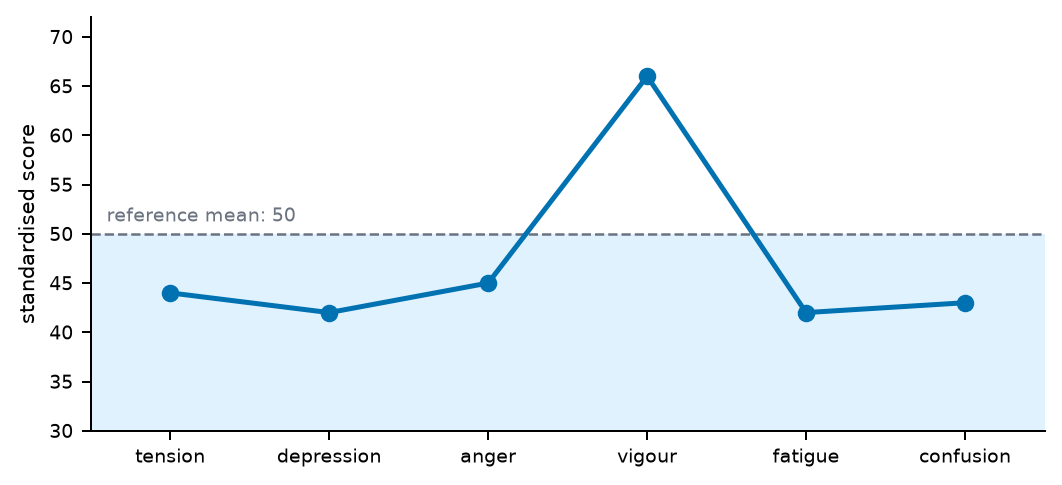
The iceberg profile reported for some successful athletes
The iceberg profile 冰山剖面 is a historical mood-profile pattern: higher vigour with lower scores on several negative-mood subscales relative to a reference. A subscale named depression is not by itself a clinical diagnosis.
Mood is a current state and can vary with sleep, illness, workload and events. Personality concerns more enduring tendencies. Neither an iceberg-shaped trace nor one trait score determines who will win. Predictive claims need relevant samples, independent outcomes, repeated measurement and evidence of generalisation. Do not attach an unsupported exact percentage of performance explained to this sketch. Supporting an athlete's needs differs from selecting or excluding them by a profile.
Measuring personality
Method
Strengths
Limitations
Questionnaires (such as Big Five inventories)
Quick, cheap, standardised; can test many people
Answers may be dishonest or socially desirable; questions may not suit every culture or language; general, not sport-specific
Interviews
Detail; can explain answers
Time-consuming; interviewer bias; hard to compare
Observation
Real behaviour in a real setting
Observer bias; behaviour depends on the situation; slow
All results should be kept confidential, used with consent and never used to label or exclude a young athlete.
Mental toughness 心理韧性 describes qualities involved in managing demanding situations: appraisal of challenges, commitment, confidence, perceived control and resilience. Resilience concerns responding and adapting after adversity, not never experiencing distress. The 4Cs model describes four parts:
Two sides of perfectionismThe 4Cs model of mental toughness
C
Meaning
Example
Control
Feeling in control of one's life and emotions
Staying calm after a bad call by the referee
Commitment
Sticking to goals and tasks
Completing hard winter training
Challenge
Seeing problems as opportunities
Welcoming a strong opponent
Confidence
Belief in one's ability, in skills and with others
Wanting the ball in the last minute
Mental toughness is measured with questionnaires such as the MTQ48. Individual development reflects biological and environmental influences, and supportive coaching, reflection and psychological skills can contribute to change (unit C.5). A questionnaire difference alone cannot estimate genetic influence or demonstrate that a programme caused improvement. "Toughness" should never mean ignoring injury, pain or mental health problems.
Perfectionism
Perfectionism 完美主义 is setting extremely high standards and judging oneself harshly against them. It has two sides:
Perfectionistic strivings: setting high personal standards and working towards them. This may support effort, but high standards alone do not guarantee improved performance.
Perfectionistic concerns: fear of mistakes, worry about others' criticism and feeling that one is never good enough. These concerns can create difficulties in managing demands; evaluate their association with well-being and participation rather than treating them as a diagnosis or an inevitable cause of dropout.
Coaches can help by praising effort and improvement, treating mistakes as part of learning (a mastery climate, unit C.3) and avoiding comparison with others.
Social learning theory 社会学习理论 explains learning through observing models and the consequences of behaviour. Attention concerns noticing the relevant action; retention concerns remembering it; reproduction requires the capacity to enact it; motivation affects whether it is performed. A learner may remember a model without copying it immediately. Regard for a coach or admired performer and observed rewards or disapproval can influence imitation, but the same model need not produce the same response in every observer.
Bandura's four steps of observational learning
In Bandura, Ross and Ross's 1961 experiment, children exposed to aggressive adult models subsequently reproduced more modelled aggression in the experimental setting. This supports a specific observational-learning inference; it does not show that every child watching sport becomes aggressive or that inherited influences do not exist. In an original sporting example, a respected captain calmly acknowledges a mistake, and a learner adopts the same response after seeing it accepted by teammates. Explain the observed action, stored representation, ability and incentive rather than simply writing “they copy a star.”
Personality can change over longer periods through experience, coaching and reflection, although traits retain some relative stability. Changing role behaviour in one session, a short-lived mood change and a durable personality change are different outcomes. Repeated validated measures and observations across contexts help evaluate development; measurement error, social desirability and life changes remain alternative explanations. There is no single personality profile that predicts every sporting result. Traits and social learning interact rather than providing an inherited-versus-learned either/or answer.
AHL: Confidence, expectations, health and attribution
Self-fulfilling expectations and learned helplessness
A self-fulfilling process occurs when an expectation changes behaviour in ways that help produce the expected outcome. A coach expecting a player to improve may provide more useful feedback and opportunities; the player may practise more and gain confidence. A negative expectation may reduce opportunities or persistence. The initial belief need not accurately measure ability. Confidence is not magic: the proposed chain runs through behaviour, opportunities and learning, and external conditions still constrain the result.
A self-fulfilling expectation
Learned helplessness describes a perception that actions do not influence outcomes, which can reduce attempts to change them. “Nothing I do affects selection” can discourage practice even where useful options exist. This is a theoretical explanation to evaluate, not a diagnosis of a quiet or unsuccessful teammate. Supportive feedback can identify specific, feasible actions and fair opportunities; blaming a learner for lacking toughness ignores barriers outside their control. An observation of low confidence and low performance alone cannot establish which came first.
Mental toughness and health evidence
Studies have found associations between reported mental toughness, stress responses and health-related outcomes. A prospective study of young elite athletes found that higher toughness scores were associated with fewer reported burnout and depressive symptoms under high stress; the pattern was not the same under low stress. A sleep study associated higher reported toughness with better objectively recorded sleep characteristics. These are bounded study findings, not guarantees that a high score prevents illness or that toughness training treats a disorder.
A prospective association, not an experiment
Temporal follow-up helps distinguish sequences but is not random allocation. Sleep, support, training stress, health and reporting can affect each other; reverse causation and confounding remain possible. Separate a questionnaire symptom score from diagnosis, and never conclude that an athlete seeking help lacks commitment. Appropriate support and care are compatible with resilience.
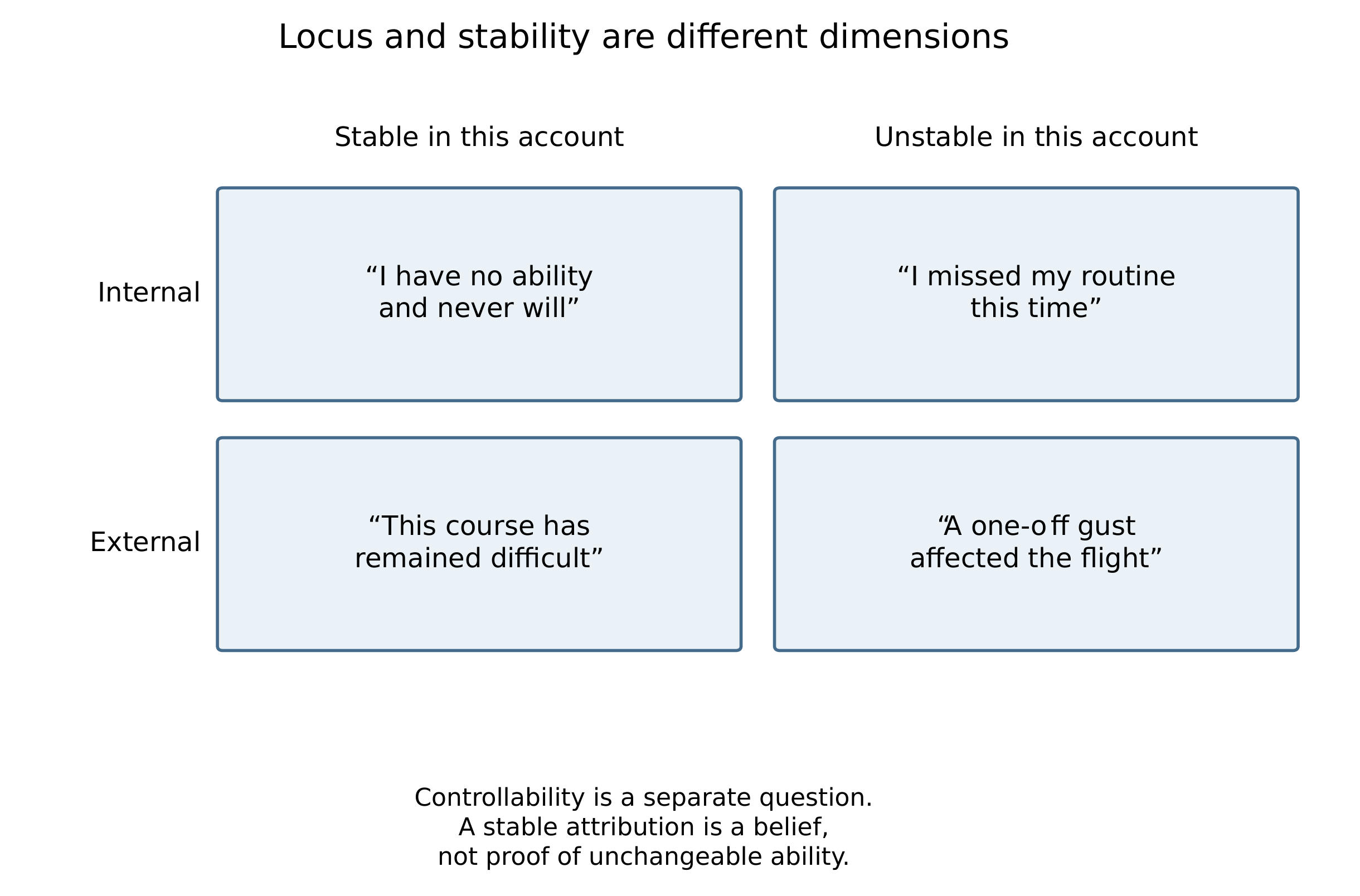
Attributions have more than one dimension
An attribution is an explanation for an outcome. Locus locates the perceived cause internally or externally; stability concerns whether that cause is expected to persist. Controllability is a separate question about whether the person can change it. An internal cause is not necessarily controllable, and external circumstances are not necessarily permanent. This distinction follows Weiner's attribution framework.
Classify the athlete's explanation. “Stable” means expected persistence in that account, not proof that a person can never develop.
Stated explanation after a missed shot
Locus and stability in this account
Possible implication to examine
“I have no ability and never will”
Internal, stable as perceived
Low expectation of improvement; test the fixed assumption
“I did not follow the planned routine this time”
Internal, unstable
A specific change may be possible if resources allow
“This course has remained unusually difficult”
External, stable over the stated comparison
Expectations may remain low without an adapted task
“A one-off gust changed the flight”
External, unstable
Outcome may be expected to differ next time; verify the explanation
Do not mechanically classify every mention of effort as unstable or all ability as permanently fixed. Use the person's actual claim and timescale. Attributions can affect future confidence, emotion and persistence, but an encouraging explanation should still fit the evidence. A practical response identifies relevant controllable actions without denying genuine external barriers or demanding a positive story unsupported by the record.
7.6
Extension: Talent and development
Nature and nurture
Sports performance depends on both nature (inherited factors, such as height, muscle fibre type and how much someone responds to training) and nurture (environment: coaching, practice, support, money, facilities). Neither a physical measurement nor one genetic marker identifies a future champion. Coaching, opportunity, health, practice and task demands interact with individual characteristics; a current result is not a fixed ceiling on development.
The relative age effect
The relative age effect in an academy of 120 playersIn youth teams grouped by birth year, a child born early in the year can be almost twelve months older than a teammate
The relative age effect 相对年龄效应 concerns differences associated with chronological age within a selection-year group. With a January cut-off, January-born children are older than December-born peers in the same annual cohort. That does not mean every older child is biologically more mature or more capable. Maturation, coaching opportunity and selection practices may interact; the relevant cut-off can differ between systems.
Worked example. In the academy, first-quarter share = 48/120×100 = 40%; fourth-quarter share = 14/120×100 = 11.666…%, and count ratio = 48/14 = 3.42857… . An assumed uniform reference would be 25% or 30 per quarter, but actual eligible births need not be uniform. These counts show the selected distribution, not proof that maturity caused selection. Compare eligible and selected populations, record the cut-off and examine alternative explanations.
Maturation 成熟 concerns biological development, distinct from chronological age. Grouping by relevant maturity measures, maintaining open selection opportunities, adjusting comparisons and reviewing cut-offs are possible approaches to evaluate. Each can have measurement, access and organisational trade-offs; none follows as a guaranteed solution from one bar chart. Do not assume late maturers necessarily develop superior decision-making or overtake others.
Early sampling or early specialisation?
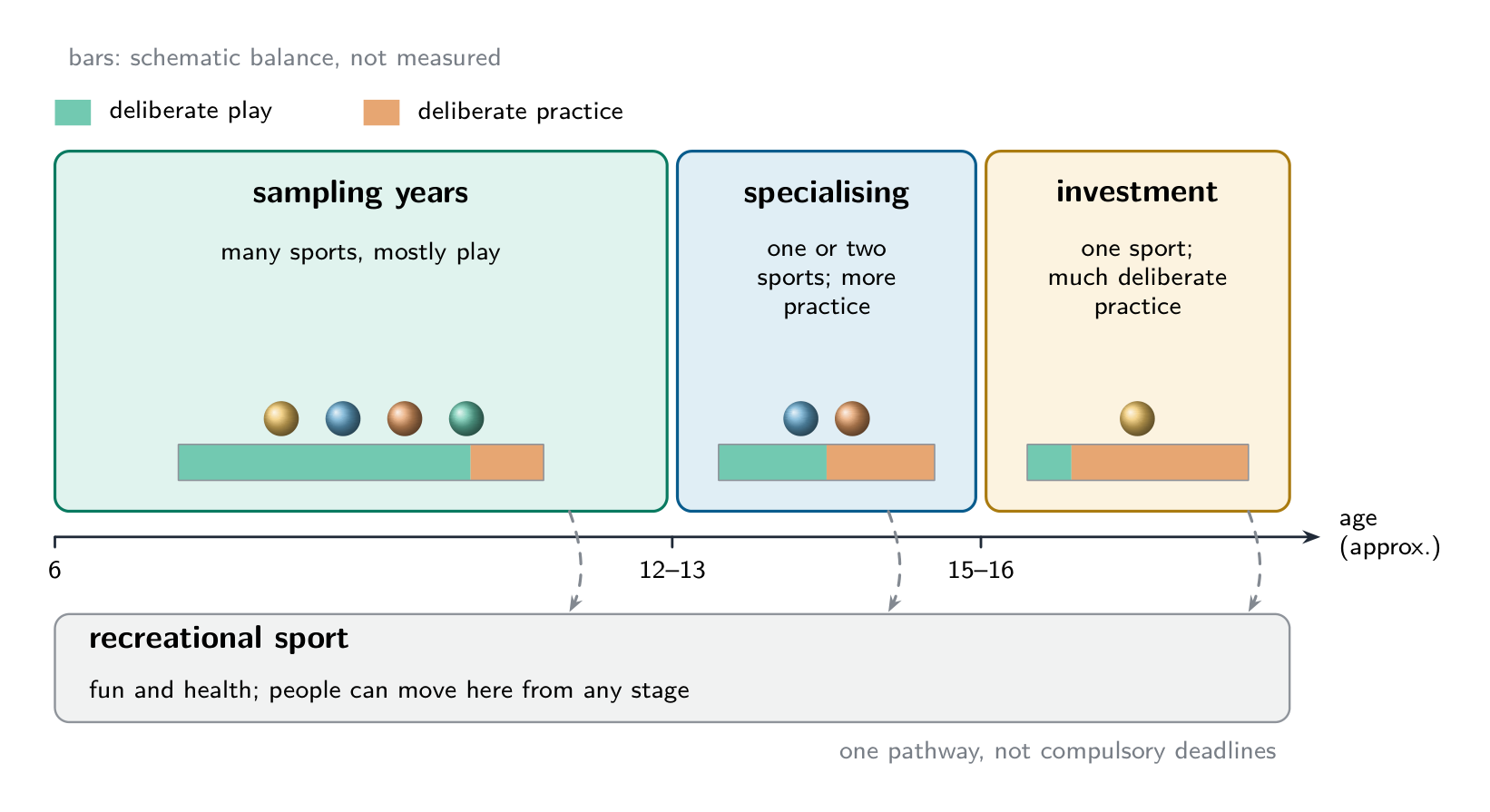
The developmental model of sport participation
The developmental model of sport participation 运动参与发展模型 (Côté) offers a framework involving sampling several sports, play and later focused practice. Its approximate age bands describe one pathway, not compulsory deadlines. Different experiences may support varied skills and enjoyment; outcomes depend on access, demands and the individual.
Early specialisation 早期专项化, training in one sport all year from a young age, is common in sports where athletes peak young, such as gymnastics, figure skating and diving. Potential concerns include repeated loading, recovery, enjoyment and restricted opportunities. Compare the actual programme and participants rather than claiming a single optimal route for all sports.
developmental model of sport participation/dɪˈveləpmentl ˈmɒdl ɒv spɔːt pɑːˈtɪsɪpeɪʃn/
early specialisation/ˈɜːlɪ ˌspeʃəlaɪˈzeɪʃn/
7.7
Comparing individuals fairly
Within-person and between-person differences
A questionnaire score describes what a person reports, using the questionnaire's own scale. It does not diagnose a disorder, and it is not a perfect measure of an inner state.
A group comparison and one person's changes over time answer different questions
Between-person comparisons compare different people: "Is athlete A more anxious than athlete B?"
Within-person comparisons follow one person over time: "Is athlete A more anxious before finals than before league games?"
The two can give different answers. Across a team, the most anxious players might perform worst; but one player might perform best on the days when they feel most anxious. Conclusions about a group do not automatically apply to each individual.
Worked example. Five students rate pre-match nerves on a 1 to 5 scale: 2, 4, 4, 5 and 5. The mean is 20 ÷ 5 = 4.0. One of the students rates themselves before five matches: 2, 3, 5, 4 and 3, a mean of 17 ÷ 5 = 3.4 and a range of 3. The group mean of 4.0 says nothing about how this student's nerves change from match to match, and the student's mean of 3.4 does not mean they are "less anxious than the class": the questions, time point and conditions must be the same before comparing. Report the scale, the time point and the number of people, and avoid labelling anyone.
Ethics of studying individual differences
Use anonymous, voluntary questionnaires approved by the school, and allow withdrawal.
Avoid sensitive personal questions and never share individual scores.
Compare the same task at the same time point, and explain the limits of the scale.
Never use results to select, exclude or label a young athlete.
7.8
Practice
Define personality and distinguish a relatively enduring trait, a current mood and role-related behaviour. Explain Hollander's three layers as a historical organizing model.
Name the Big Five, describe two tendencies relevant to sport and explain why an extraversion score or iceberg-shaped mood trace cannot identify a future winner.
Explain a person–situation interaction. Compare questionnaire, interview and observation evidence, including reliability and validity limits.
Explain appraisal, commitment, confidence, control and resilience, using the 4Cs as one framework. Why does mental toughness not mean hiding injury or distress?
Distinguish perfectionistic strivings and concerns as an extension example. Why is a high standard not proof of better performance or a mental-health diagnosis?
Explain how individual characteristics and opportunities interact in development. Evaluate a claim that one physical or genetic marker identifies champions.
A January-cut-off squad contains 40 swimmers, 17 born in its first quarter and 4 in its last. Find both percentages and the count ratio. State what additional reference information is needed before inferring selection bias.
Suggest three possible responses to a relative-age pattern and one limitation of each. Distinguish chronological age and maturation.
Outline sampling, specialising and investment as a participation model. Evaluate early specialisation without treating its age bands as compulsory or any route as a guarantee.
Group scores 2,4,4,5,5 and one person's repeated scores 2,3,5,4,3 use a specified scale. Find both means and the second range; distinguish within-person and between-person claims. For a separate scale with scores 3,3,4,8,12, find mean and range.
Give four ethical rules for a school questionnaire and explain why one self-report score cannot establish a diagnosis or justify public ranking.
AHL: Explain attention, retention, reproduction and motivation in a sporting modelling example. Explain how personality can develop over time and why a short-lived change does not prove lasting trait change.
AHL: Explain a self-fulfilling process and learned helplessness using an expectation–behaviour–opportunity chain. Evaluate an association between toughness scores and sleep or mental-health symptoms.
AHL: Classify “I have no ability and never will”, “I missed my routine this time”, “this course remains difficult” and “a one-off gust affected it” by locus and stability. Distinguish controllability and explain possible effects on future confidence without pretending the classification proves cause.
Answers.
Personality concerns relatively enduring patterns; mood is a current state; role behaviour depends on the role and context. Hollander: core values (fair play), typical responses (usual calm response), role-related behaviour (encouraging as captain). Neither model requires identical behaviour in every situation.
Openness, conscientiousness, extraversion, agreeableness and neuroticism. Conscientiousness may relate to organised practice; openness to trying approaches. These are tendencies, not fixed sport assignments. Mood reflects current conditions, measurement and reference choices; neither a trait score nor a sketch determines a result.
The same person can respond differently to provocation, task demands or support; traits and context interact. Questionnaires permit standardized self-report but can have response bias; interviews provide detail but interviewer effects; observation records behaviour but context and observer judgement matter. Consistency does not itself prove construct validity.
Appraisal interprets demands; commitment concerns sustained engagement; confidence belief in relevant capacity; control perceived influence; resilience adapting after setbacks. The 4Cs organize control, commitment, challenge and confidence. Appropriate help-seeking and injury reporting support well-being and informed participation; silence is not a toughness test.
Strivings concern high standards; concerns involve mistakes and evaluation. Their implications depend on context and measurement. A high standard does not itself demonstrate improved results, establish a disorder or predict inevitable dropout.
Body characteristics, training history, practice, coaching, resources and opportunity interact. A marker or current measurement cannot capture every contributor or identify an inevitable champion. Do not infer a biological cause from one observed group difference.
First: 17/40×100 = 42.5%; last: 4/40×100 = 10%; ratio 17/4 = 4.25, about 4.3 to one. Need the eligible population's quarter distribution, the actual cut-off, sample/selection process and uncertainty. The selected counts alone do not prove a maturity mechanism.
Examples: maturity-informed grouping requires reliable relevant measures; open/delayed selection needs resources and continued access; age-adjusted comparisons require suitable evidence; cut-off changes may redistribute rather than eliminate advantages. Chronological age follows birth date; maturation varies biologically within age.
The model describes approximate sampling/play, increasing specialisation and focused investment, with recreation possible throughout. Focused practice can develop relevant skills but narrows other opportunities and can concentrate demands. Judge load, recovery, enjoyment, access and development; no age band or programme guarantees elite performance.
Group mean = 20/5 = 4.0. Person mean = 17/5 = 3.4; range = 5−2 = 3. Across-person comparisons and one person's changes answer different questions, and conditions must match for direct comparison. Separate scale mean = 30/5 = 6; range = 12−3 = 9. No score alone establishes cause or diagnosis.
Voluntary informed participation/withdrawal; appropriate anonymity/confidential handling; avoid sensitive disclosures; approved low-risk questions; no selection, public ranking or labelling. State the scale, task, timing and limits. Anonymous data cannot later identify a particular pupil for withdrawal unless the procedure explicitly allows it; explain that before participation.
AHL: A learner notices a respected captain's constructive response, remembers it, can reproduce it and has reason to use it. Observed consequences and regard for the model influence imitation but do not guarantee identical behaviour. Experience, coaching and reflection can contribute to longer-term change; repeated suitable measures across contexts are needed to distinguish it from mood, role behaviour or measurement error.
AHL: Expectations can change feedback, opportunity, effort and persistence, which can affect outcomes and reinforce expectations. Perceived lack of action–outcome control may reduce attempts, but one poor result is not a diagnosis of helplessness. Associations with symptoms or sleep do not establish that toughness training causes a cure: stress, support, reverse causation, measurement and population matter. Seeking help is compatible with resilience.
AHL: In these stated accounts: internal/stable; internal/unstable; external/stable; external/unstable. Stability concerns expected persistence; locus concerns where the cause is placed. Controllability is separate. A perceived lasting cause may affect future expectation; a specific changeable action may support an improvement plan when justified. Classification does not verify the explanation, imply ability can never develop or eliminate real external barriers.
7.9
Exam tips
Define the construct and timescale: trait, current state, reported experience and behaviour are not interchangeable.
Apply a theory to a specific mechanism; avoid deterministic genetic, demographic or questionnaire labels.
Show the denominator, reference distribution and unrounded working for percentages and ratios.
Separate within-person changes from between-person patterns; explain measurement validity, consent and confidentiality.
AHL: Trace observation or expectation through behaviour and context. Distinguish locus, stability and controllability. Health associations do not establish diagnosis or treatment efficacy.
More topics in IB Sports, Exercise and Health Science HL