A player swings the racket after the ball has left it. Does that later movement add more impulse to the ball? A useful analysis separates the contact interval from what happens afterwards, chooses a positive direction and names the object whose motion is changing.
This handout covers B2: forces, motion and movement. Shared teaching includes Newton's laws, stability, coordinated movement, linear and angular motion, projectile paths and phases of movement analysis. Sections marked AHL are for Higher Level only. Prerequisites are the B1 descriptions of joints, muscle actions and levers, together with ratios, areas and units. They are not observations from real athletes or examination papers. Trigonometric calculations are not required.
5.2
Describe motion before explaining its cause
Distance is the length of a path; displacement is the change in position with direction. Speed is distance per time; velocity is displacement per time, including direction. A runner completing a 400 m lap in 80 s has average speed 5 metres per second, but average velocity over the complete lap is zero because displacement is zero. Neither average tells you the runner's highest instantaneous speed.
Velocity–time graph — gradient gives acceleration, area gives displacementVelocity–time graph of a lift: gradient gives each acceleration, the shaded area gives the distance
Acceleration is change in velocity per time. Choose a positive direction and use final minus initial velocity. A runner changing from +2 to +6 metres per second over 2 s has acceleration +2 metres per second squared. Slowing from +6 to +2 over 2 s gives −2. Negative acceleration is not always slowing: an object moving in the negative direction speeds up if its acceleration is also negative. Turning at constant speed also changes velocity and requires acceleration.
Angular displacement describes a change of orientation; angular velocity is its rate of change. A segment moving through 1.2 radians in 0.30 s has average angular velocity 4 radians per second. Endpoint linear speed also depends on distance from the rotation axis: at the same angular velocity, an endpoint farther from the axis moves faster. Thus two rackets can have the same angular velocity but different tip speeds. Do not compare degrees per second with radians per second without conversion.
For video measurements, calibrate a length in the movement plane and know the frame rate. A displacement of 0.60 m over 15 frame intervals at 50 frames per second takes $15/50=0.30$ s, giving average velocity 2.0 metres per second in the specified direction. There are 15 intervals between frames numbered 10 and 25, not 16. Apparent displacement from a skewed camera can be biased, and differentiating noisy positions to find acceleration magnifies measurement problems.
5.3
Newton's laws relate resultant forces to changes in motion
The first law says that velocity remains constant when resultant external force is zero. Zero resultant does not mean no forces act: weight and support can balance. An object moving at constant velocity does not require a forward resultant force simply to keep moving. In practice, a driving force may be needed to balance resistance.
A free-body diagram shows every force on the box as a labelled arrowArrows drawn to scale: the weight stays 700 N while the air resistance changes, so the resultant force changes
The second law relates resultant force to acceleration. For constant mass, $F_{\mathrm{net}}=ma$. A 60 kg athlete accelerating horizontally at 2 metres per second squared has horizontal resultant 120 N. If resistance is 20 N backwards, the forward driving force must be 140 N in this simplified model. It is not legitimate to call 120 N the force of a particular muscle: several muscle, joint and contact forces contribute within and between linked segments.
Weight is gravitational force, $W=mg$; mass is not a force. At $g=9.81$ metres per second squared, an 80 kg athlete has weight 784.8 N. A support force need not always equal weight: during upward acceleration it can be greater, and during downward acceleration it can be smaller. Draw forces on the chosen body, not a mixture of forces acting on different objects.
The third law concerns pairs of interaction forces on different bodies. A foot pushes the ground backwards and the ground pushes the foot forwards. These forces have equal magnitudes and opposite directions, but they do not cancel on a force diagram of the athlete because one acts on the ground. Balanced weight and ground support acting on a stationary athlete are also not a third-law pair: their interaction partners act on Earth and the supporting surface respectively.
5.4
Impulse needs a direction and a defined contact interval
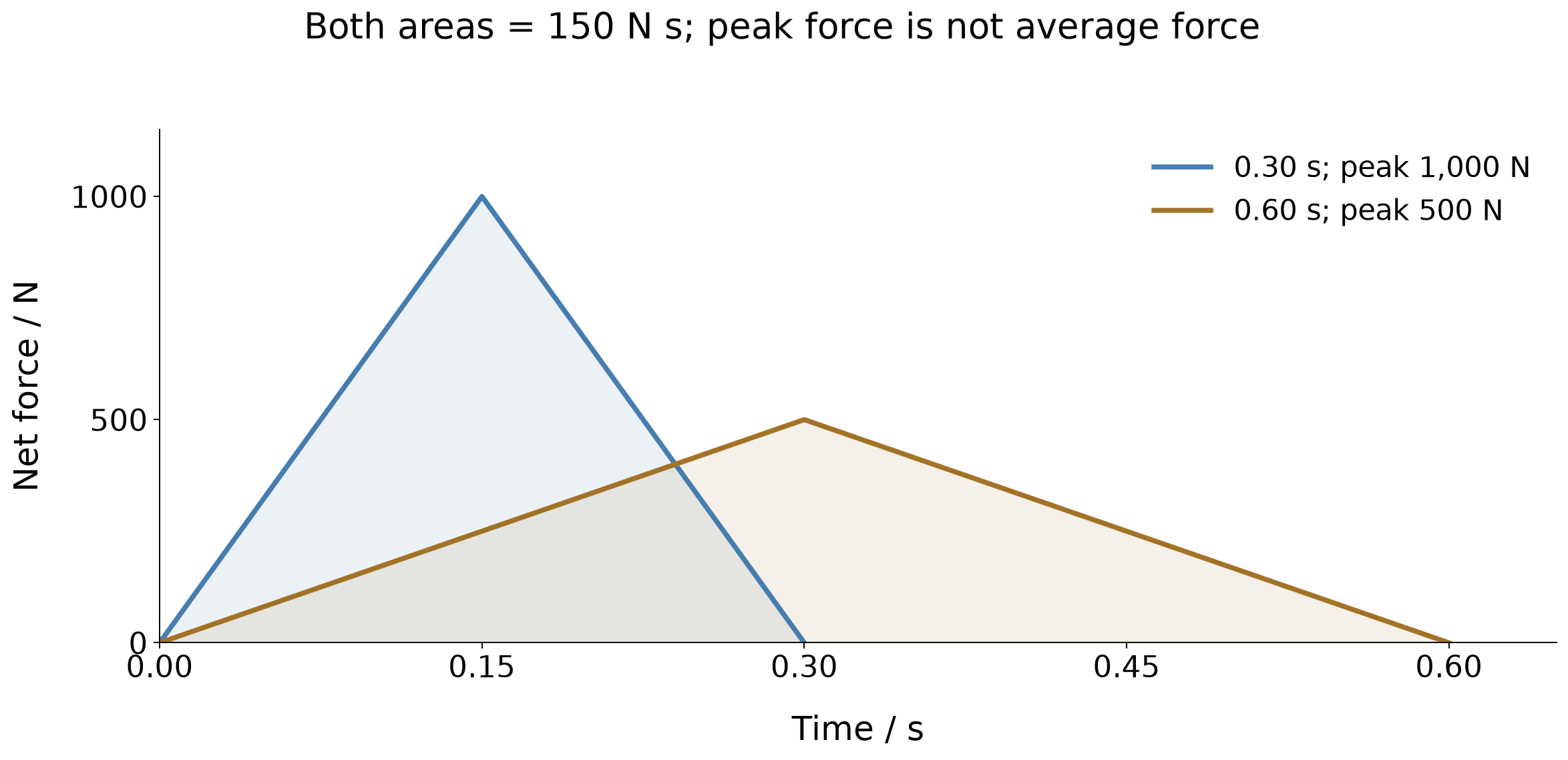
Linear momentum is mass multiplied by velocity. Impulse 冲量 is the integral of resultant force over time and equals momentum change. For an interval, average net force multiplied by interval duration gives the same impulse. On a force-time graph, signed area gives impulse; peak height alone does not.
A swimmer's start: the push against the block, held over a short contact time, sets the take-off velocityImpulse is the area under a force-time graph, equal to the change in momentumThe triangular curves have areas 150 N s: half of 0.30 s times 1,000 N and half of 0.60 s times 500 N. Their peaks are twice their respective average forces.
For momentum change 150 kg metres per second, average net force magnitude is $150/0.30=500$ N over 0.30 s, or $150/0.60=250$ N over 0.60 s. These are average values, not the triangular graph's peaks. In general, doubling contact time for a fixed impulse halves average force, but it does not determine the new peak without the curve's shape.
Retain the sign through a ball calculation. An 0.058 kg ball slowing from +30 to +20 metres per second has momentum change $0.058(20-30)=-0.58$ kg metres per second. Over 0.005 s, average resultant is −116 N, opposite the chosen positive direction. Doubling the interval to 0.010 s for this same change gives −58 N. If it instead rebounds from +30 to −20, the change is $0.058(-20-30)=-2.90$ and average resultant over 0.005 s is −580 N. Reversal is not a speed change of only 10.
Separate contact from follow-through. Movement after racket–ball separation cannot continue applying a contact force to that ball. A coordinated follow-through can reflect a useful movement sequence and help decelerate body segments, but a later arm motion is not itself an additional ball impulse. Compare the actual contact force-time record before making claims about force or momentum transfer.
In a vertical take-off, an 80 kg athlete's upward momentum increases by 240 kg metres per second over 0.20 s. Average net upward force is 1,200 N. Average upward ground reaction in the simple weight-plus-support model is $1200+784.8=1984.8$ N. The 1,200 N resultant is not the total ground reaction. A 200 N average net force acting for 0.30 s gives 60 N s; a 100 N s change spread over 0.50 s gives 200 N. In every case define what other forces the “net” has already included.
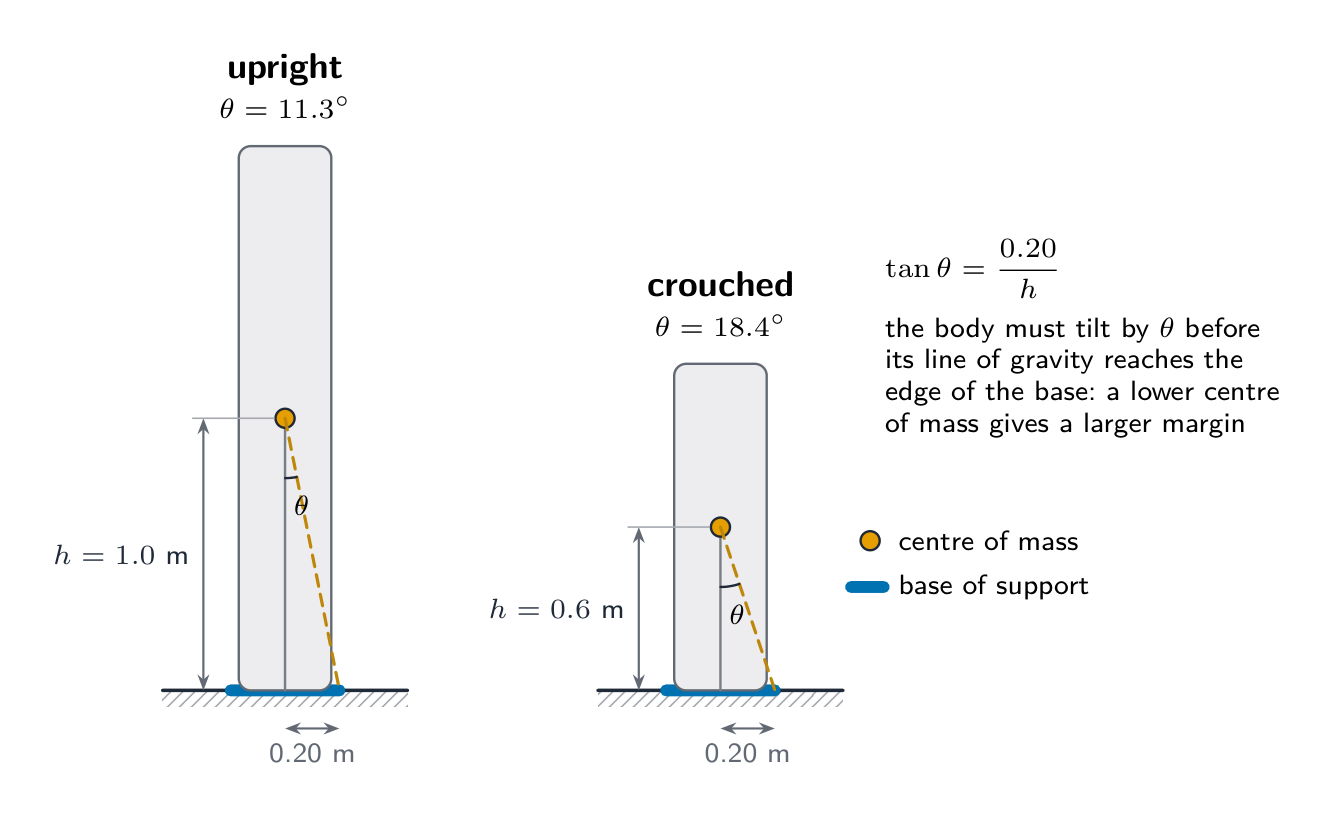
The centre of mass 质心 is the mass-weighted mean position of a body. Its vertical projection gives the line of gravity on a level support. The base of support 支撑面 is the area enclosed by supporting contacts. A wider base and a lower centre of mass can increase the margin against toppling, but direction matters: widening the feet sideways helps resist some sideways disturbances more than a fore–aft push.
On a 10 cm beam every landing must bring the gymnast's centre of mass back over a tiny base of supportBoth models have a half-base of 0.20 m. Tilting brings the line of gravity to the edge after a smaller angle in the taller model; this is a geometric comparison, not a measured fall prediction.
During static balance, the line of gravity normally lies within the base. Once it passes beyond an edge, weight can produce a toppling moment about that edge unless a step, external support or another action changes conditions. A moving runner can have the projection outside the current contact area and still maintain controlled dynamic motion through the next step; static rules are not a complete gait model.
Greater mass gives greater inertia, so the same horizontal force produces less acceleration. In a simple toppling model it can also increase a resisting weight moment. Mass alone does not guarantee stability, however: support geometry, friction, body position and the disturbance matter. Moving a centre of mass towards one edge may prepare a useful movement while reducing the margin in that direction. Coaches must balance stability with the need to move, rather than prescribing the widest possible stance for every action.
Coordinate joint actions and distinguish angular momentum from torque
Sequential actions of legs, trunk, shoulder, elbow and wrist can contribute to an implement's motion. Useful coordination depends on timing and task. “Summing joint forces” should not be treated as simply adding numerical muscle forces acting in different directions at different locations. Segment interactions, joint moments and the timing of energy transfer affect the endpoint velocity. A larger isolated muscle force does not by itself prove a faster or more accurate throw.
With no external torque, $L = I\omega$ is conserved: a smaller $I$ means a larger $\omega$
A torque 力矩 or moment is force multiplied by its perpendicular lever arm 力臂. A force whose line of action passes through the centre of mass can accelerate translation without a moment about that centre. An off-centre force can change both linear and angular motion. It is the perpendicular distance to the force's line of action, not simply the distance to the point where it touches, that determines the moment.
Angular momentum describes rotational motion and depends on both angular velocity and mass distribution. When net external torque about the chosen axis is negligible, angular momentum is conserved. An airborne athlete can rotate faster by bringing mass closer to the rotation axis, reducing moment of inertia; this does not create extra angular momentum. With $I=0.80$ kg square metres and angular velocity 4 radians per second, $L=I\omega=3.2$ kg square metres per second. At $I=0.40$, the same angular momentum gives angular velocity 8 radians per second.
The condition is negligible external torque, not the absence of every external force. Gravity still acts during flight, but its resultant through the centre of mass has no moment about that centre in the simplified model. Air resistance and contact forces can provide external moments; angular momentum need not remain constant during take-off or landing. An athlete's shape change can alter rotation rate in flight but cannot replace the external interactions that established the initial angular momentum.
Projectile paths depend on release and fluid forces
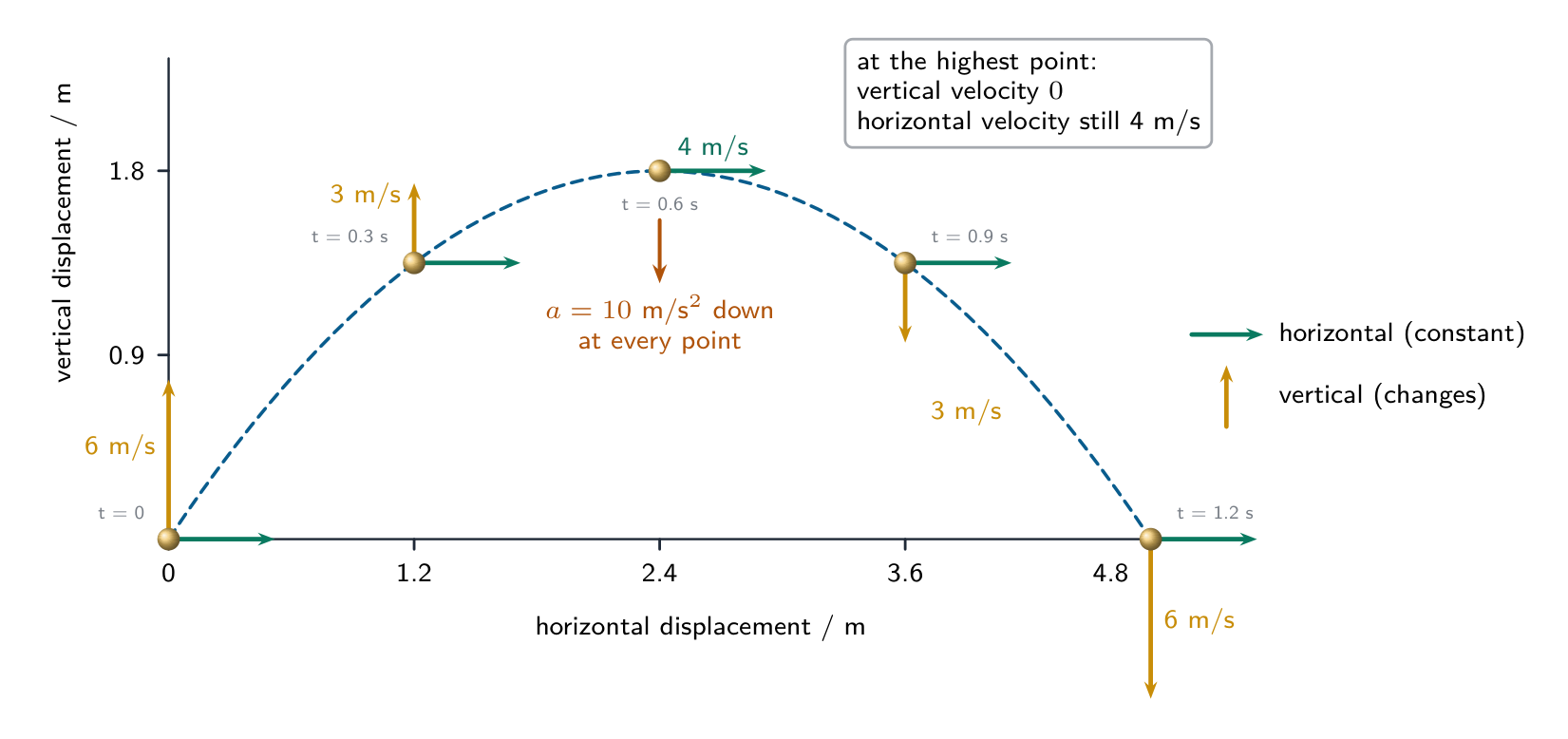
A projectile is a body moving after release; the hand or racket no longer supplies its contact force. Release speed, direction and height relative to the target help determine the path. Separate horizontal and vertical motion. In a simple no-drag model, horizontal velocity is constant and vertical acceleration is downwards. The vertical velocity is zero at the highest point, but acceleration there is still gravitational, and horizontal velocity need not be zero.
A free throw: release speed, angle and height decide the ball's path to the hoopA projectile's launch velocity resolved into horizontal and vertical parts; at the highest point the vertical velocity is zero (reused from a_level_physics 2.1, byte copy)Model: horizontal component 4 m/s, vertical component 6 m/s and downward acceleration 10 m/s². Equal launch and landing heights give flight time 1.2 s and range 4.8 m.
In this model, upward velocity falls from 6 to 0 in 0.60 s, and the object returns to release height at 1.20 s. Horizontal travel is $4(1.20)=4.8$ m. Maximum rise is 1.8 m from the model's trajectory; students need not resolve a launch velocity using trigonometry here. A higher release above a lower target generally changes flight time and the useful release direction; a 45-degree angle is not a universal optimum for every sporting task.
Air resistance can make the path asymmetric and reduce horizontal speed. A light object with a large area relative to its weight is often affected more strongly by drag than a dense compact object, under otherwise comparable conditions. A shuttlecock's rapid deceleration and a heavy compact shot's path are not well described by one identical no-drag trajectory. Spin can also produce forces that change the path. State which forces and model conditions a diagram includes before transferring its numbers to a real sport.
5.8
Movement phases turn an observation into a focused question
A discrete skill such as a throw has preparation, force production, a critical instant and follow-through. Preparation positions the body and implement; force production develops the motion towards the important event. The critical instant may be release or contact, depending on the task. Follow-through controls or decelerates subsequent movement. For continuous skills, recovery returns the body or implement into position for the next cycle.
Define each phase, and the critical instant, so observers agree
The critical instant is not the whole force-production phase. Define it operationally, for example the last frame showing hand–ball contact, so observers identify it consistently. For a swimming stroke, define propulsion and recovery boundaries rather than comparing arbitrary frames. Interpret timings alongside stroke rate, distance and phase definitions.
Analysis can identify a limited range, mistimed sequence or accessibility obstacle. A comparison in which moving a target closer reduces required reach supports evaluating that adjustment, not diagnosing an impairment. Match camera geometry, task and measurement methods. Use supplied records or consented low-risk activities; rehabilitation needs qualified assessment. Class work need not provoke impacts or disclose medical records.
5.9
AHL: Collisions require relative speeds and system boundaries
During a short collision, interaction forces exchange momentum between bodies. Total linear momentum is conserved for a chosen system when external impulse is negligible; an individual ball's momentum is not conserved merely because the collision is short. Kinetic energy may decrease as energy transfers to deformation, thermal stores and sound. Total energy is still conserved.
A rugby tackle is a collision: what happens depends on the players' relative speed and where the system boundary is drawn
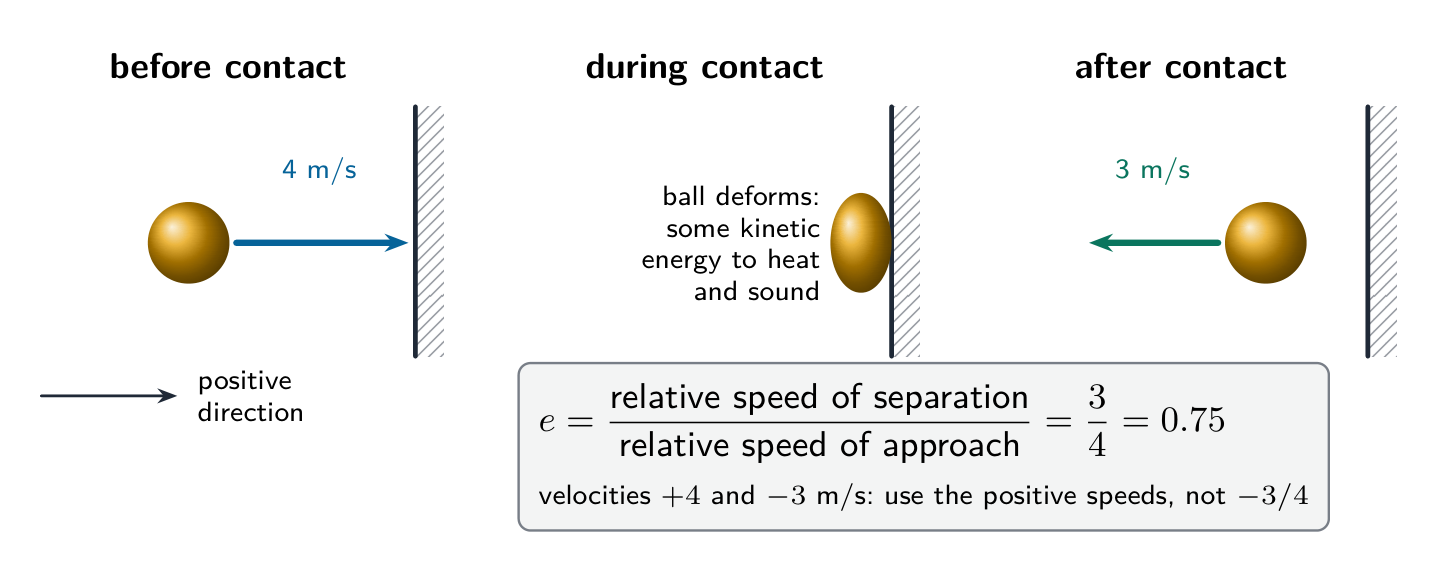
The coefficient of restitution compares relative separation speed with relative approach speed along the collision direction. For one-dimensional motion, label bodies and directions before subtracting velocities. Against an effectively fixed surface, a ball approaching at speed 4 and rebounding at speed 3 metres per second has $e=3/4=0.75$. Using signed rebound velocity directly as a negative speed would give the wrong interpretation.
For the fixed-surface model, approach speed 4 m/s and separation speed 3 m/s give e = 0.75. The rebound direction is opposite; both quantities in the speed ratio are positive.
For an ideal ordinary passive collision, $e=1$ represents elastic relative motion and $e=0$ means zero relative separation speed immediately afterwards. Values between these describe different losses of relative kinetic energy; exceptional energy-releasing systems need additional explanation. An e value is not the percentage of total energy retained in every collision. In a fixed-surface bounce, retained translational kinetic-energy fraction is $e^2=0.5625$, or 56.25%, for the same mass. Temperature, material, impact speed, surface and ball construction can affect the measured coefficient.
For two equal 0.20 kg masses, initial velocities +4 and 0 and $e=0.50$ imply $v_1+v_2=4$ from momentum conservation and $v_2-v_1=2$ from restitution. Thus $v_1=1$ and $v_2=3$ metres per second. Initial kinetic energy is 1.6 J and final is $0.5(0.20)(1^2+3^2)=1.0$ J, so 0.6 J, or 37.5%, has left translational kinetic energy. This differs from treating the second body as an immovable wall.
5.10
AHL: Friction, work and power describe different quantities
Friction acts to oppose relative sliding or its tendency at a contact. Static friction adjusts to the needed value up to a limiting value, commonly modelled as $F_{s,\max}=\mu_sN$. It is not always equal to that maximum. Sliding friction can be approximated by $F_k=\mu_kN$. The normal reaction $N$ is perpendicular to the surface and is not always equal to weight. Coefficients depend on the materials and conditions; a single value is not a property of a shoe regardless of its surface.
A pole vaulter: kinetic energy from the run-up is stored in the bent pole, then given back as heightOnly the component of the force along the displacement ($F\cos\theta$) does workPositive work ($W = +Fs$): force along the motion (top). Negative work ($W = -Fs$): force opposite to the motion, e.g. friction (bottom)
With $N=500$ N and $\mu_s=0.60$, the limiting static friction is 300 N. A 100 N horizontal push on an otherwise stationary object is balanced by 100 N static friction, not 300 N. If sliding friction is modelled with $\mu_k=0.40$, its magnitude is 200 N. Appropriate traction can permit acceleration or braking, while excessive grip in some turning situations can create unwanted loading. Surface preparation, tread, studs and conditions affect both performance and injury considerations; more friction is not universally better.
Work is energy transferred by a force through displacement in that force's direction. For a constant parallel force, $W=Fd$. A force opposite the displacement does negative work on the chosen body. An upward force of 300 N moving a load upward through 0.40 m does 120 J; doing it over 0.50 s gives average mechanical power $120/0.50=240$ W. Power is work per time, not simply a large force. The same work completed faster has greater average power.
An isometric muscle action can consume metabolic energy while doing no external mechanical work on a stationary held load. Mechanical power output and metabolic energy-use rate are different. Equipment and technique can improve useful energy transfer, reduce unwanted motion or change the force–velocity conditions; they cannot create energy. A 200 N sliding-friction force acting against travel over 2 m does −400 J on the moving object in the simple constant-force model.
5.11
AHL: Environmental conditions alter forces in fluids
Air and water are fluids. Temperature, pressure, altitude, humidity and wind can affect air density or relative flow; temperature and salinity can affect water density and other properties. At comparable pressure, warmer air is generally less dense; higher altitude commonly means lower air pressure and density. Humid air is less dense than dry air at the same temperature and pressure because water-vapour molecules replace some heavier molecules. These statements hold other conditions fixed; do not assume every warm or humid sporting setting has one predictable total effect.
Riders in a peloton shelter behind one another: drafting cuts the air resistance on each riderDrag depends on air speed relative to the athlete, roughly as its square
Wind changes velocity relative to air, which matters for aerodynamic forces. A runner moving at 6 metres per second into a 2 metre per second headwind has relative air speed 8; with the same tailwind it is 4, assuming a simple collinear model. A stationary object can experience wind force despite zero ground speed. If drag is proportional to relative speed squared with other factors fixed, the headwind model's drag is $(8/6)^2\approx1.78$ times the no-wind value; tailwind gives $(4/6)^2\approx0.44$. This does not predict the exact change in running time or metabolic cost.
Buoyancy is the upward resultant from fluid pressure differences and equals the weight of displaced fluid: $F_b=\rho Vg$. Use submerged displaced volume, not automatically total body volume. A displaced volume 0.060 cubic metres in water of density 1000 kg per cubic metre gives $F_b=1000(0.060)(9.81)=588.6$ N. This balances the weight of a 60 kg body under the stated conditions; a 65 kg body of the same submerged volume has a downward weight–buoyancy resultant of $637.65-588.6=49.05$ N before considering other forces. Denser saline water produces more buoyancy for the same displaced volume.
5.12
AHL: Lift and drag depend on flow, shape and motion
Drag acts against relative motion through the fluid. Surface or skin-friction drag relates to shear at the surface; form drag relates to pressure differences and flow separation; wave drag relates to wave generation near a water surface. A swimmer's alignment, exposed area, suit surface and depth can alter different contributions. In a simplified comparison with unchanged shape and fluid properties, doubling relative speed can quadruple drag; a change from 6 N to 24 N illustrates that model, not a universal exact law at every speed.
A ski jumper's V-shaped skis and forward lean turn the body into a wing, trading drag for liftForces on a falling object in a fluid
Lift is a fluid-force component perpendicular to the relative flow; it need not point vertically upwards. Its magnitude and direction depend on shape, orientation, flow and conditions. Angle of attack describes the orientation relative to incoming flow. Increasing it does not always increase useful lift: separation and stall can reduce lift and increase drag. Bernoulli's principle relates pressure and speed along suitable streamlines in an idealized flow; a lower-pressure/higher-speed relation is not proof that particles on opposite sides must reunite at the same time. Real lift also involves momentum change and viscous effects.
A spinning ball can experience the Magnus effect: rotation changes the surrounding flow and pressure, producing a force transverse to relative flow and spin axis. In a conventional ball moving right through still air, topspin commonly produces a downward contribution and backspin an upward one. Side spin can curve the path sideways. The actual force depends on speed, spin, surface and flow regime; “any spinning ball must curve by the same amount” is false. A projectile's trajectory then differs from the gravity-only model.
Fluid-related design has sporting, ethical and regulatory consequences. Equipment that lowers drag or changes buoyancy can affect comparisons between competitors, cost and access. Evaluate the measured benefit, conditions, safety, accessibility and the applicable competition rules; do not infer legality from a performance improvement. Rules can change, so an imagined classroom design is not a claim that a named product is currently permitted.
5.13
Practice
A runner completes a 300 m lap in 60 s. Find average speed and average velocity. Explain why neither is the maximum instantaneous speed.
Velocity changes from +1 to +7 metres per second over 3 s. Calculate acceleration. A different object goes from −1 to −7 over the same time: find acceleration and say whether it speeds up.
At 40 frames per second, positions at frames 12 and 20 differ by +0.50 m. Find elapsed time and average velocity; give two measurement limitations.
A 50 kg athlete has horizontal acceleration 1.5 metres per second squared against 15 N resistance. Find net force and the model's forward driving force. Explain why neither is the force of one muscle.
Explain a foot–ground third-law pair and distinguish it from balanced weight and support on a stationary athlete.
A triangular net force-time pulse lasts 0.40 s with peak 600 N. Find impulse and average net force. Compare with a 0.80 s triangular pulse giving the same impulse.
A 0.050 kg ball changes velocity from +24 to −16 metres per second over 0.008 s. Find momentum change and average resultant. Explain why a later follow-through cannot add ball impulse after separation.
An athlete of mass 60 kg gains upward momentum 120 kg metres per second over 0.25 s. Find average net upward force and average upward ground reaction using $g=9.81$ and a weight-plus-support model.
Explain how base width, centre-of-mass height, line of gravity and mass affect stability. Distinguish a static toppling model from running balance.
An airborne model has moment of inertia 0.60 kg square metres and angular velocity 5 radians per second, with negligible external torque. Find angular momentum and the new angular velocity at moment of inertia 0.30. Explain why gravity can still act.
A no-drag equal-height projectile has supplied horizontal speed 5 metres per second and flight time 0.80 s. Find range. Explain the velocity and acceleration at the apex, and define preparation, force production, critical instant and follow-through for a throw.
AHL: A fixed-surface bounce has approach speed 5 and rebound speed 4 metres per second. Find restitution and retained translational kinetic-energy percentage. Then solve equal-mass motion with initial velocities +6 and 0 and $e=0.50$, assuming negligible external impulse.
AHL: At normal force 400 N and static coefficient 0.50, find limiting friction and actual friction balancing an 80 N push. Sliding coefficient is 0.30: find sliding friction and its work over 3 m. Separately, a constant parallel 250 N force moves a load 0.60 m in 0.75 s: find work and average power.
AHL: A body displaces 0.050 cubic metres of water at density 1000 kg per cubic metre. Find buoyancy at $g=9.81$. Explain how salinity can affect it. A collinear athlete speed is 8 metres per second with headwind 2: find relative air speed and drag ratio to still air under a squared-speed model. Compare lift, Magnus force and three forms of drag; give one equipment-evaluation limitation.
5.14
Worked answers
Average speed $300/60=5$ metres per second; lap displacement and average velocity are zero. Instantaneous speed can vary; the averages do not locate its maximum.
$(7-1)/3=+2$ metres per second squared; $(-7-(-1))/3=-2$. The second object speeds up because velocity and acceleration both point negatively.
Eight intervals: $8/40=0.20$ s; velocity $0.50/0.20=+2.5$ metres per second. Perspective, scale-plane mismatch, uncertain landmarks and event-frame identification affect measurements.
Net $50(1.5)=75$ N forward; driving force $75+15=90$ N. Whole-body acceleration does not determine individual internal muscle forces.
Foot-on-ground and ground-on-foot are equal opposite interactions on different bodies. Weight and support both act on the athlete; their partners act on other bodies. They can balance without being each other's third-law partners.
Area $0.5(0.40)(600)=120$ N s; average $120/0.40=300$ N. At 0.80 s, average is 150 N and a triangular pulse's peak is 300 N. Equal impulse does not require equal peak or duration.
$\Delta p=0.050(-16-24)=-2.0$ kg metres per second; average resultant $-2.0/0.008=-250$ N. Subtract signed velocities. After separation, racket contact force ceases.
Net upward average $120/0.25=480$ N; weight $60(9.81)=588.6$ N; upward ground reaction $480+588.6=1068.6$ N. Assume other vertical forces are negligible.
Wider base in the disturbance direction and lower centre of mass can increase the toppling margin. Gravity's line relative to an edge determines its moment; mass affects inertia and weight moments. Friction and task matter. Running involves changing contacts and dynamic control.
$L=0.60(5)=3.0$ kg square metres per second; $\omega=3.0/0.30=10$ radians per second. Gravity through the centre of mass has no moment about it. Conserved angular momentum needs negligible external torque, not zero force or constant angular velocity.
Range $5(0.80)=4.0$ m. At the apex, vertical velocity is zero; horizontal velocity remains 5 and gravitational acceleration remains downwards. Preparation sets position; force production develops motion; release is the chosen critical instant; follow-through controls subsequent movement. Continuous skills use recovery for the next cycle.
AHL:$e=4/5=0.80$; fixed-surface kinetic-energy fraction $e^2=0.64$, or 64%. For equal masses, momentum gives $v_1+v_2=6$ and restitution gives $v_2-v_1=3$. Therefore $v_1=1.5$ and $v_2=4.5$ metres per second. A moving second body cannot be treated as a fixed wall; state the system and external-impulse assumption.
AHL: Limit $0.50(400)=200$ N; actual static friction balancing the push is 80 N. Sliding friction $0.30(400)=120$ N; its work is $-120(3)=-360$ J. The separate applied-force work is $250(0.60)=150$ J and average power $150/0.75=200$ W. Neither friction coefficient nor power is the total metabolic energy cost.
AHL:$F_b=1000(0.050)(9.81)=490.5$ N. Greater density at the same displaced volume increases buoyancy. Relative air speed $8+2=10$; drag ratio $(10/8)^2=1.5625$. Lift is perpendicular to flow; Magnus force arises from spin-altered flow. Surface drag concerns shear, form drag pressure/separation, wave drag surface waves. Equipment comparisons need matched conditions, user fit and applicable rules.
5.15
Exam tips and common mistakes
Use signed changes and frame intervals. Distinguish average/peak force, net/ground reaction and interaction pairs/balanced forces. Angular-momentum conservation needs negligible external torque. Gravity remains at an apex; a racket cannot push a separated ball.
AHL: Restitution uses relative speeds; static friction need not equal its maximum. Separate work, power and metabolic cost. Use displaced submerged volume for buoyancy and air-relative speed for aerodynamic comparisons. A named fluid principle needs its assumptions and does not automatically prove an equipment claim.
Was this helpful?
What went wrong? Only the site team sees this.
More topics in IB Sports, Exercise and Health Science HL