This handout teaches C.4 Stress and coping for the course first assessed in 2026: what stress is and how athletes appraise it, how the body responds, how arousal and anxiety affect performance, how anxiety is measured, and how athletes cope with stress and avoid burnout. Sections marked AHL are for Higher Level only. The common core covers arousal/anxiety models, measurement and coping categories.
Prerequisites: unit A.1 (the nervous and endocrine systems) and unit C.1 (individual differences). Unit C.5 teaches the psychological skills used to manage stress.
10.2
Stress and appraisal
The greatest gymnast stops
At the Tokyo Olympics in July 2021, Simone Biles withdrew during the team final. USA Gymnastics' annual report describes her difficulty with the "twisties" and the health-and-safety reasons for stopping. She returned to win balance-beam bronze on 3 August. These dated events show why safe participation and support matter even in elite sport; they do not establish one psychological cause or let a classroom observer diagnose an athlete. Stepping away from an unsafe action is different from assuming that any withdrawal is poor coping (USA Gymnastics report; beam result).
What stress is
Stress 压力 is the response to a situation that the person sees as demanding, when they are not sure they can cope and the result matters to them. A stressor 压力源 is the situation or event that causes it.
Sources of stressors
Source
Examples
Competitive
An important match, a penalty, the crowd, a strong opponent, being evaluated
Organisational
Selection, coaching style, travel, money, team conflict
Personal
School exams, relationships, family expectations, social media
Injury
Pain, fear of re-injury, losing a place in the team
Stress is not always harmful. Eustress 良性压力 is a positively experienced challenge that may support focus and effort. Distress 不良压力 is a negatively experienced demand associated with strain or difficulty coping.
The transactional model
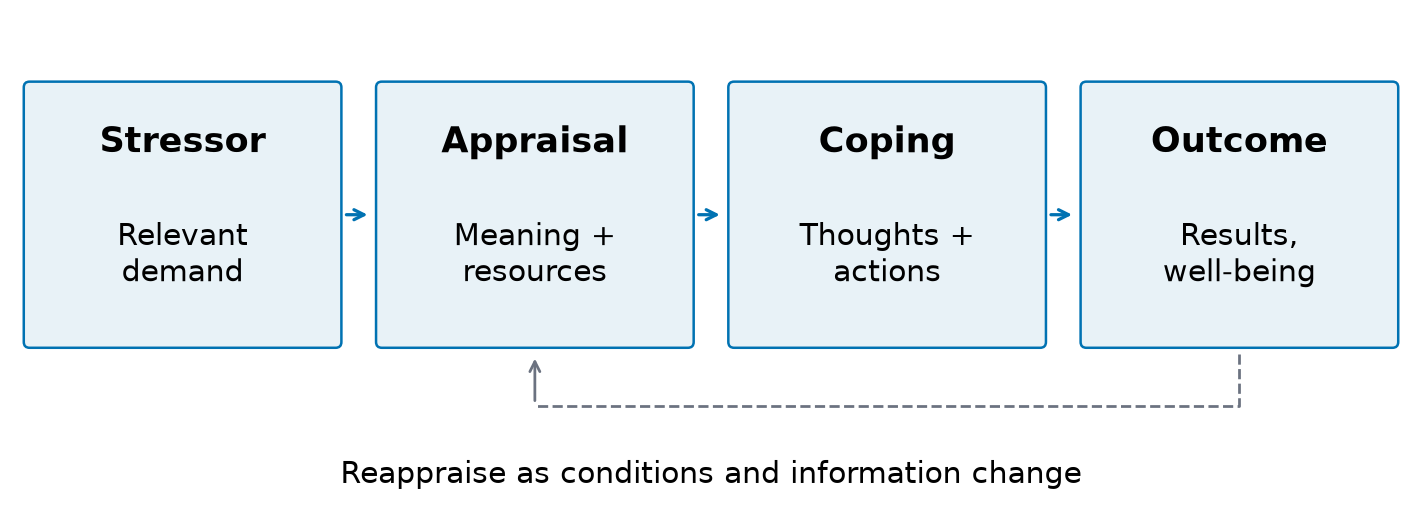
Appraisal, action and feedback form a changing process, not a fixed either/or classification
In the transactional model 交互模型 of Lazarus and Folkman, stress depends on how a person appraises 评估 the situation, not only on the situation itself:
Primary appraisal: is this irrelevant to me, a challenge (a chance to gain) or a threat (a chance of harm or loss)?
Secondary appraisal: do I have the resources (skill, fitness, support, time) to cope?
Perceived demands and resources contribute to challenge or threat appraisals. Challenge and threat can coexist or change as information changes; primary and secondary appraisal are related processes rather than a guaranteed single-file sequence. Two players can interpret the same penalty differently, and the same player can reappraise it after new feedback. Actual resources and demands matter alongside interpretation: changing a belief does not remove a genuine injury or an impossible timetable.
The body's stress response
The sympathetic nervous system and adrenaline can increase heart rate, ventilation and fuel availability rapidly. Exercise, posture and temperature also affect these measurements, so a raised pulse alone does not identify psychological stress.
The HPA axis links hypothalamic signals to pituitary ACTH and the adrenal cortex, which secretes cortisol 皮质醇. Cortisol has normal regulatory functions; prolonged dysregulation can affect sleep and immune functioning. One concentration is not a diagnosis or a direct reading of a person's coping capacity.
Selye's general adaptation syndrome 一般适应综合征 describes alarm, resistance and exhaustion as a historical model of response to sustained demands. It does not supply inevitable dates, a literal fuel gauge or a rule that every prolonged demand must end in burnout. Recovery, context and individual responses vary.
The fast sympathetic route and the slower HPA axis
general adaptation syndrome/ˈdʒenərəl ˌædæpˈteɪʃn ˈsɪndrəʊm/
10.3
Arousal and performance
What arousal is
Arousal 唤醒 is how physically and mentally activated a person is, from deep sleep to extreme excitement. It is neither positive nor negative in itself. Signs include heart rate, sweating and muscle tension (physiological), and alertness and thoughts (psychological).
Theories of arousal and performance
Drive theory 驱力理论 proposes that arousal strengthens the dominant response. If a well-learned dominant action is appropriate, this may help; if the likely action is an error, it may hinder. An expert can still have an unsuitable dominant response.
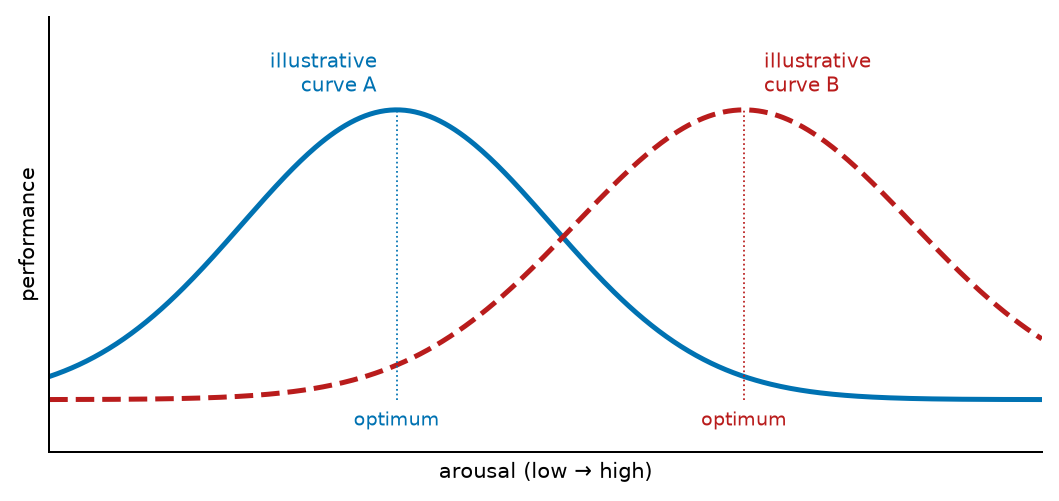
Curves, not measured task-specific optima or coaching thresholds
The inverted-U hypothesis proposes an increase in performance up to a context-dependent optimum, followed by decline. It is a model to examine, not a universal symmetrical law. Precision, force, attention, experience and the performer’s interpretation can influence the relevant relationship. A golf putt and a powerful action have different demands, but that does not make all powerful skills simple or establish a fixed arousal prescription for a rugby player, expert or extrovert.
The model combines activation into one dimension and often sketches a smooth curve. Real data may be noisy, asymmetric or show sudden transitions, and activation is not identical to worry. To investigate an optimum, define a comparable outcome, measure relevant states consistently and consider repeated within-person evidence rather than assigning a value from a sport label.
Individual zones of optimal functioning 最佳功能区 (IZOF), associated with Hanin, emphasise individual patterns of emotions and functioning. A useful zone is a range rather than one universal score. The content and interpretation of emotions, task and person matter; a group average does not specify every individual's optimal state.
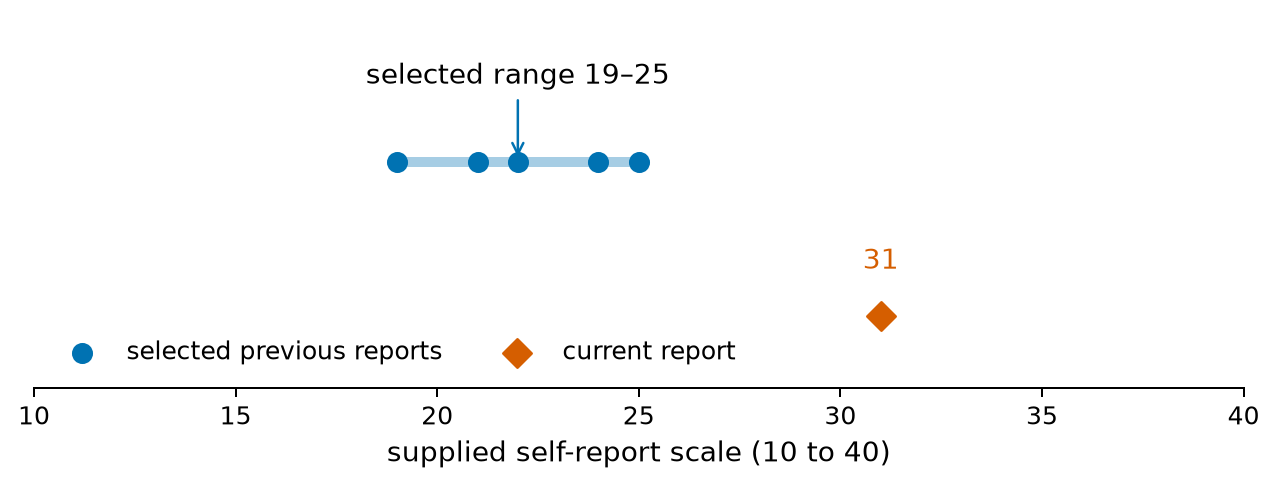
Worked example. A swimmer selects five of her best previous races and reports pre-race ratings 19,21,22,24,25 on a supplied 10-to-40 scale. The selected range is 19–25, width 6; the mean is 111/5 = 22.2. Today's rating 31 is above those five reports. This is a descriptive comparison, not a validated optimal zone or a diagnosis: all other races, outcomes, conditions and measurement error are missing. Do not infer that lowering the score must improve her next race or prescribe an intervention from it alone.
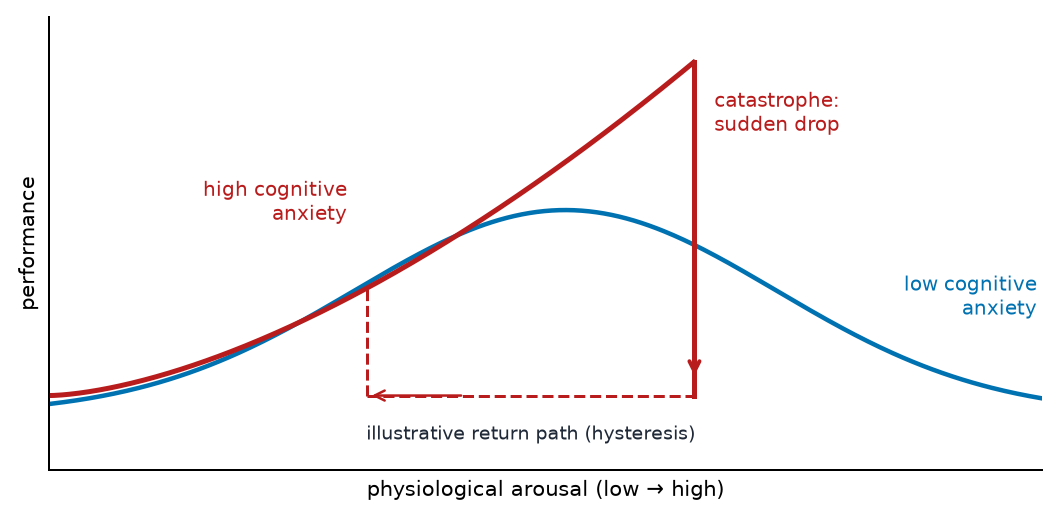
Selected reports are not a validated intervention thresholdDifferent model paths at the same activation illustrate hysteresis, not a proven recovery treatment
Catastrophe theory 突变理论 (Hardy and Fazey) distinguishes physiological arousal from cognitive anxiety. In a simplified account, high worry combined with increasing physiological activation can produce an abrupt rather than gradual performance drop. A different return path is called hysteresis: merely reversing activation a little need not retrace the outward path.
These are model predictions, not an explanation of every mistake or a prescription for how long an athlete must recover. One sudden loss of performance could involve fatigue, technical error, distraction, injury or measurement issues. The sketch neither establishes a universal trigger value nor proves that a particular calming technique causes recovery.
individual zones of optimal functioning/ˌɪndɪˈvɪdʒuːəl zəʊnz ɒv ˈɒptɪml ˈfʌŋkʃənɪŋ/
catastrophe theory/kəˈtæstrəfi ˈθɪəri/
10.4
Anxiety
Types of anxiety
Anxiety 焦虑 is an unpleasant emotional state of worry, nervousness and apprehension, with activation of the body.
A penalty kick: a skill practised a thousand times, now performed under the pressure of the momentTwo pairs of anxiety types: how stable it is (trait or state) and where it shows (mind or body)
Pair
First type
Second type
Trait or state
Trait anxiety 特质焦虑: a stable, general tendency to see situations as threatening (part of personality)
State anxiety 状态焦虑: anxiety felt at a particular moment, which changes from minute to minute
Cognitive or somatic
Cognitive anxiety 认知焦虑: worry, negative thoughts, fear of failure, poor concentration
Somatic anxiety 躯体焦虑: the bodily signs, such as a racing heart, butterflies, sweaty hands and muscle tension
Trait measures may relate to state responses, but task appraisal and context also matter; neither determines the other for every occasion. A golfer, for example, may feel little anxiety in practice rounds but a lot before the last putt of a major. Patterns over time vary. Some performers report worry well before an event and bodily activation nearer the start, but a fixed universal timeline should not be assumed.
Multidimensional anxiety theory
Multidimensional anxiety theory 多维焦虑理论 (Martens and colleagues) predicts that:
cognitive anxiety harms performance in a straight line: more worry, worse performance;
somatic anxiety has an inverted-U relationship with performance: a moderate level helps;
self-confidence improves performance in a straight line.
These are theoretical predictions, not universal individual laws. Repeated evidence may differ with task, experience and interpretation.
Is anxiety always bad?
Distinguish anxiety intensity from its interpreted direction. Two athletes with the same anxiety score may interpret it differently: one sees a racing heart as facilitative ("I'm ready"), the other as debilitative ("I'm going to fail"). Interpretation can differ within the same athlete across events. Reframing (unit C.5) may help examine meaning, but does not remove genuine hazards or guarantee improved performance.
Measuring anxiety
Method
What it measures
Strengths
Limitations
Sport Competition Anxiety Test (SCAT)
Trait anxiety: 15 items (10 scored), total 10 to 30
Quick, standardised, compares athletes
General trait only, not how the athlete feels on the day
Competitive State Anxiety Inventory-2 (original CSAI-2)
State anxiety: 27 items; cognitive anxiety, somatic anxiety and self-confidence, 9 items each, each scored 9 to 36
Separates the three parts; can be used before each event
Self-report: athletes may hide anxiety or give answers they think the coach wants
Physiological measures
Heart rate, blood pressure, galvanic skin response/sweating; cortisol or muscle tension in suitable protocols
Instrument readings do not rely only on self-report
Indirect, non-specific indicators; exercise, heat, timing and other influences require control
Observation
Behaviour such as fidgeting, yawning, repeated toilet visits
Real setting
Observer bias; behaviour differs between people
Use the correct version and scoring instructions. The original CSAI-2 has three 9-item subscales; revised CSAI-2R has a different 17-item structure and should not inherit the original raw totals blindly. A standardised format aids consistency, but its validity must be checked for each language, age and setting. A questionnaire reports experience under specified conditions; physiological measurements are proxies, not direct proof of an inner state.
Worked interpretation. A supplied original-format profile is cognitive 30, somatic 16 and confidence 14, each on a 9–36 range. The values describe different dimensions; do not add them into one undifferentiated anxiety total, or call 16 a clinical "moderate" threshold without validated interpretation. The profile invites a conversation about worry, bodily experience, task demands and support; it does not diagnose a disorder, establish a cause or select a guaranteed treatment.
The worked profile: three separate dimensions on the same 9–36 scale, never one total
Worked arithmetic (classroom items). Nine 1-to-4 ratings are 2,3,4,2,3,2,4,3,3: sum 26, mean 26/9 = 2.888… . A second set 1,2,2,1,2,2,1,2,2 sums to 15; a third 3,2,3,2,3,2,3,2,3 sums to 23. These ratings demonstrate separate subscale arithmetic; they are not the actual questionnaire items, a validated substitute or diagnostic cut-offs.
For a class investigation, use school-approved low-risk tasks and non-sensitive voluntary measures. Explain consent, confidentiality and withdrawal arrangements. Do not induce distress, expose private results or ask pupils to diagnose classmates. A recognition concern should lead to appropriate support; the IOC distinguishes recognition and clinical assessment rather than treating a positive screen as a diagnosis (IOC tool development).
Listening to music before a match, thinking about something else, leaving the situation
Classify coping by its function. Seeking information about a timetable can be problem-focused; discussing feelings with a trusted person can be emotion-focused. A short music break that helps someone regulate feelings differs from repeatedly avoiding a necessary conversation. Ignoring pain or delaying appropriate help should not be presented as a useful default strategy. Leaving an unsafe or harmful situation can be an appropriate protective action.
Social support 社会支持 can provide care, information or practical help. The same conversation can have more than one function. Do not infer that talking is always emotion-focused or that physical activity is always problem-focused; explain what the person is trying to manage.
Simple self-talk can guide an action ("scan, choose, pass"), recall a helpful past experience, or use an agreed acronym for a routine. It can also be unintentional and discouraging. Choose a concise cue related to the task, practise it in suitable conditions and evaluate its effect with the performer. More positive words do not automatically improve a technical action or resolve a real barrier.
Relaxation skills can help some performers manage activation and attention. A comfortable familiar breathing or muscle-relaxation routine should remain voluntary and suitable to the person; it is not a universal treatment or proof that all bodily activation is harmful. Do not infer efficacy from a pulse change without controlling for ordinary rest, posture and activity.
Worked comparison. In a seated low-risk classroom illustration, pulse changes from 72 to 66 beats/min: a fall of 6 beats/min or 6/72×100 = 8.333…%. This does not establish reduced anxiety, improved sport performance or an effect caused by a particular routine. A comparable rest condition, consistent measurement and the participant’s experience would improve interpretation.
Controllability concerns a particular feature and timescale. A player cannot change tomorrow's wind, but can obtain forecasts, choose permitted suitable clothing and plan a safe response. The stressor is not simply one indivisible "uncontrollable" label. A pupil may negotiate a timetable even when the examination date is fixed. Actual resources, authority and access affect what is feasible.
Match the coping strategy to what can be changed
Problem-focused strategies are often appropriate when a relevant demand can be changed; emotion-focused strategies can help manage the response when the demand cannot be changed directly. They can be combined. Appraising a stressor as controllable does not mean the athlete is to blame for it, and a suggestion is not feasible merely because the coach finds it simple.
Match the support to its function
Informational support may clarify a rehabilitation or scheduling plan; practical support may improve transport or access; emotional support may provide understanding and connection. The course highlights support seeking as particularly effective in athlete coping, while requiring attention to the individual and situation. It is an important resource, not a sign of insufficient toughness. Its usefulness depends on who provides it, what is needed and whether it is accessible and safe. No single source or strategy is most effective for every athlete and situation.
Match the support to the need
In a school–sport conflict, the athlete, coach and teachers can discuss actual commitments and feasible adjustments. A supportive friend can help with feelings while practical planning addresses demands. Do not promise that reframing removes an incompatible schedule, or prescribe a training reduction without considering the individual plan and appropriate supervision.
Evaluate strategies rather than prescribing a slogan
Logical analysis examines demands, options and consequences. Relaxation targets activation or emotional regulation. Mental imagery can rehearse an appropriate scenario; thought control can redirect attention towards a useful cue; effort expenditure can support a feasible planned action. Their effectiveness depends on the person, task, timing and implementation. Imagery and psychological skills receive further treatment in C.5.
Coping strategies and what each targets
A brief distraction may regulate emotion and help return to a task, but is not evidence that the underlying barrier has been resolved. Persistent disengagement, unproductive venting or self-blame may leave demands unaddressed or worsen experience. Distinguish these from taking necessary rest, reporting injury, seeking help or leaving an unsafe setting. Evaluate purpose and consequences rather than calling every pause or withdrawal maladaptive.
A suitable investigation defines the strategy, participants, comparison and outcomes. Record both experience and relevant performance over appropriate follow-up, consider expectancy and measurement effects, and avoid treating a group association as a guaranteed individual result. A lower anxiety score is not automatically the only successful outcome; better access, a workable plan or safe participation may be the relevant aim.
10.7
Well-being and support
Burnout and mental health
Burnout 倦怠 can follow long-term stress, often when high training demands meet low recovery and little enjoyment. Raedeke described three signs:
Physical and emotional exhaustion from training and competition.
Reduced sense of accomplishment: feeling that one is not improving or achieving.
Devaluation of sport: no longer caring about the sport, and possibly dropping out.
Raedeke's three signs of burnout
Possible interacting contributors include concentrated sporting demands, inadequate recovery, perfectionistic concerns, pressure and limited support. These associations do not diagnose burnout or make any single pathway inevitable. Prevention includes time off, variety, involving athletes in decisions, a focus on enjoyment and mastery rather than only winning, and early support.
Athletes can have mental health problems such as anxiety disorders, depression and eating disorders, like anyone else. The IOC published a mental-health toolkit in 2021, but athlete mental-health needs and support did not begin in that year. A questionnaire in class can describe how people report feeling, but it never diagnoses a disorder: anyone worried about themselves or a friend should talk to a trusted adult or a professional.
No class score below supplies a diagnostic threshold or treatment recommendation.
Distinguish stressor, appraisal, eustress and distress. Explain how two athletes can interpret the same demand differently without assuming only one can experience strain.
Outline rapid autonomic and HPA responses and the historical general adaptation syndrome. Explain why one pulse or cortisol value does not establish a diagnosis or an inevitable exhaustion stage.
Compare drive theory and the inverted-U hypothesis. Explain why calling a sport powerful, an athlete expert or a person extroverted does not establish an individual optimal arousal score.
For selected previous reports 19,21,22,24,25, calculate mean and range width and locate a current score 31. Repeat the descriptive comparison for 14,15,17,18,19 and current 11. State why neither proves an optimal zone or a need to calm down/psych up.
Explain how a catastrophe model differs from a smooth inverted U and what hysteresis means. Give two reasons not to infer a universal recovery time or treatment from a sketch.
Distinguish trait/state anxiety, cognitive/somatic anxiety and intensity/direction of interpretation. Explain why equal intensity scores may have different meanings.
Compare self-report and physiological indicators. State the original CSAI-2 subscale structure, distinguish the revised form and give controls needed in a low-risk class study.
For the three 9-item response sets in the text, find each sum and mean. Interpret a separate supplied original-format profile 30,16,14 without adding it into a clinical total or assuming an intervention.
Classify problem-focused, emotion-focused and avoidance coping by function, giving examples and distinguishing a brief regulating break from persistent avoidance of a necessary action.
Explain three practical self-talk forms and a suitable relaxation investigation. For pulse 72→66 beats/min, calculate absolute and relative changes and explain why neither establishes improved anxiety or sporting performance.
Describe the three burnout dimensions and a constructive support response. Explain why a classroom questionnaire, one absence or safe withdrawal does not establish a disorder or failed coping.
AHL Analyse controllable and uncontrollable elements in a wind-affected event or a school–sport scheduling conflict. Justify a combination of strategies with their limits.
AHL Distinguish informational, practical and emotional support. Explain why seeking support may be useful without claiming one provider or strategy is best in every situation.
AHL Evaluate logical analysis, relaxation, imagery, thought control, effort expenditure and distraction for a specific task. Distinguish disengagement/self-blame from appropriate rest or leaving danger, and propose evidence to test effectiveness.
Answers.
A stressor is a relevant demand/event; appraisal concerns its meaning and perceived coping resources. Eustress describes a positively experienced challenge; distress describes negatively experienced strain. Appraisals can differ between people and change within a person as conditions or information change. Challenge and threat may coexist; a positive interpretation does not remove a real injury, demand or barrier.
Sympathetic activation and adrenaline can rapidly change pulse, ventilation and fuel availability. HPA signalling links hypothalamus, pituitary ACTH and cortisol secretion by the adrenal cortex. The historical alarm–resistance–exhaustion model organises sustained responses; it does not predict inevitable dates or a literal empty resource tank. Exercise, posture, temperature, timing and other influences affect readings; one value neither identifies a psychological cause nor diagnoses health or coping capacity.
Drive theory strengthens the dominant response, which may help or hinder depending on whether that response suits the task. The inverted U proposes improvement to an optimum followed by decline. These are models with limits, not universal individual laws. Complex coordination can occur in powerful actions, experts can have unsuitable dominant responses, and personality or sport labels do not supply a measured optimum. Define the task and examine suitable repeated evidence.
First sum = 111; mean = 22.2; range = 25−19 = 6; 31 lies above the selected 19–25 reports. Second sum = 83; mean = 16.6; range = 19−14 = 5; 11 lies below 14–19. These selected successful-event reports omit other outcomes, contexts and error. Anxiety ratings do not directly measure all activation; neither range is a validated optimal band or intervention threshold. Seek relevant evidence and the performer’s interpretation instead of automatically prescribing psyching up or calming down.
The catastrophe account adds an interaction with cognitive anxiety and permits a sudden rather than smooth decline as physiological activation changes. Hysteresis means the return path can differ from the outward path at comparable activation. The schematic supplies neither universal numerical triggers nor recovery minutes. A sudden drop may also involve fatigue, technique, distraction or injury.
Trait describes a relatively enduring tendency; state describes a current report. Cognitive concerns worry/thoughts; somatic concerns bodily experience. Intensity concerns how much is reported; direction concerns whether the person interprets it as helpful or harmful. Two equal intensities may have different interpretations and outcomes, without proving interpretation alone caused the result. These dimensions neither diagnose a disorder nor determine every event.
Self-report accesses reported experience but depends on comprehension, context and response bias. Instrument measures such as pulse, blood pressure and galvanic skin response are indirect and non-specific; standardise task, posture, timing and environment. Original CSAI-2 has 27 items, three 9-item subscales, each raw 9–36; revised CSAI-2R uses a different 17-item structure. Use correct instructions and relevant validity evidence. Class tasks need low risk, informed voluntary participation, confidentiality and explained withdrawal limits, without induced distress or public labelling.
Sums are 26,15,23; means are 26/9 = 2.888…, 15/9 = 1.666… and 23/9 = 2.555… . The items demonstrate arithmetic, not a validated questionnaire. Supplied cognitive 30, somatic 16 and confidence 14 describe distinct original-format dimensions; confidence must not be added as if it were the same anxiety construct. Clinical high/moderate labels need suitable validated interpretation. Discuss experience, conditions and support rather than diagnose or prescribe from raw scores.
Problem-focused action addresses a demand, such as obtaining timetable information; emotion-focused action regulates feelings, such as seeking understanding or using a familiar reset cue; avoidance distances the person from the stressor. A short regulating music break can support return, while repeatedly postponing a necessary conversation leaves it unresolved. Classify by function and context. Reporting injury or leaving danger can be protective rather than evidence of poor coping.
Self-talk may recall a useful past experience, use an agreed acronym for a routine or cue a physical action briefly. Rehearse a suitable cue without overloading the performer. Pulse falls 6 beats/min; relative fall = 6/72×100 = 8.333…%. Ordinary rest, posture, timing or measurement could explain it. Compare suitable conditions and examine reported experience and relevant performance.
Burnout descriptions include physical/emotional exhaustion, reduced accomplishment and devaluation of sport. Listen respectfully, examine demands, recovery, access and support, and involve appropriate trusted adults/professionals when needed. These patterns need context and appropriate assessment. A class score or absence does not diagnose a disorder. Stopping an unsafe action, seeking help or taking appropriate rest should not be treated as a toughness failure.
AHL Wind itself may be unchangeable while access to forecasts, permitted equipment and a safe plan may be changeable. An exam date can be fixed while some scheduling decisions remain negotiable. Problem-focused actions address feasible demands; emotion-focused strategies can manage responses to remaining conditions. Combine them when appropriate, acknowledging authority, resources and safety rather than blaming the athlete or promising that reframing removes the barrier.
AHL Informational support clarifies options or a plan; practical support provides resources such as transport; emotional support offers care and understanding. One interaction may serve several functions. Seeking support can improve available resources and connection, but credibility, accessibility, the provider’s role and the individual situation affect usefulness. It does not replace clinical assessment where needed or prove one source is universally best.
AHL Logical analysis clarifies options; relaxation may regulate activation; imagery rehearses a relevant scenario; thought control redirects attention; effort expenditure implements a feasible plan; brief distraction may regulate emotion before re-engagement. Persistent disengagement, unproductive venting or self-blame may leave demands unresolved. These differ from necessary rest, safe withdrawal and appropriate help seeking. Specify the strategy, comparable opportunity, experience and relevant follow-up outcomes; consider expectancy, measurement and real barriers instead of declaring effectiveness from one lower score.
10.9
Exam tips
State the model’s prediction and its limits; avoid fixed sport/personality prescriptions.
Distinguish arousal, anxiety dimensions, interpretation and clinical diagnosis.
Retain unrounded working; selected successful reports do not validate an optimal zone.
Explain coping by its function and judge outcomes in context.
AHL Separate controllability, feasible support and evidence of strategy effectiveness.
Was this helpful?
What went wrong? Only the site team sees this.
More topics in IB Sports, Exercise and Health Science HL