An orbiting satellite is continuously falling while moving sideways. Being in orbit does not require gravity to vanish.
English narration · English + 中文 subtitles burned in
13.1
Scope and prerequisites
This handout teaches D.1 Gravitational fields in full, for the course first assessed in 2025.
Prerequisites: circular motion and centripetal force from A.2; work and energy from A.3. Use $G = 6.67 \times 10^{-11}\ \text{N m}^2\ \text{kg}^{-2}$, the Earth's mass $5.97 \times 10^{24}$ kg and radius $6.37 \times 10^{6}$ m. Numerical orbit models are circular unless an ellipse is explicitly discussed. Treat satellite mass as negligible beside the central mass and neglect losses unless stated.
13.2
Gravitation and orbits
Why doesn't the International Space Station fall down?
Use a space-station orbit about 400 km above a spherical Earth. At that height the Earth's gravity is still 89% as strong as at the surface, so gravity has not "switched off". The station is falling, all the time. But it also moves sideways at about 7.7 km every second. As it falls, the curved surface of the Earth drops away beneath it just as fast, so it never gets any closer to the ground. Isaac Newton imagined the same thing with a cannon on a very tall mountain.
The International Space Station orbits Earth, held in its path by gravity.Newton's ideal cannon: suitable sideways speed gives an orbit if atmosphere, obstacles and other perturbations are neglected
The same force that makes an apple fall keeps the Moon in orbit and the planets moving round the Sun. This unit describes that force, the field it comes from, and the orbits it produces.
13.3
Kepler's laws of orbital motion
Johannes Kepler studied careful measurements of the planets' positions and found three rules, now called Kepler's laws 开普勒定律:
First law: each planet moves in an ellipse 椭圆 with the Sun at one focus 焦点.
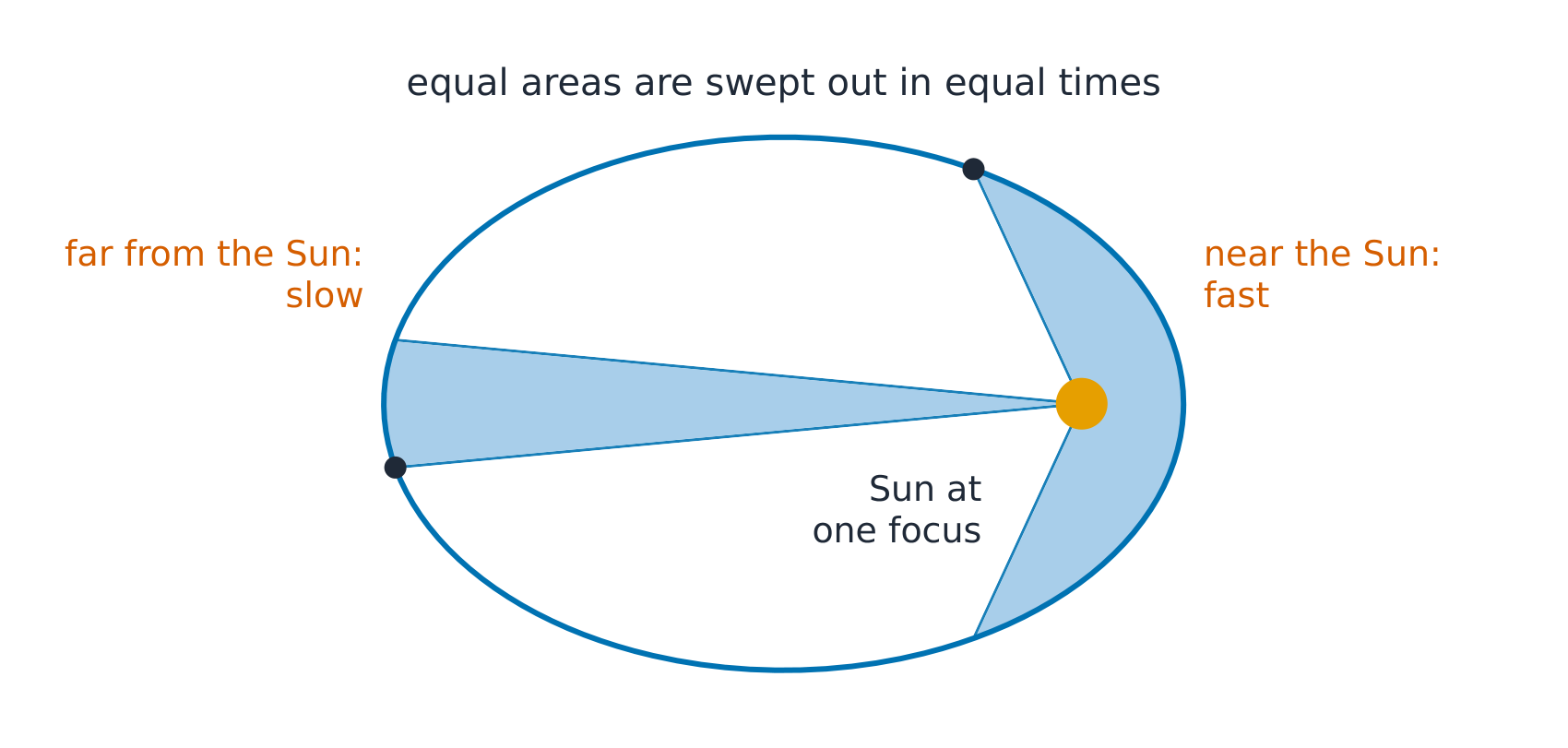
Second law: the line from the Sun to a planet sweeps out equal areas in equal times. So a planet moves fastest when it is closest to the Sun and slowest when it is furthest away.
Third law: the square of the orbital period $T$ is proportional to the cube of the semi-major axis $a$ of the ellipse: $T^2 \propto a^3$ (for a circle, $a = r$).
Kepler's second law: equal areas in equal times, so faster near the Sun
Circular approximations are useful for many planetary calculations; ellipticity varies between planets and Kepler's third law uses the semi-major axis, not an arbitrary instantaneous distance. Kepler's laws describe the motion; Newton's law of gravitation, below, explains it.
Worked example (third law): Mars takes 1.88 years to orbit the Sun. The Earth takes 1.00 year at 1.00 AU (the Earth–Sun distance). $r^3 \propto T^2$, so $r_{\text{Mars}} = 1.88^{2/3} = 1.52$ AU.
Every mass attracts every other mass. For two point masses 质点$m_1$ and $m_2$ a distance $r$ apart, Newton's universal law of gravitation 万有引力定律 gives the size of the force:
Two masses attract along the line joining them
$$F = \frac{G m_1 m_2}{r^2}$$
The force on each mass is equal in size and opposite in direction (Newton's third law), and it is always attractive.
It is an inverse-square law: double the distance and the force falls to one-quarter.
$G$ is the gravitational constant. It is so small that gravity between everyday objects is tiny; ordinary gravitational forces between small objects are usually hard to notice without sensitive apparatus.
Worked examples using the stated spherical-body model:
Two lead spheres of 5.0 kg each have centres 0.10 m apart: $F = 6.67 \times 10^{-11} \times 5.0 \times 5.0/0.10^2 = 1.7 \times 10^{-7}$ N.
The Earth and the Moon ($7.35 \times 10^{22}$ kg, $3.84 \times 10^{8}$ m apart): $F = 6.67 \times 10^{-11} \times 5.97 \times 10^{24} \times 7.35 \times 10^{22}/(3.84 \times 10^{8})^2 = 2.0 \times 10^{20}$ N.
When can a large body be treated as a point mass?
The law is written for point masses, but we can use it for real bodies when:
the body is a sphere of uniform density (or made of uniform spherical shells). Outside it, it acts as if all its mass were at its centre;
the bodies are very far apart compared with their sizes, as for the Sun and the planets.
For point masses or these spherical-body approximations, measure $r$between the centres; arbitrary nearby extended shapes require a mass-distribution calculation. For a satellite at height $h$ above the Earth, $r = R_E + h$.
Outside a uniform sphere the field is radial, exactly like a point mass at the centre
Newton's universal law of gravitation/ˈnjuːtnz ˌjuːnɪˈvɜːsl lɔː ɒv ˌɡrævɪˈteɪʃn/
13.5
Gravitational field strength
A mass creates a gravitational field 引力场 in the space around it: any other mass placed there feels a force. The gravitational field strength 引力场强度$g$ at a point is the force per unit mass on a small test mass placed there:
$$g = \frac{F}{m} = \frac{GM}{r^2}$$
where $M$ is the mass creating the field. Its unit is N kg⁻¹, which is the same as m s⁻². Field strength is a vector: it points towards the mass $M$.
Field strength falls off as $1/r^2$ with distance from a point mass
Worked examples using the stated spherical-body model:
At the Earth's surface: $g = 6.67 \times 10^{-11} \times 5.97 \times 10^{24}/(6.37 \times 10^6)^2 = 9.81\ \text{N kg}^{-1}$.
At the height of the space station, $r = 6.37 \times 10^6 + 4.0 \times 10^5 = 6.77 \times 10^6$ m: $g = 8.69\ \text{N kg}^{-1}$, still 89% of the surface value.
The resultant field of two bodies
Fields are vectors, so where two bodies both pull, add their fields with their directions. Between the Earth and Moon, their fields point in opposite directions towards their respective centres. This is a two-body static field calculation, not the rotating-frame L1 equilibrium calculation. At one point they are equal and opposite and the resultant field is zero:
so $x = 0.900\,d = 3.46 \times 10^8$ m from the Earth's centre. The point is much closer to the Moon because the Moon's mass is much smaller.
The two fields cancel nine-tenths of the way to the Moon
Explore
Twice the centre distance, one-quarter the field
Compare 8 N/kg at R with 2 N/kg at 2R. Keep centre distance separate from height above the surface, and distinguish field strength from force on a test mass.
gravitational field strength/ˌɡrævɪˈteɪʃənl fiːld streŋθ/
13.6
Gravitational field lines
Field lines 场线 show the direction of the force on a small test mass. Their spacing shows the field strength: closer lines mean a stronger field.
Around a spherical planet the field is radial: the lines point in towards the centre and spread apart further out, as the field gets weaker.
Close to the surface, over a region small compared with the planet, the lines are almost parallel and equally spaced: a uniform field 匀强场, where $g$ is constant.
Field lines cannot cross where the field has a definite nonzero direction. In this isolated attractive-mass model they point towards masses; their drawn density represents strength, not material strings.
A radial field far away; an almost uniform field close to the surface
For a satellite in a circular orbit 轨道, gravity is the only force acting, and it provides the centripetal force 向心力. Using $a = 4\pi^2 r/T^2$ for circular motion:
Gravity provides the centripetal force that keeps a planet in a circular orbit
$$\frac{GMm}{r^2} = \frac{4\pi^2 m r}{T^2} \quad\Rightarrow\quad T^2 = \frac{4\pi^2}{GM}\,r^3$$
This is Kepler's third law, now explained by Newton's law. The constant $4\pi^2/GM$ depends only on the central mass $M$, so all satellites of the same body share it, and the satellite's own mass cancels.
Kepler's third law: $T^2 \propto r^3$, a straight line through the origin
Worked examples using the stated spherical-body model:
Space station, $r = 6.77 \times 10^6$ m: $T = 2\pi\sqrt{r^3/GM} = 5.5 \times 10^3$ s, about 92 minutes.
Geostationary orbit 地球静止轨道: a circular equatorial satellite moving eastwards with Earth's rotation has a sidereal period $T = 86164$ s, about 23 h 56 min. Using $r^3 = \frac{GMT^2}{4\pi^2}$ gives $r \approx 4.215 \times 10^7$ m and altitude about 35 800 km for the stated rounded constants. Period alone is insufficient: circularity, plane and direction also matter. See ESA's orbit guide.
Mass of the Sun from the Earth's orbit ($r = 1.50 \times 10^{11}$ m, $T = 3.16 \times 10^7$ s): $M = 4\pi^2 r^3/GT^2 = 2.0 \times 10^{30}$ kg.
Astronauts in orbit feel weightless because they and their spacecraft fall together with the same acceleration, so the floor does not push on them. This is apparent weightlessness 表观失重: gravity is still acting.
Calculate the gravitational force between the Earth and the Moon.
State two conditions under which a large body can be treated as a point mass in Newton's law of gravitation.
Calculate the gravitational field strength 400 km above the Earth's surface.
Mars has mass $6.42 \times 10^{23}$ kg and radius $3.39 \times 10^6$ m. Calculate the gravitational field strength at its surface.
Find the distance from the Earth's centre, along the line to the Moon, where the resultant gravitational field is zero.
Sketch the gravitational field lines around a planet and close to its surface. Describe the difference.
Mars takes 1.88 years to orbit the Sun. Find its orbital radius in AU.
Calculate the radius and altitude of a model geostationary orbit, using T = 86164 s, and state the required orbital plane and direction.
The Earth orbits the Sun at $1.50 \times 10^{11}$ m with a period of $3.16 \times 10^7$ s. Calculate the mass of the Sun.
A small probe has mass 20 kg where Earth's model field strength is 8.0 N/kg. Find its weight. If probe mass doubles at the same point, state what happens to its weight and the field strength.
Answers.
Elliptical orbits have the Sun at one focus; the Sun–planet line sweeps equal areas in equal times; $T^2 \propto a^3$ for semi-major axis $a$, which equals radius for a circle.
The body is a sphere of uniform density (the field outside it is then the same as a point mass at its centre), or the distance between the bodies is very large compared with their sizes.
Around the planet the lines are radial, pointing to the centre and spreading apart further out (weaker field). Near the surface they are parallel, equally spaced and pointing down (uniform field).
$r = 1.88^{2/3} = 1.52$ AU.
$r=\left(\frac{GMT^2}{4\pi^2}\right)^{1/3}\approx4.215\times10^7$ m; $h=r-R_E\approx3.578\times10^7$ m, about 35 800 km. The orbit is circular, equatorial and prograde.
$F=mg=20\times8.0=160$ N towards Earth. Doubling test mass doubles weight to 320 N; Earth's field remains 8.0 N/kg when the probe's own gravitational effect is negligible.
13.9
Exam tips
Measure $r$ from the centre of the planet: add the radius to the height.
Inverse square: double $r$ and both $F$ and $g$ fall to one-quarter.
In a circular orbit gravity provides the centripetal force. Never add an extra outward force.
Orbiting astronauts are weightless only in appearance: gravity still acts on them.