A passenger continues moving when a vehicle brakes. The seat belt provides the force needed to change the passenger momentum 动量.
English narration · English + 中文 subtitles burned in
2.1
Scope and prerequisites
This handout teaches A.2 Forces and momentum in full, for the course first assessed in 2025. There is no additional higher level content in A.2.
Prerequisites: velocity, acceleration and the equations of motion from A.1; resolving a vector into components with sine and cosine. Use $g = 9.8\ \text{m s}^{-2}$.
2.2
Newton's laws and free-body diagrams
Why does a passenger lurch forward?
When a bus brakes hard, standing passengers fall forwards. Nothing pushes them forwards: their bodies simply keep moving while the bus slows down under them. A seat belt or a handrail supplies the force that changes their motion. Forces do not keep things moving; forces change how things move.
Forces are interactions
A force 力 is a push or pull that one body exerts on another. Every force is part of an interaction 相互作用 between two bodies, and is measured in newtons (N).
Newton's three laws
First law: a body stays at rest, or keeps moving at constant velocity, unless a resultant external force acts on it. Its tendency to keep its motion is called inertia 惯性.
Second law: for a fixed collection of particles, the resultant external force equals the instantaneous rate of change of its momentum. Over a finite interval, $\bar F = \dfrac{\Delta p}{\Delta t}$ gives the average resultant force. For constant mass, instantaneous force and acceleration obey $F = ma$.
Third law: if body A exerts a force on body B, then B exerts a force on A that is equal in size and opposite in direction.
A third-law pair acts on two different bodies and is always the same type of force. A book resting on a table has two forces on it: its weight (Earth pulls the book) and the normal force (table pushes the book). These are not a third-law pair: both act on the book. The partner of the book's weight is the book pulling the Earth upwards; the partner of the normal force is the book pushing down on the table.
Newton's third-law pair: R on the book (up) and R′ on the table (down)
Free-body diagrams
A free-body diagram 受力图 shows one body and only the forces acting on it, as labelled arrows starting from the body. Leave out forces the body exerts on other things.
The resultant force 合力 is the vector sum of all the forces. Resolve forces into two perpendicular directions and add each set of components.
If the resultant force is zero, the body is in translational equilibrium 平动平衡: at rest, or at constant velocity (first law).
If it is not zero, $a = F_{\text{net}}/m$ in the direction of the resultant (second law).
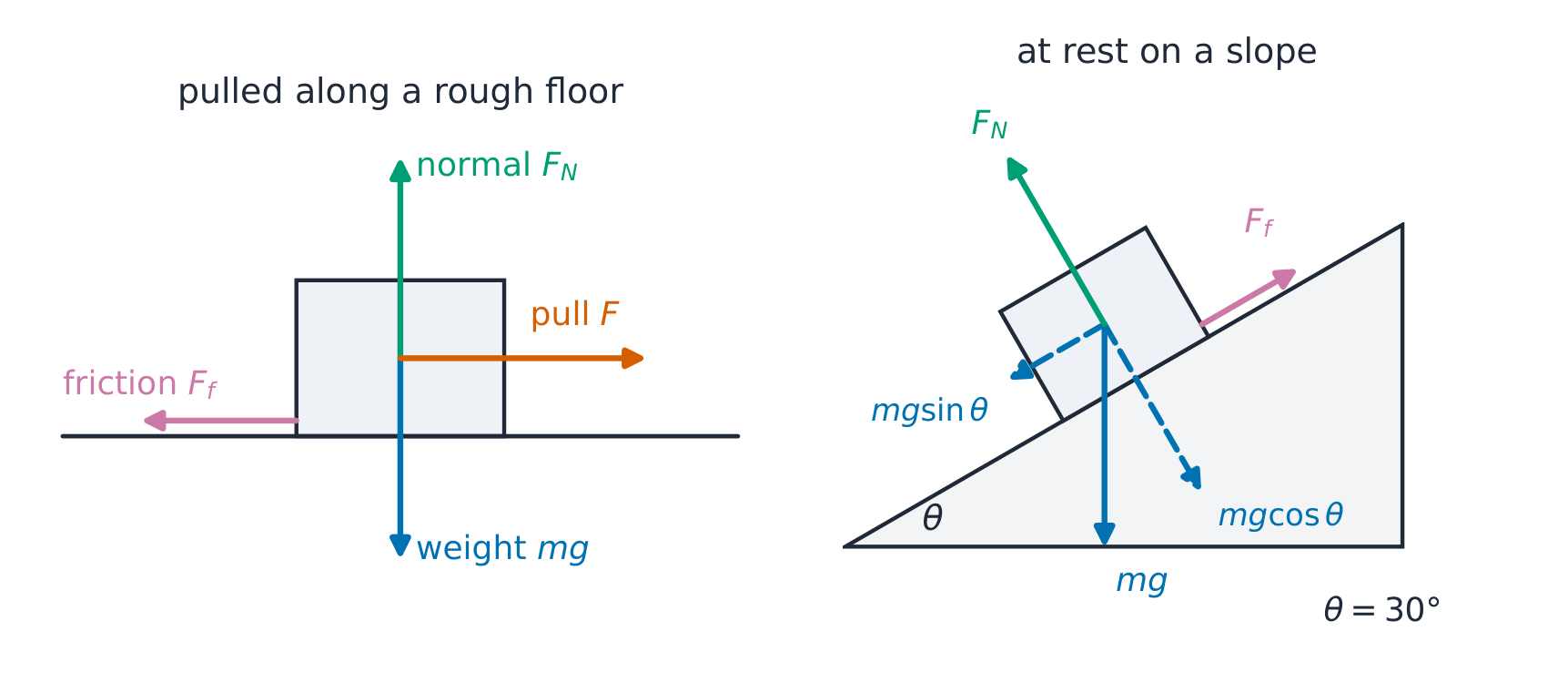
Draw only the forces on the chosen body; on a slope, resolve the weight along and perpendicular to the surface
the component of the contact force perpendicular to the surface
surface friction
$F_f$
acts parallel to the surface, opposing sliding (or the tendency to slide)
tension
$T$
the pull of a string, rope or cable, along it
elastic restoring force
$F_H$
a spring's push or pull back towards its natural length
viscous drag
$F_d$
opposes a body's motion through a fluid
buoyancy
$F_b$
the upward push of a fluid on a body that displaces it
Weight and normal contact force on a book resting on a table
Friction
On a body that is not sliding, static friction 静摩擦力 takes whatever value is needed to stop sliding, up to a maximum: $F_f \le \mu_s F_N$.
On a sliding body, dynamic friction 动摩擦力 is $F_f = \mu_d F_N$, where $\mu_d$ is usually a little smaller than $\mu_s$.
A block of mass m on a plane inclined at theta with tan theta = 3/4, showing the weight resolved into mg sin theta and mg cos theta, the normal reaction R, and friction F = mu R acting down the slope.
The coefficients $\mu_s$ and $\mu_d$ have no unit and depend on the two surfaces.
Worked example: a 5.0 kg box rests on a floor with $\mu_s = 0.50$ and $\mu_d = 0.40$. $F_N = mg = 49\ \text{N}$.
A horizontal 20 N push: the largest static friction is $0.50 \times 49 = 24.5\ \text{N}$, so the box stays still and friction is exactly 20 N.
A horizontal 30 N pull: more than 24.5 N, so the box slides. Friction $= 0.40 \times 49 = 19.6\ \text{N}$; resultant $= 30 - 19.6 = 10.4\ \text{N}$; $a = 10.4 / 5.0 = 2.1\ \text{m s}^{-2}$.
For a body with no acceleration normal to a slope and no other force component in that direction, resolve the weight for slope angle $\theta$: $mg\sin\theta$ down the slope and $mg\cos\theta$ into it, so $F_N = mg\cos\theta$. For the box at rest on a 30° slope, friction $= 49\sin 30° = 24.5\ \text{N}$ up the slope and $F_N = 49\cos 30° = 42\ \text{N}$; it can stay still only if $\mu_s \ge \tan 30° = 0.58$.
A car climbing a slope at constant speed: along the slope the driving force balances the resistive force plus the weight's component $W\sin\theta$
Springs: Hooke's law
$$F_H = -kx$$
$x$ is the extension from the natural length and $k$ is the spring constant 劲度系数 (N m⁻¹). The minus sign shows that the force acts back towards the natural length. A 0.50 kg mass hung on a spring with $k = 200\ \text{N m}^{-1}$ stretches it by $x = mg/k = 4.9/200 = 0.025\ \text{m}$.
A load–extension graph: straight up to the limit of proportionality $P$, then it curves
In the lab: add loads in equal steps, measure each extension from the unloaded position with a fixed pointer, and plot force against extension. The gradient of the straight part is $k$; stay within the linear, proportional range. A spring can return to its original length after a load is removed yet respond nonlinearly, so elastic behaviour alone does not establish constant $k$.
Viscous drag and buoyancy
For a small sphere moving slowly through a fluid, Stokes' law 斯托克斯定律 gives the drag:
$$F_d = 6\pi\eta r v$$
$\eta$ is the viscosity 黏度 of the fluid (Pa s), $r$ the sphere's radius and $v$ its speed.
Buoyancy 浮力 equals the weight of fluid displaced: $F_b = \rho V g$, where $\rho$ is the density of the fluid and $V$ the volume displaced.
Forces on a falling object in a fluid
Worked example: a steel ball (radius 1.0 mm, density 7800 kg m⁻³) falls through glycerol ($\rho = 1260\ \text{kg m}^{-3}$, $\eta = 1.4\ \text{Pa s}$). At terminal speed the forces balance: weight = buoyancy + drag.
It is a vector, measured in kg m s⁻¹. A 1200 kg car at 15 m s⁻¹ has $p = 18\,000\ \text{kg m s}^{-1}$. The total momentum of a system stays constant unless a resultant external force acts on the system: the conservation of momentum 动量守恒.
Impulse
A resultant force $F$ acting for a time $\Delta t$ gives an impulse 冲量:
$$J = F\Delta t = \Delta p$$
$F$ is the average resultant force. The impulse equals the change in momentum, and is measured in N s (the same as kg m s⁻¹). On a force–time graph, impulse is the area under the graph.
Impulse is the area under a force-time graph, equal to the change in momentum
Worked example: a 0.058 kg tennis ball hits a wall at 20 m s⁻¹ and rebounds at 15 m s⁻¹. Take the rebound direction as positive.
$\Delta p = 0.058 \times (15 - (-20)) = 2.0\ \text{kg m s}^{-1}$. Forgetting the sign change would give only 0.29.
Contact lasts 0.010 s, so the average force $= 2.0 / 0.010 = 200\ \text{N}$.
The same impulse, 600 N s, spread over a longer time needs a smaller force
Each point compares a different stopping event with the same momentum-change magnitude. The relationship is inverse: $|F_{\mathrm{avg}}|=|\Delta p|/\Delta t$. At 0.75 s, the model gives $600/0.75=800$ N; a straight segment between the 0.50 s and 1.00 s points would give the wrong intermediate value. This curve is not the force history of one collision, so its area does not give that collision's impulse.
For the same change in momentum, a longer stopping time means a smaller force. Seat belts, air bags, crumple zones, bending your knees on landing and pulling your hands back to catch a ball all increase $\Delta t$.
In a crash, a large force acts over a very short time to change momentum.
When the mass changes
$F = ma$ assumes constant mass. For a steady mass flow, account for momentum transferred per unit time across the system boundary. If a hose sends 2.0 kg of water each second at 15 m s⁻¹ against a wall, where it stops:
A rocket uses the same momentum-flow idea: ejecting 50 kg of gas per second at 2000 m s⁻¹ relative to the rocket gives a thrust of $1.0 \times 10^5\ \text{N}$ when the exhaust-pressure contribution is neglected. Ground-frame exhaust speed alone does not specify this thrust.
A rocket pushes gas down; by Newton's third law the gas pushes the rocket up.
Explore
Same impulse, different stopping time
Start with the 60 kg passenger stopping from 10 m/s in 0.50 s. Compare a longer change time; signed momentum change stays fixed while average force changes.
conservation of momentum/ˌkɒnsəˈveɪʃn ɒv məʊˈmentəm/
impulse/ˈɪmpʌls/
2.5
Collisions and explosions
Conservation in a collision
In a collision the bodies push on each other with equal and opposite forces for the same time (third law), so their impulses are equal and opposite. Total momentum is conserved as long as external forces (like friction) are small during the collision.
A Newton's cradle shows momentum and kinetic energy passing through a line of balls in a near-elastic collision
$$m_1u_1 + m_2u_2 = m_1v_1 + m_2v_2$$
Elastic and inelastic collisions
Type
Momentum
Kinetic energy
elastic collision 弹性碰撞
conserved
conserved
inelastic collision 非弹性碰撞
conserved
some transferred to thermal energy, sound and deformation
perfectly inelastic
conserved
the bodies stick together; the greatest possible KE loss
Total energy is always conserved; only the kinetic energy can decrease.
Head-on collision: velocities before and after
Worked example: a 2.0 kg trolley at 3.0 m s⁻¹ hits a stationary 1.0 kg trolley and they stick together.
KE before $= \frac{1}{2}(2.0)(3.0^2) = 9.0\ \text{J}$; KE after $= \frac{1}{2}(3.0)(2.0^2) = 6.0\ \text{J}$. 3.0 J is transferred, so the collision is inelastic.
If a 1.0 kg trolley at 4.0 m s⁻¹ hits an identical stationary trolley and stops, the second moves off at 4.0 m s⁻¹: KE is 8.0 J before and after, so that collision is elastic.
Explosions
In a two-part explosion 爆炸 initially at rest, total momentum starts at zero. If external impulse is negligible, the parts acquire equal and opposite momenta, while stored chemical or elastic energy becomes kinetic energy, so the total KE increases.
A 4.0 kg rifle fires a 0.010 kg bullet at 400 m s⁻¹. $0 = 0.010(400) + 4.0v$, so the rifle recoils at $v = -1.0\ \text{m s}^{-1}$. The bullet gets 800 J of kinetic energy and the rifle only 2.0 J: the lighter body takes almost all the energy.
A body moving in a circle at constant speed is accelerating, because the direction of its velocity keeps changing. Describe the motion with:
A Ferris wheel: a centripetal force toward the centre keeps each car moving in a circle.
the period 周期$T$: the time for one revolution;
the angular velocity 角速度$\omega$: the angle swept per second, in rad s⁻¹, $\omega = \dfrac{2\pi}{T}$;
the linear speed $v = \dfrac{2\pi r}{T} = \omega r$.
As the radius turns through $\Delta\theta$ the object moves an arc $\Delta s$ at speed $v$
Centripetal acceleration and force
The acceleration points towards the centre of the circle: the centripetal acceleration 向心加速度.
$$a = \frac{v^2}{r} = \omega^2 r = \frac{4\pi^2 r}{T^2}$$
It needs a resultant force towards the centre, the centripetal force 向心力, $F = \dfrac{mv^2}{r}$. This is not a new kind of force: tension, friction, gravity, a normal force, or a combination of them supplies it. It acts perpendicular to the velocity, so it changes the direction but not the speed, and it does no work.
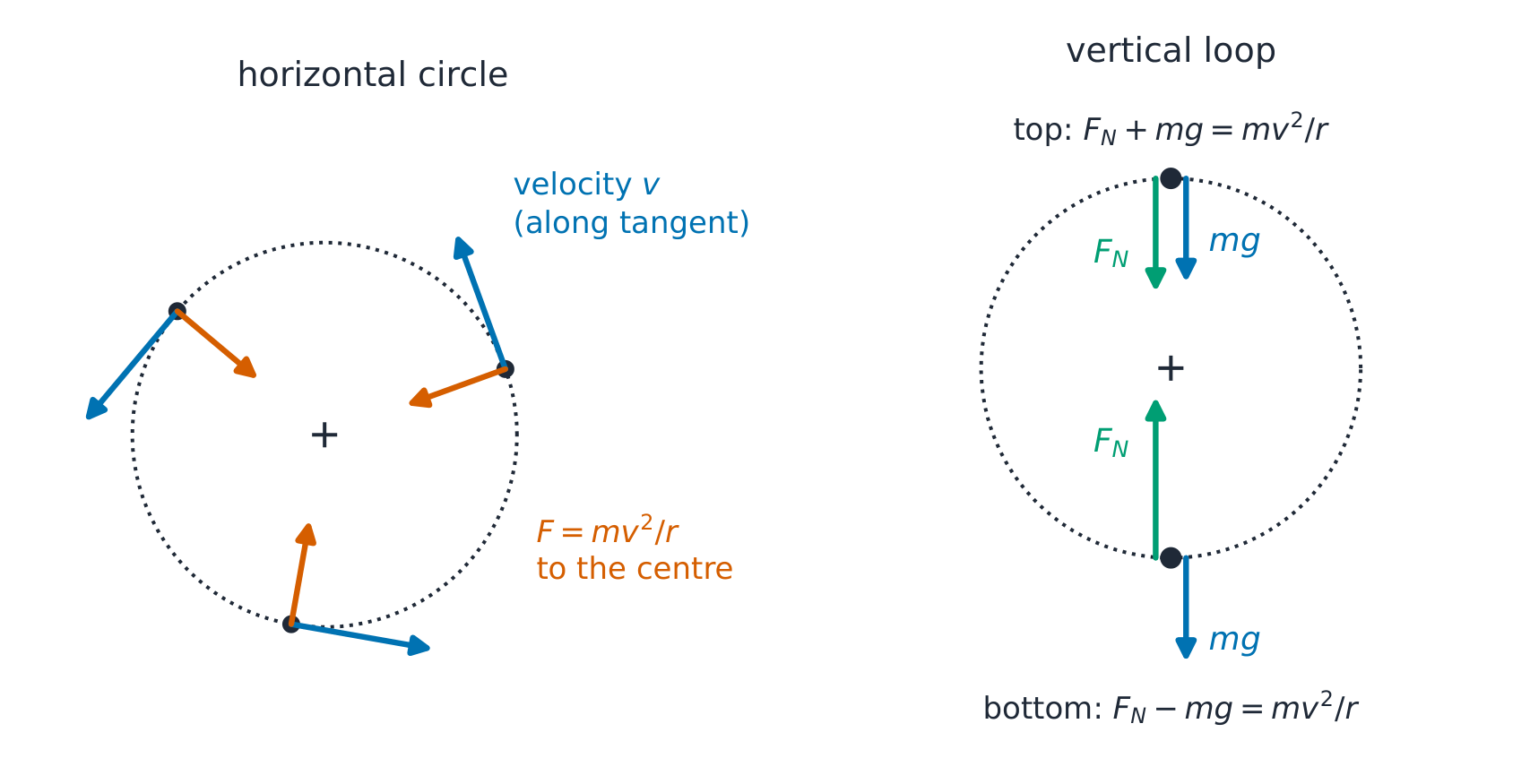
Horizontal circle: force perpendicular to velocity. Vertical loop: the resultant towards the centre is mv²/r at both top and bottom
Worked example: a stone on a string turns in a horizontal circle of radius 0.80 m, twice per second.
$a = \omega^2 r = 12.6^2 \times 0.80 = 126\ \text{m s}^{-2}$, about 13 times $g$.
A 1200 kg car rounds a level, unbanked bend of radius 20 m at 10 m s⁻¹: $a = 100/20 = 5.0\ \text{m s}^{-2}$, so friction must supply $F = 6000\ \text{N}$. The tyres must have $\mu_s \ge 5.0/9.8 = 0.51$; if horizontal friction were negligible, the car would continue along its instantaneous tangent instead of following the bend. Nonzero but insufficient friction can still curve its path without keeping it on the intended circle.
Vertical circles
In a vertical circle the speed changes (non-uniform circular motion), but at the top and the bottom the resultant force towards the centre is still $mv^2/r$.
Forces on a person at the top and bottom of a vertical circle
Bottom of a loop: $F_N - mg = \dfrac{mv^2}{r}$, so the seat pushes harder than your weight. A 500 kg roller-coaster car at 20 m s⁻¹ at the bottom of a loop of radius 10 m: $F_N = 500(9.8 + 40) = 2.5 \times 10^4\ \text{N}$.
Top of a loop (inside): $F_N + mg = \dfrac{mv^2}{r}$. The smallest speed that keeps contact has $F_N = 0$: $v = \sqrt{gr}$. A bucket of water swung in a 1.0 m circle needs at least $\sqrt{9.8} = 3.1\ \text{m s}^{-1}$ at the top.
Over a hump of radius $r$: $mg - F_N = \dfrac{mv^2}{r}$. Above $v = \sqrt{gr}$ (12 m s⁻¹ for $r = 15\ \text{m}$) a car leaves the road.
A book rests on a table. Name the third-law partner of (a) its weight, (b) the normal force on it.
A 3.0 kg block is pulled by a horizontal 25 N force across a floor with $\mu_d = 0.30$. Find its acceleration.
A spring stretches 6.0 cm under a 3.0 N load. Find $k$, and the extension under 5.0 N (assume the spring remains in its linear proportional range).
A 1.0 kg stone of volume $4.0 \times 10^{-4}\ \text{m}^3$ hangs from a string, fully under water. Find the buoyancy and the tension.
A 0.15 kg ball moving at 30 m s⁻¹ is caught and stopped in 0.050 s. Find the average force, and explain why a catcher pulls the hands back.
A force–time graph for a kick is a triangle with a peak of 400 N lasting 0.020 s in total. Find the impulse, and the speed of a 0.080 kg ball kicked from rest.
A 3000 kg railway truck at 2.0 m s⁻¹ couples with a stationary 2000 kg truck. Find their common velocity and the kinetic energy transferred.
Two skaters (60 kg and 40 kg) stand together at rest and push apart. The 60 kg skater moves at 2.0 m s⁻¹. Find the other's velocity and the total kinetic energy gained.
A fire hose ejects 3.0 kg of water per second at 20 m s⁻¹. Find the force needed to hold the hose still.
A 1000 kg car takes a level, unbanked bend of radius 50 m at 15 m s⁻¹. Find the centripetal force and name what provides it.
A 0.20 kg ball on a 0.50 m string moves in a vertical circle at 4.0 m s⁻¹ at the top. Find the tension there.
Answers.
(a) The book pulling the Earth upwards (gravitational). (b) The book pushing down on the table (contact).
On a free-body diagram, draw only forces on the chosen body; start each arrow on the body and label it with a standard name or symbol.
A third-law pair acts on two different bodies and is the same type of force; weight and normal force on one body are never a pair.
Static friction is "up to" $\mu_s F_N$; use the equals sign only when sliding is about to start.
Give momentum a sign. A rebound changes the sign of the velocity, so $\Delta p = m(v - u)$ is often larger than either momentum.
After a collision question, check the kinetic energy: it can stay the same (elastic) or fall (inelastic), but an increase requires energy transferred from another store, as in an explosion.
Centripetal force is the resultant towards the centre, never an extra force on the diagram.