This handout covers D4.1: natural selection, sources of variation, competition, abiotic pressures, fitness, heritability, sexual selection and experimental evidence.
Prerequisites: genes and alleles, meiosis, reproduction and population ecology. Endler's published guppy results are identified separately; they are not measurements or examination questions.
32.2
Natural selection connects inherited differences with reproductive success
Imagine a population whose roots vary in depth. During a drought, deeper-rooted plants may obtain more water and leave more viable offspring. If the relevant differences are inherited, later generations can contain more of the contributing alleles. The drought need not instruct each plant to make a useful new allele.
Banding varies between snails of one species: heritable differences that selection can act on
Natural selection 自然选择 is differential survival and reproduction associated with heritable differences in a particular environment. It can change a population over generations. It does not mean that an individual deliberately evolves, that every survivor reproduces, or that a population moves toward a universally perfect form.
Darwin supplied a mechanism for evolutionary change, rather than merely saying that species change. A theory is an explanatory framework supported and tested using evidence, not a guess awaiting promotion to a law. Replacing an influential explanatory framework is a paradigm shift. The selection explanation differed from an account based simply on use, disuse and inheritance of acquired improvements. Modern evolutionary understanding also includes mechanisms other than selection.
Selection operating over immense timescales has contributed to biodiversity through repeated adaptation and divergence. Its local outcome depends on conditions, inherited variation and reproductive success. A change in a measured average alone does not establish which mechanism produced it.
Mutation introduces alleles while sexual reproduction reshuffles them
Variation 变异 means differences among individuals. Some variation reflects inherited DNA differences; some reflects environmental effects or interactions. Selection can discriminate between phenotypes, but an evolutionary response requires a heritable contribution to the relevant difference.
Crossing over swaps segments between homologous chromosomes
Mutation can introduce new alleles. It can occur before or during exposure to a selection pressure, but useful mutations are not produced because an organism needs them. “Random with respect to need” does not mean all base positions have equal mutation probability or that all mutations have equal effects.
Meiosis produces new allele combinations through crossing over and independent assortment of suitable loci. Random fertilization combines gametes. These processes reshuffle existing alleles; they do not explain the origin of every new allele. In a population with variation, selection affects which combinations contribute to later generations.
A deep-rooted plant could have an inherited tendency, could have grown in a favourable soil patch, or could show plastic growth under local conditions. Measure inheritance and environmental effects rather than assigning every visible difference to a new mutation.
Overproduction and limited resources create competition
Many organisms can produce more offspring than the environment can sustain to reproduction. A plant may produce hundreds of seeds, but only some find suitable space, water, mineral supply and light. Juveniles can compete for food or shelter; reproductive adults can compete for mates. Carrying capacity depends on resource supply and conditions, not a permanently fixed population number.
Natural selection: the best-adapted survive, reproduce and pass on their alleles
Intraspecific competition occurs between members of the same species, often with overlapping requirements. Competition need not involve fighting: neighbouring plants can reduce each other's access to light and water. If a heritable feature improves access and eventual reproductive success, its carriers can contribute more alleles to the next generation.
Overproduction alone is insufficient to establish selection. If mortality removes individuals independently of the relevant heritable differences, deaths do not demonstrate a selective advantage for that trait. Conversely, selection can involve differences in mating success or fertility even without conspicuous adult mortality.
32.5
Abiotic pressures and biological interactions both affect success
A selection pressure 选择压力 is an environmental factor that affects relative survival or reproduction among variants. Low temperature can favour features that maintain function in cold conditions; drought can favour water conservation or access. Extreme weather can affect populations at low as well as high density, so its occurrence need not depend on crowding.
The dark (melanic) form of the peppered moth — the form favoured on soot-darkened barkA density-independent frost can still select between genotypes
A density-independent disturbance is not necessarily genetically indiscriminate. The same frost can affect genotypes differently if their physiology differs. State both the environmental condition and the inherited feature that changes the outcome.
Predation, disease and competition are biological pressures. A feature useful against one predator may have a cost elsewhere. Reduced stomatal opening conserves water but can restrict carbon dioxide entry; extensive roots require resources that could otherwise support leaves or reproduction. Adaptation is therefore a context-dependent trade-off, not a label meaning best in every environment.
Fitness measures contribution to later generations
Biological fitness concerns survival value and reproductive contribution of a genotype in a stated environment. It is not simply strength, speed or lifespan. A long-lived individual leaving no descendants may contribute fewer alleles than a shorter-lived individual producing many surviving, fertile offspring.
Fitness as reproductive contribution: 60 versus 40 surviving offspring from 20 parents each
For a comparison, each of two genotypes begins with 20 parents. One group leaves 60 offspring that reach the defined reproductive stage, the other 40. Their mean contributions are 3 and 2 per parent. Taking the first as relative fitness 1, the second has relative fitness $2/3\approx0.667$. Use equivalent starting numbers and the same outcome definition.
If one group had twice as many parents, comparing raw offspring totals alone would be misleading. A reproductive-success estimate also depends on time, environment and which offspring stage was counted. Fitness measured in a drought need not remain highest in a wet environment.
32.7
Heritable differences must be separated from acquired changes
A scar, a learned skill or an environmentally produced increase in size does not automatically alter the inherited base sequence so offspring receive the same change. An individual can acclimatize without the population genetically evolving. This distinction does not require claiming that every possible inheritance mechanism has been explained by one simple model.
Natural variation in snail shell banding — heritable differences selection can act on
To test the root example, grow offspring from contrasting parents under comparable conditions, using independent families and controlled age, soil and water treatments. A common-garden comparison can reduce environmental differences; growing relatives in only one shared pot would still confound family with pot conditions. Reciprocal environments can reveal genotype–environment interactions.
Evidence is stronger when inherited differences predict both the relevant function and reproductive success, and when population allele measurements agree with the proposed response. Common conditions alone do not remove every parental effect. Nor does failure to observe an increase automatically disprove selection: opposing pressures, gene flow, genetic architecture or limited measurement power can matter.
32.8
Allele counts distinguish population change from individual change
An allele frequency 等位基因频率 is the proportion of copies at a defined locus that carry the named allele. For an ordinary diploid autosomal locus, N individuals contribute 2N copies. Count heterozygotes once for each allele, rather than treating each heterozygote as two copies of the same allele.
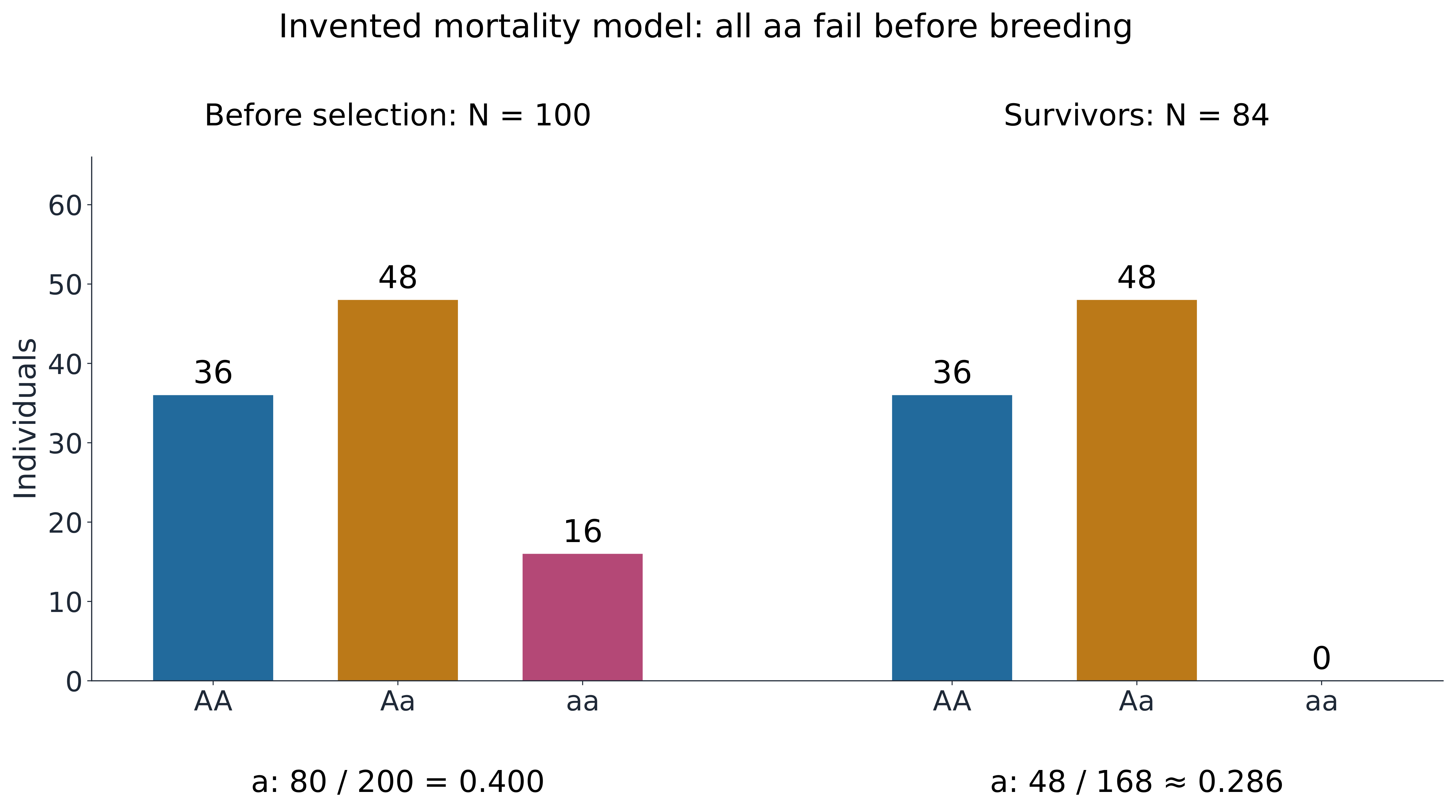
In an 100-plant model, genotypes are AA 36, Aa 48 and aa 16. Copies of a total $48+2(16)=80$ among 200, so frequency is 0.40. Copies of A total $2(36)+48=120$, giving 0.60. Frequencies of the two specified alleles sum to 1.
Suppose all aa plants fail before breeding, while the 36 AA and 48 Aa survive and contribute equally per individual. There are 84 survivors, hence 168 copies. The a frequency among them is $48/168=2/7\approx0.286$; A frequency is $120/168=5/7\approx0.714$. No surviving Aa plant changed its own genotype. The composition of the contributing population changed.
After mortality is not automatically a new offspring generation. Transmission carries the survivors' alleles forward; later frequencies depend on the stated breeding and selection conditions.
If those survivors contribute equally to gametes and no further process changes frequencies, a does not have to decline again merely because offspring are born. Continued selection against aa can cause further change, while a can remain hidden in heterozygotes. Root depth in real plants is more complex than this single-locus teaching model.
Another record has 90 of 200 copies of a named allele initially and 120 of 200 later: 45% to 60%, an increase of 15 percentage points. Relative increase is $15/45\times100\approx33.3\%$, a different comparison. A rise to 140 of 200 is 70%, ten percentage points above 60%.
A frequency shift alone does not uniquely prove natural selection. Migration, chance sampling of reproduction in a finite population, sampling error and changing sample definitions can also affect observations. Measure reproductive differences and heritability, compare suitable controls, and specify population boundaries and collection times.
Explore
Selection changes the allele pool, not each plant's genotype
Count a alleles in 36 AA, 48 Aa and 16 aa plants. Compare the initial 80/200 = 40% with the drought survivors' 48/168 ≈ 28.57%. Vary the surviving subset to distinguish plant counts from allele frequencies and identify cases with no shift or no surviving pool.
Sexual selection can favour traits with survival costs
Sexual selection arises through differences in mating or fertilization success. Competition for access to mates and mate choice can favour physical or behavioural traits even when those traits carry an energetic or predation cost. A benefit in one component of fitness need not be a benefit in every component.
Sexual selection: a mating benefit can outweigh a survival cost
Male birds of paradise provide a context: elaborate plumage and courtship displays can affect attraction of mates, while production, maintenance and display consume resources and can increase exposure. Do not assume that the most conspicuous male necessarily leaves the most offspring under every condition, or that preferences are identical in every population.
A clear explanation connects inherited variation, a mating-success difference and transmission to offspring. “Females liked it, so males grew new inherited colours” omits the existing variation and differential reproduction. Experiments can compare mate responses while controlling background, light and other visual cues, subject to suitable animal-care requirements.
32.10
Endler's guppies show why background and predation must be considered together
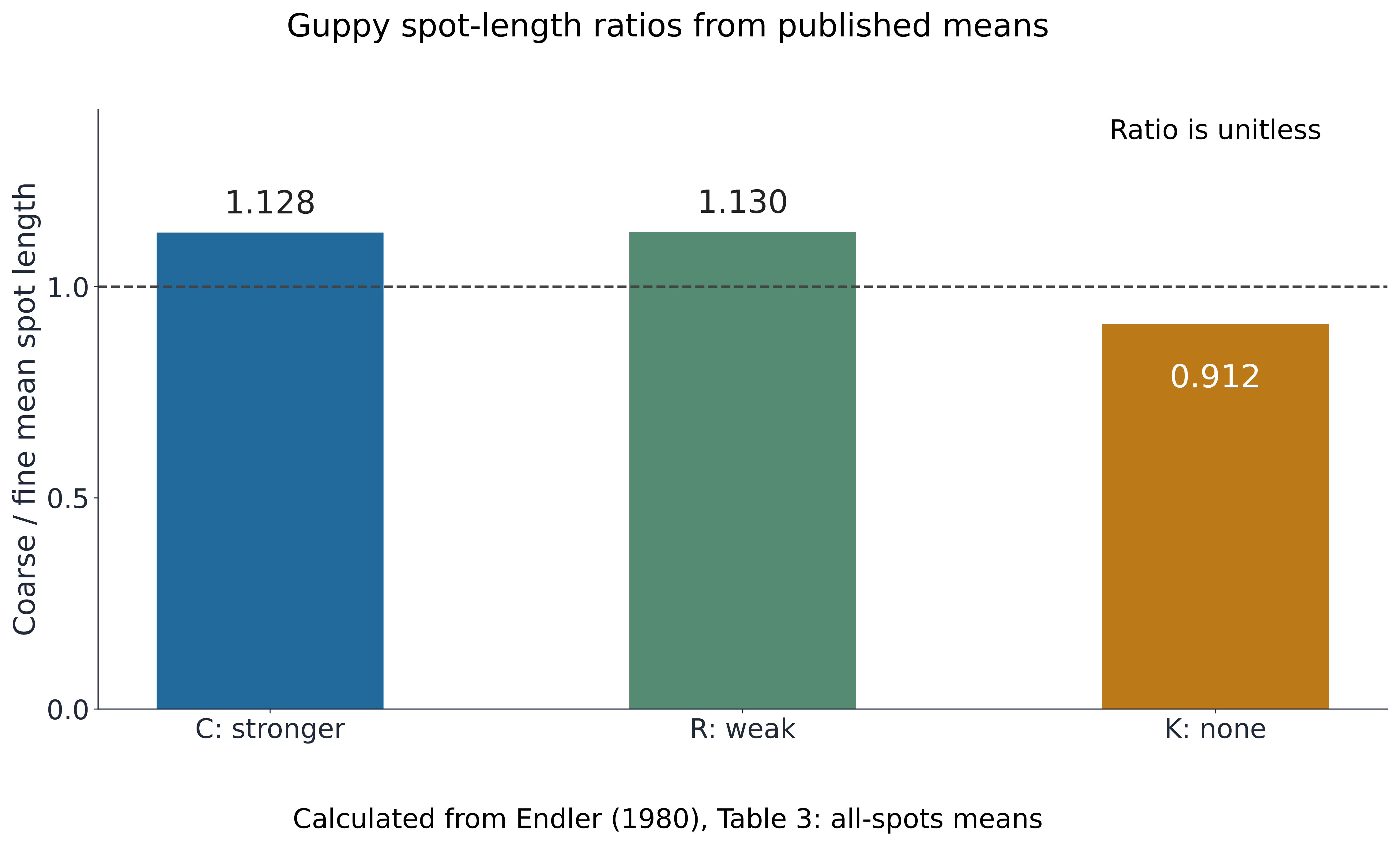
Endler's 1980 guppy study varied predation and gravel background. Table 3 reports these mean lengths for all colour spots, measured in millimetres (mm). C denotes stronger predation, R weaker predation and K no predators. The coarse/fine ratios summarize the published values without converting them into measurements.
Treatment
Fine / mm
Coarse / mm
Coarse/fine ratio
C
1.17
1.32
1.128
R
1.54
1.74
1.130
K
1.47
1.34
0.912
Ratios above one mean larger mean spots on coarse gravel; below one reverses that comparison. No uncertainty interval is supplied here.
Background matching occurred with predation, while the no-predator comparison reversed direction, consistent with a role for sexual selection. Different pattern components responded differently. Read the original paper, table 3 and discussion.
For an experimental comparison, identify the independent variables, measured outcome, treatment allocation and independent replicate units before drawing a conclusion. Many fish in one pond do not supply many independent ponds. A ratio of means is descriptive; it does not by itself establish statistical significance, remove body-size effects or prove one mechanism uniquely. These general evaluation principles apply beyond guppies.
32.11
Practice
Explain natural selection as a mechanism and why its adoption represented a change in explanatory framework. Distinguish population evolution from an individual's intentional improvement.
Compare the roles of mutation, meiosis and fertilization in variation. Correct “a drought produces the useful mutation because the plant needs it”.
Explain how overproduction and limited light, water or food can create intraspecific competition. Why is high offspring mortality alone insufficient to demonstrate selection for a named trait?
Distinguish an abiotic pressure from biological competition. Explain how density-independent weather can still affect genotypes differently, and give one adaptation trade-off.
In a comparison, 10 parents of genotype P leave 50 offspring reaching a specified reproductive stage; 10 of Q leave 30. Calculate mean contributions and relative fitness of Q if P is 1. Explain why strength or lifespan alone is insufficient.
Design a comparison of offspring from deep- and shallow-rooted parents to investigate heritability. Identify environmental controls, independent replicates and a remaining limitation.
Allele-copy counts change from 90/200 to 120/200 and later 140/200. Calculate frequencies, percentage-point changes and the relative increase from the first to second observation. Does this alone prove selection?
Explain sexual selection using a physical or behavioural bird-of-paradise trait, including a possible survival or resource cost.
Interpret the three published coarse/fine ratios in the guppy table. Why can treatment and background change the conclusion?
Explain why many fish from one experimental pond are not many independent ponds, and why a ratio of means alone does not demonstrate significance or remove confounding.
For AA 36, Aa 48 and aa 16, calculate A and a frequencies before mortality. If all aa fail and remaining individuals contribute equally, calculate survivor frequencies. Must a decline again in the next generation if no further frequency-changing process acts?
32.12
Worked answers
Inherited differences affect reproductive contribution and transmission, changing populations over generations. Selection supplied a new explanatory mechanism, illustrating a paradigm shift. Individual acclimatization need not be inherited evolution.
Mutation introduces alleles; meiosis and fertilization reshuffle combinations. Mutations can occur before or during drought, without being directed toward need. Selection changes contributions of available variants.
Potential offspring exceed limited resources; same-species requirements overlap. Heritable acquisition differences can affect reproduction. Mortality unrelated to the named trait does not establish its selective advantage.
Temperature/drought are abiotic; competition is biological. Frost need not depend on crowding, yet genotypes can differ in response. Water-saving stomatal closure restricts carbon dioxide entry; roots consume resources.
P: $50/10=5$ offspring per parent; Q: $30/10=3$. Relative fitness Q $=3/5=0.60$. Use equivalent groups and outcomes; strength or long life without descendants does not establish contribution.
Compare independent families at matched ages; control soil, water and light. Allocate families across replicate pots and, if suitable, reciprocal environments. Persistent differences support inheritance, but parental effects or unmeasured factors can remain.
Frequencies 45%, 60%, 70%; changes +15 then +10 percentage points. First relative increase $=15/45\times100\approx33.3\%$. Drift, migration and sampling also change records; test inheritance and reproductive differences.
Plumage/display can aid mating but cost resources or predator exposure. Heritable variants leaving more descendants can spread. Neither universal preference nor cost-free improvement follows.
C/R ratios above one mean larger spots on coarse gravel; K below one reverses this. Background and predator regime interact; pattern components need not respond identically.
Pond is the independent treatment unit: fish share its environment. A mean ratio alone supplies no significance test or removal of body-size effects. Replication, allocation, controls and outcome definitions matter.
Initially A $=120/200=0.60$; a $=80/200=0.40$. Survivor N = 84: A $=120/168=5/7\approx0.714$; a $=48/168=2/7\approx0.286$. Genotypes did not change. Equal transmission alone need not lower a further; systematic further decline requires a frequency-changing process.
32.13
Exam tips
Link inherited variation, pressure, reproduction and transmission. Count gene copies with the correct denominator. Distinguish percentage points, relative change and evidence of causation.