This handout covers D3.3: internal conditions, negative feedback, blood glucose, diabetes and human thermoregulation.
Prerequisites: membranes, transport, hormones, cell respiration and blood circulation.
IB Biology SL · Topic 31
This handout covers D3.3: internal conditions, negative feedback, blood glucose, diabetes and human thermoregulation.
Prerequisites: membranes, transport, hormones, cell respiration and blood circulation.

A person can move from a warm room to a cool street while their cells continue working. The external environment changes more than the conditions immediately surrounding those cells. Homeostasis 稳态 is regulation of the internal environment within suitable limits despite disturbances. Relevant human variables include core temperature, blood pH, blood glucose concentration and blood osmotic concentration.

The internal environment includes blood plasma and tissue fluid around cells; it is not simply the air beside the skin. Enzymes and membranes work within ranges of temperature, pH and solute conditions. Excessive change can alter reaction rates, protein structure, ion gradients or cell volume. Regulation therefore supports coordinated metabolism, rather than keeping a number constant for its own sake.
A set point is a reference around which a variable is regulated. Use a suitable range and allow ordinary fluctuations, measurement error and time delays. A classroom reference of 5.0 mmol/L for blood glucose is a model value, not a universal target for every person and situation. Different measurement sites can also give different temperature readings.
Homeostasis requires continued exchange and energy use. A steady internal concentration can coexist with rapid entry and removal of substances. An unchanged glucose value does not mean that glucose is neither absorbed nor used.
| English |
|---|
| homeostasis/ˌhəʊmiːəˈstɑːsiz/ |

A negative feedback 负反馈 loop links detection, coordination, signalling and an effector response. A detector responds to the regulated variable; a coordinating process relates that information to a suitable reference; effectors change relevant fluxes. One tissue can perform more than one role. Pancreatic endocrine cells can detect glucose changes and alter hormone secretion without every correction first requiring a separate decision in the brain.
If glucose rises, a response that increases its removal from blood opposes the rise. If it falls, a response that increases supply to blood opposes the fall. As the deviation decreases, the corrective drive generally decreases. Negative refers to opposition to the disturbance, not a negative measured concentration or a harmful effect.
Positive feedback reinforces an initial change. For example, cervical stretch and oxytocin can amplify uterine contractions until delivery removes the major stimulus. Such amplification can complete a specific event, but by itself it does not stabilize a variable above and below a reference. Homeostatic control therefore commonly uses negative feedback.
Detection, hormone transport and cellular responses take time. A delayed response can allow a peak or a small overshoot before recovery. Neither a perfectly horizontal line nor instantaneous correction is required for homeostasis. Conversely, every return toward an initial value is not proof of one particular feedback mechanism: the disturbance may simply have ended.
Compare 7.0 and 4.2 mmol/L against the illustrative 5.0 mmol/L set point. Calculate +40% and −16% deviation, connect each sign with the opposing insulin or glucagon response, and distinguish balance from absent hormone secretion.
| English |
|---|
| negative feedback/ˈneɡətɪv ˈfiːdbæk/ |

The endocrine pancreas contains islets with beta cells and alpha cells. Rising blood glucose normally stimulates beta-cell secretion of insulin 胰岛素. The hormone travels in blood and acts on target cells with suitable receptors. It is a signal, not the enzyme that physically joins glucose molecules into glycogen.
Insulin promotes glucose uptake in skeletal muscle and adipose tissue, including movement of GLUT4 transporters to the surface. It also promotes storage and reduces glucose output by the liver, including promotion of glycogen synthesis and suppression of glucose-producing pathways. These processes lower raised blood glucose. Do not give liver cells the same GLUT4 uptake mechanism as muscle: liver glucose transport and metabolic regulation differ.
Falling glucose normally promotes alpha-cell secretion of glucagon 胰高血糖素. In the liver, glucagon favours glycogen breakdown and glucose production from suitable non-carbohydrate substrates, increasing glucose supply to blood. Glycogen breakdown and glucose synthesis are different pathways. Muscle glycogen mainly supports the muscle's own metabolism; muscle is not simply a second liver exporting its glycogen as free blood glucose.
As glucose returns toward its suitable range, the original stimulus for the increased corrective secretion declines. Basal secretion can remain; “less insulin” does not necessarily mean no insulin. After a meal and during fasting, several hormones, nutrient inputs and activity interact. The two-hormone model explains key opposing actions without claiming that only two substances ever influence glucose.
| English |
|---|
| insulin/ˈɪnsjuːlɪn/ |
| glucagon/ˈɡluːkæɡən/ |
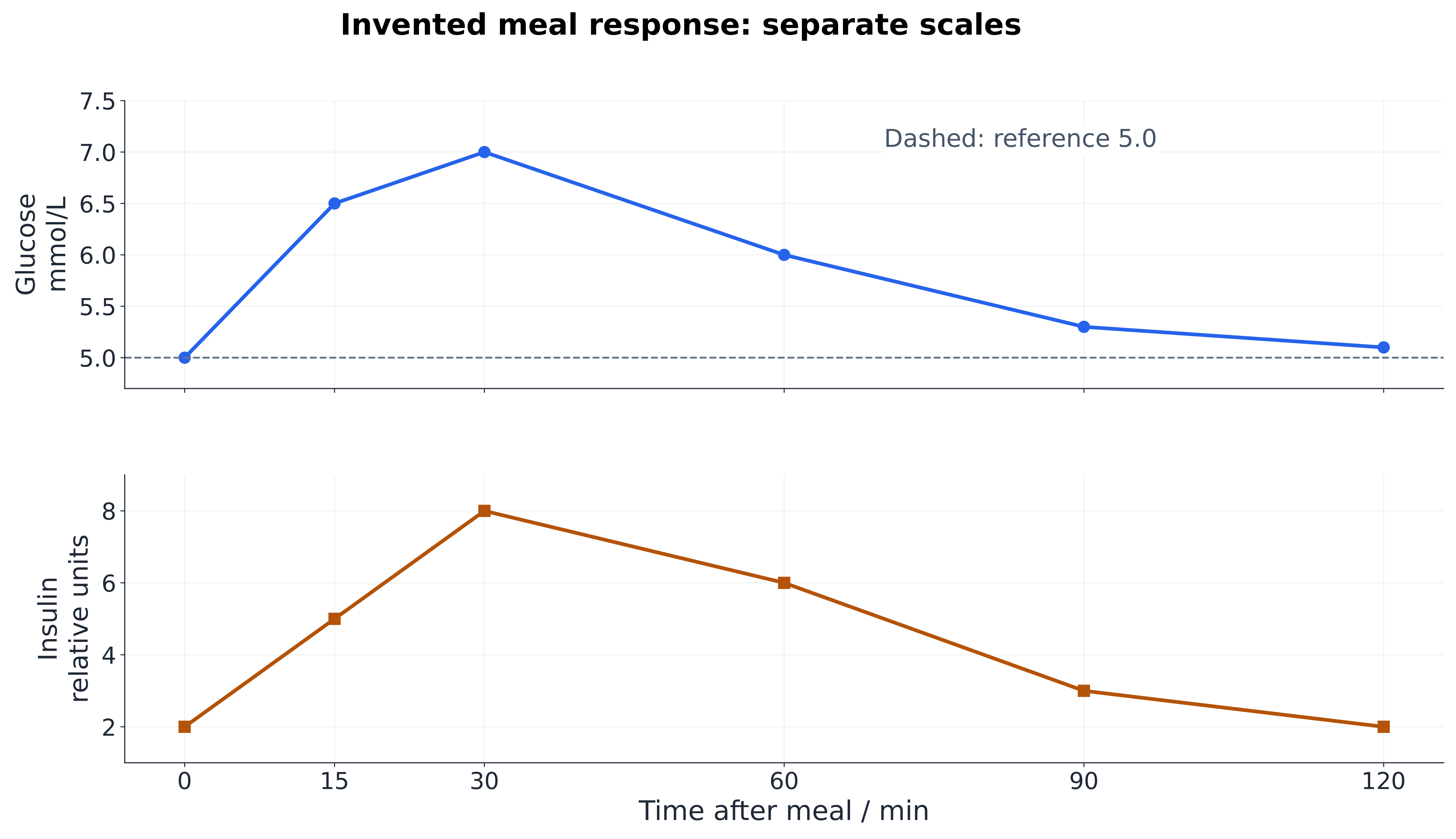
Consider this model record after a meal at time zero. Insulin is given in relative units; those numbers cannot be compared directly with mmol/L as though both measured the same substance.
| Time / min | Glucose / mmol/L | Insulin / relative unit |
|---|---|---|
| 0 | 5.0 | 2 |
| 15 | 6.5 | 5 |
| 30 | 7.0 | 8 |
| 60 | 6.0 | 6 |
| 90 | 5.3 | 3 |
| 120 | 5.1 | 2 |
Relative to the model 5.0 mmol/L reference, the peak change is $7.0-5.0=2.0$ mmol/L. Percentage deviation uses the reference as denominator: $(2.0/5.0)\times100=40\%$. From the peak to 120 minutes, the fall is $7.0-5.1=1.9$ mmol/L, or about 27.1% of the peak. These percentages differ because they answer different questions.
The largest observed value occurs at 30 minutes. The true peak might occur between observations, so report sampling interval and measurement uncertainty. A glucose-only trace does not directly measure insulin. Even with both traces, meal absorption, activity and other hormones can also influence the pattern. Manipulating one factor under controlled conditions supplies stronger causal evidence than timing alone.
For supplied or approved observational data, standardize timing, meal description, activity and measurement method. Independent participants provide biological replication; repeated readings from one participant do not become several independent people. Analyse supplied records rather than performing unapproved blood sampling or provoking abnormal glucose values.

In type 1 diabetes, immune-mediated destruction of pancreatic beta cells usually causes severe insulin deficiency. Inherited susceptibility and environmental influences contribute; eating sugar is not the simple cause. It can begin at any age. Management usually requires replacement insulin, monitoring and planned nutrition/activity. Lifestyle management supports health but does not replace missing insulin. General lifestyle measures do not reliably prevent the autoimmune disease; specific therapies can delay onset in some selected high-risk people. NIDDK overview of type 1 diabetes.
In type 2 diabetes, insulin resistance and inadequate beta-cell compensation cause persistently raised glucose. Insulin may initially be present at high concentrations, while secretion can become insufficient relative to need. Family history, age, inactivity and excess body fat can increase risk; no single characteristic determines an individual's outcome. Appropriate activity, nutrition and weight management can reduce risk or delay onset in susceptible groups. Treatment can include medicines and sometimes insulin; “type 2 never needs insulin” is false. NIDDK overview of type 2 diabetes.
Both types can cause long-term damage when glucose regulation is poor. Similar high-glucose readings do not establish the same underlying mechanism. A classroom graph cannot diagnose a person, and age alone cannot distinguish the types. Explain the physiological difference before linking a management method to the problem it addresses.
Peripheral thermoreceptors in skin detect environmental and skin-temperature changes. Temperature-sensitive regions associated with the hypothalamus also respond to internal conditions. The hypothalamus coordinates neural and endocrine responses with information about temperature, rather than measuring the outside air alone.
Rapid neural pathways can alter sweating, skin-vessel diameter and skeletal-muscle activity. An endocrine pathway can change metabolic heat production over a longer timescale: hypothalamic signals regulate anterior-pituitary TSH secretion, TSH acts on the thyroid gland, and thyroid hormones including thyroxin influence metabolism. Thyroxin is secreted by the thyroid, not by the pituitary. It is not the immediate motor signal for every shiver or drop of sweat.
Effectors include sweat glands, smooth muscle in skin arterioles, skeletal muscle and adipose tissue. Their actions change heat production or exchange. Birds and mammals use physiological and behavioural regulation, but the detailed mechanisms here concern humans. Regulation is not perfect independence from the environment: capacity, water supply, clothing, humidity and activity constrain outcomes.
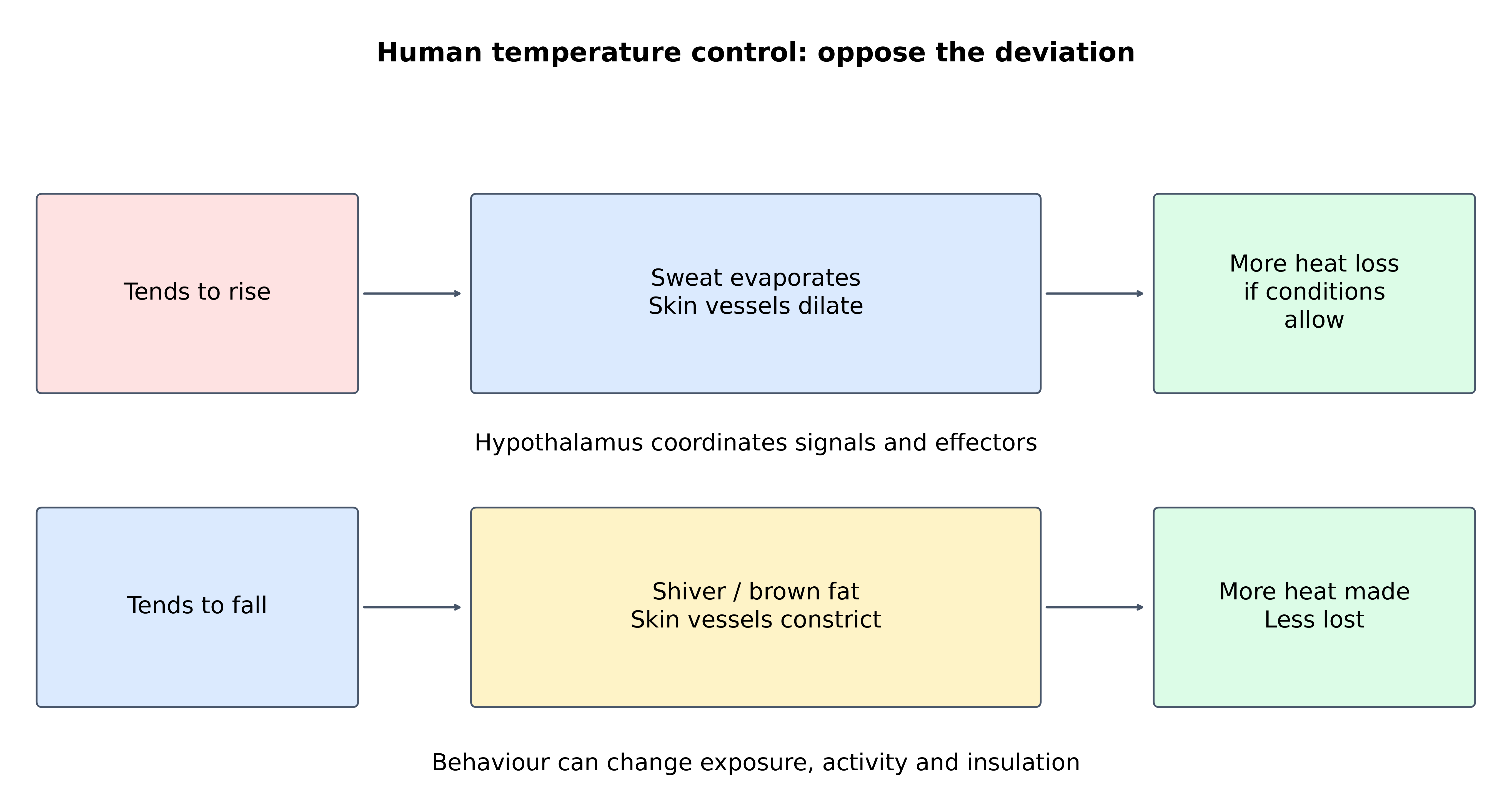
When core temperature tends to rise, vasodilation increases skin blood flow and can increase heat transfer to the surroundings. When it tends to fall, vasoconstriction reduces skin blood flow and conserves heat near the core. The vessels change diameter; capillaries do not move physically nearer to or farther from the skin surface.
Sweat can remove energy when it evaporates from the skin. Water that merely drips away has not provided the same evaporative cooling at that surface. High humidity limits evaporation by reducing the water-vapour gradient. Increased skin blood flow supports heat loss when conditions favour outward transfer; if surroundings are hotter than skin, dry heat exchange can instead bring energy into the body.
Shivering is involuntary repeated skeletal-muscle contraction. Increased metabolism generates heat; it is not purposeful movement to another location. Brown adipose tissue can generate heat through uncoupled respiration. A mitochondrial inner-membrane pathway permits proton return without using ATP synthase, so more of the released energy appears as heat rather than captured ATP. This does not mean respiration has stopped. Brown fat is important in infants and can also be active in adults.
Hair erection uses small muscles attached to follicles. In a furred mammal, raised hairs help trap an insulating air layer. Sparse human body hair makes this a relatively limited insulation mechanism; goosebumps do not equal the thick coat of another mammal.
Seeking shade, reducing exertion or changing clothing can limit heat gain; adding insulation, moving to shelter or changing posture can conserve heat. Behaviour and physiology are complementary. Negative feedback reduces the corrective response as temperature approaches a suitable range; it does not require all effectors to switch fully on or off together.

A positive heat balance means internal thermal energy is increasing. In a short interval, heat generation is 160 J/s and heat loss is 120 J/s, giving net retention of $160-120=40$ J/s. If those rates stay constant for 10 minutes, energy retained is $40\times600=24\,000$ J, or 24 kJ.
This calculation alone does not give a temperature increase: body mass, effective heat capacity and changes in the exchange rates would also matter. A steady temperature can occur when heat production equals heat loss, even with large flows in both directions.
For a temperature record, state measurement site, device, timing, surrounding conditions and activity. Three repeat values 36.8, 37.0 and 37.2 degrees Celsius have mean 37.0, but repeated readings from one person are not independent participants. A skin reading can change without the same change in core temperature. Avoid treating every recorded difference as a biological effect without considering instrument resolution and method.
Name variable, detector, signal, target and opposing response. State the percentage reference; distinguish hormone/enzyme, skin/core and heat/temperature.
What went wrong? Only the site team sees this.
Loading subjects…