A brighter lamp does not always produce more oxygen from pondweed. Another factor may limit the process when light is already sufficient.
English narration · English + 中文 subtitles burned in
22.1
Scope and prerequisites
A brighter lamp can increase a plant's oxygen output, but only up to a point. Understanding the plateau needs both an energy pathway and a controlled experiment.
This handout covers full common C1.3 content: energy conversion, oxygen production, pigments and chromatography, absorption and action spectra, limiting factors and carbon-dioxide enrichment. Sections marked AHL are for Higher Level only.
AHL adds photosystems, photolysis, cyclic and non-cyclic photophosphorylation, chloroplast compartments and the Calvin cycle.
Prerequisites: membranes, enzyme activity, ATP, oxidation and reduction.
Exam tips: State which rate was measured, keep carbon separate from energy, and name the controlled variable that makes a comparison valid. A plateau alone does not identify the next limiting factor.
22.2
Photosynthesis converts light energy into chemical energy
Photosynthesis 光合作用 uses light energy to build organic compounds from carbon dioxide. In oxygenic photosynthesis, water supplies hydrogen and electrons; oxygen is released as a by-product. Plants, algae and cyanobacteria perform oxygenic photosynthesis. Cyanobacteria do not need chloroplasts: their photosynthetic membranes are inside prokaryotic cells. Some other photosynthetic bacteria use different electron donors and do not release oxygen.
Chloroplasts (the small green discs) inside the cells of an Elodea (pondweed) leaf, seen under a microscopePhotosynthesis takes in carbon dioxide and water and makes glucose and oxygen, using lightThe two stages are linked: the first makes the ATP and reduced NADP that the second spends to turn CO₂ into sugars
Word equation: carbon dioxide + water → glucose + oxygen, using light energy and photosynthetic pigments. A simplified net equation for producing one glucose equivalent is
This balances atoms, but is not a single reaction or a map of atom movements. The oxygen released comes from water, not from splitting carbon dioxide. Carbon dioxide supplies the carbon incorporated into carbohydrate. Light supplies energy; it does not supply carbon atoms. Chlorophyll participates in absorption rather than being consumed as a reactant in this net equation.
Energy becomes stored in the chemical organization of organic compounds. These can support respiration, growth and food webs. Plants also respire, including in illuminated tissues. A gas measurement in light therefore often records a net exchange, after respiratory uptake or release has occurred alongside photosynthesis.
If a leaf produces oxygen photosynthetically at 15 units per hour and uses 3 units per hour in respiration, net oxygen release is 12 units per hour. Conversely, net 12 plus respiratory use 3 gives gross production 15, if the respiration estimate applies under the light conditions. A dark measurement is a useful estimate, but assuming that respiration is identical in darkness and light is a limitation to state.
Separate pigments before interpreting their absorption
Chloroplasts contain several pigments, including chlorophyll a, chlorophyll b and carotenoids. They absorb different ranges of visible wavelengths. Their combined absorption broadens the light that can support photosynthesis. Leaf colour reflects light that is reflected or transmitted as well as what is absorbed; a green leaf does not absorb no green light at all.
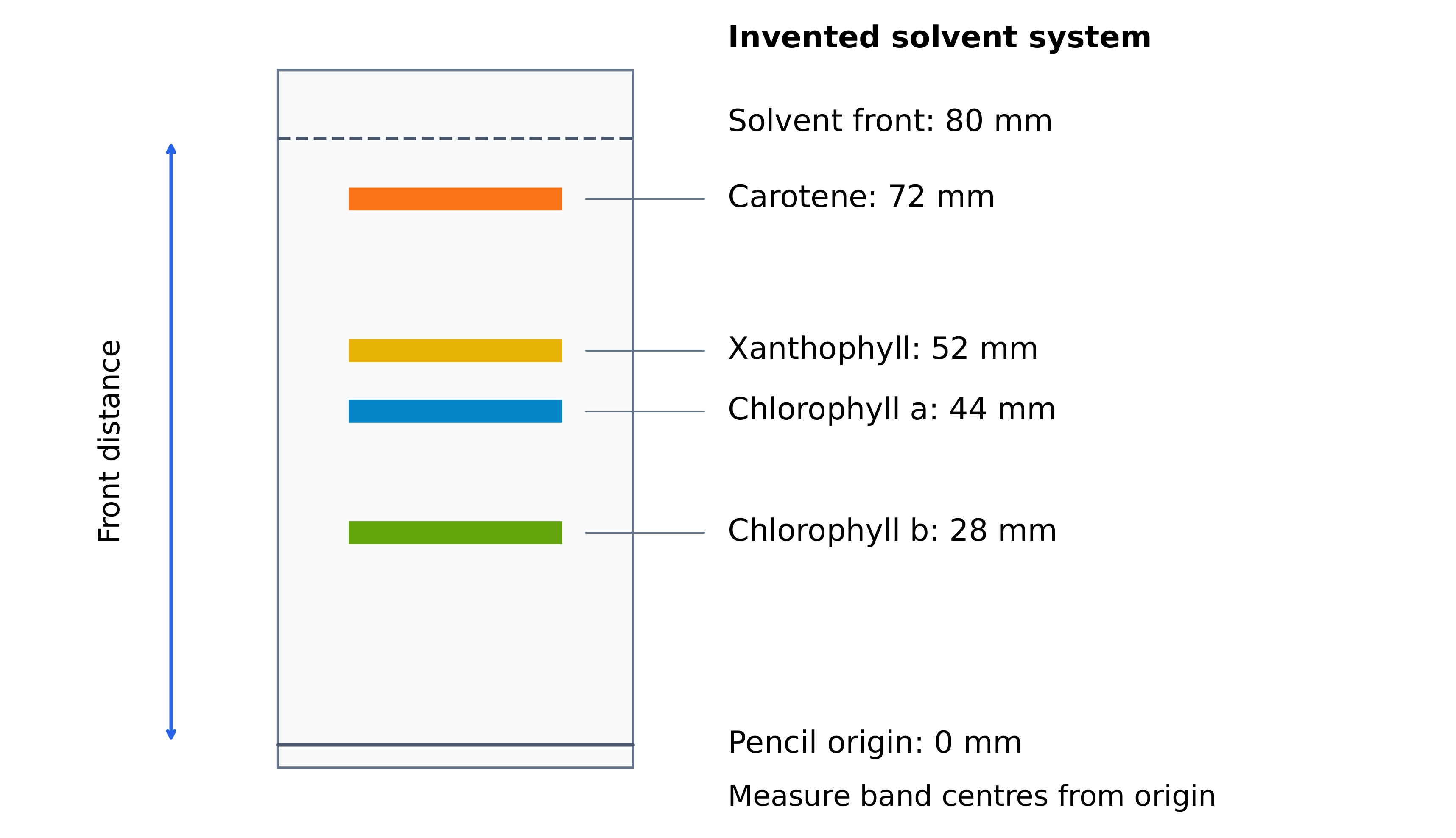
A chromatogram of leaf pigments: carotene, chlorophylls and xanthophylls travel different distancesEach pigment travels its own distance up the paper; its Rf is the spot distance divided by the solvent distance
Chromatography separates an extract because pigments differ in their interactions with a stationary phase and a moving solvent. A pigment that spends relatively more time in the mobile phase travels farther under those conditions. Use an approved extraction solvent, small concentrated spots and a covered chamber under the school safety protocol. Keep the starting spot above the solvent level, or the pigment can dissolve directly into the solvent reservoir.
Draw the origin in pencil. Mark the solvent front promptly after removing the paper or plate; it may become invisible as solvent evaporates. Measure from the origin to the centre of each pigment band, and from the same origin to the solvent front:
$$R_f=\frac{\text{distance travelled by pigment}}{\text{distance travelled by solvent front}}.$$
The ratio has no unit. For a resolved band between origin and front it is between zero and one. The paper's top edge is not automatically the solvent front. A streaked or overlapping band makes its centre uncertain and may need a better separation.
In this example the front travels 80 mm. Orange carotene travels 72 mm, a yellow xanthophyll 52 mm, blue-green chlorophyll a 44 mm, and yellow-green chlorophyll b 28 mm. Their ratios are 0.90, 0.65, 0.55 and 0.35. A separate unknown band travelling 56 mm has $R_f=56/80=0.70$; it does not match any of those four standards exactly.
Compare unknown and reference pigments under the same solvent, stationary phase and other conditions. Colour and a matching ratio support an identification, but two compounds can migrate together. A ratio is not a universal molecular identity or an absorption wavelength. Changing the solvent can change both the ratios and the order of separation.
Separation: compare band centres with the same solvent front. Names and ratios apply to this teaching example, not every solvent system.
22.4
Absorption and action spectra answer different questions
Visible light spans approximately 400–700 nm for this topic. Violet/blue wavelengths are shorter than red wavelengths. A pigment absorbs a photon when the photon can cause an allowed change in electron energy. The electron becomes excited; the nucleus does not absorb light by changing into another element. Different pigments have different patterns of absorption because their molecular structures differ.
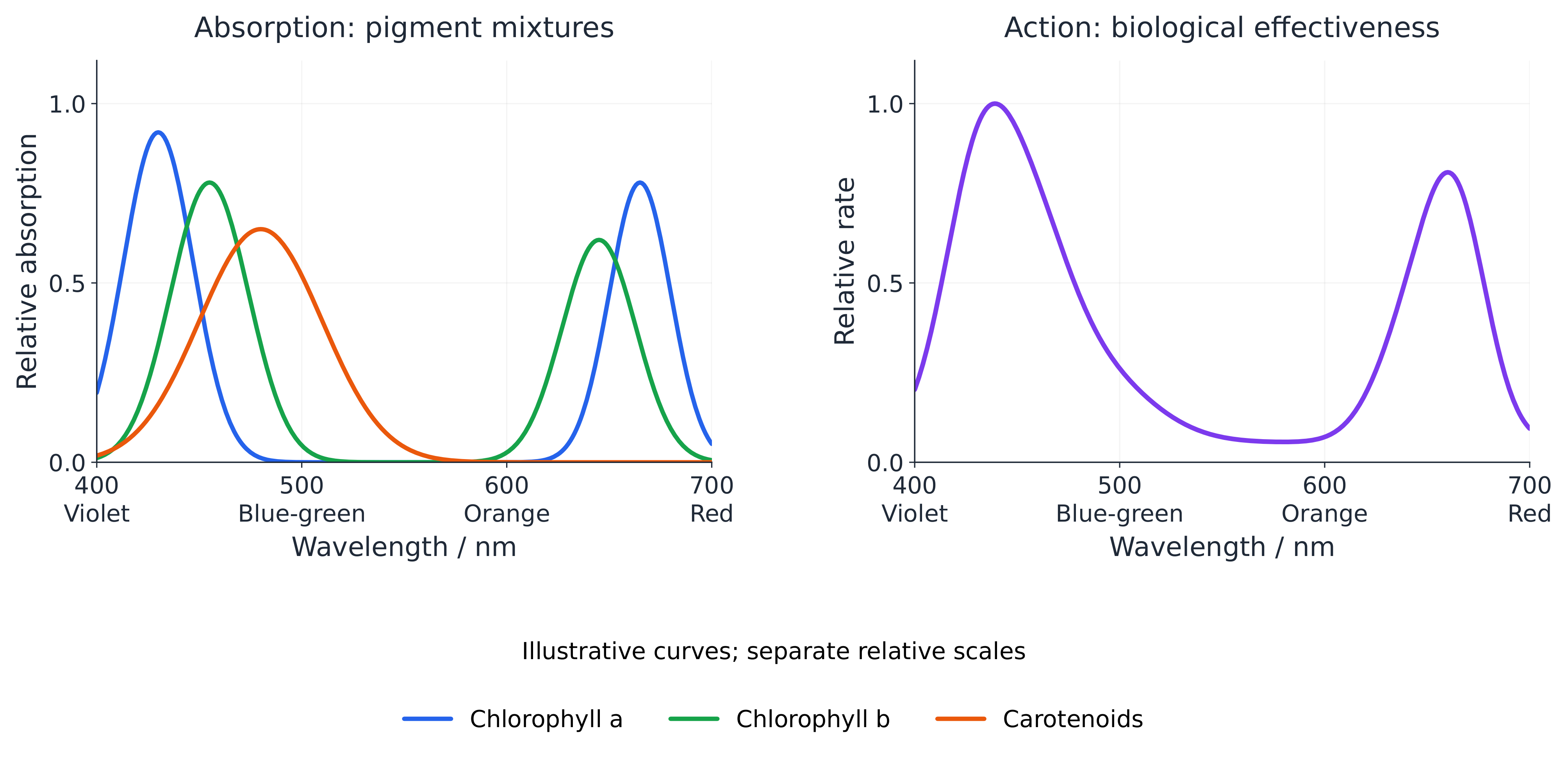
An absorption spectrum plots how strongly a pigment or pigment mixture absorbs light against wavelength. Chlorophylls absorb strongly in parts of the blue and red regions, and less strongly in much of the green region. Carotenoids absorb mainly in the blue/blue-green region. Exact peaks depend on the pigment and measurement conditions; the curves below are deliberately simplified.
An absorption curve concerns absorbed light. An action curve concerns biological rate. Curves have separate relative scales and are not interchangeable measurements.
An action spectrum plots photosynthetic effectiveness or rate against wavelength, for example using oxygen production or carbon-dioxide uptake. Keep photon supply, temperature, carbon-dioxide availability and sample conditions comparable. Equal lamp power does not necessarily mean equal numbers of photons at each wavelength. State whether the measurement is net gas exchange or a gross rate corrected using an explicit assumption.
In a separate test, 450, 550 and 650 nm light each illuminates comparable samples for 2.0 minutes. Supplied oxygen volumes are 4.8, 1.2 and 3.6 cubic centimetres. Rates are 2.4, 0.60 and 1.8 cubic centimetres per minute. Plot wavelength horizontally and rate vertically to make an action spectrum; these three observations alone do not locate an exact peak.
The action spectrum often has relatively high rates in blue and red light, consistent with the absorption of photosynthetic pigments. It is not necessarily identical to the spectrum of purified chlorophyll a. Accessory pigments transfer excitation energy, intact tissues scatter light, and other rate limits can intervene. A green-light rate above zero is compatible with weaker absorption; it does not disprove pigment selectivity.
22.5
A limiting factor restricts the rate under stated conditions
A limiting factor 限制因素 is a factor whose availability or condition restricts rate in the situation tested. At low light, extra photons can increase photosynthesis. At higher light, another constraint can prevent a further increase. Raising light further does not remove insufficient carbon dioxide or a temperature constraint on enzyme-controlled reactions.
Temperature is not simply a material used up. Warming below a suitable range can accelerate enzyme-controlled steps. Excessive heat can impair enzymes, membranes and water balance. There is no single universal optimum for every plant and condition. Carbon dioxide is a substrate; greater supply can increase rate when carbon fixation is constrained by its availability and other requirements are met.
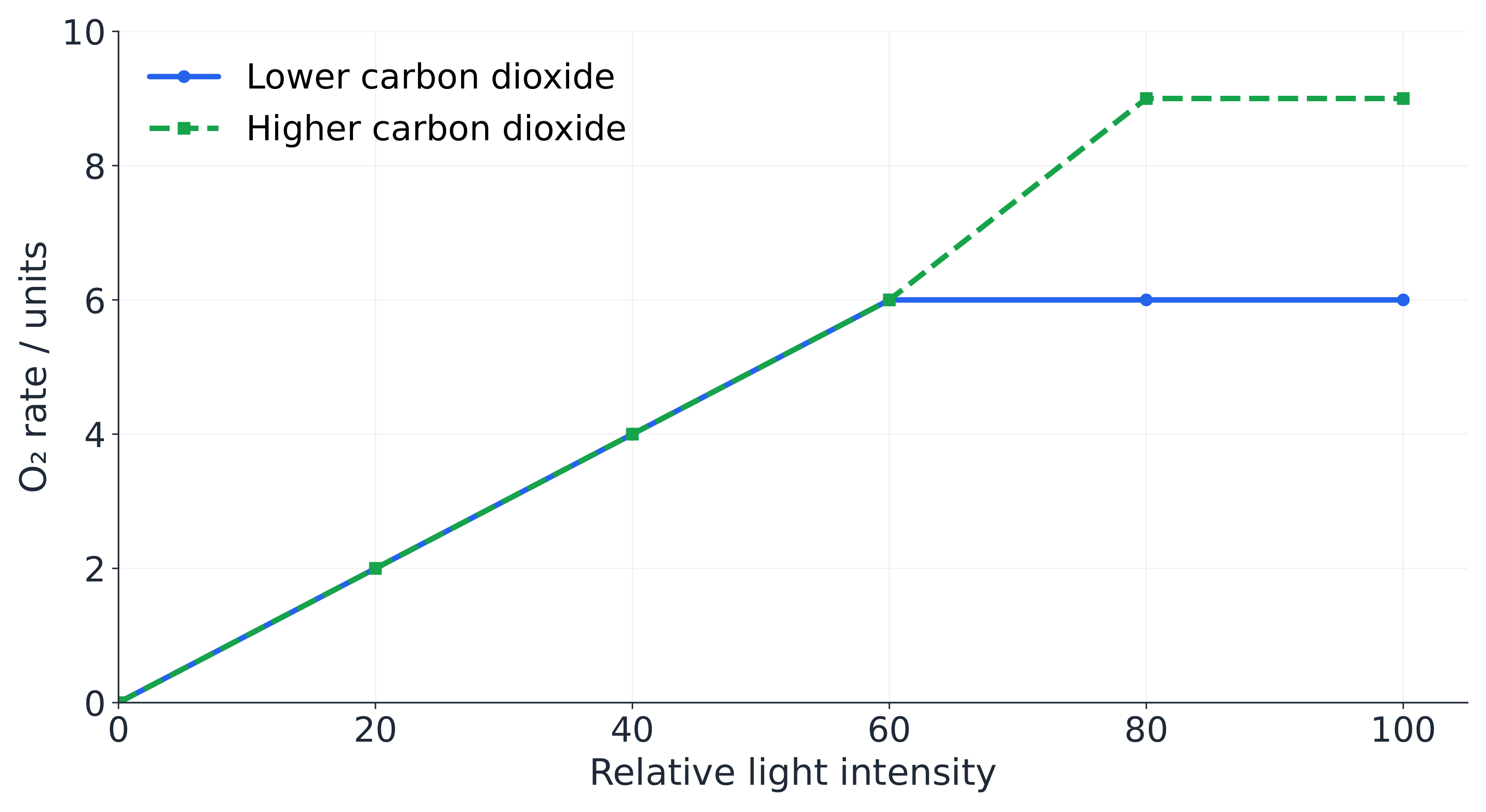
The higher-carbon-dioxide treatment raises the high-light plateau in this experiment. The original plateau alone would not have identified carbon dioxide as the constraint.
Suppose at fixed temperature and carbon dioxide, raising relative light from 20 to 40 raises oxygen release from 2 to 4 units per minute, while raising light from 80 to 100 leaves it at 6. The second comparison shows little response to added light in that interval. It does not establish whether carbon dioxide, temperature, water status or another factor caused the plateau. Increase carbon dioxide in a separate controlled comparison at the same high light to test one candidate explanation.
If rate then rises from 6 to 9 units per minute, the increase is $3/6\times100=50\%$. This supports carbon-dioxide limitation under the original high-light conditions. It does not show that further increases will always help, or that the same factor limits at low light. Several constraints can interact rather than acting as one fixed limit for the whole plant's life.
Explore
A plateau reveals a different limiting factor
When more light no longer increases rate, another factor limits the model.
Measure a rate without introducing a second changing variable
A pondweed investigation can collect gas volume over a fixed time after acclimation. For 7.2 cubic centimetres collected in 4.0 minutes, rate is $7.2/4.0=1.8$ cubic centimetres per minute. Bubble counts are a rough proxy: bubble volumes vary, and dissolved gas need not immediately enter collected bubbles. Gas identity and collection conditions matter if the claim is specifically about oxygen production.
Measure light at the sample, hold temperature with a bath and heat filter, and collect gas volume rather than counting bubbles
Use a suitable light sensor at the sample rather than treating lamp distance as a direct intensity measurement. Moving a lamp also changes heating and sometimes the illuminated area. A controlled water bath, suitable low-heat lighting and temperature measurement help separate these effects. An inverse-square relationship is an approximation for a point source under suitable geometry, not a guaranteed calibration for a nearby extended lamp.
Control species, shoot size or an appropriate mass/area basis, health, temperature, carbon-dioxide supply, acclimation and measurement interval. Changing bicarbonate concentration can change pH as well as dissolved inorganic carbon, so a bicarbonate comparison needs attention to solution chemistry rather than being labelled a pure carbon-dioxide manipulation automatically. Check for leaks and gas-volume changes caused by temperature or pressure.
Use independent biological samples to estimate variation between shoots. Randomizing treatment order or using separate comparable samples helps reduce time/order effects. Repeated readings on one shoot measure repeatability, but do not create independent plants. Report means with a measure of variation and avoid claiming an exact optimum from two temperatures or a causal mechanism from one uncontrolled correlation.
22.7
Carbon-dioxide enrichment must be tested at a useful scale
Greenhouses can enrich carbon dioxide while controlling light, temperature, water and mineral supply. If carbon dioxide limits photosynthesis, enrichment can increase assimilation. That does not guarantee a proportional increase in harvested yield: respiration, allocation, water or nitrogen limitation, heat stress and development also affect the crop.
Free-air carbon-dioxide enrichment, or FACE, releases additional carbon dioxide around plants outdoors. It tests enrichment under a field environment with much less enclosure-induced change to wind, humidity and temperature. Maintaining the target concentration in moving air is difficult, however, and weather still varies. Use replicated treatment and control rings, monitor concentrations and compare comparable crops and management. Plants within one enriched ring share an experimental environment; many sampled leaves in one ring are not many independent enrichment treatments.
A FACE field: replicated enriched and control rings. Each ring, not each leaf, is one replicate.
In data, control rings average 400 g of dry harvested product per square metre and enriched rings average 460 g. The yield increase is $60/400\times100=15\%$. Evaluate ring-to-ring variation and other conditions before attributing the difference to enrichment. A short-term leaf-rate increase alone does not establish whole-season yield, long-term carbon storage, or the response of all species. Predictions are conditional and can be tested rather than treated as guarantees.
22.8
AHL: Photosystems collect excitation energy at reaction centres
Photosystems are membrane-embedded pigment–protein arrangements. They occur in cyanobacterial photosynthetic membranes and, in plants and algae, in chloroplast thylakoid membranes. Antenna pigments absorb photons across a broader range of wavelengths than a single pigment type. Excitation energy is transferred among pigments toward a reaction centre. This is energy transfer through an organized array, not every antenna pigment sending its own electron down the full electron-transport chain.
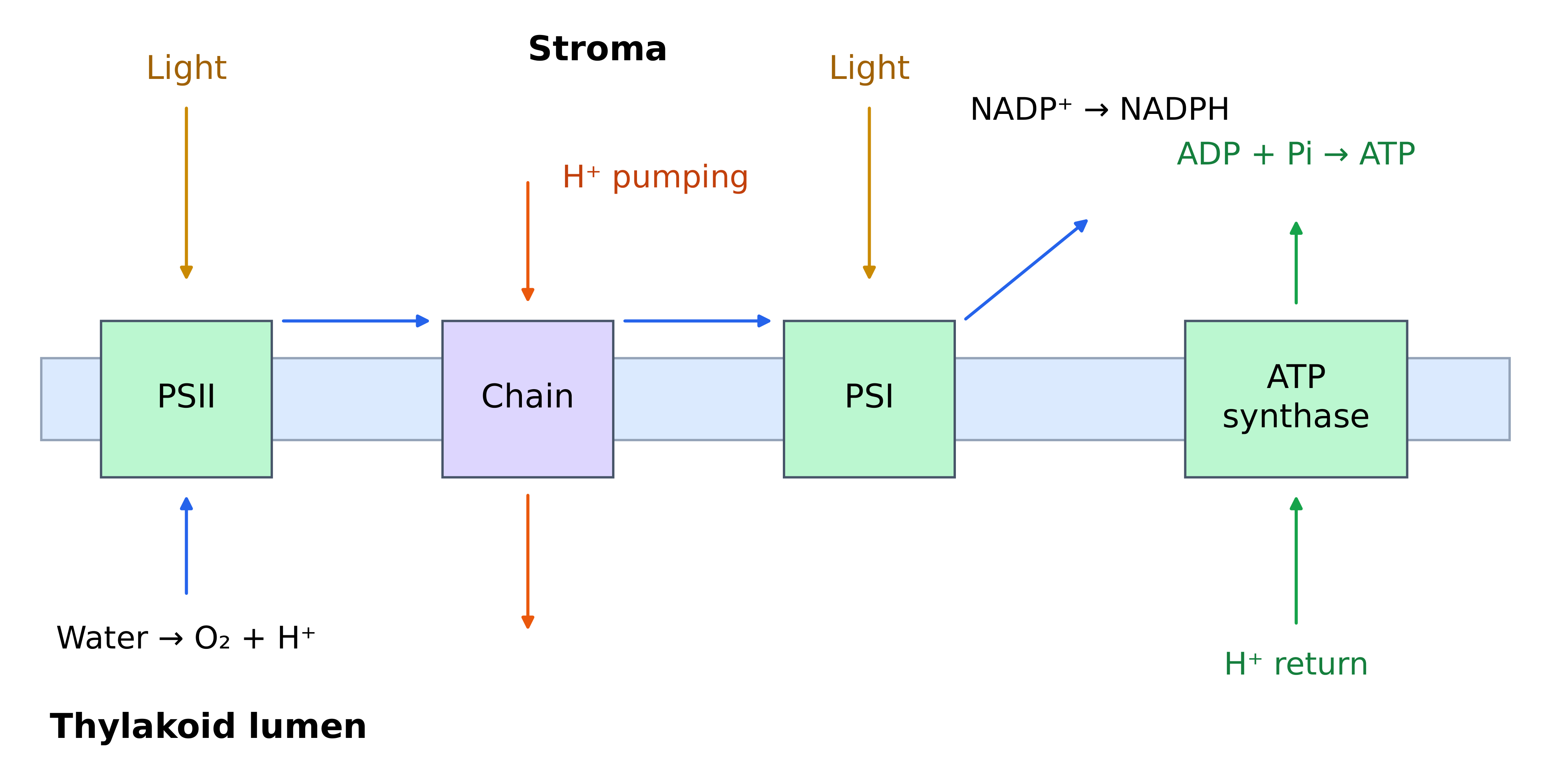
In non-cyclic photophosphorylation, photolysis splits water; electrons flow PSII → PSI, making ATP and reduced NADP
A special chlorophyll at the reaction centre can transfer an excited electron to an acceptor, initiating electron flow. The oxidized reaction centre must gain a replacement electron to continue. The array combines broad light capture with organized charge separation; an isolated pigment can absorb light but does not on its own carry out the coordinated membrane pathway.
In non-cyclic flow, photosystem II acts before photosystem I; their numbers reflect discovery history, not that order of operation. At photosystem II, light-driven water oxidation replaces electrons lost from the reaction centre:
$$2H_2O\rightarrow O_2+4H^++4e^-.$$
This photolysis releases oxygen and contributes protons to the thylakoid lumen. Oxygen is a by-product here; it is not the terminal electron acceptor of this pathway as it is in aerobic respiratory electron transport.
22.9
AHL: Thylakoid membranes couple electron flow to ATP and reduced NADP
Electrons pass from photosystem II through carriers toward photosystem I. Energy transfer through the chain supports movement of protons from the stroma into the lumen. Photosystem I absorbs further light energy, re-exciting electrons. They can then support reduction of NADP on the stromal side:
The light reactions: electrons flow from water to NADPH, and the $\text{H}^+$ gradient they build drives ATP synthase
$$NADP^++2e^-+H^+\rightarrow NADPH.$$
Reduced NADP is NADPH; it carries reducing power for later carbon reactions. It is different from NADH, although both act as electron carriers. Water oxidation replenishes electrons at the start, and NADP accepts them at the end of this non-cyclic route.
Electron flow is from water through photosystems II and I toward NADP. Proton return through ATP synthase is from lumen to stroma, opposite to pumping.
The membrane limits uncontrolled proton flow. Both proton concentration and electrical differences contribute to the electrochemical gradient. Protons returning from the lumen to the stroma through ATP synthase support ATP production from ADP and inorganic phosphate on the stromal side. This is chemiosmosis. ATP synthesis driven by light-supported electron flow is photophosphorylation.
Thylakoid membranes provide extensive area for photosystems, carriers and ATP synthase. The small enclosed lumen allows a proton gradient to develop. The surrounding stroma contains enzymes for carbon fixation. Chloroplast envelope membranes surround the organelle but are not the photosystem-bearing thylakoid membrane; distinguish these boundaries in a diagram.
In cyclic photophosphorylation, electrons excited at photosystem I return through carriers instead of producing a net reduction of NADP. Their flow can support proton translocation and ATP production. This route involves photosystem I, produces no net NADPH, and does not split water or release oxygen as part of that cyclic route. Non-cyclic flow uses both photosystems and supplies ATP and NADPH while releasing oxygen. Cyclic flow helps adjust ATP supply relative to reducing power; it does not replace the need for carbon dioxide.
22.10
AHL: The Calvin cycle fixes carbon and regenerates its acceptor
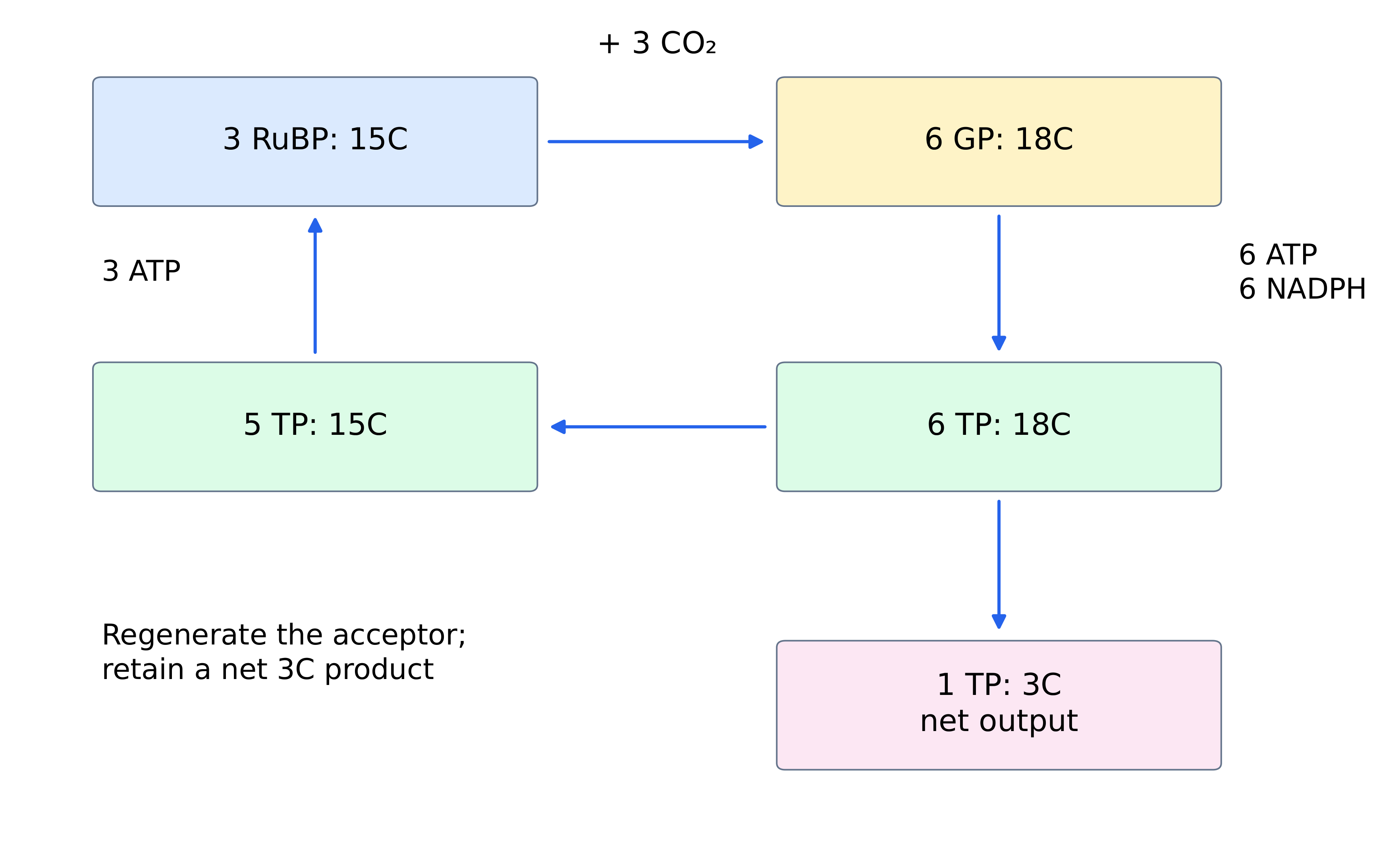
In the stroma, Rubisco catalyses fixation of carbon dioxide by ribulose bisphosphate, RuBP, a five-carbon acceptor. The unstable six-carbon product forms two molecules of glycerate 3-phosphate, GP, each with three carbons. This is carboxylation, not the production of a complete glucose molecule from a single carbon-dioxide molecule.
Fixation adds CO₂ to RuBP; reduction uses ATP and reduced NADP to make TP; regeneration uses ATP to remake RuBP. Only 1 TP in every 6 leaves the cycle
ATP and reduced NADP support conversion of GP into triose phosphate, TP. ATP supplies energy and phosphate-transfer capacity; NADPH supplies reducing power and becomes oxidized NADP. Most TP is used to regenerate RuBP, requiring further ATP. Some TP can leave the cycle for synthesis of other compounds. An enzyme catalyses a reaction rather than being consumed in the carbon ledger.
Three incoming carbon atoms permit a net three-carbon TP output while the original 15-carbon acceptor pool is regenerated. The 15 recycled carbons are not a new net input.
Follow three carbon-dioxide molecules. Three RuBP contain 15 carbons; adding three more produces six GP containing 18 carbons in total. Conversion forms six TP, also containing 18 carbons. Five TP, containing 15 carbons, regenerate three RuBP. One TP, containing three carbons, is the net output. Thus five-sixths of the TP molecules are used for regeneration in this model. This does not mean five-sixths of the newly fixed carbon dioxide is simply wasted or released.
For one net TP, reduction of six GP uses six ATP and six NADPH; regeneration uses three further ATP. The total is nine ATP and six NADPH per three carbon dioxide fixed. Two net TP supply a six-carbon carbohydrate equivalent, requiring six carbon dioxide, 18 ATP and 12 NADPH in this standard accounting. The cycle does not directly deliver a whole glucose at each turn.
TP-derived carbon can enter glucose, sucrose, starch, cellulose, lipid and amino-acid synthesis. Additional pathways and raw materials are needed: amino acids require a nitrogen source, while other compounds require minerals such as phosphorus or magnesium. Fixing carbon cannot create these elements. Rubisco is commonly described as the most abundant enzyme on Earth. High stromal concentrations help support carbon fixation despite relatively slow catalytic turnover and poor performance at low carbon-dioxide concentrations; enzyme presence alone does not guarantee a high rate when substrates or energy carriers are limited. Its global abundance has been investigated using biomass and leaf-protein estimates (Bar-On and Milo, 2019).
22.11
AHL: Light reactions and carbon reactions depend on each other
Light-dependent reactions provide ATP and reduced NADP. The Calvin cycle uses them and returns ADP, inorganic phosphate and oxidized NADP. Without enough light, ATP and NADPH supply falls, restricting GP reduction and RuBP regeneration. Calling carbon reactions “light-independent” means they do not directly absorb photons; it does not mean they can operate indefinitely in darkness without the products of light reactions.
The light reactions make ATP and NADPH; the Calvin cycle spends them to fix $\text{CO}_2$ into sugar
If carbon dioxide becomes scarce while light remains high, carboxylation and downstream carbon processing are restricted. Use of NADPH decreases, reducing regeneration of NADP as an electron acceptor. Non-cyclic electron flow can then be constrained too. These responses involve transient pools and regulatory/alternative pathways; they do not imply that all photon absorption instantly stops or that the chloroplast is immediately destroyed. This interdependence explains why light alone cannot overcome all carbon-dioxide limitation.
22.12
Practice
Attempt each question before using the worked answers.
A student says the oxygen released by a leaf is removed from carbon dioxide, and that light supplies the carbon in sugar. Correct both claims and name three groups that carry out oxygenic photosynthesis.
A chromatogram's front moves 90 mm. Bands move 81, 54 and 36 mm from the same origin. Calculate their ratios and explain why measuring to the paper's top would be unreliable.
An unknown has the same colour and ratio as a reference pigment. Give one condition needed for a fair comparison and one reason identification is still provisional.
Distinguish absorption and action spectra. At 450, 550 and 650 nm, oxygen volumes in 3.0 minutes are 6.0, 1.5 and 4.5 cubic centimetres. Calculate rates and plot an action spectrum. Explain why it need not equal purified chlorophyll a's absorption spectrum.
A leaf's net oxygen release is 9 units per hour; estimated respiratory oxygen uptake is 2 units per hour. Estimate gross production and state the assumption.
At fixed temperature and carbon dioxide, photosynthetic rate reaches a plateau as light rises. Explain what the plateau shows, what it does not show, and how to test carbon-dioxide limitation.
Adding carbon dioxide at fixed high light raises a rate from 8 to 10 units per minute. Calculate the percentage increase and explain why unlimited further increases are not implied.
A shoot produces 9.0 cubic centimetres of gas in 5.0 minutes. Calculate rate, give two controls for a light investigation, and explain one weakness of counting bubbles instead.
A student moves a lamp closer and sees a faster gas release. Identify a confounding variable and a way to address it. Explain why ten readings on this one shoot are not ten independent shoots.
Suppose FACE control rings average 500 g dry yield per square metre; enriched rings average 560 g. Calculate the increase and explain why a higher leaf photosynthetic rate does not guarantee the same percentage yield increase.
Compare one advantage and one limitation of FACE with an enclosed greenhouse experiment. Identify the experimental replicate in a trial with four separate enriched rings.
AHL Trace electrons from water to reduced NADP in non-cyclic flow, distinguishing energy transfer in an antenna from reaction-centre electron transfer. Name the direction of ATP-synthase proton flow.
AHL Account for carbon, ATP and reduced NADP when six carbon-dioxide molecules supply two net TP. Explain why regenerating RuBP is necessary and compare cyclic flow with non-cyclic flow.
AHL Light stays high but carbon dioxide supply falls. Explain how restriction of the Calvin cycle can eventually restrict non-cyclic electron flow, and why “light-independent” does not mean independent of light-reaction products.
22.13
Worked answers
Released oxygen comes from water. Carbon dioxide supplies carbon; light supplies energy. Plants, algae and cyanobacteria carry out oxygenic photosynthesis. The net balanced equation alone does not trace every atom's route.
$81/90=0.90$, $54/90=0.60$, $36/90=0.40$. The ratios have no units. The paper top need not be where the solvent front reached, so it can give the wrong denominator.
Use the same solvent and stationary phase under comparable conditions. Distinct compounds can co-migrate; colour and ratio are supporting evidence rather than unique proof of identity.
Absorption measures absorbed light; action measures biological rate/effectiveness. Rates are $6.0/3.0=2.0$, $1.5/3.0=0.50$ and $4.5/3.0=1.5$ cubic centimetres per minute. Plot those rates vertically against 450, 550 and 650 nm horizontally. Accessory pigments, excitation transfer, tissue optics and other limits can make the curves differ; control photon supply.
Gross estimate $9+2=11$ units per hour. This assumes the respiratory uptake estimate applies in the illuminated state and the gas quantities use comparable conditions.
Extra light produces little rate increase over the plateau interval. The graph alone does not identify the other constraint. Raise carbon dioxide at the same high light with other conditions controlled, replicate and measure variation; a rate rise supports the proposed limitation there.
$(10-8)/8\times100=25\%$. Another constraint can limit at a higher carbon-dioxide supply. The response at high light does not establish the response at low light or in a different plant.
$9.0/5.0=1.8$ cubic centimetres per minute. Control temperature and carbon-dioxide supply, with comparable shoot size and acclimation. Bubble volumes vary, so equal counts need not mean equal gas volumes.
Lamp heating can change temperature; use temperature measurement and a controlled bath or suitable lighting. One shoot's repeated readings estimate within-shoot repeatability, not biological variation between independent shoots. Also consider time/order effects.
$(560-500)/500\times100=12\%$. Yield depends on whole-season assimilation, respiration, allocation, water, nutrients and development. A short leaf measurement does not fix the final harvested amount; use variation between independent rings to evaluate the trial.
FACE retains a more realistic outdoor microclimate, but wind and weather make concentration control harder. A greenhouse allows tighter environmental control but the enclosure changes conditions. The independent ring is the treatment replicate; four separate enriched rings give four enriched treatment replicates, not one replicate per leaf.
AHL Antenna pigments transfer excitation energy to a reaction centre. Water oxidation replaces electrons lost at photosystem II; electrons pass through carriers to photosystem I, are re-excited and support NADP reduction to NADPH. Water splitting releases oxygen and lumen protons. Proton translocation builds a gradient; ATP-synthase return is lumen to stroma, supporting ATP formation on the stromal side.
AHL Six carbon dioxide add six carbons to six RuBP (30 carbons), producing 12 GP and then 12 TP (36 carbons). Ten TP regenerate six RuBP (30 carbons), leaving two TP (six carbons) net. The standard cost is 18 ATP and 12 NADPH. Regeneration maintains the carbon acceptor. Cyclic flow uses photosystem I to support ATP without net NADPH or oxygen production; non-cyclic flow uses both photosystems and supplies ATP and NADPH with oxygen release.
AHL Less carbon fixation reduces NADPH use and regeneration of oxidized NADP. Acceptor shortage can restrict non-cyclic flow despite available light. Conversely, low light restricts ATP/NADPH supply to carbon reactions. Existing pools permit transient activity, so neither shortage instantly stops every reaction.