Neurons, synapses and brain systems
Scope and prerequisites
Supported GRE topic 13 (NE.1). Use the overview measurement lesson VI when interpreting research evidence. Existing official questions are traced in bank_review_form.yaml; original tasks below are not ETS items.
Concepts and method
all-or-none principle 全或无定律: Once threshold is reached a neuron fires a complete spike; stronger stimuli raise rate, not spike size. reuptake 再摄取: Reabsorption of neurotransmitter into the presynaptic cell, ending its action.
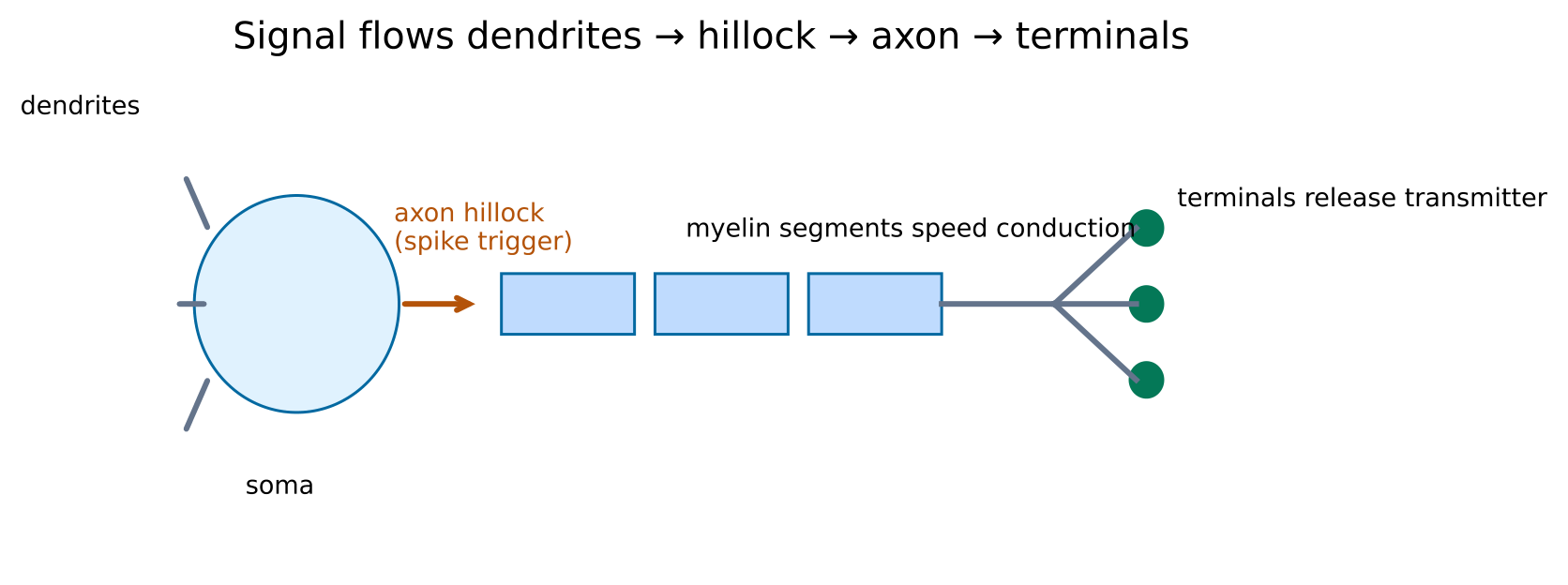
The action potential begins at the axon hillock, where graded inputs sum; once the threshold is reached the neuron fires a complete spike (the all-or-none principle), and during the absolute refractory period it cannot fire again. Stimulus intensity is coded by firing rate and by how many neurons fire, not by spike size. Myelin insulates the axon and speeds conduction by saltatory conduction between the nodes of Ranvier; demyelinating disease slows or blocks conduction.
At the synapse, the arriving spike opens calcium channels, vesicles release neurotransmitter into the cleft, and receptors on the postsynaptic cell convert binding into a new graded potential. Reuptake and enzymatic breakdown clear the transmitter. A drug can be an agonist (mimicking or enhancing a transmitter) or an antagonist (blocking receptors); SSRIs block serotonin reuptake, leaving more in the cleft.
Structure-function anchors: the amygdala supports emotion and fear learning; the hippocampus is needed to form new episodic memories; the hypothalamus regulates drives and homeostasis; the cerebellum coordinates movement; Broca's area supports speech production and Wernicke's area comprehension; the prefrontal cortex supports planning and control. Localisation is real but partial: most behaviours involve distributed networks.
Dopamine illustrates specificity: it supports movement and reward, its loss produces Parkinson's disease, and excessive dopaminergic signalling is linked to positive symptoms of schizophrenia, which many antipsychotics treat by blocking D2 receptors. One transmitter serves many systems, so a drug's behavioural effect depends on the pathway, not the molecule alone.
Graded input can vary in size and combine at the trigger region; a propagated action potential is all-or-none. Stronger input can change firing frequency and recruitment, rather than making every spike taller. At a chemical synapse, arrival opens calcium channels, vesicles release transmitter and receptors alter the receiving cell. An agonist increases a receptor-related action; an antagonist blocks it. Effects depend on receptor and circuit, not just the transmitter's name.
Worked reasoning
A spike is triggered at the axon hillock once summed inputs cross threshold; after firing, the absolute refractory period enforces a pause. Blocking serotonin reuptake raises synaptic serotonin, which is the SSRI mechanism. Loss of dopaminergic neurons impairs movement in Parkinson's disease.
A fictional substance blocks receptors without activating them. Another slows transmitter reuptake. Predict their immediate actions with qualifications.
The receptor blocker acts as an antagonist at the stated receptor. Slower reuptake can prolong or increase transmitter availability in the cleft. Neither description establishes an overall behavioural effect: receptor subtype, feedback and affected pathways matter. Do not infer a drug recommendation.
Independent transfer
A stronger stimulus produces more spikes of unchanged height. A pupil calls this evidence against all-or-none firing. Correct the inference.
Attempt independently, then use the matching skill sheet solution.
Review and source limits
Avoid this error: Describing a stronger stimulus as producing a bigger spike, or naming a single brain centre as the whole basis of a complex behaviour. Teaching scope comes from teaching.yaml and the source/key/crop review in bank_review_form.yaml. Detailed current diagnostic criteria require an authenticated manual; neither historical ETS practice nor this educational reference certifies them.