Skip to content

Q.C · Quantitative comparison and number reasoning

GRE General TestTopic 3

Video lesson for this topic Open the video page
6:29

Quantitative comparison and number reasoning

In 1202 Leonardo of Pisa, later known as Fibonacci, published Liber Abaci ("The Book of Calculation"). He had learnt the Hindu–Arabic numerals as a boy in…

English narration · English and 中文 subtitles you can switch

3.1

GRE Quantitative Comparison and Number Reasoning

In 1202 Leonardo of Pisa, later known as Fibonacci, published Liber Abaci ("The Book of Calculation"). He had learnt the Hindu–Arabic numerals as a boy in North Africa, where his father was a trade official, and his book taught Italian merchants to calculate with them, including zero. In one problem he accepted a negative answer by reading it as a debt. Thinking about every kind of number, including negative ones, fractions and zero, is exactly what GRE Quantitative Comparison demands.

On the shorter GRE General Test, Quantitative Reasoning has 27 questions in two sections, and an on-screen calculator is available. Quantitative Comparison questions ask you to:

  • Compare Quantity A and Quantity B, using every constraint 约束条件 given.
  • Choose from four fixed answers: A greater, B greater, equal, or cannot be determined.
  • Recognise when the relationship is indeterminate 不能确定的.
  • Use arithmetic, powers, ratios and divisibility to simplify.
Vocabulary Train
English
constraint/kənˈstreɪnt/
indeterminate/ˌɪndɪˈtɜːmɪnət/
3.2

The four answers

  • (A) Quantity A is always greater; (B) Quantity B is always greater; (C) they are always equal; (D) the relationship cannot be determined.
  • "Always" means for every value the conditions allow.
  • If you find one case where A is greater and another where B is greater, the answer is (D).
3.3

Test the allowed values

  • Unless the question says otherwise, a variable can be positive, negative, zero, a fraction or not an integer.
  • Try a few kinds of value: 2, −2, 0, $\tfrac12$, a large number.
  • Examples can prove (D), but a few examples never prove (A), (B) or (C); for those, you need a reason that covers all cases.
3.4

Simplify safely

  • You may add or subtract the same amount from both quantities.
  • You may multiply or divide both by the same positive number.
  • Never divide by a quantity that could be zero or negative without considering those cases.
  • Figures are not necessarily drawn to scale: use the given facts.
Number line with x = 3 to the right of 0 where A is greater and x = -3 to the left where A is smaller, so the relationship cannot be determined
Two allowed values on opposite sides of zero.
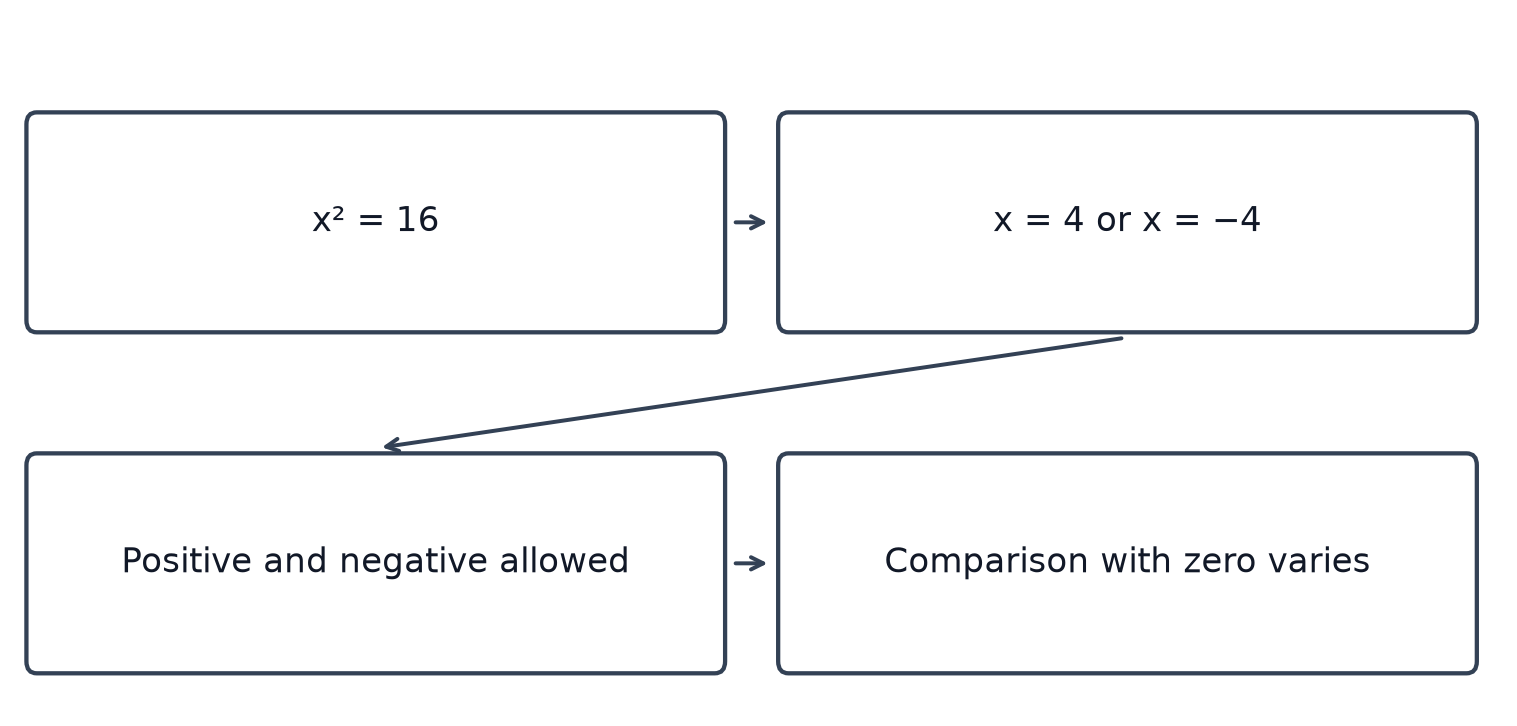
Four linked steps: x² = 16; x = 4 or x = −4; Positive and negative allowed; Comparison with zero varies
x² = 16 allows x = 4 or x = −4, so the comparison with zero is not fixed
3.5

Worked example: powers of a fraction

$0 < x < 1$. Quantity A: $x^2$. Quantity B: $x^3$.

  • Try $x = \tfrac12$: $\tfrac14 > \tfrac18$, so A is greater.
  • Reason for every allowed $x$: $x^2 - x^3 = x^2(1 - x)$. Both factors are positive when $0 < x < 1$, so A is always greater: answer (A).
  • Without the condition, $x = 2$ gives $4 < 8$, so the answer would be (D).
3.6

Worked example: an original application

Quantitative Comparison uses these relationships: A. Quantity A is greater. B. Quantity B is greater. C. Equal. D. Cannot be determined. Given real x with $x^2=16$, compare Quantity A: x, Quantity B: 0. Repeat with the added condition $x>0$.

Model and reasoning

Without the added condition, D: x=4 makes A greater, while x=-4 makes B greater. With $x>0$, A, because only x=4 is permitted. The principal square root of 16 is four, but the equation has both roots. One chosen example cannot prove a relationship over all allowed values.

3.7

Independent transfer

With the same four answer categories, let $a>0$ and $b<0$. Compare Quantity A: $a/b$, Quantity B: $b/a$. Give admissible examples if the relationship can vary, and identify when equality occurs.

Check after attempting

D. For a=2,b=-1, A=-2 and B=-1/2, so B is greater. For $a=1$,b=-2, A=-1/2 and B=-2, so A is greater. For $a=1$,b=-1 they are equal. More generally $a/b=b/a$ means $a^2=b^2$, and the stated opposite signs give a=-b. Multiplying an inequality by the negative product ab reverses direction; ignoring this sign would reverse conclusions.

3.8

Common errors

  • Assuming a variable is a positive integer.
  • Concluding (A), (B) or (C) from one or two examples.
  • Dividing both sides by an expression that could be negative.
  • Trusting a figure's appearance.
  • Writing $\sqrt{16} = \pm 4$ (the root is 4; the equation $x^2 = 16$ has two solutions).
3.9

Key terms

constraint: A condition that limits the allowed values.

indeterminate: Not fixed by the information given.

3.10

Check yourself

  • $x \ne 0$. Quantity A: $x$. Quantity B: $\dfrac1x$. What is the answer?
  • $n$ is a positive integer. Quantity A: $(-1)^{2n}$. Quantity B: 1. What is the answer?
  • Why can examples prove (D) but not (A)?

Answers: (D): $x = 2$ gives A greater; $x = \tfrac12$ gives B greater. (C): an even power of $-1$ is 1. One counterexample shows the relationship varies; "always" needs a reason for every value.

Was this helpful?

Interactive lessons on this topic

Work through it step by step, with instant-check exercises.

More topics in GRE General Test

Log in or create account

IGCSE, A-Level & AP