The energy you cannot see
Press a switch and a room lights. Between the power station and the lamp stands everything in this section: how domestic wiring keeps you safe, how voltage drives current through circuits, and — (P) — how electrons rubbed from one surface to another make charges that attract, repel and sometimes spark.
Edexcel International GCSE Physics 4PH1, Section 2 (statements 2.1–2.28P). Units: ampere (A), coulomb (C), joule (J), ohm (Ω), volt (V), watt (W). P-suffixed statements are the Physics-only extension, assessed on Paper 2P.
Mains electricity
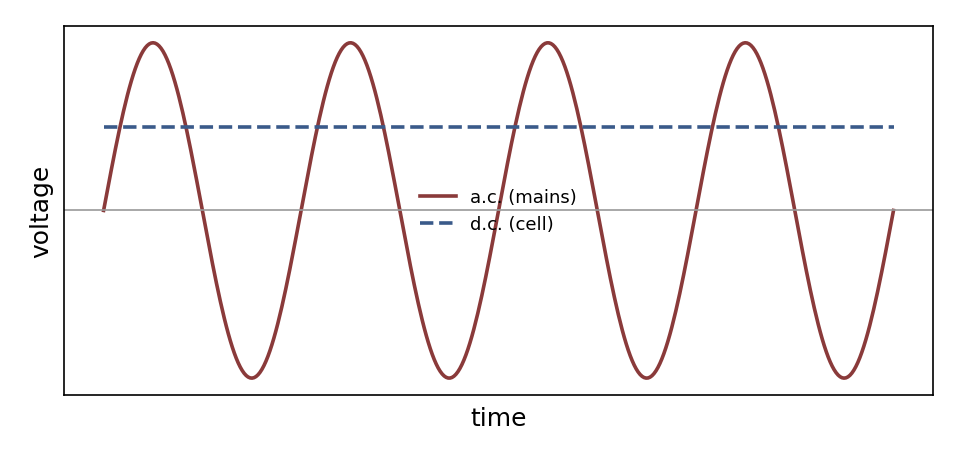
Mains electricity is alternating current (a.c.) 交流电 — direction reverses many times a second; a cell gives direct current (d.c.) 直流电 — one direction only.
Safety: insulation on wires; double insulation (plastic casing, no earth needed); earthing 接地 (a low-resistance path so a fault current blows the fuse); fuses 保险丝 and circuit breakers 断路器 (melt or trip on excess current, protecting wiring and people). Current in a resistor transfers electrical energy to thermal energy — the point of kettles and heaters, and the reason fuse ratings matter:
Worked check (fuse choice). A 230 V, 1.15 kW heater draws $I = P/V = 1150/230 = 5$ A — fit a 13 A fuse (next standard rating above the current); a 3 A fuse would blow in normal use.
Circuits
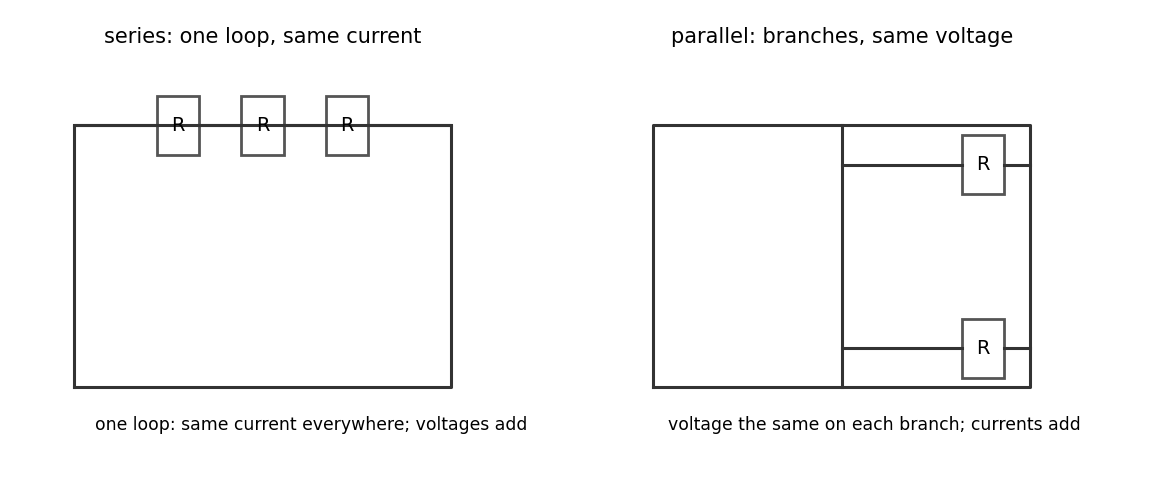
Series 串联 suits chains (switches, ammeters, fairy lights) — the same current everywhere, voltages add, and one failure breaks all. Parallel 并联 suits domestic lighting — each lamp gets the full supply voltage, works independently, and currents add at junctions (charge is conserved at a junction).
Current is a flow of negatively charged electrons in metals. Voltage is the energy transferred per unit charge (1 V = 1 J/C). Two resistors in series: $R = R_1 + R_2$; in parallel the combined resistance is less than either alone.
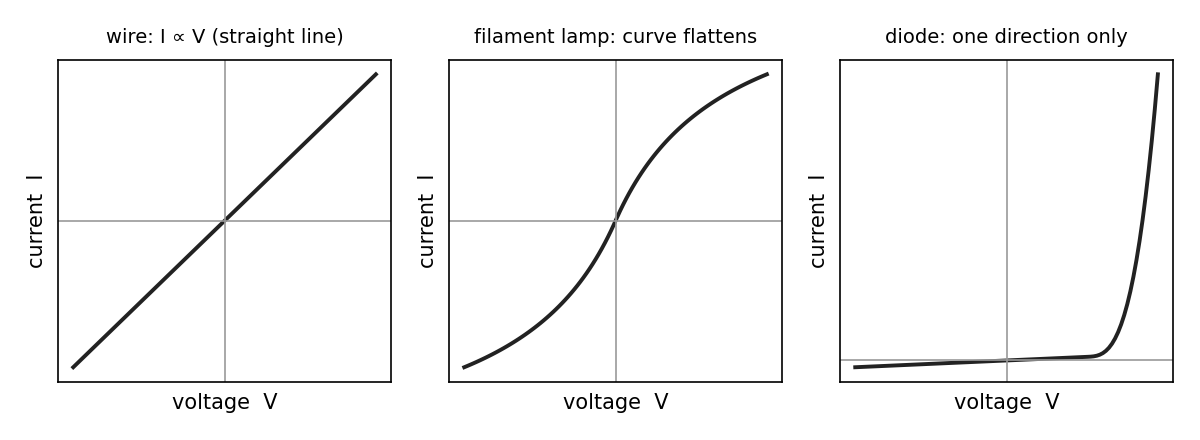
I–V characteristics 伏安特性: a wire gives a straight line through the origin (constant resistance); a filament lamp curves as heating raises its resistance; a diode conducts in one direction only. LDRs: resistance falls as light rises. Thermistors: resistance falls as temperature rises (or rises as it cools — used in temperature sensors). Lamps and LEDs indicate current.
Worked check. Two resistors, 4 Ω and 6 Ω, in series across 10 V: total 10 Ω, $I = 10/10 = 1$ A; voltages 4 V and 6 V. In parallel across 10 V: each branch draws 10/4 = 2.5 A and 10/6 ≈ 1.67 A — total ≈ 4.17 A, equivalent resistance ≈ 2.4 Ω (less than either).
Electric charge (P)
Conductors (metals) let charge flow; insulators (plastics) 绝缘体 do not.
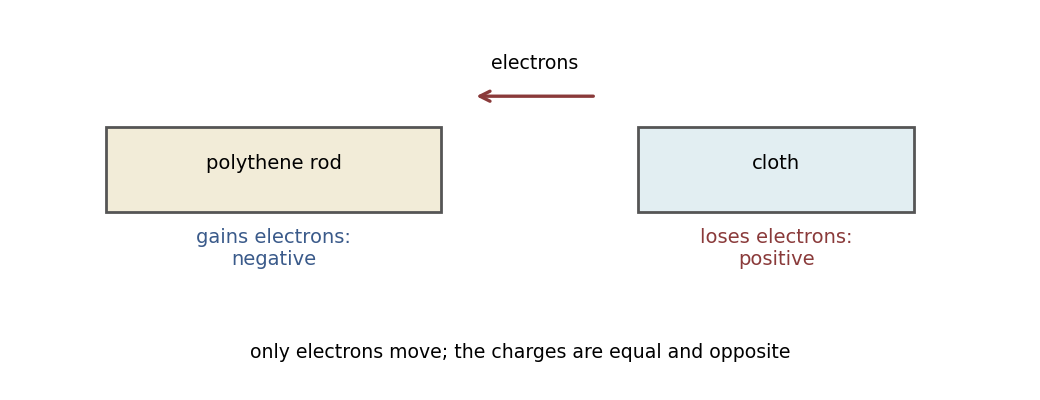
Rubbing an insulator transfers electrons: the loser becomes positive, the gainer negative — never protons moving. Unlike charges attract; like charges repel. A charged rod attracts tiny uncharged paper because it induces charge separation. Dangers: sparks while fuelling aircraft and tankers — earthed bonds drain charge safely. Uses: photocopiers and inkjet printers steer charged toner or droplets.
Check yourself
- State the difference between a.c. and d.c. and give one source of each.
- Explain how earthing and a fuse work together to protect a user.
- A 230 V kettle is rated 2.0 kW. Calculate the current and the best fuse.
- State two reasons domestic lighting is wired in parallel.
- State the I–V shapes for a wire, a filament lamp and a diode.
- What happens to an LDR's resistance in bright light?
- Define voltage in terms of energy and charge.
- Calculate the charge passing when 2 A flows for 30 s.
- (P) Explain how rubbing a polythene rod with a cloth makes it negative.
- (P) Give one danger and one use of electrostatic charge.
Answers: 1 a.c. reverses direction repeatedly — the mains; d.c. flows one way — a cell or battery; 2 the earth wire gives a low-resistance path, so the large fault current flows to earth and melts the fuse, cutting off the supply before a user can touch the live casing; 3 $I = 2000/230 = 8.7$ A — a 13 A fuse; 4 each lamp receives the full mains voltage; one lamp failing leaves the others working (and switches control lamps independently); 5 straight line through the origin; S-shaped curve (gradient falls as it heats); zero until a forward threshold then steep (one direction); 6 it falls; 7 voltage is the energy transferred per unit charge (1 volt = 1 joule per coulomb); 8 $Q = 2 \times 30 = 60$ C; 9 (P) friction transfers electrons from the cloth to the rod — the rod gains electrons and becomes negative, the cloth positive; 10 (P) danger — sparking while fuelling aircraft/tankers; use — photocopier or inkjet printer.