Skip to content
Subjects

Pearson Edexcel · International GCSE · Physics

  • 1

    1 · Forces and motion

    Learning program coming soon

    Handout

    Describing and explaining motion

    Physics begins with movement. This first section builds the toolkit: graphs that describe motion, the equations that link speed, acceleration and distance, the forces that cause every change, and (P) the momentum and moments that explain crumple zones and balanced beams.

    Edexcel International GCSE Physics 4PH1, Section 1 (statements 1.1–1.33P). P-suffixed statements are the separate-science extension, assessed on Paper 2P; units to learn include the newton (N) and, (P), the newton metre and kg m/s.

    Movement and position
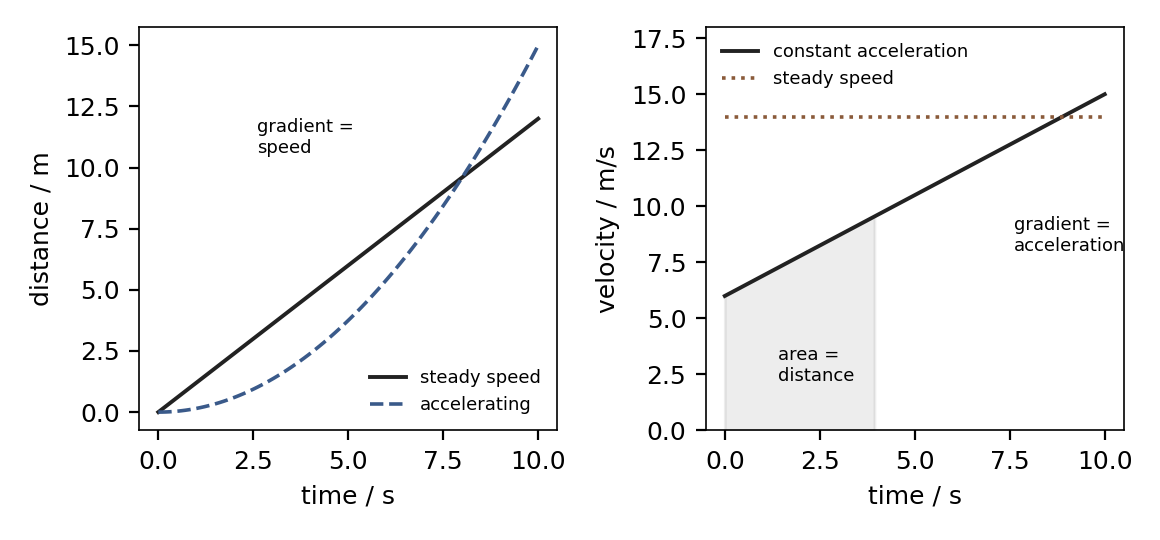
    Distance-time and velocity-time graphs: gradient means speed on one, acceleration on the other; the area under a velocity-time graph is distance.

    Average speed = distance moved ÷ time taken. On a distance–time graph the gradient is the speed: a straight sloping line is steady speed, a curve is acceleration, a flat line is at rest. Acceleration 加速度 is the change of velocity per second:

    $$a = \frac{v - u}{t} \qquad v^2 = u^2 + 2as$$

    On a velocity–time graph the gradient is acceleration and the area between the line and the time axis is the distance travelled.

    Worked check. A car accelerates from 4 m/s to 16 m/s in 6 s: $a = (16 - 4)/6 = 2\ \mathrm{m/s^2}$. Distance covered $= \frac{1}{2}(4 + 16) \times 6 = 60$ m.

    Forces and movement

    Forces change a body's speed, shape or direction. Force is a vector 矢量 (size + direction); scalars like speed have only size. Along a line, forces add: two 5 N pulls against one 8 N pull give a resultant force 合力 of 2 N. Friction 摩擦 opposes motion. The unbalanced force causes acceleration:

    $$F = m \times a \qquad W = m \times g$$

    Worked check. A 1200 kg car with a driving force of 3600 N against 1200 N of drag: $F = 2400$ N; $a = 2400/1200 = 2\ \mathrm{m/s^2}$. Weight at $g = 10$ N/kg: $W = 1200 \times 10 = 12\,000$ N.

    Stopping distance = thinking distance + braking distance. Thinking grows with speed and reaction time (tiredness, alcohol, phones); braking grows with speed squared, mass, weak brakes, poor grip (wet or icy roads, worn tyres).
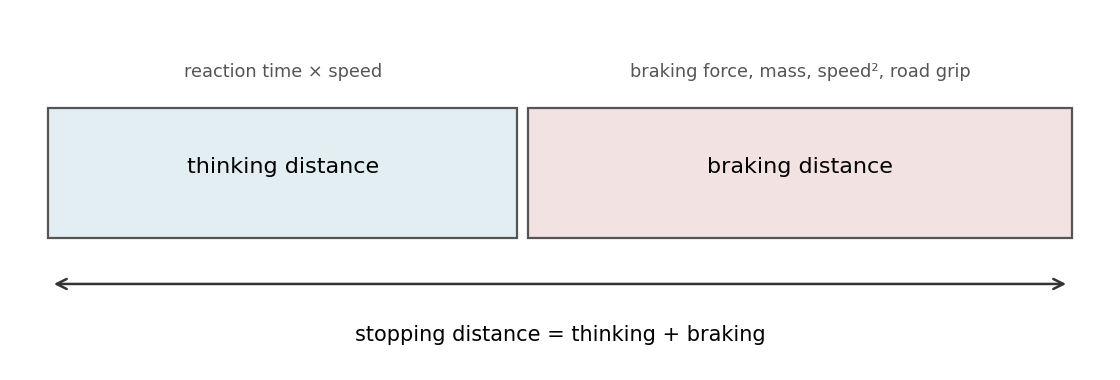
    Stopping distance splits into thinking distance (reaction) and braking distance.

    Falling objects accelerate while weight exceeds drag; as speed rises, drag rises, the resultant falls, until weight = drag — terminal velocity 终末速度.
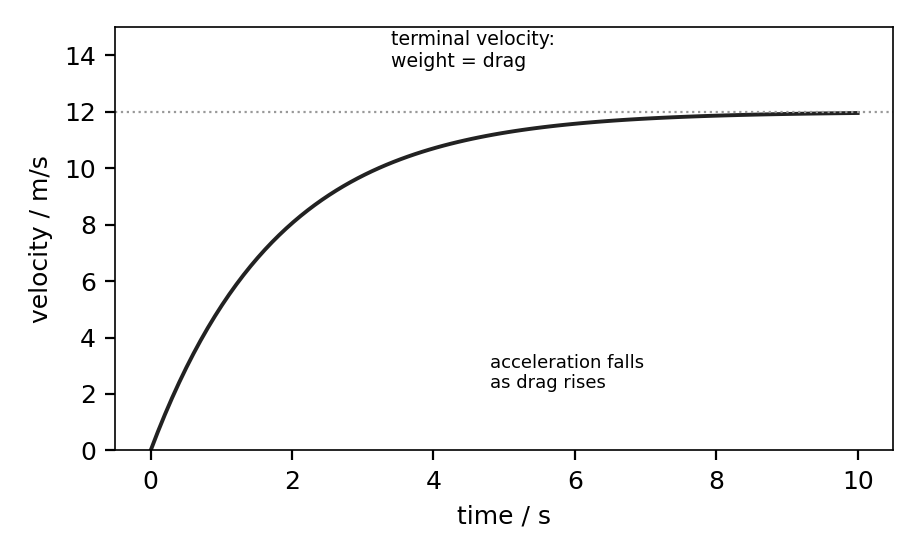
    Velocity against time for a falling object: acceleration falls to zero at terminal velocity.

    Forces and shape

    A spring stretches with load. In the initial linear region, extension is proportional to force — Hooke's law 胡克定律; beyond the limit of proportionality it bends away. Elastic behaviour 弹性 recovers the original shape when the force is removed. Practical: hang masses on a spring (or rubber band), plot force against extension.
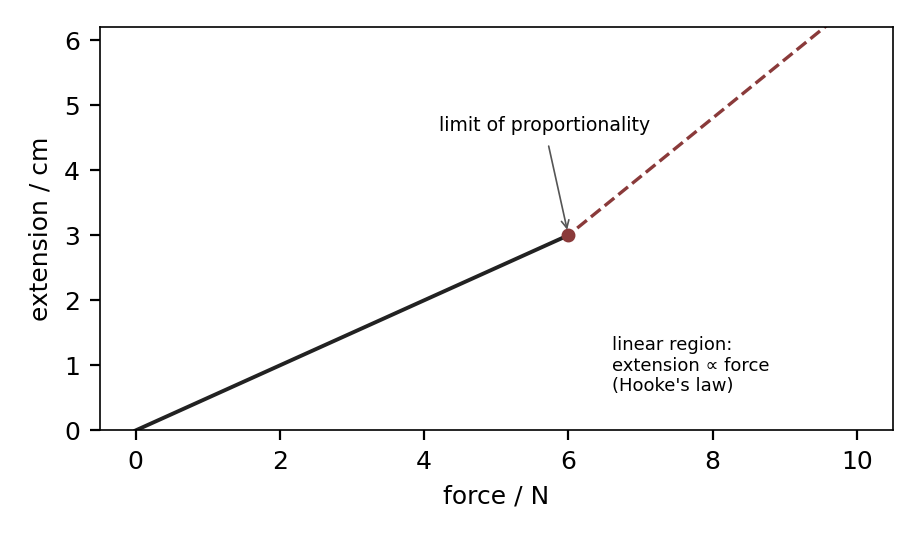
    A force-extension graph: a straight line to the limit of proportionality, then curving.

    Momentum and moments (P)

    $$p = m \times v \qquad F = \frac{mv - mu}{t}$$

    Momentum 动量 (kg m/s) is conserved in collisions: total before = total after. Safety features work by stretching the time of a collision, so for the same momentum change the force is smaller — crumple zones, seat belts, airbags. Newton's third law: to every action there is an equal and opposite reaction.

    Moment 力矩 = force × perpendicular distance from the pivot. A beam balances when clockwise moments = anticlockwise moments; the weight of a body acts through its centre of gravity 重心.
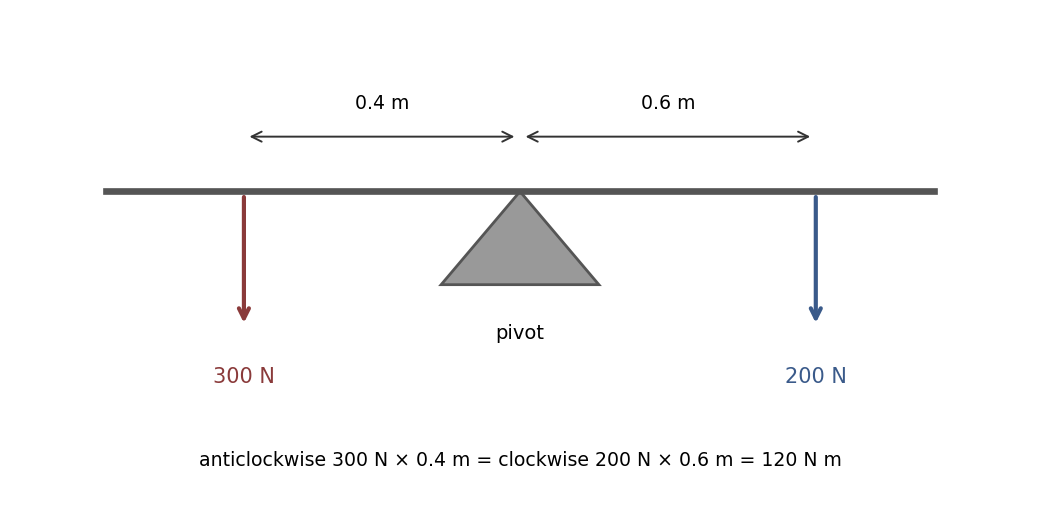
    A loaded beam: moments about each support balance when clockwise equals anticlockwise.

    Worked check. Two children (300 N at 0.4 m, 200 N at 0.6 m from the pivot) on a see-saw: clockwise $200 \times 0.6 = 120$ N m; anticlockwise $300 \times 0.4 = 120$ N m — balanced.

    Check yourself

    1. What does the gradient of a distance-time graph give, and of a velocity-time graph?
    2. A cyclist covers 900 m in 3 minutes. Calculate the average speed in m/s.
    3. Calculate the acceleration from 30 m/s to rest in 5 s.
    4. State the equation linking unbalanced force, mass and acceleration, and its unit.
    5. Name two factors that lengthen the thinking distance and two that lengthen the braking distance.
    6. Explain, in terms of forces, why a skydiver reaches terminal velocity.
    7. State Hooke's law.
    8. (P) A 60 kg runner at 8 m/s: calculate momentum.
    9. (P) Explain how a crumple zone protects passengers.
    10. (P) What is the moment of a 50 N force at 0.3 m from the pivot?

    Answers: 1 speed; acceleration (and the area under the velocity-time line is distance); 2 $900/180 = 5$ m/s; 3 $a = (0 - 30)/5 = -6\ \mathrm{m/s^2}$ (deceleration of 6 m/s²); 4 F = ma, with F in newtons; 5 thinking — higher speed, longer reaction time; braking — higher speed (speed²), mass, poor brakes/tyres, wet or icy roads; 6 drag rises with speed until it equals the weight — resultant and acceleration reach zero, so velocity is constant; 7 extension is proportional to force, up to the limit of proportionality; 8 (P) $p = 60 \times 8 = 480\ \mathrm{kg\,m/s}$; 9 (P) it crumples, lengthening the collision time; force = momentum change ÷ time, so a longer time means a smaller force on the passengers; 10 (P) $50 \times 0.3 = 15$ N m.
    Vocabulary
    English
    acceleration/əkˌseləˈreɪʃn/
    vector/ˈvektə/
    resultant force/rɪˈzʌltənt fɔːs/
    friction/ˈfrɪkʃn/
    terminal velocity/ˈtɜːmɪnl vəˈlɒsɪti/
    elastic behaviour
    Hooke law
    momentum/məʊˈmentəm/
    moment/ˈməʊmənt/
    centre of gravity/ˈsentə ɒv ˈɡrævɪti/
  • 2

    2 · Electricity

    Learning program coming soon

    Handout

    The energy you cannot see

    Press a switch and a room lights. Between the power station and the lamp stands everything in this section: how domestic wiring keeps you safe, how voltage drives current through circuits, and — (P) — how electrons rubbed from one surface to another make charges that attract, repel and sometimes spark.

    Edexcel International GCSE Physics 4PH1, Section 2 (statements 2.1–2.28P). Units: ampere (A), coulomb (C), joule (J), ohm (Ω), volt (V), watt (W). P-suffixed statements are the Physics-only extension, assessed on Paper 2P.

    Mains electricity

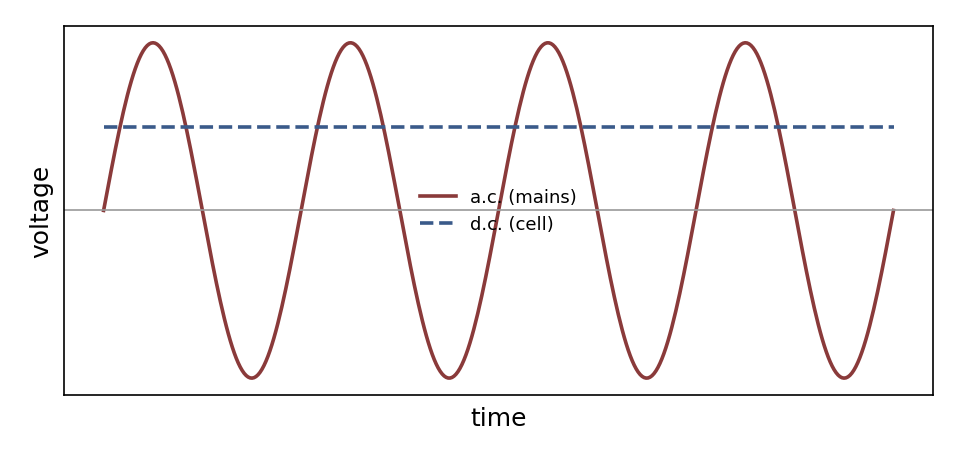
    Mains electricity is alternating current (a.c.) 交流电 — direction reverses many times a second; a cell gives direct current (d.c.) 直流电 — one direction only.

    An a.c. trace oscillates about zero; a d.c. line is flat.

    Safety: insulation on wires; double insulation (plastic casing, no earth needed); earthing 接地 (a low-resistance path so a fault current blows the fuse); fuses 保险丝 and circuit breakers 断路器 (melt or trip on excess current, protecting wiring and people). Current in a resistor transfers electrical energy to thermal energy — the point of kettles and heaters, and the reason fuse ratings matter:

    $$P = I \times V \qquad E = I \times V \times t$$

    Worked check (fuse choice). A 230 V, 1.15 kW heater draws $I = P/V = 1150/230 = 5$ A — fit a 13 A fuse (next standard rating above the current); a 3 A fuse would blow in normal use.

    Circuits

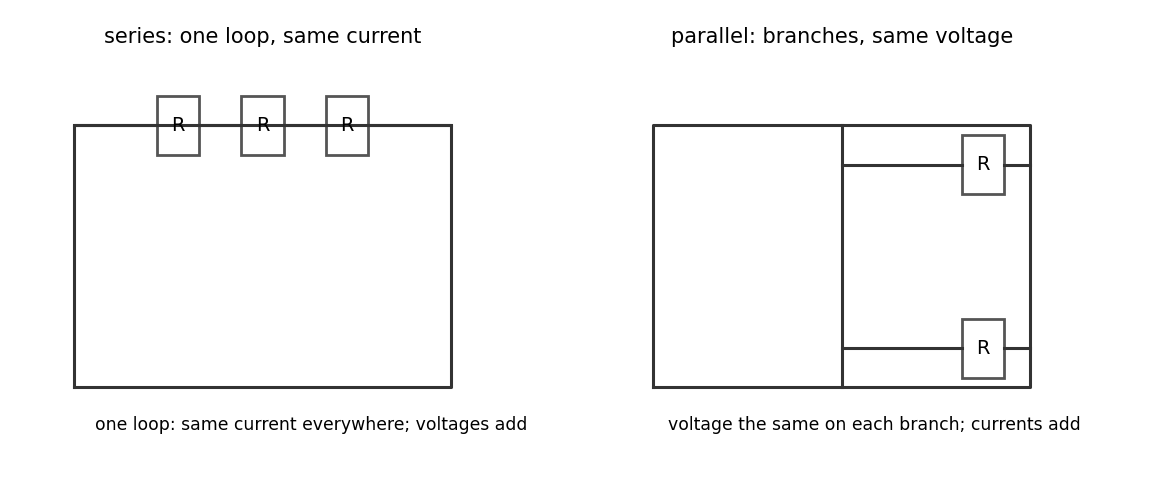
    Series: one loop, same current, voltages add. Parallel: branches share the same voltage, currents add.

    Series 串联 suits chains (switches, ammeters, fairy lights) — the same current everywhere, voltages add, and one failure breaks all. Parallel 并联 suits domestic lighting — each lamp gets the full supply voltage, works independently, and currents add at junctions (charge is conserved at a junction).

    $$V = I \times R \qquad Q = I \times t \qquad E = Q \times V$$

    Current is a flow of negatively charged electrons in metals. Voltage is the energy transferred per unit charge (1 V = 1 J/C). Two resistors in series: $R = R_1 + R_2$; in parallel the combined resistance is less than either alone.

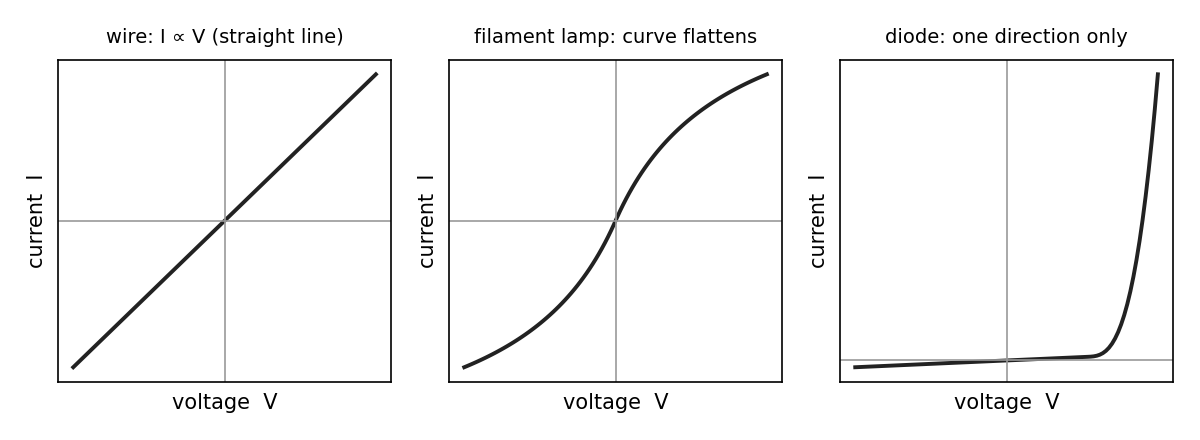
    I–V characteristics 伏安特性: a wire gives a straight line through the origin (constant resistance); a filament lamp curves as heating raises its resistance; a diode conducts in one direction only. LDRs: resistance falls as light rises. Thermistors: resistance falls as temperature rises (or rises as it cools — used in temperature sensors). Lamps and LEDs indicate current.

    I-V curves for a wire, a filament lamp and a diode.

    Worked check. Two resistors, 4 Ω and 6 Ω, in series across 10 V: total 10 Ω, $I = 10/10 = 1$ A; voltages 4 V and 6 V. In parallel across 10 V: each branch draws 10/4 = 2.5 A and 10/6 ≈ 1.67 A — total ≈ 4.17 A, equivalent resistance ≈ 2.4 Ω (less than either).

    Electric charge (P)

    Conductors (metals) let charge flow; insulators (plastics) 绝缘体 do not.

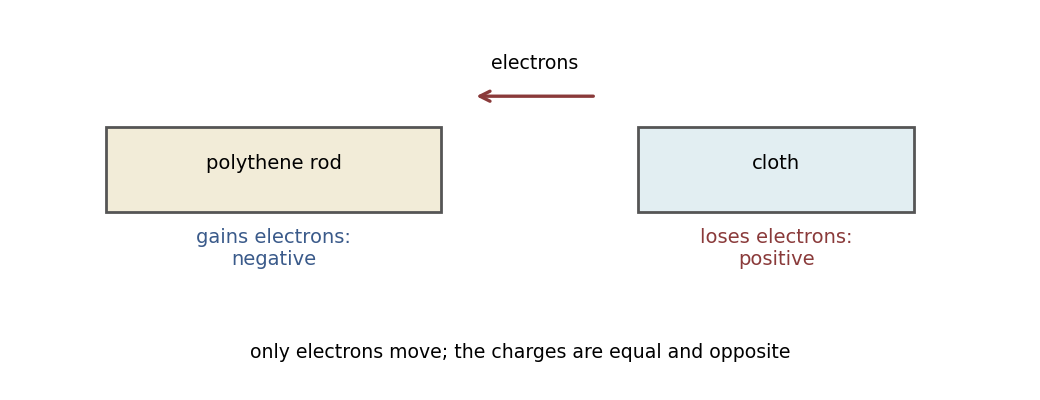
    Rubbing transfers electrons from cloth to rod: the rod becomes negative, the cloth positive.

    Rubbing an insulator transfers electrons: the loser becomes positive, the gainer negative — never protons moving. Unlike charges attract; like charges repel. A charged rod attracts tiny uncharged paper because it induces charge separation. Dangers: sparks while fuelling aircraft and tankers — earthed bonds drain charge safely. Uses: photocopiers and inkjet printers steer charged toner or droplets.

    Check yourself

    1. State the difference between a.c. and d.c. and give one source of each.
    2. Explain how earthing and a fuse work together to protect a user.
    3. A 230 V kettle is rated 2.0 kW. Calculate the current and the best fuse.
    4. State two reasons domestic lighting is wired in parallel.
    5. State the I–V shapes for a wire, a filament lamp and a diode.
    6. What happens to an LDR's resistance in bright light?
    7. Define voltage in terms of energy and charge.
    8. Calculate the charge passing when 2 A flows for 30 s.
    9. (P) Explain how rubbing a polythene rod with a cloth makes it negative.
    10. (P) Give one danger and one use of electrostatic charge.

    Answers: 1 a.c. reverses direction repeatedly — the mains; d.c. flows one way — a cell or battery; 2 the earth wire gives a low-resistance path, so the large fault current flows to earth and melts the fuse, cutting off the supply before a user can touch the live casing; 3 $I = 2000/230 = 8.7$ A — a 13 A fuse; 4 each lamp receives the full mains voltage; one lamp failing leaves the others working (and switches control lamps independently); 5 straight line through the origin; S-shaped curve (gradient falls as it heats); zero until a forward threshold then steep (one direction); 6 it falls; 7 voltage is the energy transferred per unit charge (1 volt = 1 joule per coulomb); 8 $Q = 2 \times 30 = 60$ C; 9 (P) friction transfers electrons from the cloth to the rod — the rod gains electrons and becomes negative, the cloth positive; 10 (P) danger — sparking while fuelling aircraft/tankers; use — photocopier or inkjet printer.

    Vocabulary
    English
    alternating current/ˈɔːltəneɪtɪŋ ˈkʌrənt/
    direct current/daɪˈrekt ˈkʌrənt/
    earthing
    fuse/fjuːz/
    circuit breaker
    series/ˈsɪəriːz/
    parallel/ˈpærəlel/
    I-V characteristics
    insulator/ˈɪnsjuːleɪtə/
  • 3

    3 · Waves

    Learning program coming soon

    Handout

    Waves: energy that travels

    Ripples cross a pond, light crosses a room, sound crosses air — waves carry energy and information without transferring matter. This section gives you their vocabulary and equations, the electromagnetic spectrum with its uses and dangers, and the behaviour of light and (P) sound: reflection, refraction and total internal reflection.

    Edexcel International GCSE Physics 4PH1, Section 3 (statements 3.1–3.29P). Units: degree (°), hertz (Hz), metre (m), m/s, second (s).

    Properties of waves

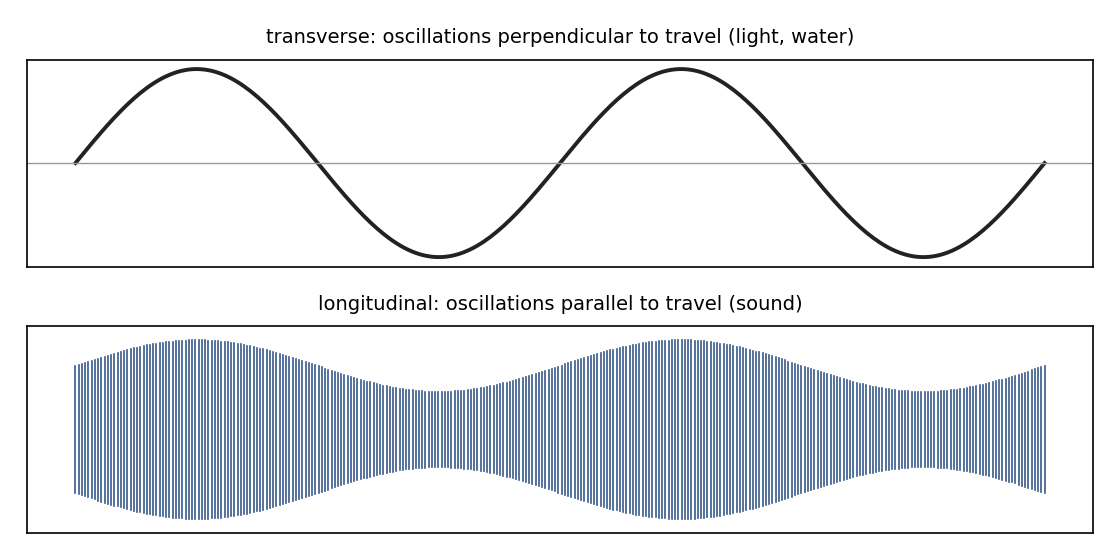
    A transverse wave oscillates across its travel; a longitudinal wave oscillates along it, making compressions.

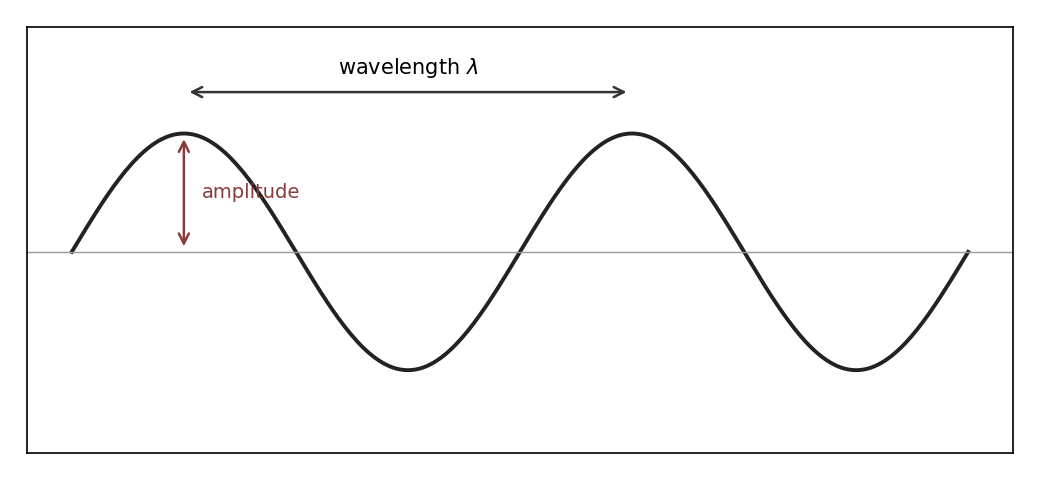
    Transverse waves 横波 oscillate perpendicular to travel (light, water). Longitudinal waves 纵波 oscillate along the travel direction as compressions and rarefactions (sound). Vocabulary: amplitude 振幅 (maximum displacement), wavelength λ 波长 (one crest to the next), frequency f 频率 (waves per second, Hz), period T (time per wave), wavefront (a line of simultaneous crests).

    A labelled wave with amplitude and wavelength marked.
    $$v = f \times \lambda \qquad f = \frac{1}{T}$$

    Worked check. A 340 Hz sound wave at 340 m/s: $\lambda = 340/340 = 1$ m; period $= 1/340 \approx 2.9$ ms. The Doppler effect 多普勒效应: a source moving towards an observer bunches wavefronts — higher observed frequency; moving away stretches them — lower.

    The electromagnetic spectrum

    One family, same speed in free space, ordered by decreasing wavelength (increasing frequency): radio → microwave → infrared → visible (red to violet) → ultraviolet → X-ray → gamma.

    Radiation Use Danger
    radio broadcasting, communications —
    microwave cooking, satellite TV internal heating of tissue
    infrared heaters, night vision skin burns
    visible optical fibres, photography —
    ultraviolet fluorescent lamps damage to surface cells, blindness
    X-ray imaging inside objects/bodies cancer, mutation (ionising)
    gamma sterilising food and equipment cancer, mutation

    Protection: limit exposure time, shielding, sun cream (UV).

    Light and sound

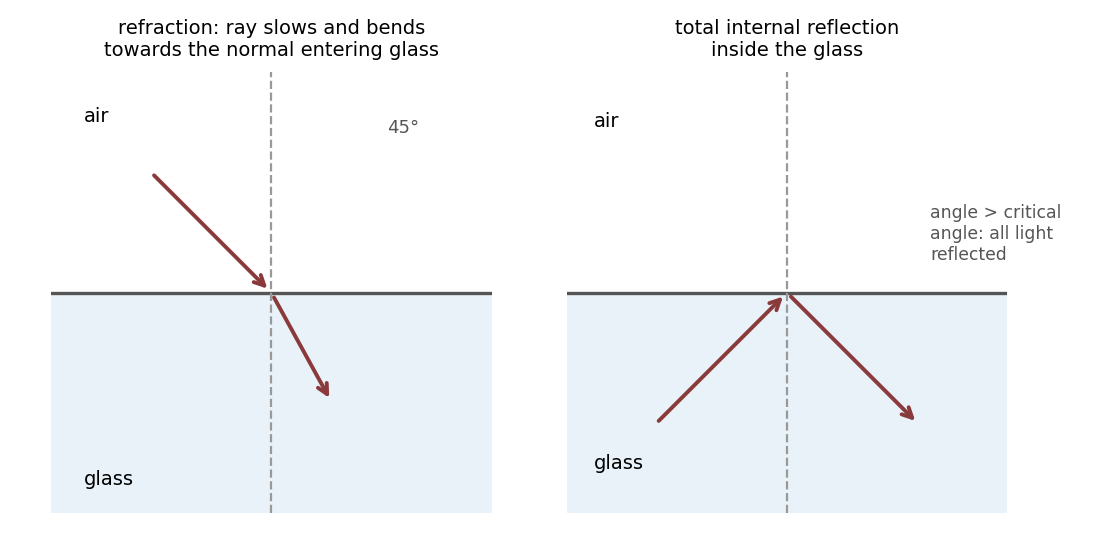
    Light is transverse and reflects and refracts. Law of reflection: angle of incidence = angle of reflection. Refraction 折射: entering glass (optically denser), light slows and bends towards the normal; leaving, it bends away.

    Refraction bends a ray towards the normal entering glass; beyond the critical angle light is totally internally reflected.
    $$n = \frac{\sin i}{\sin r} \qquad \sin c = \frac{1}{n}$$

    Total internal reflection 全内反射 happens when the angle inside the denser medium exceeds the critical angle 临界角 — the principle of optical fibres (communications, endoscopes) and prisms in periscopes.

    Worked check. Glass with $n = 1.5$: $\sin c = 1/1.5 = 0.667$, so $c \approx 41.8°$. A ray inside the glass hitting the boundary at 45° exceeds 41.8° — totally internally reflected.

    (P) Sound is longitudinal, 20–20 000 Hz for human hearing; pitch rises with frequency, loudness with amplitude. An oscilloscope with a microphone displays the wave; practicals time echoes or resonances to find the speed of sound in air.

    Check yourself

    1. Give one similarity and one difference between transverse and longitudinal waves.
    2. Define amplitude, wavelength and frequency.
    3. A wave of frequency 500 Hz travels at 340 m/s. Calculate its wavelength.
    4. State the order of the electromagnetic spectrum by increasing frequency.
    5. Give one use each of microwaves, infrared and gamma rays, and one danger of UV.
    6. State the law of reflection.
    7. Which way does light bend entering glass, and leaving it?
    8. Glass has n = 1.5. Calculate the critical angle.
    9. (P) State the human hearing frequency range, and what raises pitch and loudness.
    10. (P) How does an oscilloscope trace change when a sound gets louder at the same pitch?

    Answers: 1 both transfer energy without transferring matter; transverse oscillates across the travel direction (light), longitudinal along it as compressions (sound); 2 amplitude — maximum displacement from the rest position; wavelength — distance between successive identical points; frequency — number of waves passing per second; 3 $\lambda = 340/500 = 0.68$ m; 4 radio, microwave, infrared, visible, ultraviolet, X-ray, gamma; 5 microwaves — cooking/satellite; infrared — heaters/night vision; gamma — sterilising; UV damages surface cells and can blind; 6 angle of incidence = angle of reflection; 7 towards the normal entering, away from the normal leaving; 8 $\sin c = 1/1.5$, $c \approx 41.8°$; 9 (P) 20–20 000 Hz; higher frequency raises pitch, larger amplitude raises loudness; 10 (P) the trace's peaks grow taller (amplitude) while the number of cycles per second (frequency) stays the same.

    Vocabulary
    English
    transverse wave/trænsˈvɜːs weɪv/
    longitudinal wave/ˌlɒŋɡɪˈtjuːdɪnl weɪv/
    amplitude/ˈæmplɪtjuːd/
    wavelength/ˈweɪvleŋθ/
    frequency/ˈfriːkwənsi/
    Doppler effect/ˈdɒplə ɪˈfekt/
    refraction/rɪˈfrækʃn/
    total internal reflection/ˈtəʊtl ɪnˈtɜːnl rɪˈflekʃn/
    critical angle/ˈkrɪtɪkl ˈæŋɡl/
  • 4

    4 · Energy resources and energy transfers

    Learning program coming soon

    Handout

    Energy: stored, transferred, wasted

    Nothing uses energy up — energy only moves between stores and leaks along the way. This section names the stores and transfers, measures efficiency 效率 with Sankey diagrams 桑基图, follows heat by conduction, convection and radiation, links work, GPE and kinetic energy, and (P) weighs how electricity is generated.

    Edexcel International GCSE Physics 4PH1, Section 4 (statements 4.1–4.19P). Units: joule (J), watt (W), newton (N), and (P) J/kg °C.

    Energy transfers

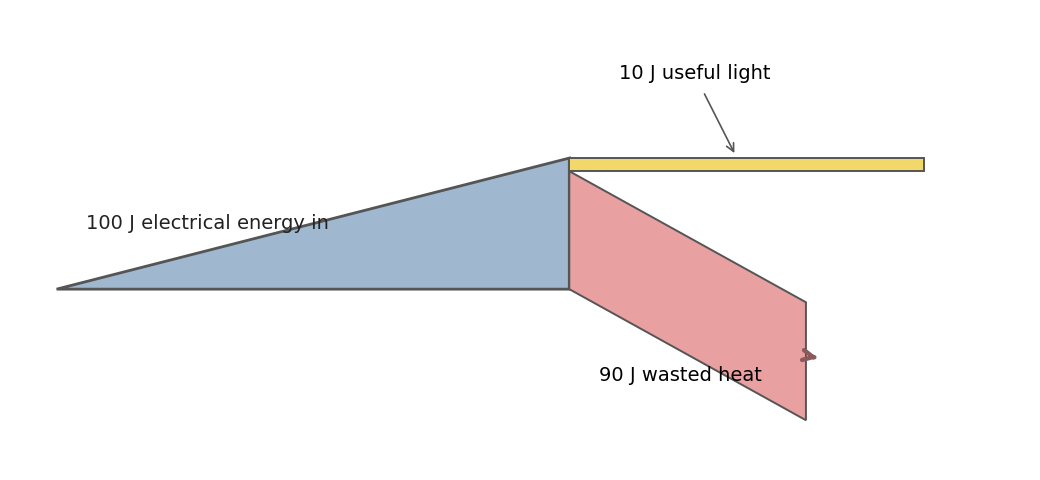
    Eight stores: chemical, kinetic, gravitational, elastic, thermal, magnetic, electrostatic, nuclear. Four transfer pathways: mechanically, electrically, by heating, by radiation (light and sound). Energy is conserved — the total is unchanged; devices just divert part of it from the store we want to ones we do not.

    $$\text{efficiency} = \frac{\text{useful energy output}}{\text{total energy output}} \times 100\%$$
    A Sankey diagram: an incandescent lamp turns 100 J of electrical energy into 10 J of light and 90 J of wasted heat.

    Worked check. The lamp above: efficiency $= 10/100 \times 100 = 10\%$.

    Thermal energy transfer

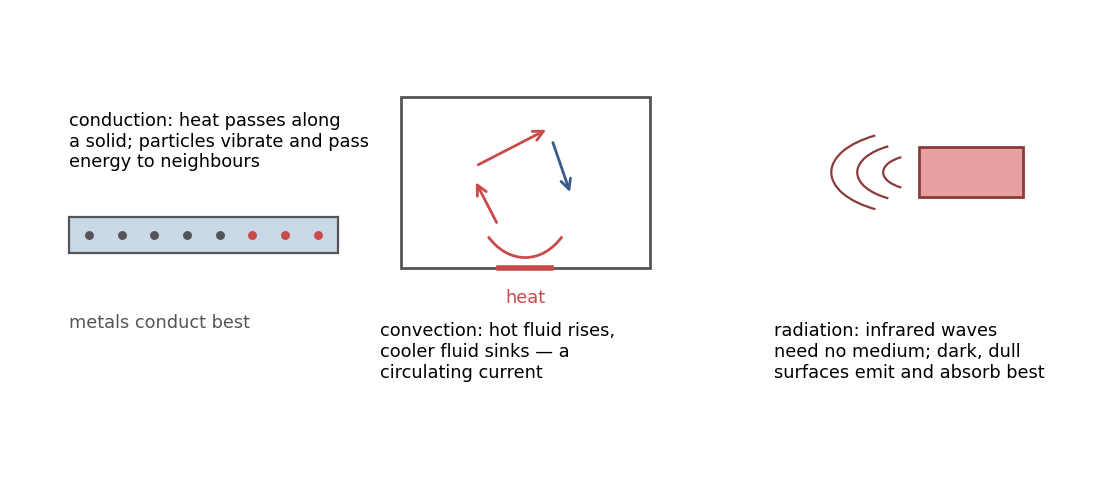
    Heat moves three ways, each with its own mechanism and each beaten by a different defence.

    Conduction passes heat along a solid; convection circulates fluid; radiation carries infrared waves with no medium.

    Conduction 传导: particle vibrations pass energy along a solid — fast in metals (free electrons). Convection 对流: fluid warms, expands, becomes less dense and rises; cooler fluid sinks to replace it — sea breezes, radiators heating rooms. Radiation 辐射: infrared waves travel through a vacuum; dark, dull surfaces are the best emitters and absorbers; light, shiny surfaces reflect. Reducing unwanted transfer: insulation (cavity wall, loft, double glazing cuts conduction and convection; shiny foil reflects radiation).

    Work, power and the energy equations

    $$W = F \times d \qquad GPE = mgh \qquad KE = \tfrac{1}{2}mv^2 \qquad P = \frac{W}{t}$$

    Work done equals energy transferred. Falling, GPE converts to KE (minus work against drag).

    Worked check. A 2 kg book lifted 1.5 m at g = 10 N/kg: $GPE = 2 \times 10 \times 1.5 = 30$ J. Dropped, at the ground $KE = 30$ J → $v = \sqrt{2 \times 30/2} = \sqrt{30} \approx 5.5$ m/s. A 60 W lamp runs 10 s: $W = 60 \times 10 = 600$ J.

    Energy resources and electricity generation (P)

    Every power station is an energy-transfer chain from a store to electricity; the table names the seven the specification requires.

    Method Energy transfer Advantages Disadvantages
    wind kinetic → electrical renewable, no fuel cost unreliable, visual/noise impact
    hydroelectric gravitational → electrical renewable, instant supply floods valleys, few sites
    geothermal thermal → electrical renewable, steady few suitable locations
    solar heating thermal (hot water) renewable, no running cost daytime/cloud dependent
    solar cells light → electrical renewable, silent expensive, low intensity output
    fossil fuels chemical → thermal → electrical reliable, concentrated CO₂ emissions, non-renewable
    nuclear nuclear → thermal → electrical huge energy per kg, no CO₂ radioactive waste, decommissioning

    Check yourself

    1. Name four energy stores and two transfer pathways.
    2. A motor uses 500 J and delivers 350 J of useful work. Calculate the efficiency.
    3. Name the three thermal transfer methods and the one needing no medium.
    4. Which surfaces emit infrared best?
    5. State two ways a house reduces unwanted heat loss.
    6. Calculate the work done by a 40 N force moving 3 m.
    7. Calculate the KE of a 800 kg car at 20 m/s.
    8. A heater transfers 12 000 J in 30 s. Calculate its power.
    9. (P) Give one advantage and one disadvantage each of wind and nuclear power.
    10. (P) Which two renewable methods extract energy already stored as heat in the ground or in falling water?

    Answers: 1 chemical, kinetic, gravitational, thermal (also elastic, magnetic, electrostatic, nuclear); mechanically and electrically (also heating, radiation); 2 $350/500 \times 100 = 70\%$; 3 conduction, convection, radiation — radiation needs no medium; 4 dark, dull (matt black) surfaces; 5 loft/cavity-wall insulation and double glazing (also reflective foil, draught excluders); 6 $W = 40 \times 3 = 120$ J; 7 $KE = \frac{1}{2} \times 800 \times 400 = 160\,000$ J; 8 $P = 12\,000/30 = 400$ W; 9 (P) wind — renewable with no fuel cost, but unreliable and visually intrusive; nuclear — enormous energy per kilogram with no CO₂, but radioactive waste must be stored safely for centuries; 10 (P) geothermal (ground heat) and hydroelectric (gravitational store of water).

    Vocabulary
    English
    conduction/kənˈdʌkʃn/
    convection/kənˈvekʃn/
    radiation/ˌreɪdɪˈeɪʃn/
    efficiency/ɪˈfɪʃənsi/
    Sankey diagram/ˈsæŋki ˈdaɪəɡræm/
  • 5

    5 · Solids, liquids and gases

    Learning program coming soon

    Handout

    Matter under pressure

    The same substance can be solid, liquid or gas, and its molecules never stop moving. This section measures matter: density and pressure, the (P) energy needed to heat or melt things, and the ideal-gas behaviour that links pressure, volume and temperature.

    Edexcel International GCSE Physics 4PH1, Section 5 (statements 5.1–5.22). Units include the pascal (Pa), kelvin (K) and (P) J/kg °C.

    Density and pressure

    $$\rho = \frac{m}{V} \qquad p = \frac{F}{A} \qquad p = h \times \rho \times g$$

    Density is measured directly — mass on a balance, volume by displacement (irregular solid) or dimensions (regular shape). Pressure in a fluid at rest acts equally in all directions, and the pressure difference between two depths comes from the weight of fluid between them.

    Worked check. A diver at 10 m in water ($\rho = 1000\ \mathrm{kg/m^3}$, $g = 10$ N/kg): pressure difference $= 10 \times 1000 \times 10 = 100\,000$ Pa on top of atmospheric pressure.

    Change of state (P)

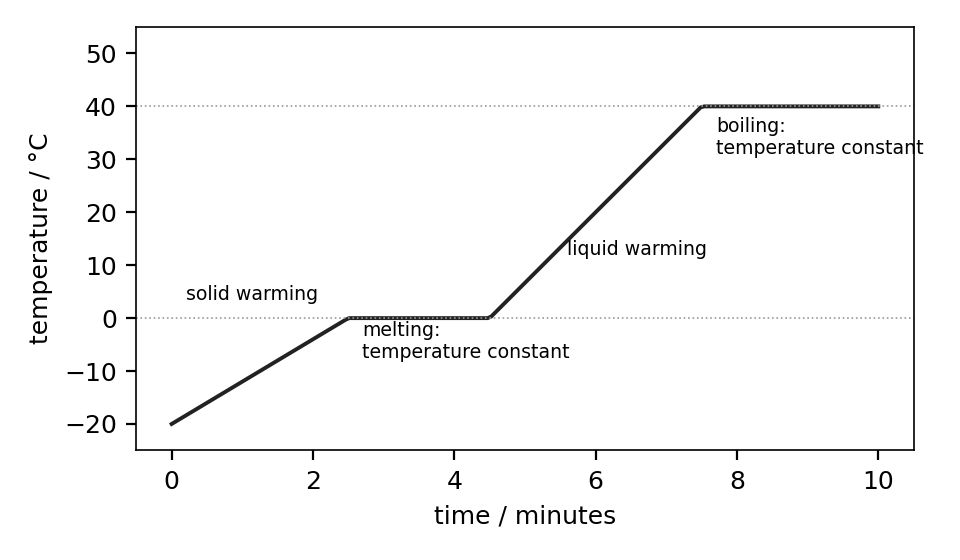
    A heating curve: temperature rises, plateaus at melting, rises, plateaus again at boiling.

    Heating raises the energy stored in a system — either its temperature rises, or at a melting point or boiling point the extra energy breaks bonds while the temperature stays constant. Particles: solids vibrate about fixed points; liquids move randomly but touch; gases move fast, far apart, in straight lines between collisions. Specific heat capacity 比热容 is the energy needed to raise 1 kg by 1 °C:

    $$\Delta Q = m \times c \times \Delta T$$

    Worked check. Heating 2 kg of water ($c = 4200\ \mathrm{J/(kg\ °C)}$) by 30 °C: $\Delta Q = 2 \times 4200 \times 30 = 252\,000$ J.

    Ideal gas molecules

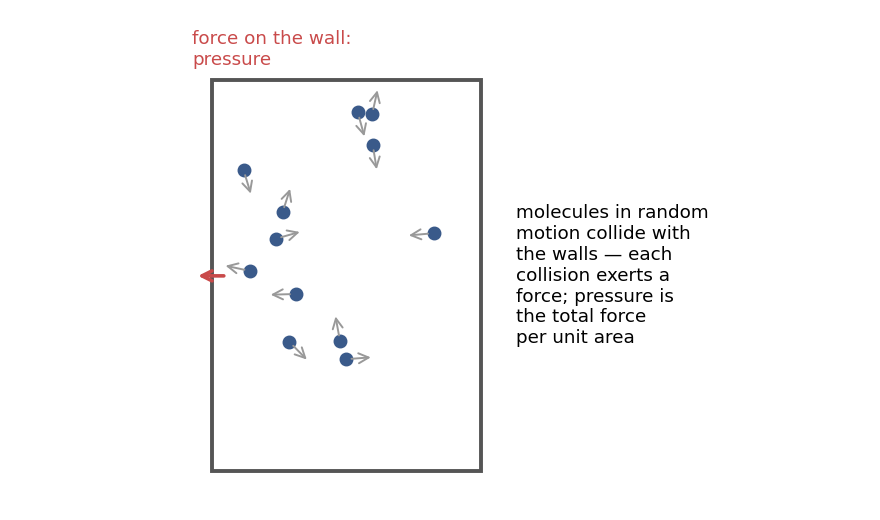
    Gas molecules collide with the container walls; the collisions' total force per area is the pressure.

    Gas molecules move randomly, exerting force — and so pressure — on the walls at every collision. Absolute zero 绝对零度 (−273 °C) is the temperature at which molecular kinetic energy is minimum: K = °C + 273. Higher temperature → faster average molecular speed, and the Kelvin temperature is proportional to the average kinetic energy of the molecules.

    For a fixed mass of gas: at constant temperature, pressure × volume is constant (squeeze it and the molecules hit the walls more often); at constant volume, pressure/T (K) is constant (hotter molecules hit harder):

    $$\frac{p_1 V_1}{1} = p_2 V_2 \qquad \frac{p_1}{T_1} = \frac{p_2}{T_2}$$

    Worked check. A gas at 100 kPa and 300 K is heated (constant volume) to 450 K: $p_2 = 100 \times 450/300 = 150$ kPa. Squashed from 2 dm³ to 0.5 dm³ at constant temperature: $p_2 = 100 \times 2/0.5 = 400$ kPa.

    Check yourself

    1. A 240 g block has volume 40 cm³. Calculate its density in kg/m³.
    2. State the pressure equation and its unit.
    3. Calculate the pressure under a 500 N boot heel of area 0.01 m².
    4. (P) What stays constant in a substance's temperature while it melts?
    5. (P) Calculate the energy to heat 0.5 kg of aluminium (c = 900 J/(kg °C)) by 40 °C.
    6. Convert 27 °C to kelvin, and 373 K to °C.
    7. Why does a gas exert pressure on its container?
    8. What happens to average molecular speed as temperature rises?
    9. A gas at 120 kPa in 3 dm³ is compressed to 1 dm³ at constant temperature. Find the new pressure.
    10. State two conditions that make a gas's pressure double.

    Answers: 1 $m = 0.24$ kg, $V = 4.0 \times 10^{-5}\ \mathrm{m^3}$; $\rho = 0.24/4.0\times10^{-5} = 6000\ \mathrm{kg/m^3}$; 2 $p = F/A$, in pascals (N/m²); 3 $p = 500/0.01 = 50\,000$ Pa; 4 (P) temperature — the energy goes to breaking intermolecular bonds, not to faster molecules; 5 (P) $\Delta Q = 0.5 \times 900 \times 40 = 18\,000$ J; 6 300 K; 100 °C; 7 its molecules collide with the walls, each collision exerting a force; the total force per unit area is the pressure; 8 it increases; 9 $p_2 = 120 \times 3/1 = 360$ kPa; 10 doubling the Kelvin temperature at constant volume, or halving the volume at constant temperature.

    Vocabulary
    English
    specific heat capacity/spəˈsɪfɪk hiːt kəˈpæsɪti/
    absolute zero/ˈæbsəluːt ˈzɪərəʊ/
  • 6

    6 · Magnetism and electromagnetism

    Learning program coming soon

    Handout

    Magnetism to mains

    A magnet moves, and current appears in a wire kilometres away. This section builds that chain: permanent magnets and field patterns, the magnetic effect of a current, the motor force with its left-hand rule, induction in coils and generators, and (P) the transformers that move electrical energy across a country.

    Edexcel International GCSE Physics 4PH1, Section 6 (statements 6.1–6.20P). P-suffixed statements are the Physics-only extension.

    Magnetism

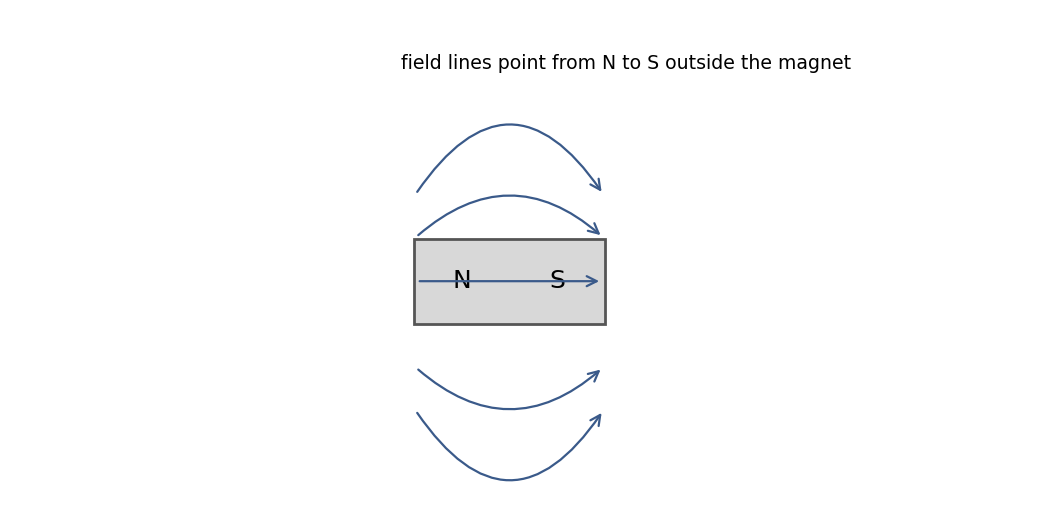
    Magnets repel like poles and attract unlike ones, and attract magnetic materials (iron, steel, nickel, cobalt). Magnetically hard materials (steel) keep their magnetism — permanent magnets; soft materials (iron) magnetise and demagnetise easily — electromagnet cores. Field lines 磁感线 point from N to S outside a magnet (never cross); magnetism is induced in a magnetic material placed in a field. Two unlike poles facing each other give a uniform field 匀强磁场 between them.

    A bar magnet's field lines, N to S outside, never crossing.

    Electromagnetism and the motor effect

    A current in a conductor creates a magnetic field around it — concentric circles, right-hand grip rule. (P) Electromagnets: a coil (solenoid) 螺线管 around a soft-iron core, switchable and adjustable. (P) Field patterns for a straight wire, flat coil and solenoid.

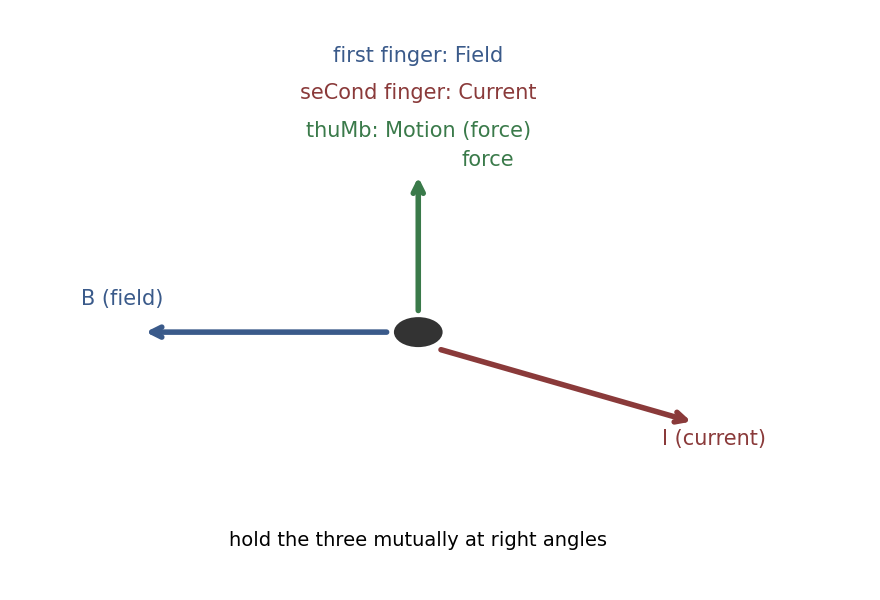
    A wire carrying current across a magnetic field feels a force — the motor effect, used in d.c. motors (rotating coil + commutator) and loudspeakers. Predict the direction with the left-hand rule 左手定则: first finger Field, seCond finger Current, thuMb Motion. The force grows with stronger field and larger current, and reverses if either reverses.

    The left-hand rule: field, current and force mutually at right angles.

    Electromagnetic induction

    A voltage is induced 感生 in a conductor or coil when it moves through a magnetic field or when the field through it changes. The induced voltage is larger with faster movement, a stronger field, more turns and (for generators) faster rotation. Generators rotate a magnet inside a coil (or a coil inside a magnet) — the size and frequency of the induced a.c. follow the rotation.

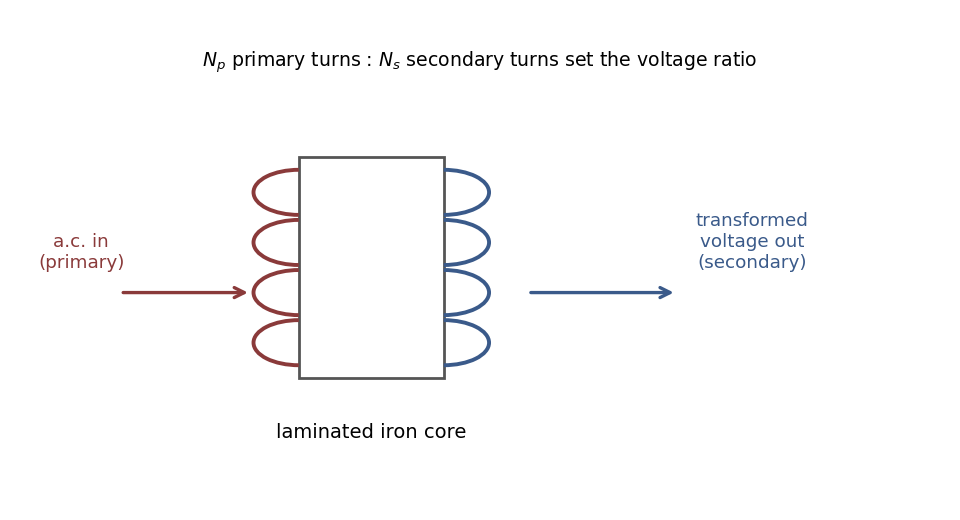
    (P) Transformers change an alternating voltage using two coils on an iron core:

    $$\frac{V_p}{V_s} = \frac{N_p}{N_s} \qquad V_p I_p = V_s I_s \ (100\% \text{ efficient})$$
    A transformer: primary and secondary coils on a laminated iron core.

    Step-up transformers raise the voltage (and cut the current) for transmission — high voltage means low current, so far less energy lost as heat in the cables; step-down transformers bring it back to safe levels for use.

    Worked check. A transformer has 200 primary turns and 50 secondary turns; the primary is 230 V. $V_s = 230 \times 50/200 = 57.5$ V — a step-down. If the primary current is 0.5 A: $I_s = 230 \times 0.5/57.5 = 2.0$ A.

    Check yourself

    1. State two differences between magnetically hard and soft materials.
    2. In which direction do field lines point outside a magnet?
    3. Describe how to produce a uniform magnetic field with two bar magnets.
    4. What does a current in a wire create around it?
    5. State the left-hand rule's three fingers.
    6. Name two factors that increase the force on a current-carrying wire in a field.
    7. State two ways to induce a voltage in a coil.
    8. Name two factors that increase the size of an induced voltage.
    9. (P) A step-down transformer has 1000 primary and 100 secondary turns; input 230 V. Calculate the output.
    10. (P) Why is electricity transmitted at high voltage?

    Answers: 1 hard keeps its magnetism (permanent magnets, steel); soft loses it easily (temporary, iron — electromagnet cores); 2 from N to S; 3 place N and S poles facing each other with a gap — the parallel field lines between them are uniform; 4 a magnetic field of concentric circles (grip rule); 5 first finger Field, second finger Current, thumb Motion; 6 stronger field; larger current.

    Answers continued: 7 move the coil or magnet so the coil cuts field lines, or change the field through a stationary coil; 8 faster movement; stronger magnet; more turns; 9 (P) $V_s = 230 \times 100/1000 = 23$ V; 10 (P) high voltage gives low current for the same power; cable heating is $I^2R$, so losses fall sharply over long distances.

    Vocabulary
    English
    field line/fiːld laɪn/
    solenoid/ˈsəʊlənɔɪd/
    left-hand rule/left hænd ruːl/
    induce
    uniform field/ˈjuːnɪfɔːm fiːld/
  • 7

    7 · Radioactivity and particles

    Learning program coming soon

    Handout

    The nucleus at work

    Some nuclei are unstable: they throw out radiation at random, decay by half-lives, and — in reactors and stars — release energy by splitting or joining. This section covers atomic notation, the three ionising radiations with their penetrating powers, half-life calculations, the fission chain reaction, and why fusion lights the stars but not our power stations.

    Edexcel International GCSE Physics 4PH1, Section 7 (statements 7.1–7.26). Units: becquerel (Bq), with time in s, min or h.

    Radioactivity

    An atom holds protons and neutrons in a nucleus; notation $^{A}_{Z}X$ gives mass (nucleon) number A and atomic (proton) number Z. Isotopes share Z but differ in neutrons.

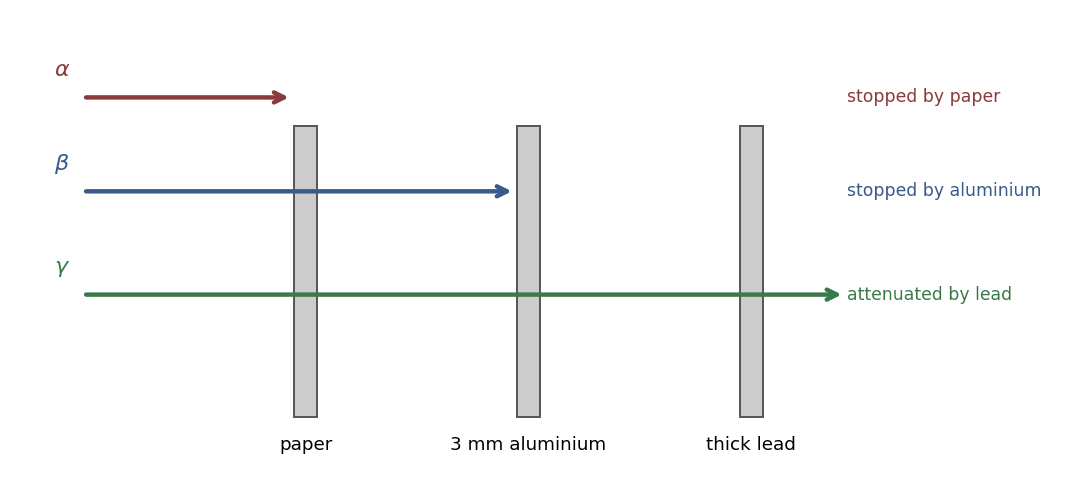
    Unstable nuclei emit — randomly — alpha α (helium nucleus, $^4_2$He), beta-minus β⁻ (an electron, created as a neutron turns proton) and gamma γ (high-energy electromagnetic wave, no particles). Balancing: both mass number and charge are conserved.

    Worked check. Carbon-14: $^{14}_{6}C \rightarrow {}^{14}_{7}N + {}^{0}_{-1}e$ — A stays 14; charge 6 = 7 + (−1) ✓. Radon: $^{222}_{86}Rn \rightarrow {}^{218}_{84}Po + ^{4}_{2}He$.

    Penetration: alpha stopped by paper, beta by a few mm of aluminium, gamma attenuated by lead.
    Radiation Nature Ionising Range in air
    alpha 2p + 2n strongest a few cm
    beta fast electron medium tens of cm
    gamma EM wave weakest metres

    Detection: photographic film (badge) or a Geiger–Müller tube. Background radiation comes from rocks and cosmic rays (space), food, medical uses and fallout.

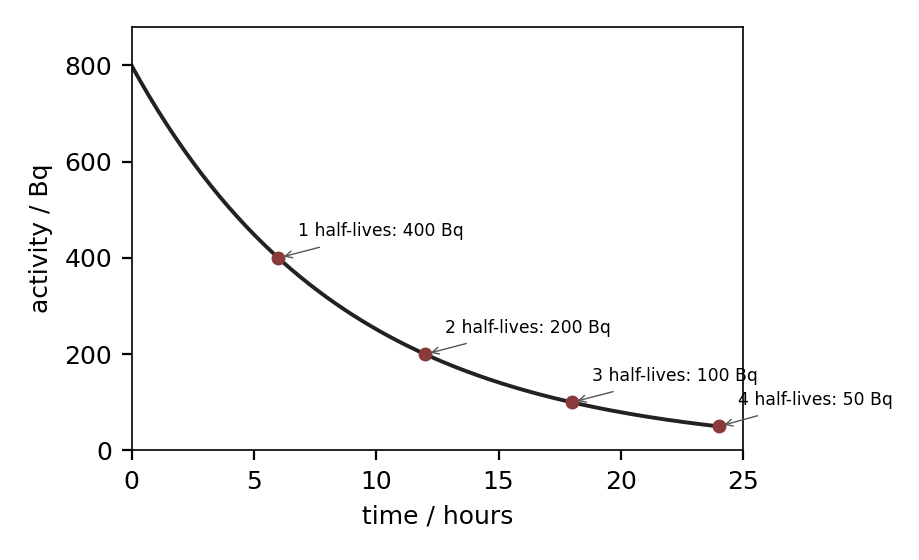
    Activity 活度 (in becquerels; 1 Bq = 1 decay/s) falls steadily: the half-life 半衰期 is the time for half the undecayed nuclei to decay. Worked check. 800 Bq with half-life 6 h: after 24 h (4 half-lives) activity $= 800/2^4 = 50$ Bq.

    A decay curve halving every half-life.

    Uses: medical tracers (short half-life, gamma), cancer treatment, sterilising, thickness control (beta through paper). Contamination (radioactive material on you — must be removed) differs from irradiation (exposure to radiation — stops when the source leaves). Dangers: mutation of DNA, cell and tissue damage; radioactive waste must be stored safely for its long half-lives.

    Fission and fusion

    Split a big nucleus or join two small ones — both release energy, and each powers a different machine.

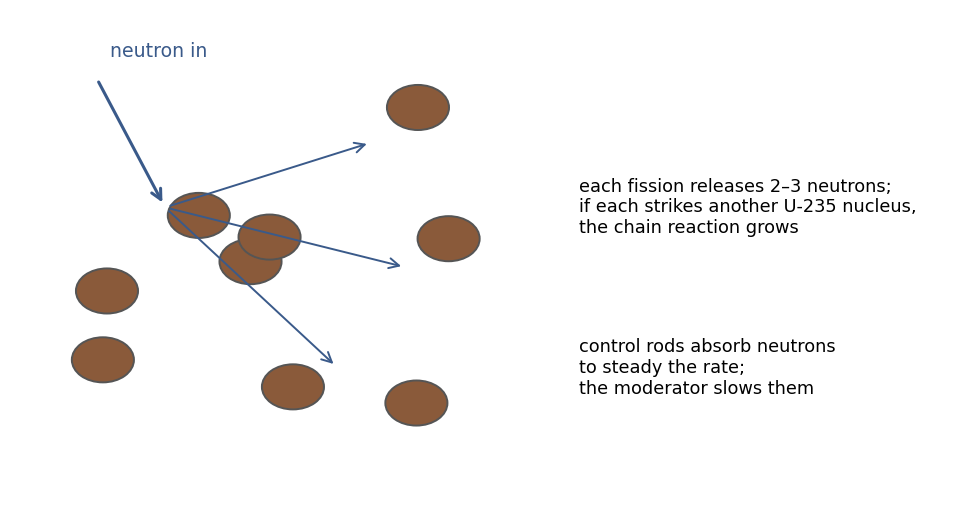
    A chain reaction: each fission's neutrons strike further U-235 nuclei; control rods and moderator manage it.

    Fission 裂变: a neutron strikes U-235, splitting it into two radioactive daughter nuclei, 2–3 neutrons and kinetic energy — and if those neutrons strike more U-235, a chain reaction runs. The moderator 慢化剂 slows neutrons so they split nuclei efficiently; control rods 控制棒 absorb neutrons to hold the rate steady; shielding protects workers. Fusion 聚变 joins small nuclei into a larger one, converting mass to energy — the Sun's source. Fusion needs enormous temperature and pressure because positively charged protons electrostatically repel — the nuclei must collide fast enough to overcome that repulsion.

    Check yourself

    1. In $^{19}_{9}F$, state the numbers of protons, neutrons and electrons in the neutral atom.
    2. Name the three ionising radiations and their natures.
    3. Write the full equation for alpha decay of $^{226}_{88}Ra$.
    4. Which radiation is stopped by paper, and which passes through aluminium?
    5. Give two sources of background radiation.
    6. Define half-life.
    7. A source of 3200 Bq has half-life 8 days. Find its activity after 32 days.
    8. State the difference between contamination and irradiation.
    9. Name the roles of the moderator, control rods and shielding in a reactor.
    10. Why does fusion need such high temperatures?

    Answers: 1 9 protons, 10 neutrons, 9 electrons; 2 alpha — helium nucleus (2p+2n); beta-minus — fast electron; gamma — high-energy electromagnetic wave; 3 $^{226}_{88}Ra \rightarrow {}^{222}_{86}Rn + {}^{4}_{2}He$; 4 alpha stopped by paper; gamma passes aluminium (needs thick lead); 5 any two: rocks/building materials, cosmic rays, food/drink, medical, radon gas, nuclear fallout; 6 the time taken for half the undecayed nuclei (or the activity) to decay; 7 32 days = 4 half-lives: $3200 \rightarrow 1600 \rightarrow 800 \rightarrow 400 \rightarrow 200$ Bq; 8 contamination — radioactive material stuck to you, hazard remains until removed; irradiation — exposure to radiation from a source, ends when the source is removed; 9 moderator slows neutrons for efficient fission; control rods absorb neutrons to control the rate; shielding absorbs escaping radiation to protect workers; 10 the positively charged protons of two nuclei repel electrostatically, so nuclei must collide at enormous speed — only reached at very high temperature and pressure — to get close enough to fuse.

    Vocabulary
    English
    activity/ækˈtɪvɪti/
    half-life/hɑːf laɪf/
    fission/ˈfɪʃn/
    fusion/ˈfjuːʒn/
    moderator
    control rod
  • 8

    8 · Astrophysics

    Learning program coming soon

    Handout

    The universe and its history

    The universe is billions of galaxies; each galaxy is billions of stars; the Sun is one star in the Milky Way. Gravity shapes every orbit in it, stars are born and die in patterns set by their mass, and the red-shift of distant galaxies tells us the whole universe is expanding — evidence for a beginning: the Big Bang.

    Edexcel International GCSE Physics 4PH1, Section 8 (statements 8.1–8.18P). P-suffixed statements are the Physics-only extension (Paper 2P).

    Motion in the universe

    Universe 宇宙 → billions of galaxies 星系 → each billions of stars → our solar system lies in the Milky Way. Gravitational field strength g varies with mass and size — weaker on the Moon, stronger on Jupiter. Gravity holds every orbit: moons orbit planets, planets and comets orbit the Sun, artificial satellites orbit the Earth.

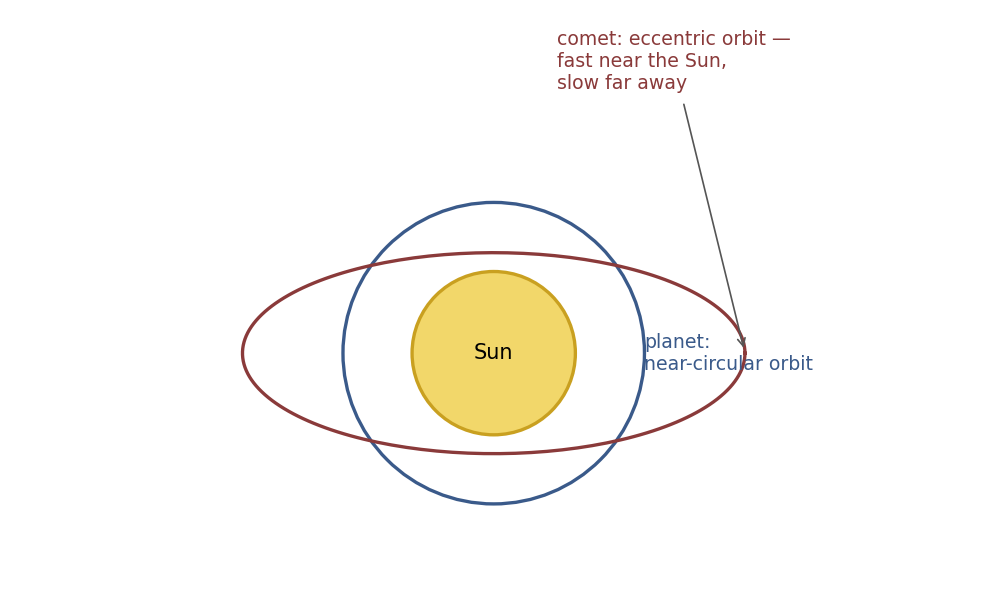
    A planet's near-circular orbit beside a comet's eccentric orbit around the Sun.

    Planetary orbits are nearly circular; comet orbits are highly eccentric — fast near the Sun, slow far away. Orbital speed comes from circumference ÷ period:

    $$v = \frac{2 \times \pi \times r}{T}$$

    Worked check. A satellite at orbital radius 7000 km (r measured from Earth's centre) with period 5800 s: $v = 2\pi \times 7.0 \times 10^6/5800 \approx 7580$ m/s ≈ 7.6 km/s.

    Stellar evolution

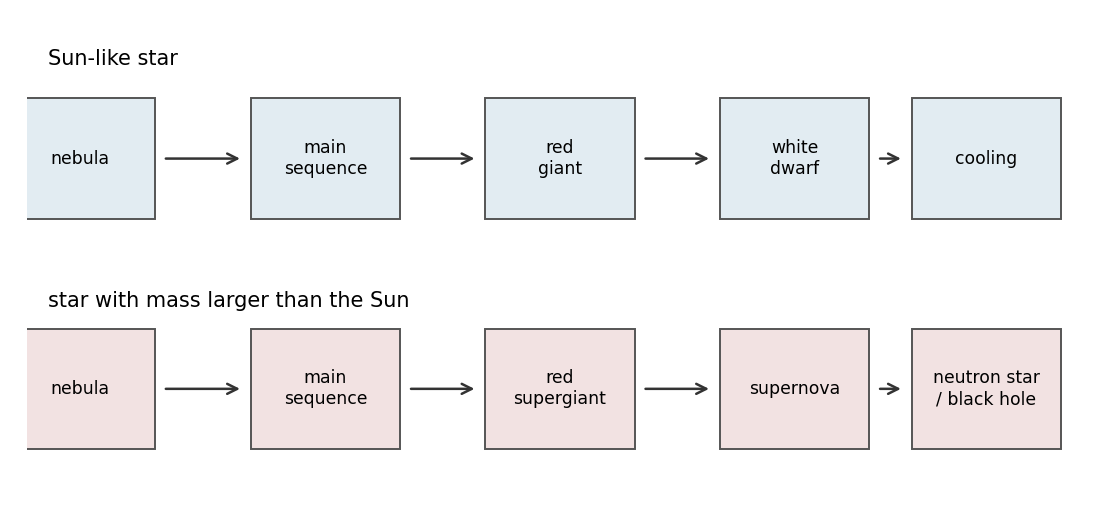
    Stars are classified by colour, which follows surface temperature: blue hottest → red coolest. A Sun-like star runs nebula → main sequence (fusion balances gravity for billions of years) → red giant → white dwarf; a star more massive than the Sun runs nebula → main sequence → red supergiant → supernova → neutron star or black hole.

    Two life cycles: Sun-like stars end as white dwarfs; massive stars end in supernovae, neutron stars or black holes.

    (P) A star's brightness is compared using absolute magnitude at a standard distance; the Hertzsprung–Russell diagram plots absolute magnitude against temperature, with the main sequence, giants and white dwarfs as its main bands.

    Cosmology (P)

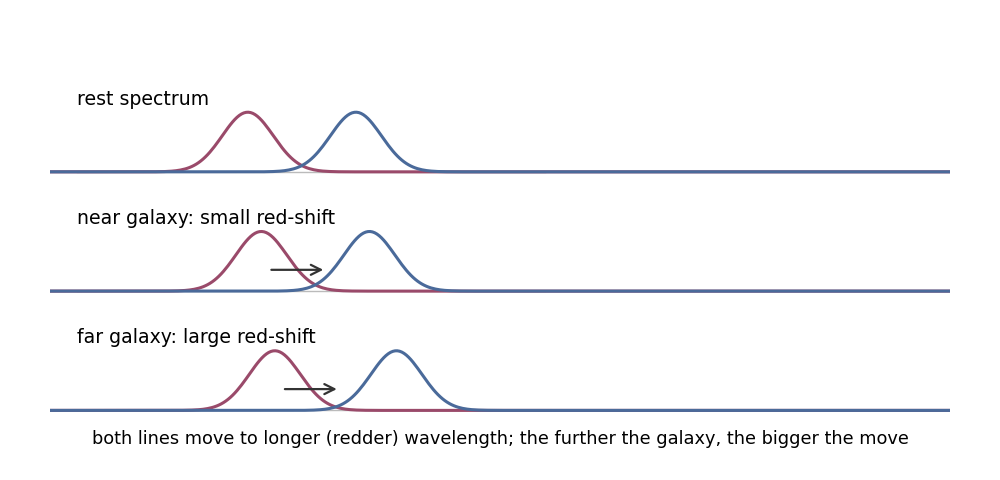
    Spectral lines shift to the red as a galaxy recedes faster — the further the galaxy, the larger the shift.

    A moving wave source changes the observed wavelength (red-shift 红移 for recession). Galaxy red-shift grows with distance, and the relationship is quantified as:

    $$\frac{\Delta\lambda}{\lambda_0} = \frac{v}{c}$$

    Worked check. A spectral line at 500 nm appears at 505 nm in a distant galaxy: $\Delta\lambda/\lambda_0 = 5/500 = 0.01$, so $v = 0.01c = 3000$ km/s.

    Red-shift increasing with distance means the galaxies are receding faster the further they are — the universe is expanding, which points back to a hot, dense beginning: the Big Bang 大爆炸. The cosmic microwave background (CMB) — faint microwaves from every direction — is the cooled remnant of that early radiation, the second pillar of evidence.

    Check yourself

    1. Put in order of size: galaxy, solar system, universe, star.
    2. Why does g differ between the Earth and the Moon?
    3. Name the two orbit shapes of comets and planets.
    4. Calculate the orbital speed of a satellite at r = 42 000 km with T = 24 hours.
    5. State the two stages after the main sequence for a Sun-like star.
    6. What does a star's colour tell you?
    7. (P) Which two quantities does the HR diagram plot?
    8. (P) A line at 400 nm shifts to 404 nm. Calculate v/c.
    9. (P) State the two pieces of evidence for the Big Bang.
    10. (P) Why does red-shift increase with distance?

    Answers: 1 star (smallest) → solar system → galaxy → universe (largest); 2 g depends on the body's mass and radius — the Moon is smaller and less massive, so its g is about 1.6 N/kg; 3 planets — nearly circular; comets — highly eccentric ellipses; 4 $r = 4.2 \times 10^7$ m, $T = 86\,400$ s; $v = 2\pi \times 4.2\times10^7/86\,400 \approx 3060$ m/s ≈ 3.1 km/s; 5 red giant, then white dwarf; 6 its surface temperature — blue hottest, red coolest; 7 (P) absolute magnitude against temperature (or colour); 8 (P) $\Delta\lambda/\lambda_0 = 4/400 = 0.01 = v/c$; 9 (P) the red-shift of galaxies increasing with distance, and the cosmic microwave background radiation; 10 (P) the further the galaxy, the faster it recedes — space itself expands, so recession speed grows with distance, shifting the light further to the red.

    Vocabulary
    English
    universe/ˈjuːnɪvɜːs/
    galaxy/ˈɡæləksi/
    red-shift/red ʃɪft/
    Big Bang/bɪɡ bæŋ/

Log in or create account

IGCSE, A-Level & AP