Describing and explaining motion
Physics begins with movement. This first section builds the toolkit: graphs that describe motion, the equations that link speed, acceleration and distance, the forces that cause every change, and (P) the momentum and moments that explain crumple zones and balanced beams.
Edexcel International GCSE Physics 4PH1, Section 1 (statements 1.1–1.33P). P-suffixed statements are the separate-science extension, assessed on Paper 2P; units to learn include the newton (N) and, (P), the newton metre and kg m/s.
Movement and position
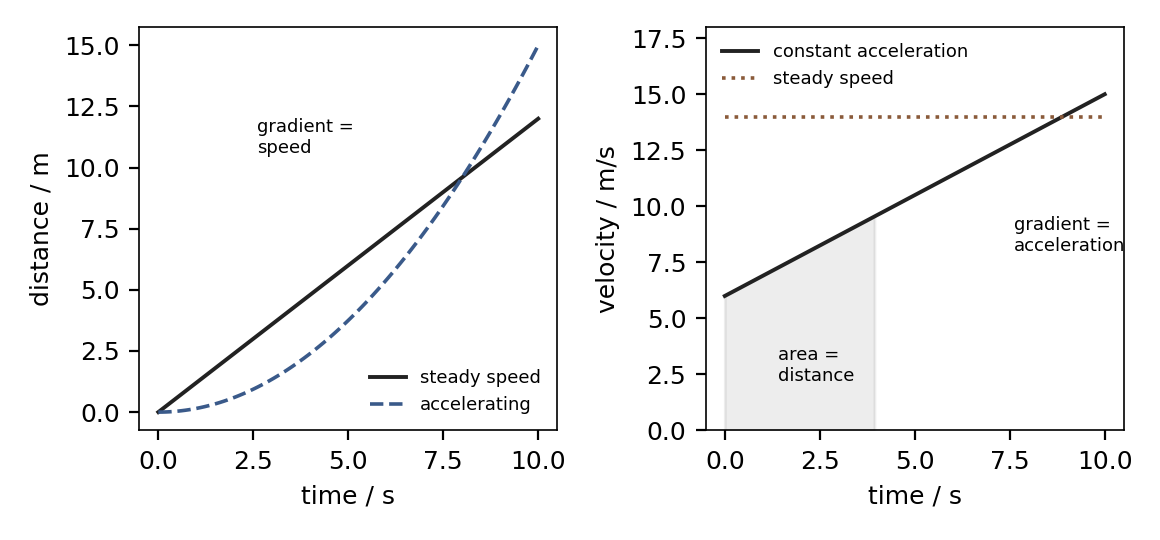
Average speed = distance moved ÷ time taken. On a distance–time graph the gradient is the speed: a straight sloping line is steady speed, a curve is acceleration, a flat line is at rest. Acceleration 加速度 is the change of velocity per second:
On a velocity–time graph the gradient is acceleration and the area between the line and the time axis is the distance travelled.
Worked check. A car accelerates from 4 m/s to 16 m/s in 6 s: $a = (16 - 4)/6 = 2\ \mathrm{m/s^2}$. Distance covered $= \frac{1}{2}(4 + 16) \times 6 = 60$ m.
Forces and movement
Forces change a body's speed, shape or direction. Force is a vector 矢量 (size + direction); scalars like speed have only size. Along a line, forces add: two 5 N pulls against one 8 N pull give a resultant force 合力 of 2 N. Friction 摩擦 opposes motion. The unbalanced force causes acceleration:
Worked check. A 1200 kg car with a driving force of 3600 N against 1200 N of drag: $F = 2400$ N; $a = 2400/1200 = 2\ \mathrm{m/s^2}$. Weight at $g = 10$ N/kg: $W = 1200 \times 10 = 12\,000$ N.
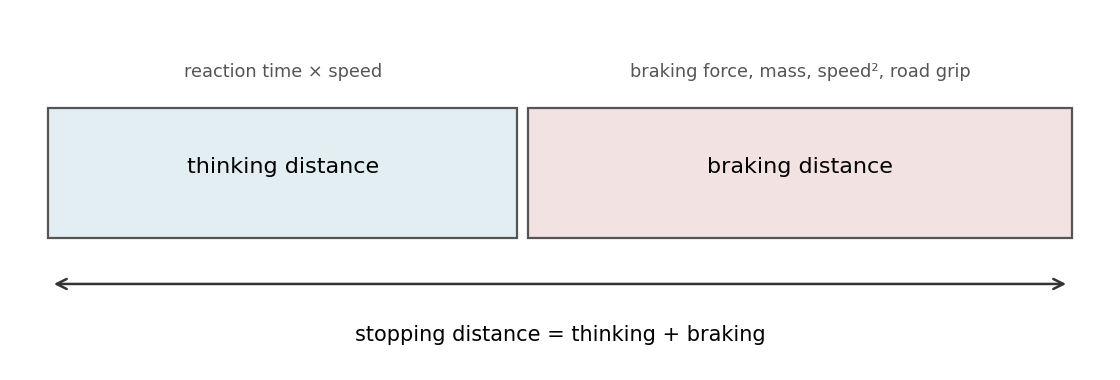
Stopping distance = thinking distance + braking distance. Thinking grows with speed and reaction time (tiredness, alcohol, phones); braking grows with speed squared, mass, weak brakes, poor grip (wet or icy roads, worn tyres).
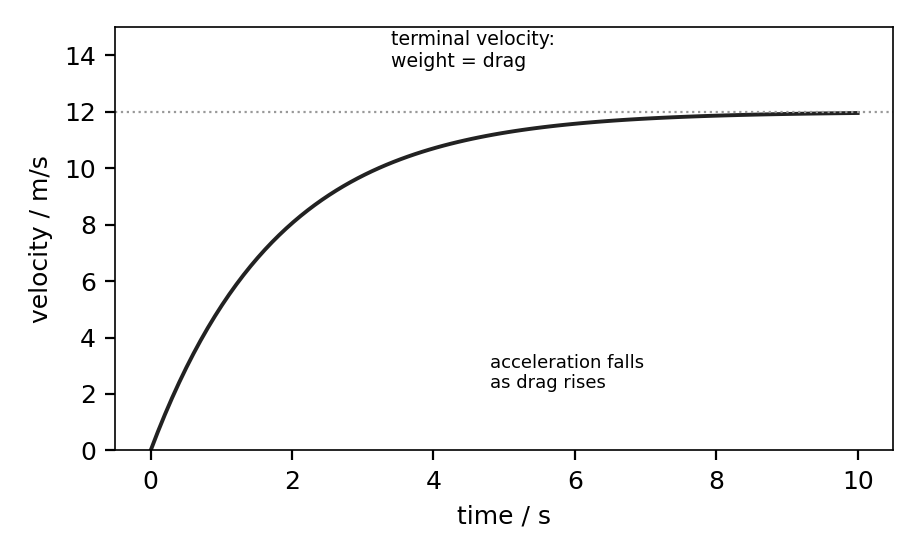
Falling objects accelerate while weight exceeds drag; as speed rises, drag rises, the resultant falls, until weight = drag — terminal velocity 终末速度.
Forces and shape
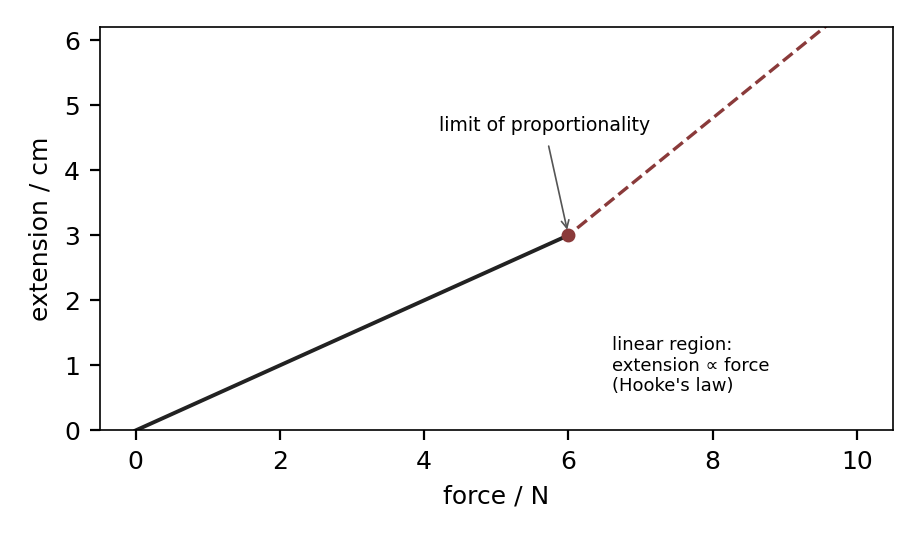
A spring stretches with load. In the initial linear region, extension is proportional to force — Hooke's law 胡克定律; beyond the limit of proportionality it bends away. Elastic behaviour 弹性 recovers the original shape when the force is removed. Practical: hang masses on a spring (or rubber band), plot force against extension.
Momentum and moments (P)
Momentum 动量 (kg m/s) is conserved in collisions: total before = total after. Safety features work by stretching the time of a collision, so for the same momentum change the force is smaller — crumple zones, seat belts, airbags. Newton's third law: to every action there is an equal and opposite reaction.
Moment 力矩 = force × perpendicular distance from the pivot. A beam balances when clockwise moments = anticlockwise moments; the weight of a body acts through its centre of gravity 重心.
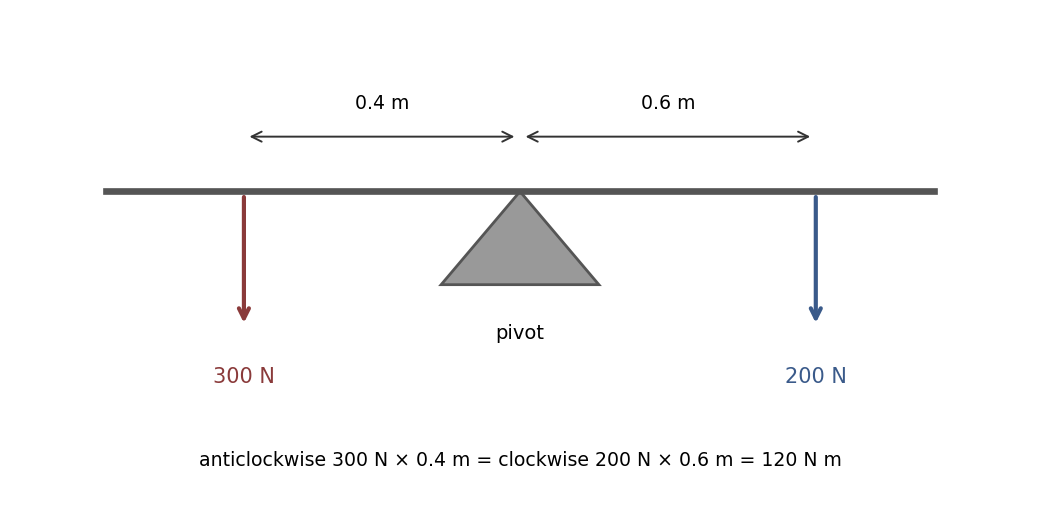
Worked check. Two children (300 N at 0.4 m, 200 N at 0.6 m from the pivot) on a see-saw: clockwise $200 \times 0.6 = 120$ N m; anticlockwise $300 \times 0.4 = 120$ N m — balanced.
Check yourself
- What does the gradient of a distance-time graph give, and of a velocity-time graph?
- A cyclist covers 900 m in 3 minutes. Calculate the average speed in m/s.
- Calculate the acceleration from 30 m/s to rest in 5 s.
- State the equation linking unbalanced force, mass and acceleration, and its unit.
- Name two factors that lengthen the thinking distance and two that lengthen the braking distance.
- Explain, in terms of forces, why a skydiver reaches terminal velocity.
- State Hooke's law.
- (P) A 60 kg runner at 8 m/s: calculate momentum.
- (P) Explain how a crumple zone protects passengers.
- (P) What is the moment of a 50 N force at 0.3 m from the pivot?
Answers: 1 speed; acceleration (and the area under the velocity-time line is distance); 2 $900/180 = 5$ m/s; 3 $a = (0 - 30)/5 = -6\ \mathrm{m/s^2}$ (deceleration of 6 m/s²); 4 F = ma, with F in newtons; 5 thinking — higher speed, longer reaction time; braking — higher speed (speed²), mass, poor brakes/tyres, wet or icy roads; 6 drag rises with speed until it equals the weight — resultant and acceleration reach zero, so velocity is constant; 7 extension is proportional to force, up to the limit of proportionality; 8 (P) $p = 60 \times 8 = 480\ \mathrm{kg\,m/s}$; 9 (P) it crumples, lengthening the collision time; force = momentum change ÷ time, so a longer time means a smaller force on the passengers; 10 (P) $50 \times 0.3 = 15$ N m.