Carbon's family tree
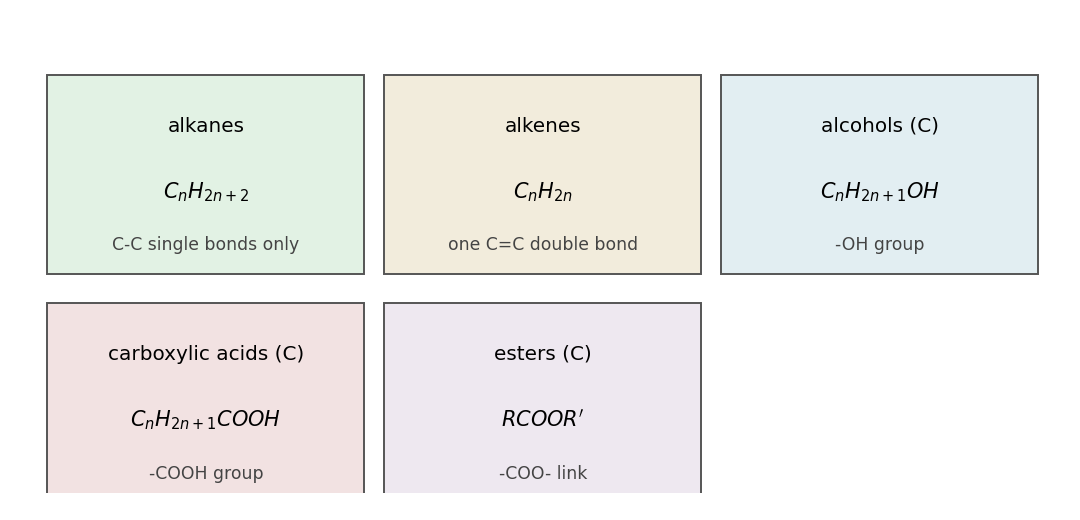
Crude oil is a mixture of hydrocarbons — compounds of carbon and hydrogen only — built from the smallest molecules in the gas fraction to the tars of bitumen. This section organises them into families, follows crude oil from well to fraction, and then meets each family in turn: the unreactive alkanes, the double-bonded alkenes, and (C) the alcohols, acids, esters and polymers that come after.
Edexcel International GCSE Chemistry 4CH1, Section 4 (statements 4.1–4.50C) closes the course. C-suffixed statements are Chemistry-only.
Introduction and crude oil
A hydrocarbon 烃 holds hydrogen and carbon only. Molecules are drawn as empirical, molecular, general, structural and displayed formulae 结构式. A homologous series 同系列 shares a general formula and functional group 官能团, members differing by CH₂; isomerism 同分异构现象 — isomers 同分异构体 share a molecular formula with different structures. IUPAC naming runs to six carbons.
Crude oil separates by fractional distillation 分馏: the furnace vaporises the oil, and vapours rise up the column, cooling as they go — small molecules with low boiling points collect at the top, large viscous molecules at the bottom.

Fractions darken and thicken down the column (rising boiling point and viscosity). Complete combustion gives CO₂ + H₂O; incomplete combustion 不完全燃烧 also gives carbon monoxide — poisonous because it reduces the blood's oxygen-carrying capacity — and soot. In engines, hot air makes nitrogen and oxygen combine into oxides of nitrogen; sulfur impurities burn to SO₂; both gases dissolve in rain making it acidic (acid rain damages leaves, lakes and buildings). Cracking 裂解 converts long-chain alkanes to alkenes + shorter alkanes over silica/alumina at 600–700 °C — because the refinery's supply of long fractions outstrips demand while short fractions are wanted.
Alkanes and alkenes
Alkanes 烷烃 ($C_nH_{2n+2}$) are saturated 饱和 — only single C–C bonds. Methane, ethane, propane, butane, pentane. With halogens in ultraviolet light they substitute one hydrogen: CH₄ + Cl₂ → CH₃Cl + HCl (substitution 取代).
Alkenes 烯烃 ($C_nH_{2n}$) carry C=C — unsaturated 不饱和. With bromine they add across the double bond to a dibromoalkane (addition 加成): C₂H₄ + Br₂ → C₂H₄Br₂. Bromine water distinguishes them: decolourised (orange → colourless) by an alkene, unchanged by an alkane.
Alcohols, acids and esters (C)
Alcohols 醇 carry –OH: methanol, ethanol, propan-1-ol, butan-1-ol. Ethanol oxidises to ethanoic acid by complete combustion, by microbial oxidation in air, or by warming with potassium dichromate(VI) in dilute sulfuric acid. Ethanol is made by ethene + steam over a phosphoric acid catalyst (≈300 °C, 60–70 atm) or by fermentation 发酵 of glucose with yeast enzymes in the absence of air at ≈30 °C — the optimum for the enzymes, and no oxygen so the yeast produces ethanol not water.
Carboxylic acids 羧酸 carry –COOH: methanoic, ethanoic, propanoic, butanoic. Their solutions react with metals (giving H₂) and carbonates (giving CO₂) like other acids; vinegar is dilute ethanoic acid.
Esters 酯 carry –COO–: ethanol + ethanoic acid, with an acid catalyst, give ethyl ethanoate 乙酸乙酯 and water (esterification). Given an alcohol and an acid, join the acid's –COOH to the alcohol's –O–. Esters are volatile, sweet-smelling, used as flavourings and perfumes.
Synthetic polymers
Addition polymers 加成聚合物 form when many alkene monomers 单体 join, opening their C=C bonds.
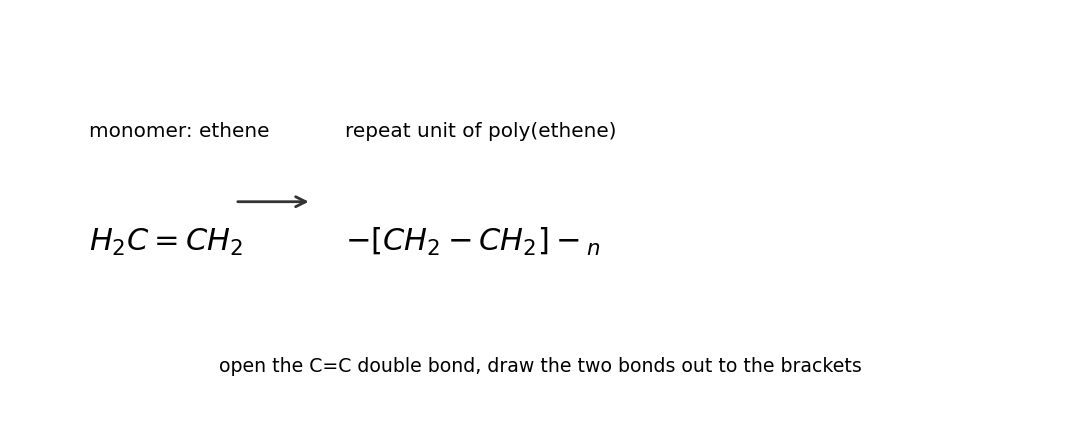
Draw the repeat unit of poly(ethene), poly(propene), poly(chloroethene), PTFE; from a repeat unit, close the two bonds back into a C=C to recover the monomer. Disposal problems: polymers are inert and do not biodegrade, and burning can release toxic gases. (C) Condensation polymerisation: a dicarboxylic acid + a diol link ester bonds, releasing water — a polyester 聚酯; some (biopolyesters) biodegrade.
Check yourself
- Define hydrocarbon, homologous series and isomerism.
- Name the six main fractions of crude oil in boiling-point order.
- Write the products of complete and incomplete combustion of a hydrocarbon.
- Give two pollutant gases from burning fuels and one source of each.
- Why is cracking necessary?
- Write the equation for methane reacting with chlorine in UV light, naming the reaction type.
- How does bromine water distinguish an alkene from an alkane?
- (C) Name the two methods of manufacturing ethanol with one condition for each.
- (C) Which alcohol and acid make ethyl ethanoate, and what else forms?
- (C) What monomers make a polyester, and what small molecule is released?
Answers: 1 a compound of hydrogen and carbon only; a family with the same general formula and functional group, differing by CH₂; molecules with the same molecular formula but different structures; 2 refinery gases, gasoline, kerosene, diesel, fuel oil, bitumen; 3 complete: carbon dioxide + water; incomplete adds carbon monoxide (and soot); 4 carbon monoxide — incomplete combustion; sulfur dioxide — burning sulfur impurities; oxides of nitrogen — hot engine air; 5 supply of long-chain fractions exceeds demand while short fractions and alkenes are in short supply; 6 CH₄ + Cl₂ → CH₃Cl + HCl — substitution (photo, UV); 7 the alkene decolourises orange bromine water; the alkane leaves it orange; 8 (C) ethene + steam, phosphoric acid catalyst, ~300 °C, 60–70 atm; fermentation of glucose with yeast, no air, ~30 °C; 9 (C) ethanol + ethanoic acid — water also forms (acid catalyst); 10 (C) a dicarboxylic acid and a diol; water is released at each ester link.