The reactive world of inorganic chemistry
Drop lithium in water and it fizzes gently; drop potassium and it ignites. This section follows the patterns behind those observations — the families of the Periodic Table, the air we breathe, the ladder of reactivity that decides how every metal is extracted and why iron rusts — and then the huge practical centre of the course: acids, alkalis, salt preparation and the identification tests.
Edexcel International GCSE Chemistry 4CH1, Section 2 (statements 2.1–2.50) supplies most of the recall and practical questions on both papers. C-suffixed statements are Chemistry-only.
Group 1 and Group 7
Group 1 (Li, Na, K) react with water to make the hydroxide and hydrogen — fizzing, floating, melting (Na), lilac flame (K). The reactions get faster and more vigorous down the group: a family with a trend. (C) Reactivity rises because the outer electron is further from the nucleus and lost more easily.
Group 7 (Cl₂ pale green gas, Br₂ orange-brown liquid, I₂ grey-black solid) darken down the group. A more reactive halogen displaces a less reactive one's salt: chlorine displaces bromine from potassium bromide (solution turns orange). (C) Reactivity falls down the group — the outer shell is further away, so gaining an electron is harder.
Air and gases
Dry air: about 78 % nitrogen, 21 % oxygen, 0.96 % argon, 0.04 % carbon dioxide (the four most abundant). The oxygen percentage can be measured by using it up — iron rusting in damp air over water, or phosphorus burning, so the water rises about one-fifth of the way. Elements burn in oxygen: magnesium gives a bright white flame and white MgO; hydrogen burns with a pop to steam; sulfur gives a blue flame and choking SO₂. Copper(II) carbonate decomposes on heating: CuCO₃ → CuO + CO₂ (limewater turns milky). CO₂ is a greenhouse gas 温室气体 whose rising level contributes to climate change.
The reactivity series and metals
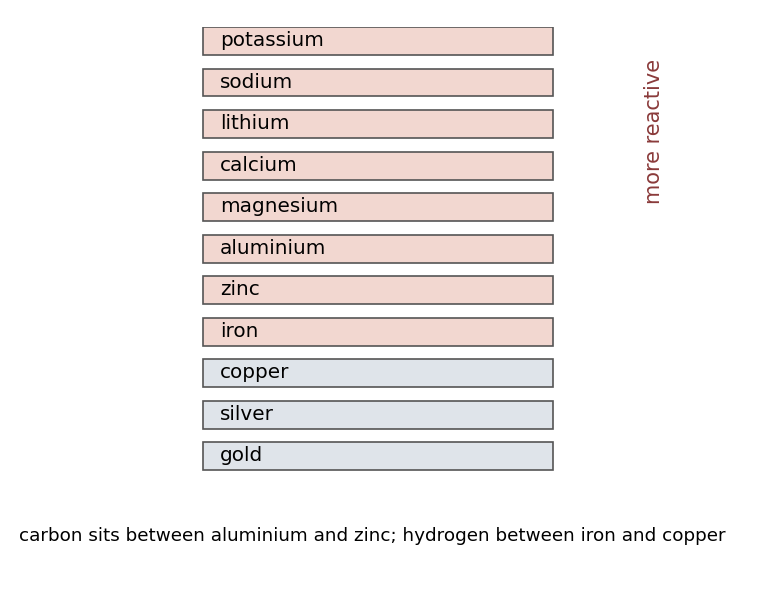
Order to learn: potassium, sodium, lithium, calcium, magnesium, aluminium, (carbon), zinc, iron, (hydrogen), copper, silver, gold. Metals above hydrogen — everything down to iron — react with dilute HCl/H₂SO₄ giving hydrogen; the more reactive, the faster the fizz. A metal displaces any less reactive metal from its salt solution or oxide.
Rusting 生锈 needs oxygen and water; prevented by barrier methods (paint, oil, plastic), galvanising 镀锌 (zinc coat) and sacrificial protection 牺牲保护 (a more reactive metal such as zinc or magnesium corrodes instead). Oxidation 氧化 is loss of electrons or gain of oxygen; reduction 还原 the reverse; a redox reaction has both; the oxidising agent 氧化剂 is reduced, the reducing agent 还原剂 is oxidised.
(C) Extraction matches reactivity: unreactive metals (gold, silver) occur native; those below carbon (iron) are reduced by carbon in a blast furnace; those above (aluminium) need electrolysis of molten ore. Aluminium (low density, resists corrosion), copper (conducts), iron and steels (strong; stainless resists rust) are chosen for their properties. Alloys 合金 mix a metal with other elements and are harder because the different-sized atoms disturb the layers' sliding.
Acids, alkalis and salts
Acids provide H⁺(aq); alkalis provide OH⁻(aq). Indicators: litmus (red in acid, blue in alkali), phenolphthalein (colourless → pink), methyl orange (red → yellow). The pH scale pH值 0–14 classifies solutions (0–3 strongly acidic … 11–14 strongly alkaline); universal indicator measures approximate pH. Neutralisation: acid + alkali → salt + water. (C) Acids are proton donors, bases proton acceptors; alkalis are soluble bases. (C) Titration 滴定: fixed volume of alkali with indicator in a flask, acid from a burette dropwise to the colour change, repeat for concordant results.
Solubility rules: sodium, potassium and ammonium salts — soluble; all nitrates — soluble; chlorides — soluble except AgCl and PbCl₂; sulfates — soluble except BaSO₄, CaSO₄ and PbSO₄; carbonates — insoluble except Na⁺, K⁺, NH₄⁺; hydroxides — insoluble except Na⁺, K⁺ (Ca(OH)₂ slightly).
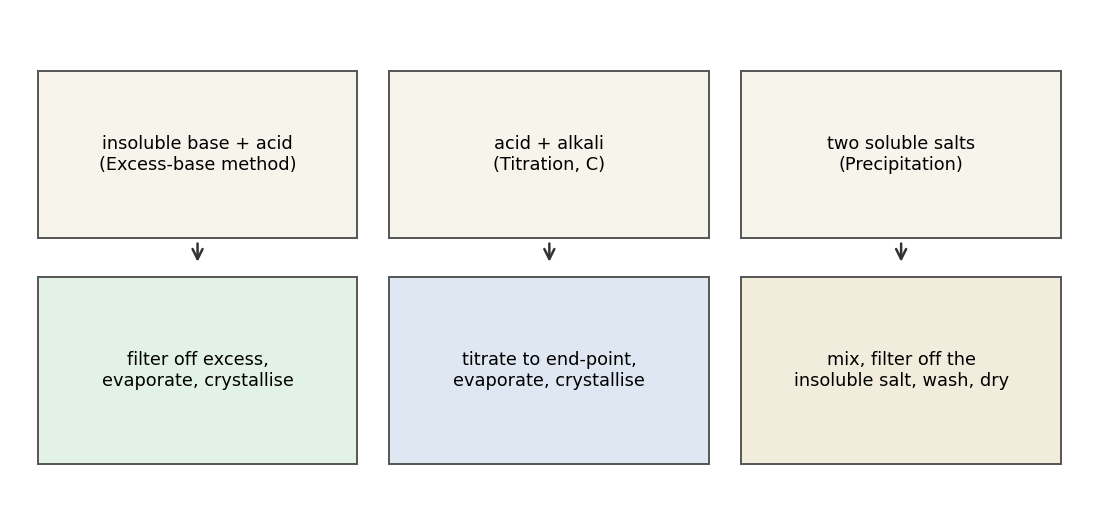
Acid + metal / base / carbonate gives a salt: e.g. Zn + H₂SO₄ → ZnSO₄ + H₂; CuO + 2HNO₃ → Cu(NO₃)₂ + H₂O. Soluble salt from an insoluble reactant (CuO + warm dilute H₂SO₄): add excess base, filter, evaporate, crystallise. (C) From acid + alkali: titrate, then evaporate. (C) Insoluble salt: mix two solutions so a precipitate 沉淀 forms (Pb(NO₃)₂ + Na₂SO₄ → PbSO₄↓ + 2NaNO₃), filter, wash, dry.
Chemical tests

Gases: hydrogen — a lit splint pops; oxygen — relights a glowing splint; carbon dioxide — turns limewater milky; ammonia — turns damp red litmus blue; chlorine — bleaches damp litmus paper white. Cations: flame tests 焰色试验 (Li⁺ red, Na⁺ yellow, K⁺ lilac, Ca²⁺ orange-red, Cu²⁺ blue-green); NH₄⁺ warms with NaOH(aq) giving ammonia; Cu²⁺/Fe²⁺/Fe³⁺ give blue/green/rust-brown precipitates with NaOH(aq). Anions: Cl⁻/Br⁻/I⁻ give white/cream/pale-yellow precipitates with acidified silver nitrate; SO₄²⁻ gives a white precipitate with acidified barium chloride; CO₃²⁻ fizzes with dilute HCl giving CO₂. Water: turns anhydrous copper(II) sulfate white → blue; a pure water sample boils sharply at 100 °C.
Check yourself
- Describe the trend in reactivity down Group 1 and give the (C) electron reason.
- What is seen when chlorine water is added to potassium bromide, and why?
- Name the four most abundant gases in dry air with approximate percentages.
- State the two conditions needed for iron to rust, and two prevention methods.
- Define oxidation and reduction in terms of electrons.
- (C) Why is aluminium extracted by electrolysis but iron by carbon reduction?
- Which chlorides are insoluble, and which sulfates?
- Write the equation for copper(II) oxide reacting with sulfuric acid.
- Describe the flame-test colours for sodium, potassium and copper.
- Describe the test for sulfate ions and the positive result.
Answers: 1 reactivity increases down the group (B1); (C) the outer electron is in a shell further from the nucleus, so it is lost more easily; 2 the solution turns orange — chlorine displaces bromine because chlorine is the more reactive halogen; 3 nitrogen ≈78 %, oxygen ≈21 %, argon ≈0.96 %, carbon dioxide ≈0.04 %; 4 oxygen and water; barrier methods (paint/grease/plastic) and galvanising or sacrificial zinc; 5 oxidation is loss of electrons, reduction is gain; 6 (C) aluminium lies above carbon in the reactivity series, so carbon cannot reduce its oxide — electrolysis of molten alumina is needed; iron lies below carbon, so carbon displaces it from its oxide; 7 AgCl and PbCl₂; BaSO₄, CaSO₄ and PbSO₄; 8 CuO(s) + H₂SO₄(aq) → CuSO₄(aq) + H₂O(l); 9 sodium yellow, potassium lilac, copper blue-green; 10 acidify with dilute hydrochloric acid, add barium chloride solution — a white precipitate of BaSO₄ confirms sulfate.