The language of chemistry
Everything in this course is written in one language: particles, formulae and equations. Section 1 teaches it — how particles arrange themselves in solids, liquids and gases; how atoms are built and lined up in the Periodic Table; how to turn a sentence about a reaction into a balanced equation and a mass calculation; and how the three kinds of bonding give every substance its properties.
Edexcel International GCSE Chemistry 4CH1, Section 1 (statements 1.1–1.60C) is the largest section and the foundation for the other three. C-suffixed statements are the separate-science (Chemistry-only) extension.
States of matter and solutions
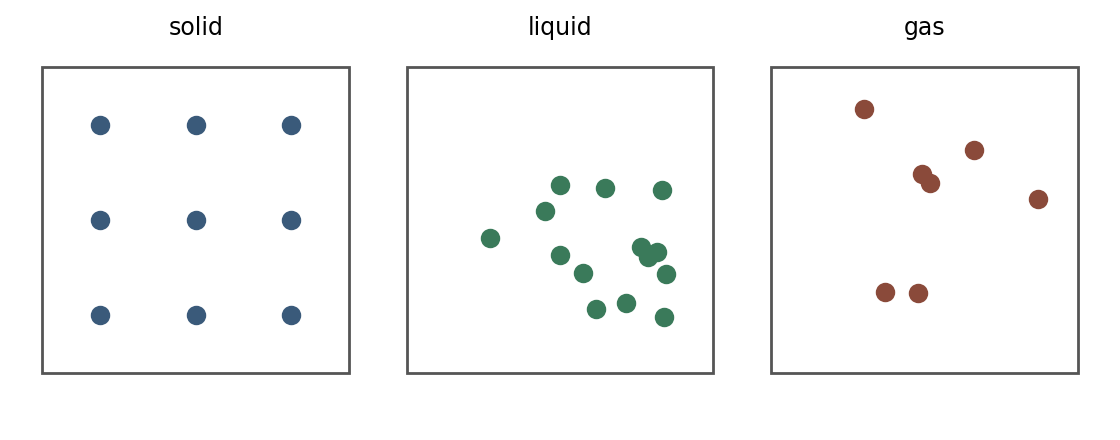
Solid: particles vibrate about fixed positions in a regular pattern. Liquid: particles touch but move past each other at random. Gas: particles far apart, fast, random. Interconversions: melting 熔化 / freezing 凝固, boiling 沸腾 / condensation 凝结, evaporation 蒸发 (surface only, below boiling), sublimation 升华 (solid → gas directly). Energy is absorbed to separate particles and released as they bond again.
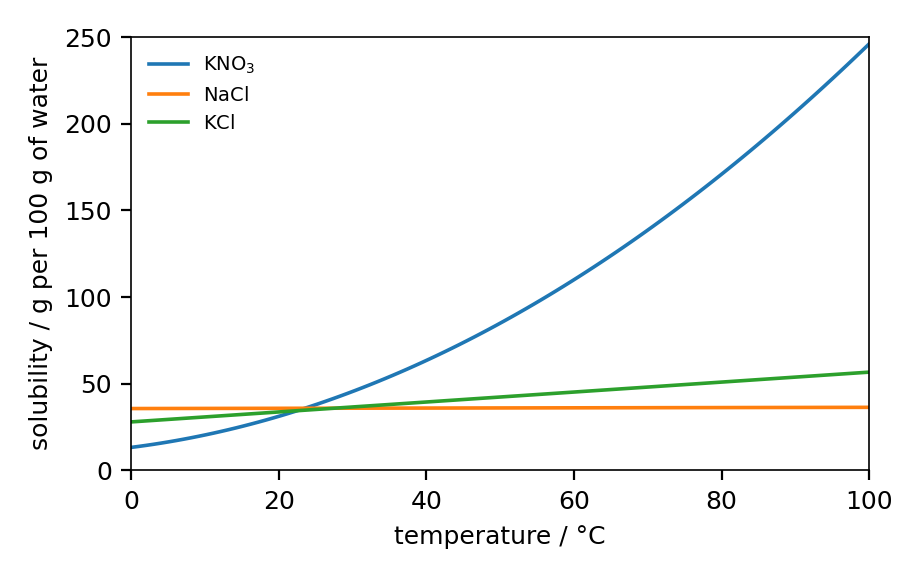
A solvent 溶剂 dissolves the solute 溶质 to make a solution 溶液; a saturated solution 饱和溶液 holds all the solute it can at that temperature. (C) Solubility is the mass dissolved per 100 g of solvent at a stated temperature, read from a solubility curve 溶解度曲线 — points on the line are saturated; below it, unsaturated.
Dilution of coloured solutions and gas diffusion (bromine spreading through air) both show particles moving from where they are many to where they are few.
Elements, compounds, mixtures and separation
An element 元素 contains one type of atom; a compound 化合物 holds different atoms chemically joined; a mixture 混合物 is not chemically joined. A pure substance has a sharp melting/boiling point; mixtures melt and boil over a range — the test for purity.
Separation techniques, matched to the job: filtration 过滤 (insoluble solid from liquid); crystallisation 结晶 (evaporate a solution to leave crystals); simple distillation 蒸馏 (liquid from dissolved solid — evaporate then condense); fractional distillation 分馏 (liquids with close boiling points, using a fractionating column); paper chromatography 纸层析 (solutes that dissolve differently in a solvent).
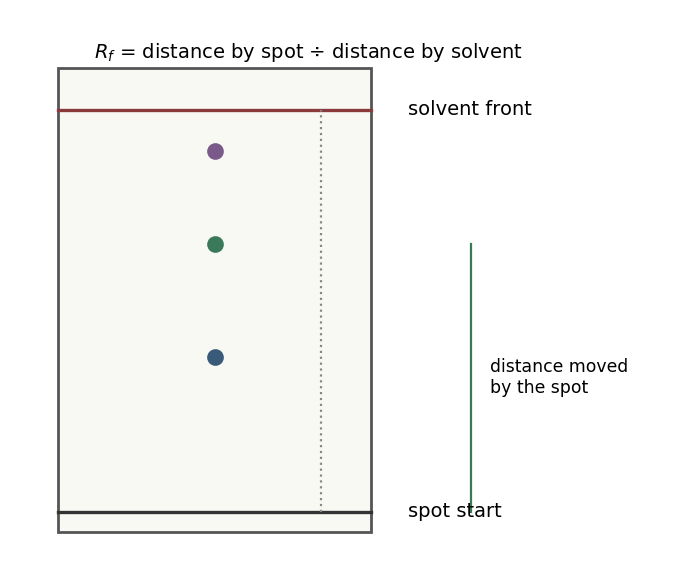
Rf = distance moved by the spot ÷ distance moved by the solvent. The same substance always has the same Rf in the same solvent — comparing with known values identifies the components of the mixture.
Atoms and the Periodic Table
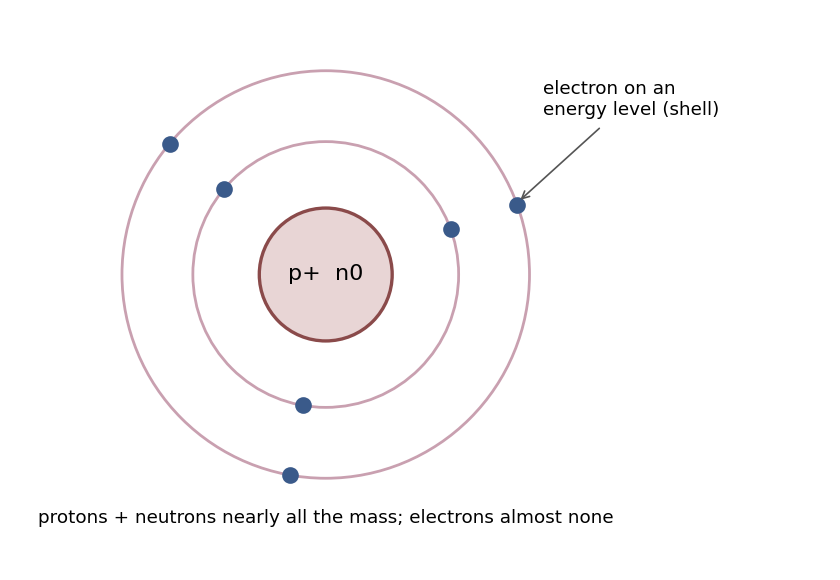
| Particle | Relative mass | Relative charge |
|---|---|---|
| proton | 1 | +1 |
| neutron | 1 | 0 |
| electron | 1/1835 (≈0) | −1 |
Atomic number 质子数 = protons; mass number 质量数 = protons + neutrons. Isotopes 同位素 have the same protons but different neutrons. Relative atomic mass ($A_r$) is the weighted mean over the isotopes.
Worked check. Chlorine: 75 % Cl-35, 25 % Cl-37 → $A_r = (75 \times 35 + 25 \times 37)/100 = 35.5$.
The Periodic Table lists elements by atomic number into groups 族 (columns, same outer electrons) and periods 周期 (rows). The first 20 electronic configurations follow 2,8,8,2 shells (e.g. sodium 2.8.1). Metals sit left/centre: their oxides are basic and they conduct; non-metal oxides are acidic. Group members behave alike because they have the same number of outer electrons; Group 0 noble gases have full outer shells and do not readily react.
Formulae, equations and calculations
Balance equations with state symbols 状态符号: (s), (l), (g), (aq). $M_r$ sums the $A_r$ values. The mole 摩尔 is the amount of substance: $n = m/M_r$ (mass in grams).
Worked check (reacting masses). What mass of magnesium oxide forms from 6.0 g of magnesium? $2\mathrm{Mg} + \mathrm{O_2} \rightarrow 2\mathrm{MgO}$: $n(\mathrm{Mg}) = 6.0/24 = 0.25$ mol → $n(\mathrm{MgO}) = 0.25$ mol → mass $= 0.25 \times 40 = 10$ g.
Percentage yield 产率 $=$ actual ÷ theoretical × 100 %. Empirical formula 实验式 is the simplest whole-number ratio (divide each mass by its $A_r$, scale to integers); the molecular formula is the true count ($M_r$ ÷ empirical mass gives the multiplier).
Worked check. A hydrocarbon is 85.7 % C, 14.3 % H: C 85.7/12 = 7.14, H 14.3/1 = 14.3 → ratio 1:2 → empirical CH₂. With $M_r = 56$: 56/14 = 4 → molecular C₄H₈.
(C) Solutions: $n = c \times V$ with $c$ in mol/dm³ and $V$ in dm³ (cm³ ÷ 1000). Gases: molar volume 24 dm³ at rtp, so $n = V/24$. (C-practical) A metal oxide's formula comes from combustion (weigh magnesium, burn, weigh the oxide) or reduction (weigh copper(II) oxide, reduce with hydrogen, weigh the copper).
Bonding
Ionic bonding 离子键: metals lose electrons to non-metals; the charged ions attract electrostatically in a giant lattice — dot-and-cross diagrams show the transfer (Groups 1–3 with 5–7). High melting points (strong attractions); conduct only when molten or dissolved (ions free to move). Learn the charges: Groups 1/2/3 → 1+/2+/3+; Groups 5/6/7 → 3−/2−/1−; Ag⁺, Cu²⁺, Fe²⁺, Fe³⁺, Pb²⁺, Zn²⁺; OH⁻, NH₄⁺, CO₃²⁻, NO₃⁻, SO₄²⁻. Formulae balance the charges: calcium nitrate Ca(NO₃)₂, ammonium sulfate (NH₄)₂SO₄.
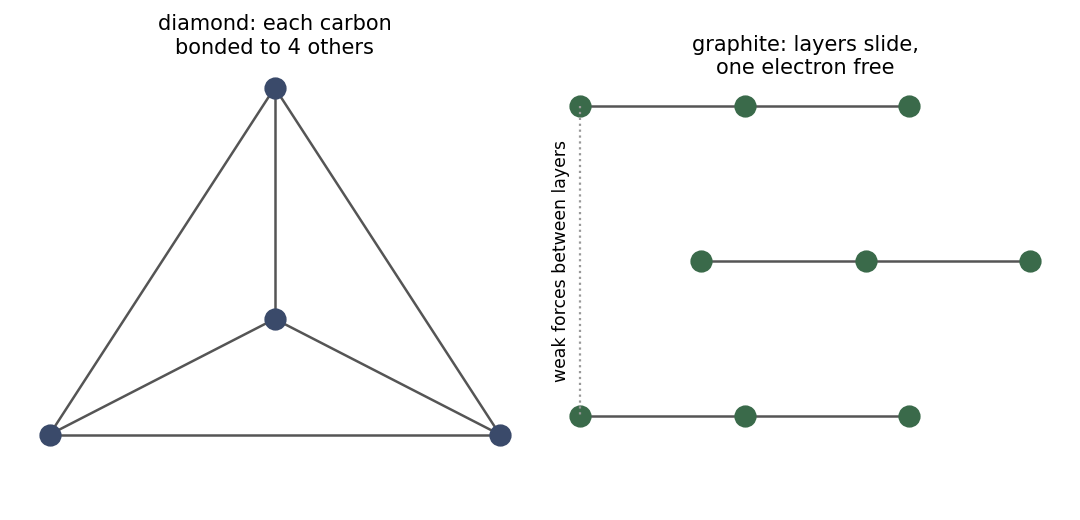
Covalent bonding 共价键: shared pairs of electrons (dot-and-cross for H₂, O₂, N₂, halogens, HCl, H₂O, NH₃, CO₂ and small organics). Simple molecular substances have weak intermolecular forces — low melting points, rising with $M_r$; they do not conduct (no ions, no free electrons). Giant covalent: diamond (each C bonded to 4 — very hard, non-conductor), graphite (3 bonds + one free electron per C, layers with weak forces — soft, conducts, slippery), C₆₀ fullerene (simple molecular cage).
(C) Metallic: a lattice of positive ions in a sea of delocalised electrons — electrostatic attraction; the free electrons conduct electricity, and layers slide (malleable).
Electrolysis (C)
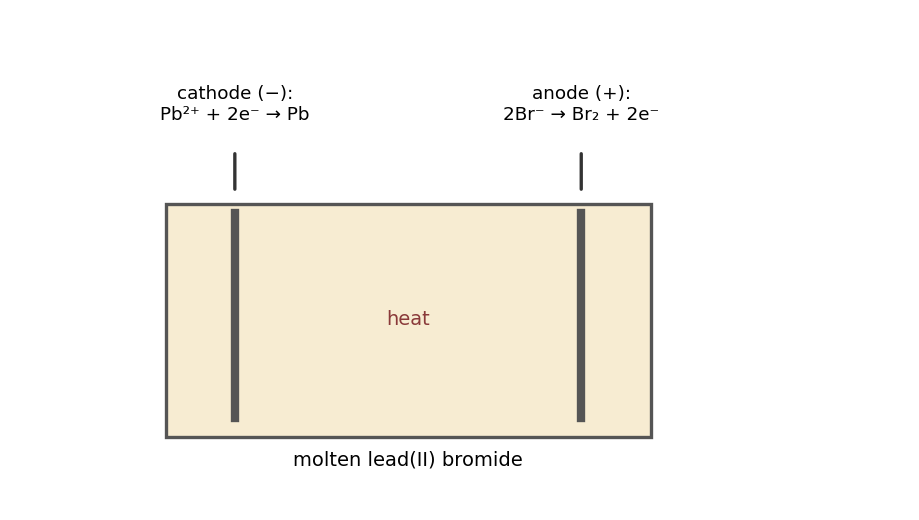
Electrolysis 电解 uses electricity to split molten or dissolved ionic compounds: the cathode 阴极 (negative) attracts cations 阳离子; the anode 阳极 (positive) attracts anions 阴离子. Molten PbBr₂ gives Pb at the cathode (Pb²⁺ + 2e⁻ → Pb) and Br₂ at the anode (2Br⁻ → Br₂ + 2e⁻). In aqueous solution, hydrogen forms at the cathode if the metal is more reactive than hydrogen; at the anode, halide ions give the halogen, otherwise oxygen (4OH⁻ → O₂ + 2H₂O + 4e⁻). Loss of electrons is oxidation 氧化, gain is reduction 还原.
Check yourself
- Describe the particle arrangement and movement in a liquid.
- Define saturated solution, and state the units of solubility.
- Which technique separates two miscible liquids with close boiling points?
- An isotope has 17 protons and 20 neutrons. Give its mass number and the numbers of each particle.
- Calculate $A_r$ of an element with 80 % of mass 20 and 20 % of mass 22.
- Balance with state symbols: magnesium + oxygen → magnesium oxide.
- 8.4 g of the oxide of calcium forms from 6.0 g of calcium. Show the empirical formula of the oxide.
- Write the formula of ammonium carbonate.
- Explain why graphite conducts but diamond does not.
- (C) What forms at each electrode in the electrolysis of molten potassium chloride?
Answers: 1 particles touch but are disordered, moving randomly past each other; 2 a solution containing the maximum mass of dissolved solute at that temperature; g per 100 g of solvent; 3 fractional distillation; 4 mass number 37; 17 protons, 20 neutrons, 17 electrons; 5 $(80 \times 20 + 20 \times 22)/100 = 20.4$; 6 2Mg(s) + O₂(g) → 2MgO(s); 7 Ca 6.0/40 = 0.15 mol; O mass 8.4 − 6.0 = 2.4 g → 2.4/16 = 0.15 mol; ratio 1:1 → empirical formula CaO; 8 (NH₄)₂CO₃; 9 graphite uses three bonds per carbon, leaving one delocalised electron per carbon free to move between layers — diamond uses all four in fixed bonds; 10 (C) potassium at the cathode (K⁺ + e⁻ → K) and chlorine at the anode (2Cl⁻ → Cl₂ + 2e⁻).