From cell to system
One cell became many; many cells became tissues, organs and systems; and every system serves the same three jobs — taking in what the body needs, moving it to where it is used, and removing what the body must not keep. This section is the core of IGCSE Biology: cells and molecules, how substances cross membranes, nutrition in plants and humans, respiration, gas exchange, transport, excretion and coordination.
Edexcel International GCSE Biology 4BI1, Section 2 (statements 2.1–2.95) is the largest section of the course and feeds every long question on both papers. B-suffixed statements are the separate-science (Biology-only) extension; double-award students learn the unlettered core.
Organisation and cells
Organisation runs upward: organelles 细胞器 → cells 细胞 → tissues 组织 → organs 器官 → systems 系统.
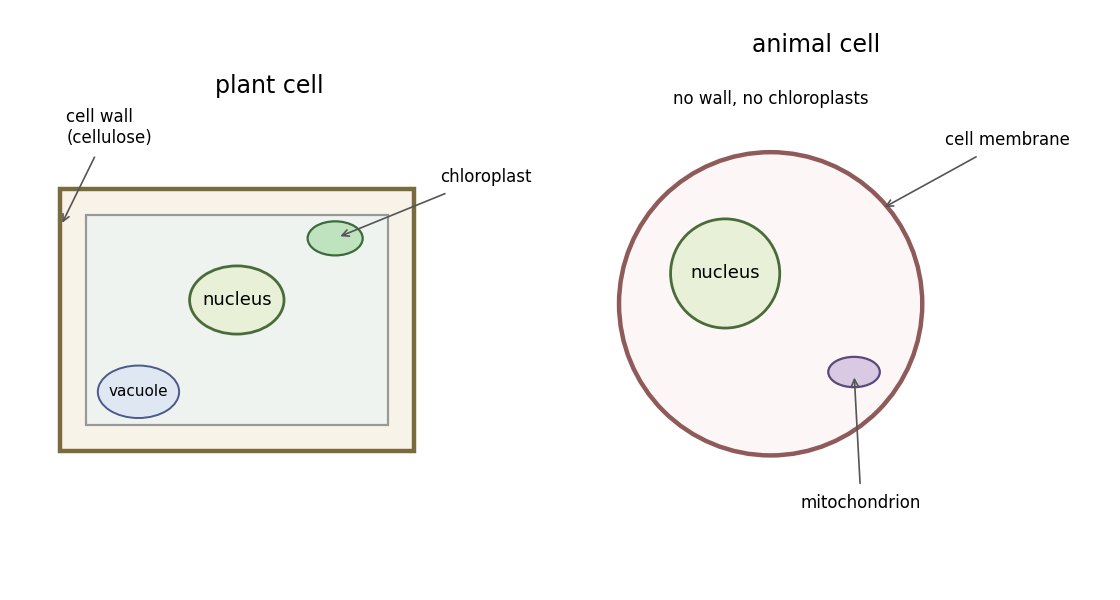
| Structure | Function |
|---|---|
| Nucleus | contains DNA, controls the cell |
| Cytoplasm | where reactions happen |
| Cell membrane | controls what enters and leaves |
| Cell wall (plants) | strength (cellulose) |
| Mitochondria | release energy in respiration |
| Chloroplasts (plants) | absorb light for photosynthesis |
| Ribosomes | protein synthesis |
| Vacuole | stores water and dissolved substances (large and permanent in plants) |
2.5B Specialised cells develop by cell differentiation 细胞分化; 2.6B stem cells can replace damaged cells — advantages: treat conditions like paralysis or leukaemia; disadvantages: ethical concerns over embryos, risk of rejection and uncontrolled division.
Biological molecules and enzymes
Carbohydrates contain C, H, O; proteins add N; lipids are C, H, O with much less oxygen. Large molecules are chains of small units: starch and glycogen from simple sugars, protein from amino acids, lipid from fatty acids and glycerol. 2.9 Food tests: glucose — Benedict's (heated, blue → brick red); starch — iodine (yellow-brown → blue-black); protein — Biuret (blue → purple); fat — ethanol emulsion (cloudy white layer).
Enzymes 酶 are biological catalysts 生物催化剂: they speed metabolic reactions without being used up. Each has an active site 活性部位 the substrate must fit. Above an optimum temperature or away from the optimum pH, the active site changes shape (denaturation 变性) and the enzyme no longer works. Practical 2.12/2.14B follow amylase digesting starch at different temperatures or pH with iodine.
Movement into and out of cells
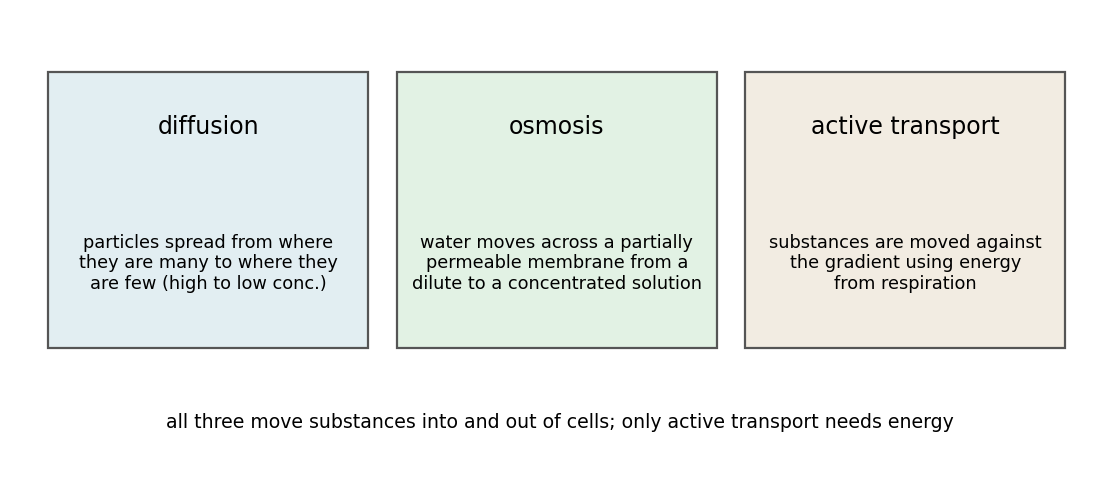
Diffusion 扩散 is the net movement of particles from a higher to a lower concentration (oxygen into blood). Osmosis 渗透 is the diffusion of water across a partially permeable membrane from a dilute to a more concentrated solution. Active transport 主动运输 moves substances against the gradient using energy from respiration (mineral ions into root hair cells). Rate increases with surface-area-to-volume ratio, concentration gradient and temperature, and decreases with distance.
Nutrition
Flowering plants. Photosynthesis converts light energy into chemical energy stored in glucose:
Limiting factors: carbon dioxide concentration, light intensity, temperature — each raises rate until another factor limits. Magnesium ions build chlorophyll (deficiency yellows leaves); nitrate ions build amino acids. 2.23: pondweed shows oxygen evolution; iodine tests a leaf for starch after blocking light, CO₂ or chlorophyll.
Humans. A balanced diet: carbohydrate, protein, lipid, vitamins A (night vision), C (connective tissue), D (calcium absorption), calcium (bones) and iron (haemoglobin), water, and dietary fibre. Energy needs rise with activity, growth (age) and pregnancy. The alimentary canal — mouth → oesophagus → stomach → duodenum and ileum → colon and rectum, with the pancreas supplying enzymes — moves food by peristalsis 蠕动. Digestion: amylase and maltase (starch → glucose), proteases (protein → amino acids), lipases (lipid → fatty acids + glycerol). Bile (made in the liver, stored in the gall bladder) neutralises stomach acid and emulsifies lipids into droplets. The ileum's wall is folded into villi 绒毛: huge surface area, one-cell-thick walls, dense capillary network — built for absorption.
Respiration and gas exchange
Respiration releases energy from glucose to make ATP, which supplies energy for muscle contraction, protein synthesis and active transport. Aerobic: glucose + oxygen → carbon dioxide + water (symbol equation: C₆H₁₂O₆ + 6O₂ → 6CO₂ + 6H₂O). Anaerobic (without oxygen): in animals glucose → lactic acid (less energy, oxygen debt); in plants and yeast glucose → ethanol + carbon dioxide.
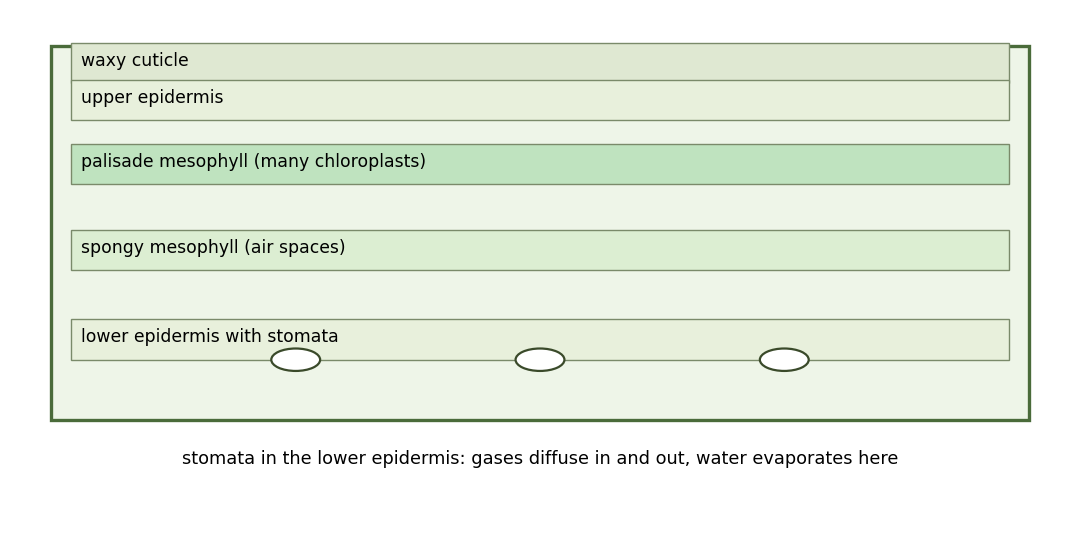
Plants (2.40B–2.45B). Gases move by diffusion through stomata; the leaf's flat shape, air spaces and thin, moist surfaces serve gas exchange as they serve photosynthesis. By day, photosynthesis outweighs respiration, so the net exchange is CO₂ in and O₂ out; at night only respiration continues (net O₂ in, CO₂ out). Hydrogen-carbonate indicator shows this: orange → yellow with CO₂ (dark), orange → purple with less CO₂ (bright light).
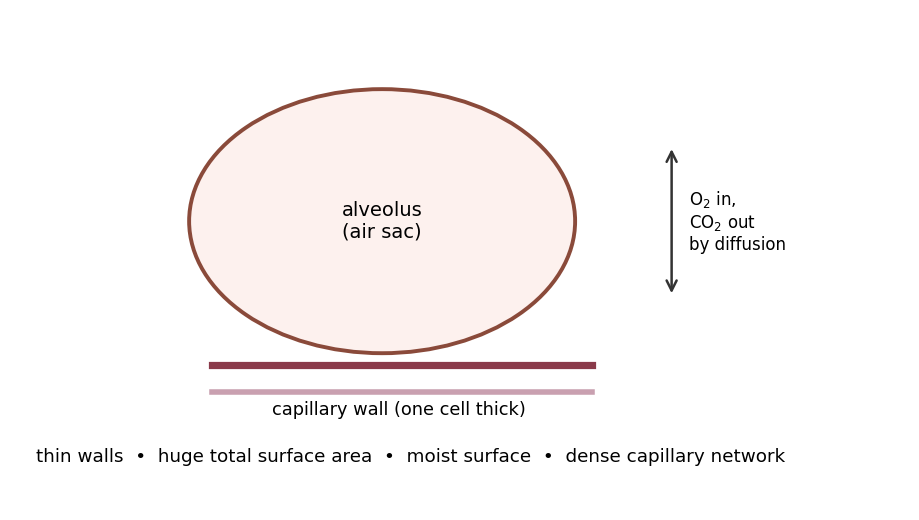
Humans (2.46–2.50). The thorax: ribs, intercostal muscles, diaphragm, trachea → bronchi → bronchioles → alveoli, all in pleural membranes. Inhaling: intercostal muscles and diaphragm contract, the chest volume rises, pressure falls and air flows in. Smoking damages alveoli (emphysema), clogs arteries and raises coronary heart disease risk.
Transport
Unicellular organisms manage with diffusion alone — every part is close to the surface. Multicellular organisms need transport systems.
Plants. Xylem transports water and mineral ions from roots to leaves; phloem carries sucrose and amino acids between leaves and the rest of the plant. B-extension: root hair cells absorb water by osmosis; transpiration 蒸腾作用 is the evaporation of water from surfaces, mostly via stomata, faster in low humidity, high wind, high temperature and bright light.
Humans. Blood: plasma (carries CO₂, digested food, urea, hormones, heat), red blood cells (biconcave discs, no nucleus, full of haemoglobin 血红蛋白 — a large surface and short diffusion path for oxygen), white blood cells (phagocytes ingest pathogens; lymphocytes release specific antibodies), and platelets (clotting, B-extension; vaccination builds memory cells, B-extension).
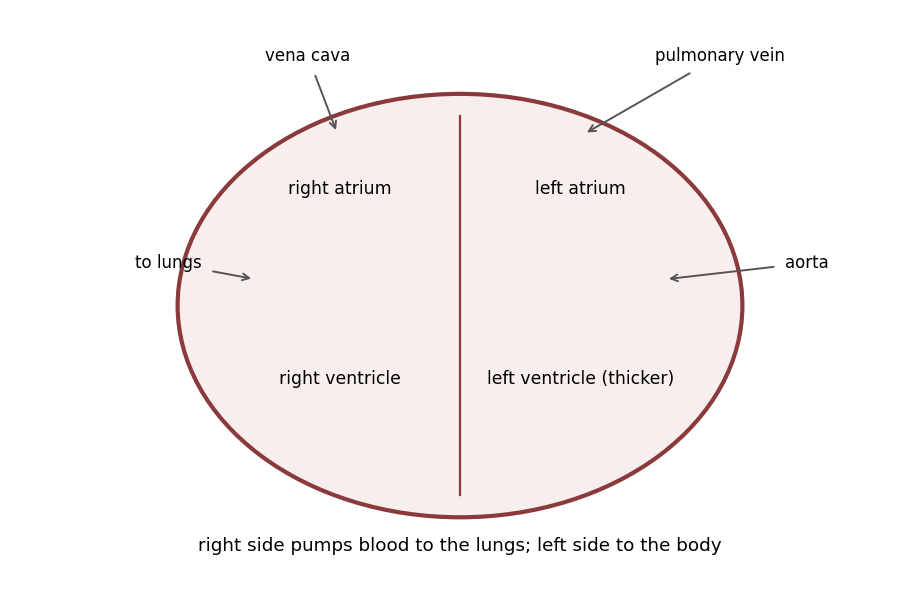
The heart's right side pumps blood to the lungs, the left side to the body; exercise and adrenaline raise heart rate. Arteries carry blood away at high pressure (thick, elastic walls), veins return it at low pressure (wide lumen, valves), capillaries exchange materials (one-cell-thick walls). Risk factors for coronary heart disease include smoking, high-fat diet and lack of exercise.
Excretion
Plants lose waste O₂ and CO₂ through stomata. Humans excrete CO₂ (lungs), urea + water + ions (kidneys — water and urea also in sweat). B-extension: the kidney filters blood in nephrons (Bowman's capsule → glomerulus; ultrafiltration; selective reabsorption of all glucose at the proximal convoluted tubule; water reabsorbed from the collecting duct under ADH — osmoregulation). Urine holds water, urea and ions; the urinary system runs kidneys → ureters → bladder → urethra.
Coordination and response
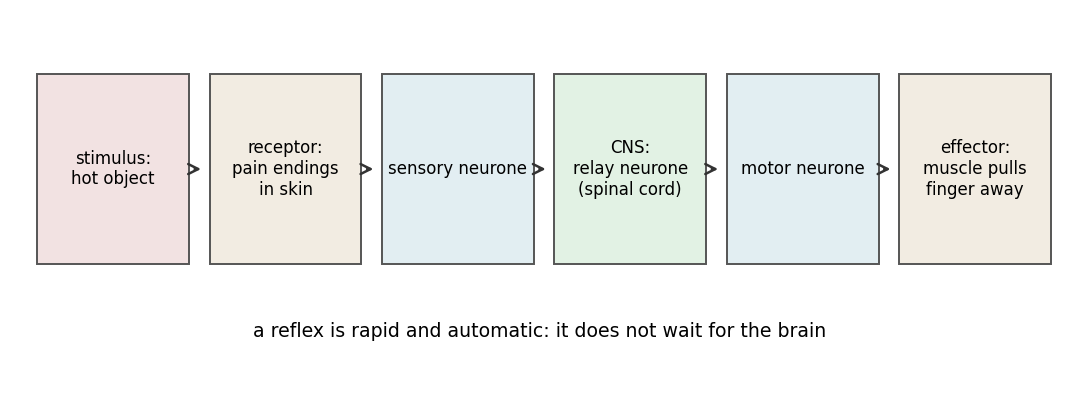
Homeostasis 稳态 keeps the internal environment constant (water content, temperature). A coordinated response needs stimulus → receptor → effector. Plants respond to light (phototropism 向光性) and gravity (geotropism) — shoots grow towards light, roots downwards — controlled by auxin 生长素 accumulating on the shaded side of a shoot.
Nervous control is electrical, fast and short-lived; hormonal control is chemical in the blood, slower and longer-lasting. The CNS (brain and spinal cord) links to sense organs by nerves; at a synapse 突触 a neurotransmitter 神经递质 passes the signal between neurones.
The eye focuses by changing lens shape (near: more curved) and responds to light via the pupil. Skin temperature control: sweating cools by evaporation; vasodilation loses heat; vasoconstriction conserves it. Hormones: adrenaline (adrenal glands — fight or flight), insulin (pancreas — lowers blood glucose), testosterone (testes), progesterone and oestrogen (ovaries); B-extension adds ADH (pituitary), FSH and LH (pituitary — menstrual cycle).
Check yourself
- Put in order of size: cell, organ, organelle, system, tissue.
- Give two structures a plant cell has that an animal cell lacks, and one the animal cell has that most plant cells lack many of.
- Name the small units that build proteins, starch and lipids.
- State the colour changes for Benedict's, iodine and Biuret tests.
- Why does heating an enzyme far above its optimum stop it working?
- Distinguish diffusion, osmosis and active transport in one sentence each.
- Write the balanced symbol equation for photosynthesis and for aerobic respiration.
- Give two adaptations of the leaf for photosynthesis and two of the alveolus for gas exchange.
- Why can a single-celled organism survive without a transport system?
- Compare arteries, veins and capillaries by wall thickness, lumen size and function.
- Outline what happens to glucose, water and urea as liquid passes along a nephron (B).
- State the pathway of a reflex arc, and give one advantage of reflexes.
Answers: 1 organelle → cell → tissue → organ → system; 2 cellulose wall and chloroplasts (and a large permanent vacuole); animal cells contain many mitochondria; 3 amino acids; simple sugars; fatty acids and glycerol; 4 Benedict's blue → brick red (with glucose, heated); iodine yellow-brown → blue-black (with starch); Biuret blue → purple (with protein); 5 the active site changes shape (denaturation) so the substrate no longer fits; 6 diffusion — net movement down a concentration gradient; osmosis — water only, across a partially permeable membrane; active transport — against the gradient, using energy; 7 6CO₂ + 6H₂O → C₆H₁₂O₆ + 6O₂ (light, chlorophyll); C₆H₁₂O₆ + 6O₂ → 6CO₂ + 6H₂O; 8 leaf: broad flat surface and palisade cells packed with chloroplasts (or air spaces/stomata); alveolus: one-cell-thin walls and enormous surface area (moist surface, capillary network); 9 its surface area is large compared with its volume, so diffusion reaches every part quickly enough; 10 arteries — thick muscular walls, narrow lumen, carry blood away at high pressure; veins — thin walls, wide lumen, valves, return blood at low pressure; capillaries — one-cell-thick walls, exchange materials; 11 (B) all glucose is selectively reabsorbed into the blood at the proximal convoluted tubule; water is reabsorbed from the collecting duct (controlled by ADH); urea is not reabsorbed and leaves in the urine with water and ions; 12 stimulus → receptor → sensory neurone → relay neurone (CNS) → motor neurone → effector; reflexes are rapid and automatic, protecting the body before harm is done.