What counts as alive?
A housefly and a maize plant could not look more different, yet both are alive in the same eight ways, and both are built from the same kind of cell. This first section gives you the words for that shared life — the characteristics every organism shows — and a map of life's variety: five groups of organisms plus the viruses, which are not alive at all but still infect every living thing.
Edexcel International GCSE Biology 4BI1, Section 1 is assessed in both papers; expect direct recall and "compare" questions from 1.1–1.4, often one mark for a feature and one for the named example.
The characteristics of life
Every living organism does all eight: it takes in nutrition 营养 (material for energy or growth), it respires 呼吸 (releases energy from food), it excretes 排泄 (removes waste), it responds 反应 to its surroundings, it moves 运动, it controls its internal conditions (keeps itself steady inside), it reproduces 繁殖, and it grows and develops 生长. The memory hook MRS GREN lists movement, reproduction, sensitivity, growth, respiration, excretion, nutrition — the "control of internal conditions" is the eighth that the hook leaves out, so name it separately.
A virus does none of these by itself — that is why it is not living.
Variety: the five groups and their give-away features
Plants 植物: multicellular; cells contain chloroplasts 叶绿体 and carry out photosynthesis 光合作用; walls of cellulose 纤维素; carbohydrate stored as starch 淀粉 or sucrose. Examples: a cereal (maize) and a herbaceous legume (peas or beans).
Animals 动物: multicellular; no chloroplasts, no photosynthesis; no cell walls; usually nervous coordination and movement from place to another; store carbohydrate as glycogen 糖原. Examples: mammals (humans) and insects (housefly, mosquito).
Fungi 真菌: no photosynthesis; body usually a mycelium 菌丝体 of thread-like hyphae 菌丝 containing many nuclei; some single-celled (yeast); walls of chitin 几丁质; feed by secreting digestive enzymes onto food outside the body and absorbing the products — saprotrophic nutrition 腐生营养; store glycogen. Examples: Mucor (typical hyphae) and yeast 酵母 (single-celled).
Protoctists 原生生物: microscopic single-celled organisms. Amoeba (pond water) is like an animal cell; Chlorella has chloroplasts and is like a plant. The pathogenic example is Plasmodium, which causes malaria 疟疾.
Bacteria 细菌: microscopic single-celled organisms with a cell wall, cell membrane, cytoplasm and plasmids 质粒; they lack a nucleus but have a circular chromosome of DNA 环状DNA. Some photosynthesise; most feed off living or dead organisms. Examples: Lactobacillus bulgaricus (rod-shaped, used to make yoghurt) and Pneumococcus (spherical, causes pneumonia 肺炎).
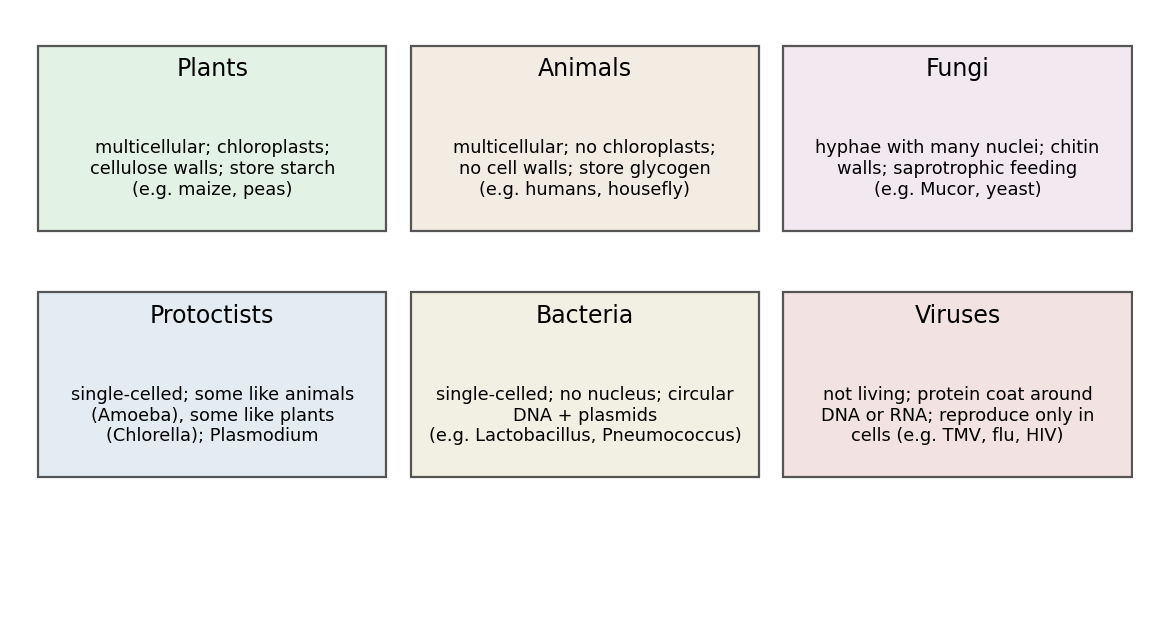
The four-way comparison the examiners like: cell wall material (cellulose / none / chitin / bacterial wall), nucleus (yes / yes / yes / no), chloroplasts (plants and some protoctists only), storage carbohydrate (starch / glycogen / glycogen / —).
Pathogens and the viruses
A pathogen 病原体 is any organism or particle that causes disease — the specification allows fungi, bacteria, protoctists or viruses.
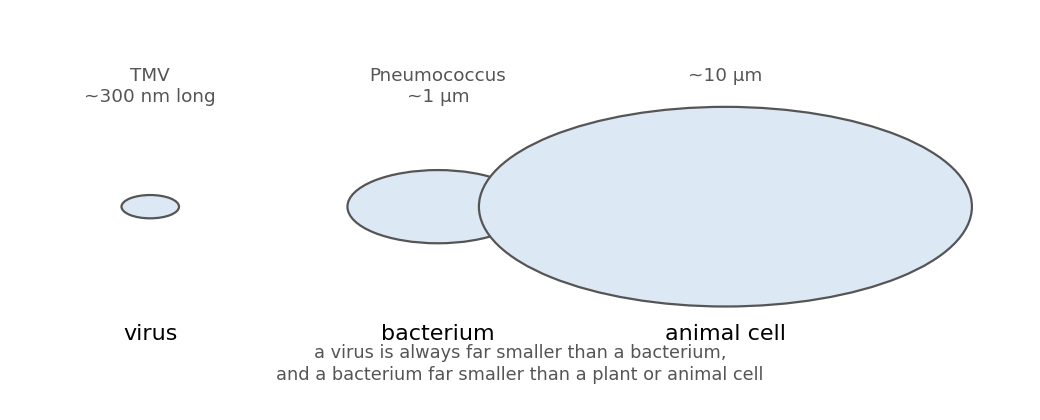
Viruses 病毒 are not living organisms: they are small particles (smaller than bacteria), parasitic, and can reproduce only inside living cells; they have no cellular structure — just a protein coat 蛋白质外壳 containing one type of nucleic acid, DNA or RNA (never both). Learn the three named examples with their diseases: tobacco mosaic virus 烟草花叶病毒 (discoloured tobacco leaves — it stops chloroplasts forming), influenza virus 流感病毒 (flu) and HIV 艾滋病毒 (AIDS).
Check yourself
- List the eight characteristics shared by all living organisms.
- Give two features of a plant cell that an animal cell lacks.
- Which group stores carbohydrate as glycogen, and which as starch?
- Describe saprotrophic nutrition in fungi, using the words hyphae, enzymes and absorb.
- How does the genetic material of a bacterium differ from that of a plant cell?
- Name the pathogenic protoctist and the disease it causes.
- State three reasons why viruses are not classified as living organisms.
- Which named virus prevents chloroplast formation, and what is the visible result?
Answers: 1 nutrition, respiration, excretion, response, movement, control of internal conditions, reproduction, growth; 2 chloroplasts and a cellulose cell wall; 3 animals and fungi store glycogen; plants store starch (or sucrose); 4 fungi secrete digestive enzymes from their hyphae onto dead food material, then absorb the soluble organic products; 5 a bacterium has no nucleus — circular DNA chromosome plus plasmids — while a plant cell keeps its DNA in a nucleus; 6 Plasmodium — malaria; 7 no cellular structure; reproduce only inside living cells; no life processes alone; 8 tobacco mosaic virus — discoloured, mosaic-patterned leaves.