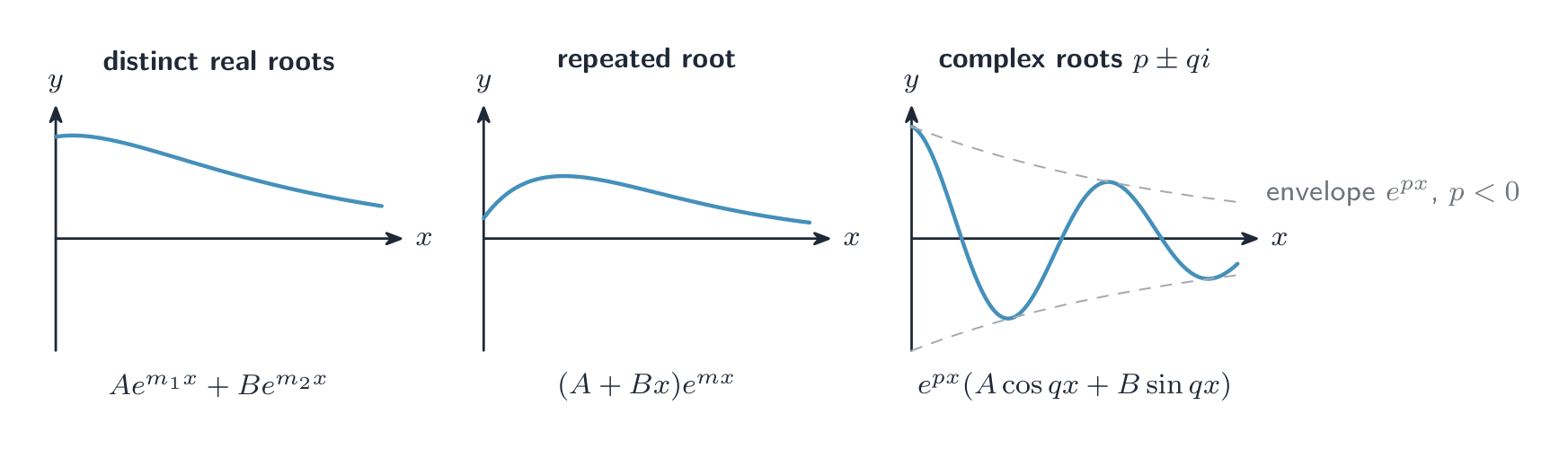
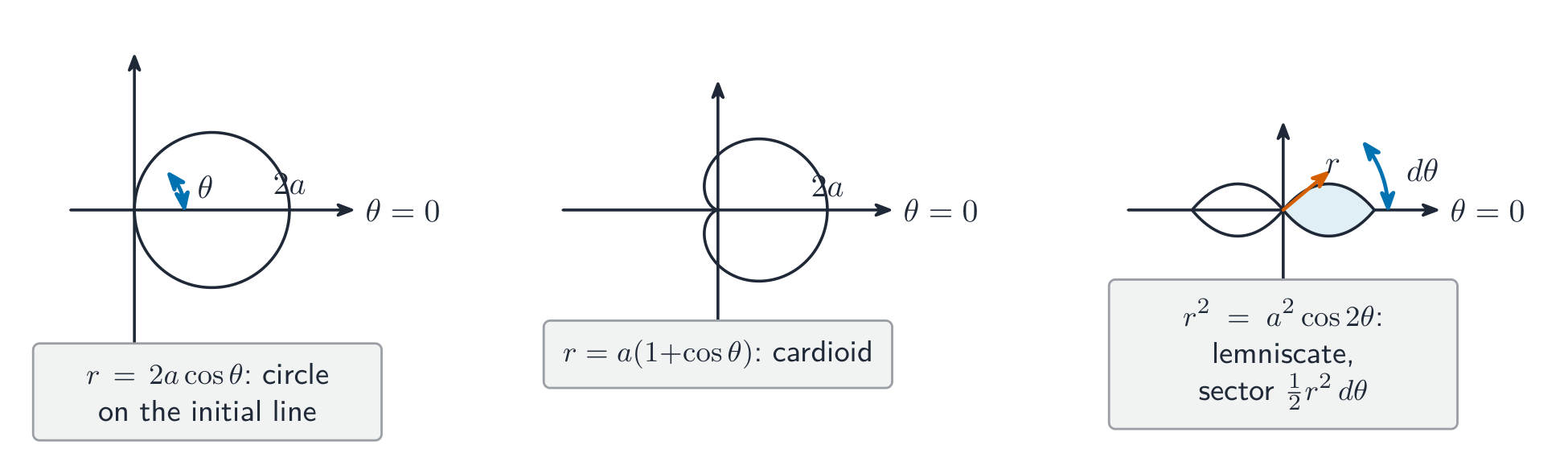
Why it matters. In 1748 the Swiss mathematician Leonhard Euler, then working at the Berlin Academy, published Introductio in analysin infinitorum, a textbook on infinite series. In chapter 8 he showed that the series for $e^x$, $\cos x$ and $\sin x$ fit together in a surprising way when $x$ is imaginary: $e^{ix} = \cos x + i\sin x$. Put $x = \pi$ and you get $e^{i\pi} + 1 = 0$, which links the five most important numbers in mathematics. Euler's formula turns difficult trigonometry into simple algebra with powers. Engineers use it every day to analyse vibrating bridges, electrical circuits and radio signals, and the differential equations in this unit describe the same vibrations.
In this unit you will:
- solve inequalities involving the modulus sign, and sum series by the method of differences;
- use Euler's relation and de Moivre's theorem, and find the $n$th roots of complex numbers;
- sketch loci in the Argand diagram, and find images under transformations $w = \frac{az + b}{cz + d}$;
- solve first and second order differential equations;
- find Maclaurin and Taylor series, and work with curves in polar coordinates.
Edexcel International A Level, Further Pure Mathematics 2 (FP2, paper WFM02/01, 1 hour 30 minutes, 75 marks). Pure Mathematics 1 to 4 and FP1 are assumed, especially partial fractions, integration by parts and substitution, separation of variables, and complex numbers.
These results are assumed knowledge:
| Topic | Results |
|---|---|
| modulus | $\lvert x\rvert = x$ if $x \ge 0$ and $-x$ if $x < 0$; $\lvert z_1z_2\rvert = \lvert z_1\rvert\lvert z_2\rvert$, $\arg(z_1z_2) = \arg z_1 + \arg z_2$ |
| sums | $\sum r = \tfrac12 n(n + 1)$; $\sum r^2$ and $\sum r^3$ are in the formula booklet |
| partial fractions | for example $\dfrac{1}{r(r + 1)} = \dfrac1r - \dfrac{1}{r + 1}$ |
| calculus | product, quotient and chain rules; integration by substitution, by parts and with partial fractions |