Why it matters. In 1545 the Italian doctor and mathematician Gerolamo Cardano published Ars Magna (The Great Art), with the first printed method for solving cubic equations. One of his problems was to split 10 into two parts whose product is 40. The answer, $5 + \sqrt{-15}$ and $5 - \sqrt{-15}$, seemed meaningless, and Cardano called it "as subtle as it is useless". In 1572 Rafael Bombelli went further. For the cubic $x^3 = 15x + 4$, Cardano's formula needs the square root of $-121$, yet the equation has the ordinary answer $x = 4$. Bombelli showed that if you calculate with $\sqrt{-1}$ as if it were a number, the impossible parts cancel and 4 appears. Today these complex numbers describe alternating current, signal processing and quantum physics.
In this unit you will:
- calculate with complex numbers, and find the complex roots of polynomials with real coefficients;
- use the sum and product of the roots of a quadratic, and solve equations numerically;
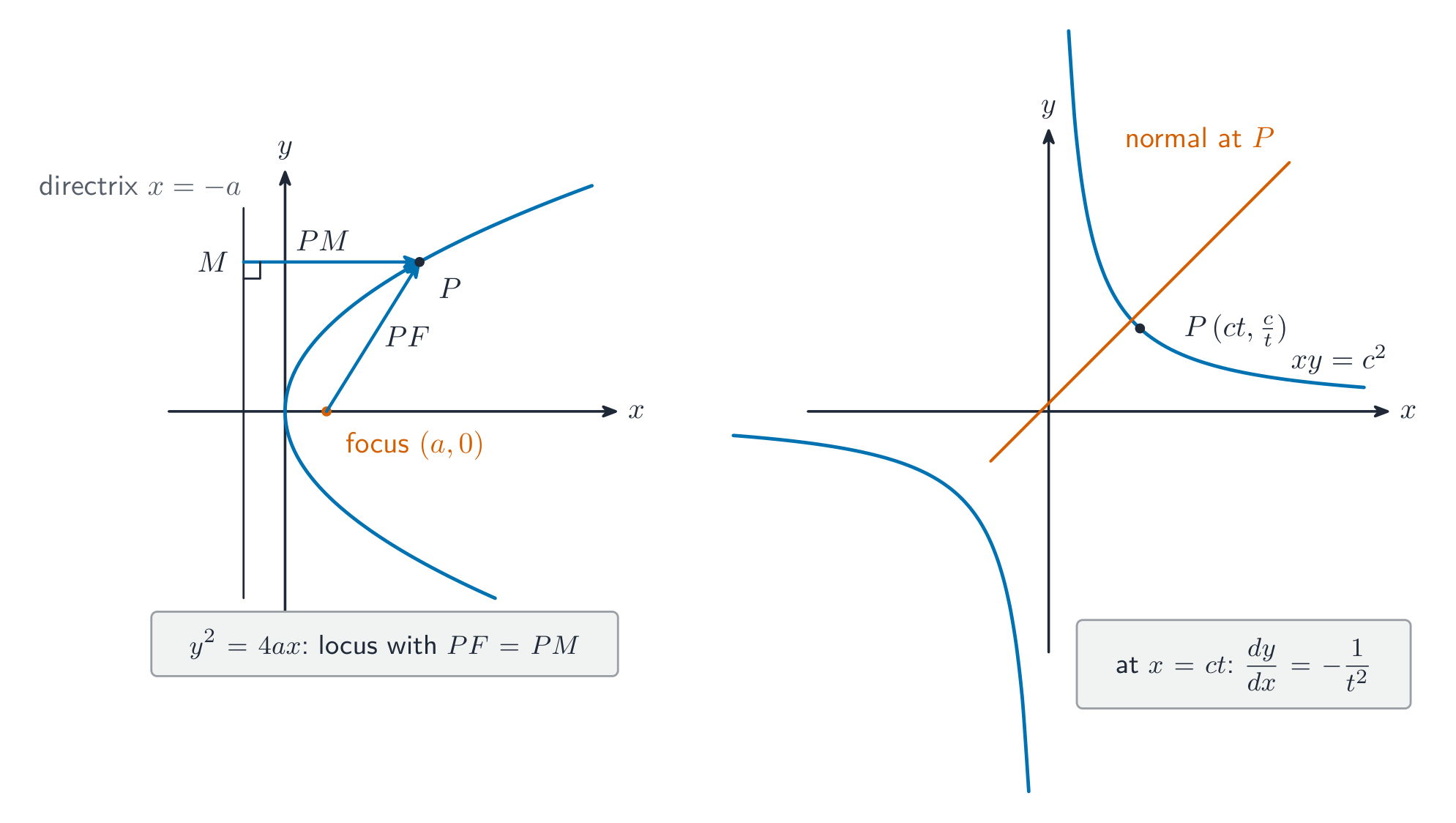
- work with the parabola and the rectangular hyperbola;
- use matrices to represent and combine transformations;
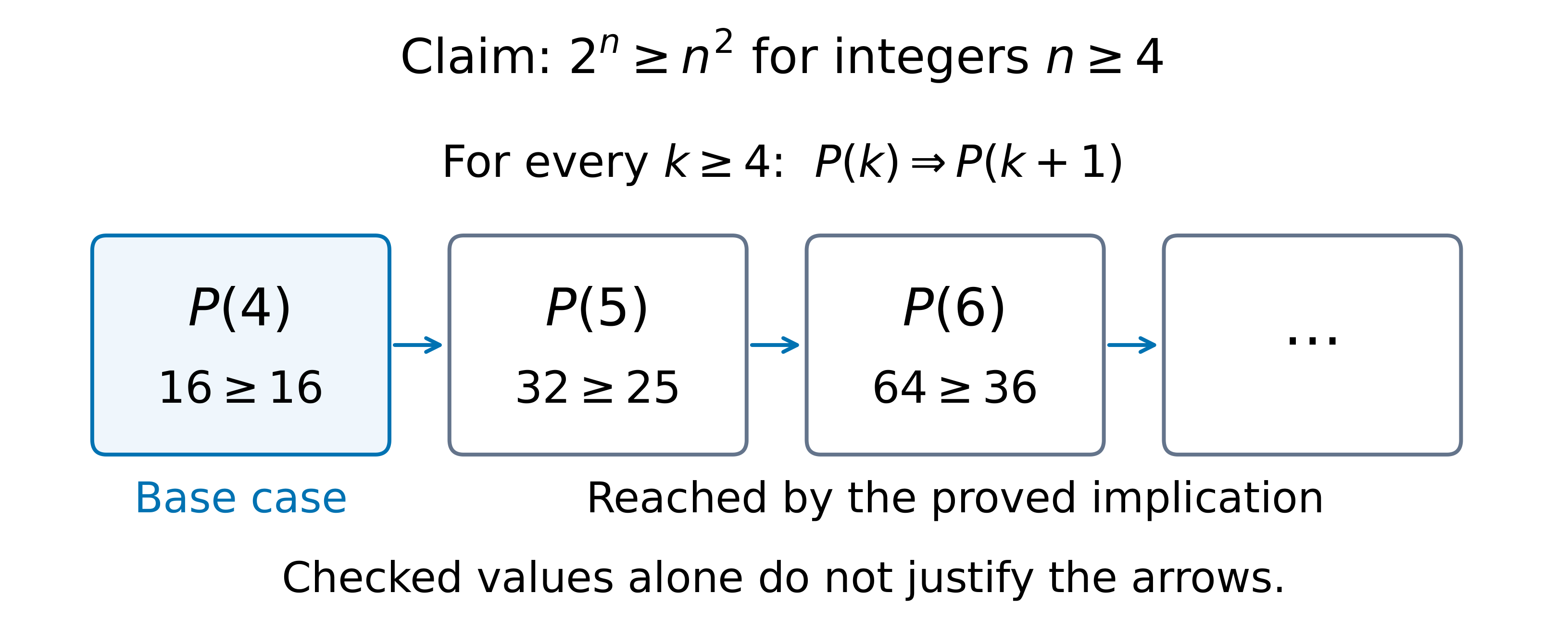
- sum series and prove results by mathematical induction.
Edexcel International A Level, Further Pure Mathematics 1 (FP1, paper WFM01/01, 1 hour 30 minutes, 75 marks). FP1 is compulsory for International AS and A Level Further Mathematics and for Pure Mathematics. Pure Mathematics 1 and 2 are assumed, including locating roots by a change of sign, and dividing a cubic or quartic by a quadratic.
These results are not in the formula booklet, so learn them:
| Topic | Results to learn |
|---|---|
| roots of a quadratic | for $ax^2 + bx + c = 0$ with roots $\alpha, \beta$: $\alpha + \beta = -\dfrac ba$, $\alpha\beta = \dfrac ca$ |
| series | $\displaystyle\sum_{r=1}^n r = \tfrac12 n(n+1)$ |
| complex numbers | $z = a + bi$, $\lvert z\rvert = \sqrt{a^2 + b^2}$, $z^* = a - bi$, $\lvert z_1z_2\rvert = \lvert z_1\rvert\lvert z_2\rvert$ |
| conics | parabola $y^2 = 4ax$, with $x = at^2$, $y = 2at$; rectangular hyperbola $xy = c^2$, with $x = ct$, $y = \tfrac ct$ |
| matrices | $\det\begin{pmatrix}a&b\\c&d\end{pmatrix} = ad - bc$, $\mathbf M^{-1} = \dfrac1{ad-bc}\begin{pmatrix}d&-b\\-c&a\end{pmatrix}$, $(\mathbf{AB})^{-1} = \mathbf B^{-1}\mathbf A^{-1}$ |