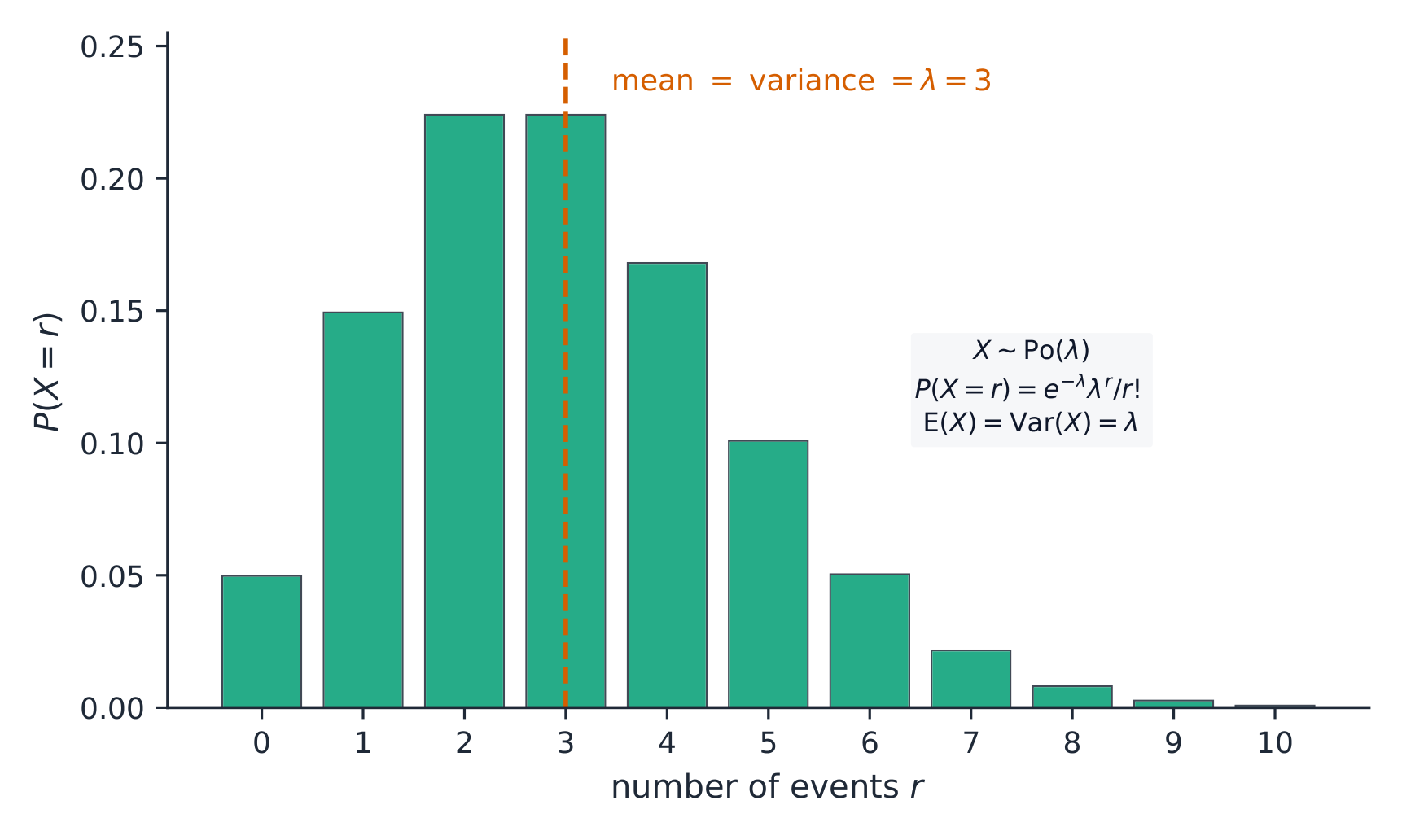
Why it matters. In 1898 the Russian-born statistician Ladislaus von Bortkiewicz published Das Gesetz der kleinen Zahlen (The Law of Small Numbers) in Leipzig. One of his examples was a grim one: the number of soldiers in Prussian cavalry corps killed by kicks from horses, over the 20 years from 1875 to 1894. In 10 corps over 20 years there were 200 "corps-years" and 122 deaths, a mean of 0.61 per corps per year. In 109 of the corps-years nobody was killed, in 65 one soldier was killed, in 22 two, in 3 three and in 1 four. The Poisson distribution with mean 0.61 predicts 108.7, 66.3, 20.2, 4.1 and 0.6: almost exactly what happened. Rare, random events, from horse kicks to radioactive decays and calls to a help desk, follow the same pattern.
In this unit you will:
- use the binomial and Poisson distributions, and approximations to them;
- work with continuous random variables and their density and distribution functions;
- use the continuous uniform distribution;
- understand populations, samples and sampling distributions;
- carry out hypothesis tests for a binomial proportion and a Poisson mean.
Edexcel International Advanced Level, Statistics 2 (S2, paper WST02/01, 1 hour 30 minutes, 75 marks). It builds on S1 and uses calculus from Pure Mathematics 1 and 2. The formula booklet gives the binomial, Poisson and Normal tables.
These results are not in the formula booklet, so learn them:
| Topic | Results |
|---|---|
| binomial | $X \sim B(n, p)$: $P(X = r) = \binom nr p^r(1 - p)^{n - r}$; $E(X) = np$; $\text{Var}(X) = np(1 - p)$ |
| Poisson | $X \sim \text{Po}(\lambda)$: $P(X = r) = \dfrac{e^{-\lambda}\lambda^r}{r!}$; $E(X) = \text{Var}(X) = \lambda$ |
| continuous | $P(a < X < b) = \int_a^b f(x)\,dx$; $f(x) = F'(x)$; $E(X) = \int xf(x)\,dx$; $E(X^2) = \int x^2f(x)\,dx$ |
| uniform on $[a, b]$ | $f(x) = \dfrac{1}{b - a}$; $E(X) = \dfrac{a + b}{2}$; $\text{Var}(X) = \dfrac{(b - a)^2}{12}$ |