Why it matters. In 1638 Galileo Galilei, old, nearly blind and under house arrest near Florence, published Two New Sciences in Leiden in the Netherlands, out of reach of the Church's censors. In it he described rolling bronze balls down a long, smooth wooden groove and timing them with a water clock: he weighed the water that flowed out of a container while each ball rolled. In equal intervals of time, the distances travelled were in the ratio $1 : 3 : 5 : 7$, so the total distance grew with the square of the time. This is $s = \tfrac12 at^2$, the first law of motion ever found by experiment. Mechanics turns everyday motion like this into equations that engineers use to design lifts, cranes and cars.
In this unit you will:
- state and use the modelling assumptions of mechanics;
- use vectors for position, velocity and force;
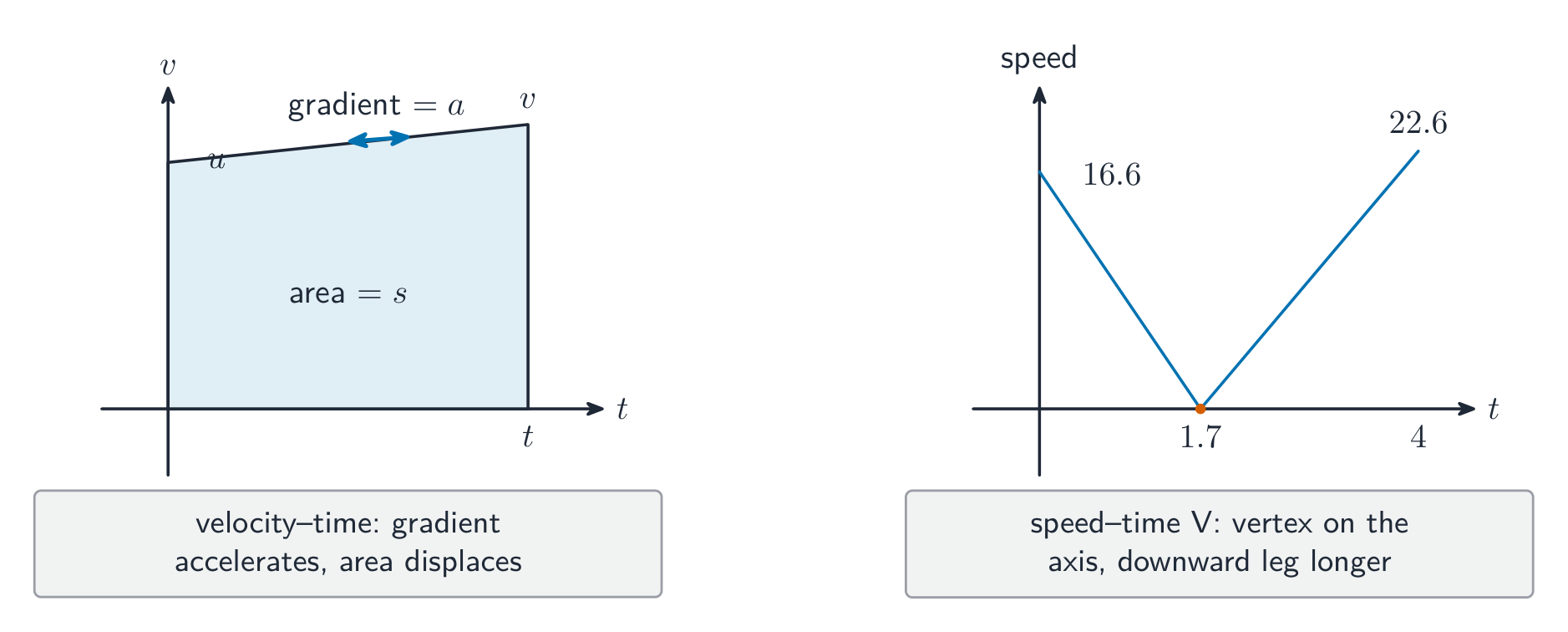
- solve problems with constant acceleration, and read motion graphs;
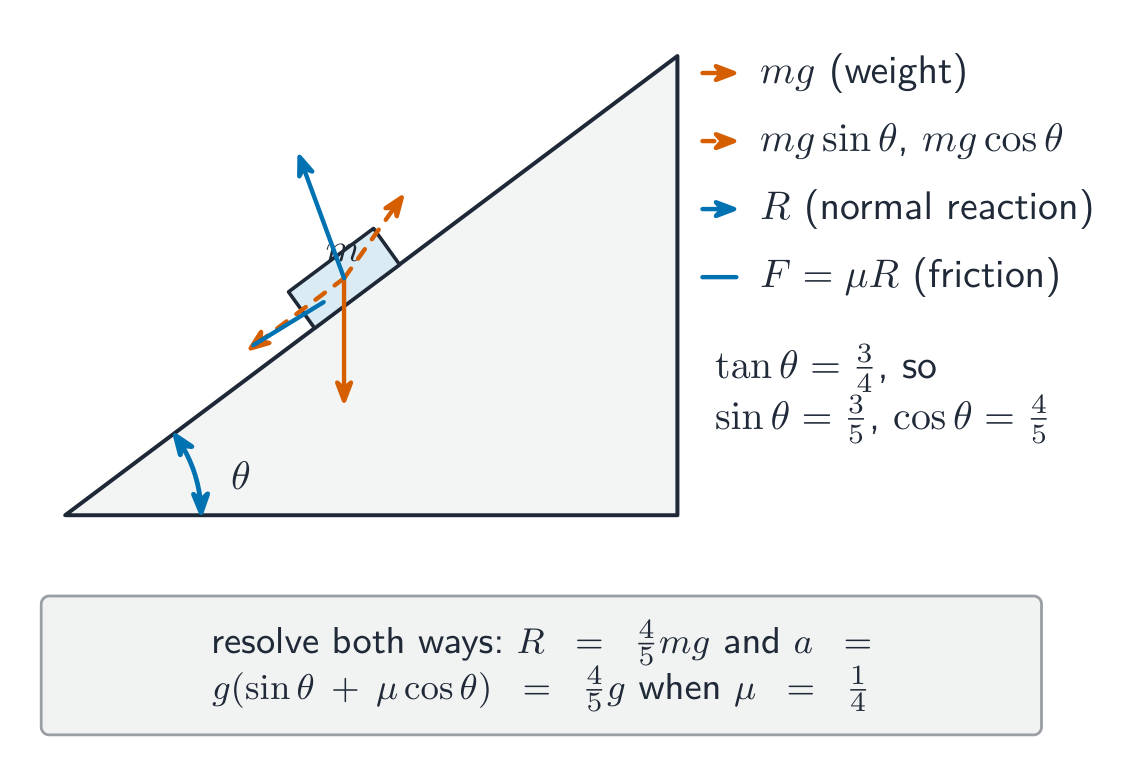
- apply Newton's laws, including to connected particles and pulleys;
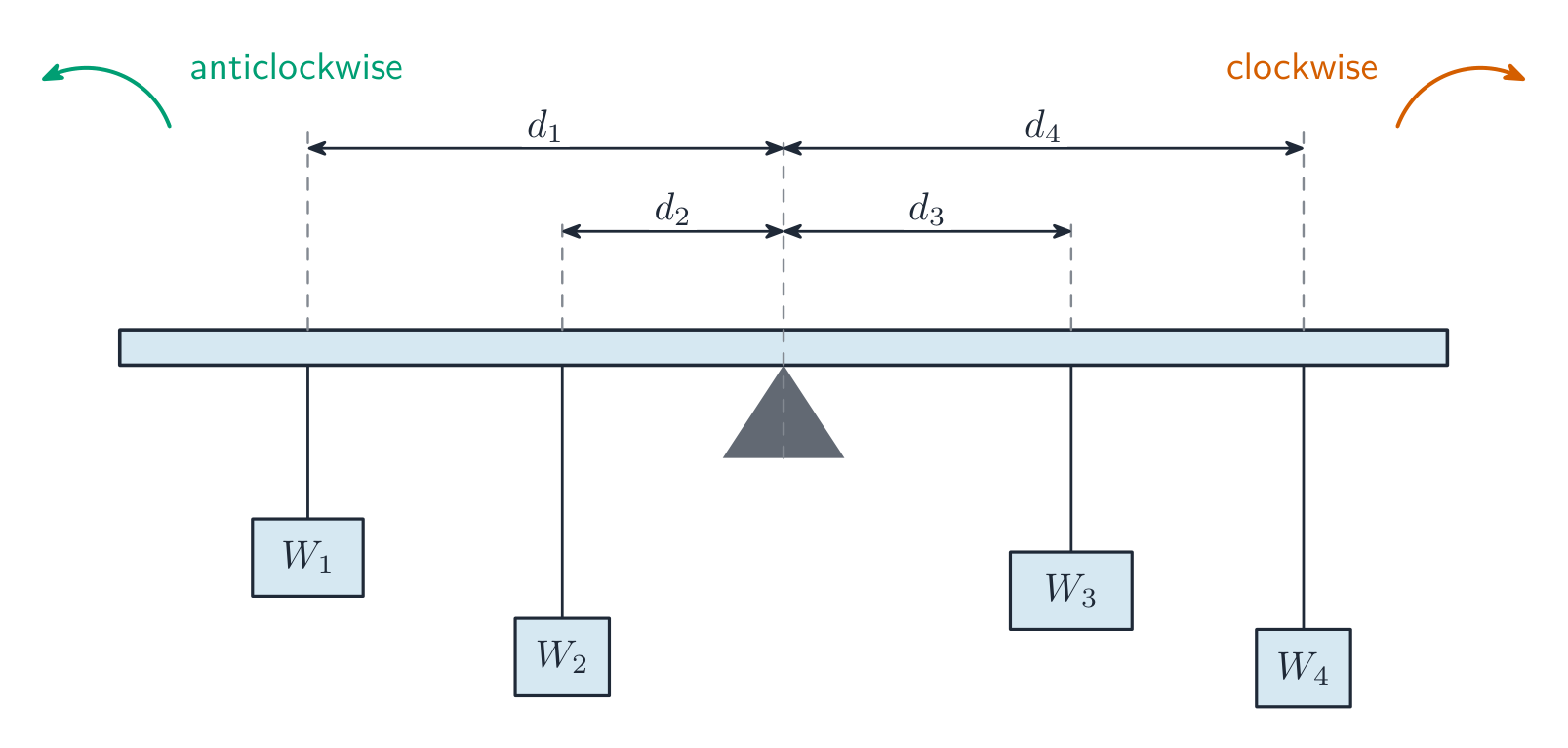
- use momentum and impulse, friction, equilibrium and moments.
Edexcel International Advanced Subsidiary, Mechanics 1 (M1, paper WME01/01, 1 hour 30 minutes, 75 marks). Pure Mathematics 1 and 2 are assumed. Take $g = 9.8\ \text{m s}^{-2}$ unless the question says otherwise, and give answers that use $g = 9.8$ to 2 or 3 significant figures.
These results are not in the formula booklet, so learn them:
| Topic | Results |
|---|---|
| momentum | momentum $= mv$; impulse $= mv - mu$ |
| constant acceleration | $v = u + at$, $s = ut + \tfrac12 at^2$, $s = vt - \tfrac12 at^2$, $v^2 = u^2 + 2as$, $s = \tfrac12(u + v)t$ |
| forces | $F = ma$ in each direction; weight $= mg$; friction $F = \mu R$ when moving or about to move |
| vectors | $\lvert a\mathbf i + b\mathbf j\rvert = \sqrt{a^2 + b^2}$ |